Clio's $400M Journey to Market Leadership
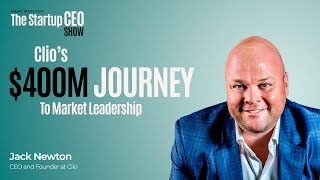
This is a transcript of a Startup CEO Show interview with Jack Newton, co-founder and CEO of Clio, hosted by Mark MacLeod. Newton recounts Clio’s 16-year journey from a two-founder cloud product for lawyers to a market-leading vertical SaaS with over $400M raised and ~1,100 employees. Key themes: origin story and technical background, early fundraising and the role of angel Christoph Janz, vertical-SaaS product/market fit and retention, strategic recap/transition to growth/private-equity investors (TCV, JMI) to reset liquidity and pursue an IPO, and reflections on scaling leadership and capital choices.
Chapters
That first million dollars is so, so hard, but once you get a little bit of traction, you know, and we've now raised over $400 million of capital at Clio, that, that other $399 million was a cakewalk by comparison.
Welcome to the Startup CEO Show. I'm your host, Mark McClad. In this episode, I sit down with Jack Newton, co founder and CEO of Clio. I first met Jack back in 2008 and lost an opportunity to invest in his company because I didn't think lawyers would trust having their documents in the public cloud. Jack now runs an 1100 person, absolute market leader in his category and he's preparing for an IPO as his next milestone. So I clearly got that one wrong. We unpacked his whole 16 year journey, going from venture capital to private equity backing, preparing for an ipo, many other topics. I really hope you enjoy this discussion as much as I did. Thank you. Jack. Welcome to the Startup CEO Show. It's a true pleasure to have you. How are you doing today?
I'm great. Thanks for having me, Mark.
It's a real pleasure. We were just chatting a little bit before going on air and hadn't seen each other since 2019 and the world has changed a ton since then. And actually you and I go back, way, way back. I feel like maybe it was an intro from Christophe jans in like 2008 or something. And, you know, not that you were pitching me, I think maybe it was an advice thing or whatever. But by the way, that's very often how funding begins, right? If you want advice, ask for money, and if you want money, ask for advice. And I remember being my biggest concern was like, would lawyers trust having their documents in the public cloud? So I clearly got that wrong.
Well, I think it's the right question to ask though, back in 2008. And you're right, Christoph did introduce us. You offered some great advice on navigating the fundraising journey. And some of your listeners are probably too young to recall, but 2008, 2009 was not the best time to be raising money smack dab in the middle of the global financial crisis that I think makes the, the turmoil today look like. Looked like a pretty easy journey by comparison. But, but yeah, you know, we, we, we really orbited around that as probably the highest risk aspect of Clio from an investment perspective. What did you need to believe for to believe that Clio would be successful in the future? And you had to believe that lawyers would eventually trust the cloud and trust the idea that they could store their confidential client documents in the cloud. And that was really something. I think myself and my co founder, Ryan Govreau really believed in our bones that that was the direction the world was going and that the legal world could be guided in that direction as well. And I think with the benefit of now 16 years of hindsight, that's clearly right. Yeah, it seems obvious in hindsight, but it was anything, anything back in.
It was a big, at the time, it was a big assumption. Yeah. Well, I'm always curious, you know, you weren't a lawyer. Like, it wasn't like, oh, I'm sick of how I run my practice. Like, what was the origin story of Clio?
Yeah, the origin story was, you know, I, we have to rewind all the way back to when I was 8 years old and I, I met Ryan Govreau, my, my co founder back in grade 3 in Edmonton, Alberta at Rio Terrace Elementary School. And we, we became fast friends. Always wanted to, you know, do something together post graduation, but we weren't sure exactly what that looked like. I went off to do computer science at the University of Alberta, eventually got my master's degree specializing in, in machine learning. Actually, look, using neural networks to build recommender systems. So it's actually very interesting how, you know, now 20 years later, some of that's come full circle and it started to impact my, my professional life at CLIO with, with LLMs in the age of AI, which we can, we can talk more about later. But, but I, I did spend some time doing my master's degree in, in machine learning. And, and meanwhile Ryan went off and moved to Vancouver BC to, to do his undergrad and eventually his MBA at ubc. And what was the trajectory for me after getting my master's degree was joining a University of Alberta spinoff company called Canomics that was doing medical diagnostic software. And I got, I got the opportunity to be exposed to the fundraising journey. I got exposed to what it's like to be building a brand new product in a brand new category. And I kind of caught the startup bug. I really came to appreciate how exciting it could be to build a company which to a prairie boy in Edmonton coming out of a computer science degree, especially in that mid-2000s era, I graduated. That was not a common path. Success was going to work for IBM or Microsoft. You know, those were the companies that were hiring up entire graduating classes. And I remember a really inspiring book for me at the time was reading Hackers and Painters by Paul Graham. Oh yeah, have you read that book, Mark?
It's a. I haven't, but I absolutely remember it.
Yeah, it's a great book. And it just talked about this idea that, like, hey, why go work for someone else when you can go build your own thing? And I found that really inspiring. And Ryan and I started batting around ideas for what building our own company could look like, because I enjoyed eventually becoming the number two person at Conomics over time and being the director of product development. But I started to feel like I really want to lean into building my own thing. And this was around the 2006, 2007 timeframe. And what was really obvious to me was the cloud was going to transform every industry. And again, this is rewinding the clock a little bit, but just to set the context at this point in time, Salesforce was just four or five years into its growth journey. There's a few companies like 37signals that were building web applications like Basecamp, but we were still very, very early in the cloud journey. But what was obvious to me as a technologist was that this is the future. This is actually. It's very reminiscent, I think, of how AI feels to people today. You just see this is going to change everything. And I started. I reached out to Ryan and said, hey, like, I. I think this cloud thing is going to be big. And Ryan and I rapidly became what I describe as two hammers looking for a nail where we had conviction that the cloud was the solution and we were looking for the problem to apply the solution to. Exactly looking for the nail that could be the solution we implemented. And at the time, Ryan was working at Gowlings as their IT manager. Gowling's for your listeners that aren't familiar with them, are one of the biggest law firms in Canada, over a thousand lawyers. And Ryan's observation was, I can tell you, lawyers don't have great technology at their disposal. They don't make good use of the technology they have. And maybe the cloud would be a great distribution model to look at for lawyers. So we very quickly honed in on legal as the opportunity really started to understand that the core problem we were trying to solve was helping lawyers with project management. Even though lawyers call this legal practice management as a category, at the end of the day, it's really project management, timekeeping and billing. And we went to work building that platform, what we now call the operating system for legal, and that's the origin story for Clio and how two legal outsiders really built what eventually became the largest legal practice management platform in the world.
It's amazing. I'VE mentioned this on the podcast before, but Y Combinator released a study, I forget when where they looked at different predictors of startup success. And the number one predictor by far was how long the co founders knew each other. And so by that dimension, I think it's hard to beat grade three in terms of tenure. So that's pretty impressive now. So you were the technologist, Ryan was the business guy. How did you end up as CEO?
Yeah, it was an early conversation that Ryan and I had, and we actually punted on that decision probably for as long as we. As we could, until investors started asking, who's the CEO? Because we initially just rolled up our sleeves. And even though Ryan had a bit more of a business background, he was also a hacker. He enjoyed coding and building. So he and I both built the first versions of Clio side by side, collaborating on building out the code base. And what, what Ryan felt was like, hey, I'm, I'm fine being the, the person in the background helping do the hiring, helping coordinate the background activities that are happening at the company, helping build the culture as the company was scaling. And we both felt that if, you know, there's a frontman, so to speak, that's, that's better dealing with investors and so on, that, that was a better fit for, for my skill set. And early on, you know, I think it's probably a year into building the product, designated myself as CEO and Ryan as coo.
Yep. Honestly, I think it makes sense. Obviously, first of all, the results speak for themselves. I've never met Ryan, so it's not a criticism on Ryan, but like I often say, like, accountants don't start law firms. You have to be a lawyer to start a law firm. And there are exceptions to this, but I think technology companies should be run by people who at the very least have product chops, if not actual technology chops. So it makes sense.
Yeah, I was very deep on product, and thanks to my experience at Konomics, I had quite a bit of experience working with investors, having got. We went through an accelerator, did an early version of some of the accelerators that bridged B.C. and Alberta and Silicon Valley. So, you know, just that that range of experience put me in a pretty good position to quarterback some of those initial investor conversations and, and so on. So. But it's been. I think that's one of the harder decisions that, that early founding teams need to. Need to make. And there's probably a lot of companies that don't get off the ground because of that. That being maybe the first disagreement between, between founders. And I think if, if there's something I can give Ryan a lot of credit for is he's, he's always been very ego free in his approach to building the company alongside me and happy to act more in the background than on the center stage.
I love that. And I'll say, for what it's worth, it's not like I run into you all the time, but I don't think you've changed. You have the same humility that you had at the beginning, even though you've been wildly successful. And so I actually think that's a huge part of your success. Right. I think if you, if you think your shit doesn't stink, you're not open to input and feedback and you're not learning. And of course, learning is the only way you can keep up with, like, you're over 1100 people now, the only way you've transformed. Yes, it's the same company. You get a paycheck from the same entity in the same bank account, but it's not the same company and you're not the same leader.
Yeah, I, I think if there's a death knell for, for anyone, you know, and that's probably applies in your personal life as much as your business life, but if you ever feel like you've got it all figured out and you don't need someone else's perspective to get better or that there's not an opportunity for you to get better at your job, you're. You're dead in the water. And, and so I've, I've looked at this as the learning experience of a lifetime. You know, I, I get asked, especially having been at this for 16 years now, a question I get occasionally is, you know, hey, you've been at this for over 16 years now. How do you stay engaged? Is it still exciting? Is it still fun? And I answer that question by saying I've got a new job every quarter. You know, it's so dramatically different today than it was in 2008. And I, I appreciate your comment and what I'll take as a compliment around the humility, because back in 2008, I was very clear that I had no idea what I was doing. And just like a lot of founder CEOs figuring it out day by day. But looking at that as a learning opportunity, looking even at your failures as a learning opportunity, I think is crucial. And what I've felt is I've gone through one of the most exciting learning experiences I think anybody could hope for over the last 16 years. And now running a company that is over 1100 people and on a potential track to an IPO, well, on its way to transforming an industry that we really care about at a profound level. It's humbling, but I still wake up very excited every morning to run it. The day that lies ahead of me.
I love it, love it so much. While we're on this, like you said, you're. You have a different job every three months. Other than just kind of hanging on for dear life and kind of surfing the growth, what have you done to make sure that you're always growing faster than the business? Like, what methods have you, what inputs? Yeah. How, how have you managed to stay ahead of the business?
I, I found one of the most useful things to do is finding ways to surround myself with people that have been through the next stage of the journey. And if they can just help you see around a corner and help. I like to use the phrase avoid accumulating scar tissue, you know, because they've already got the scar tissue accumulated that can be just so powerful. And there's a few ways to achieve that. When you know, when you're hiring people, especially in your senior team, if you can hire somebody that's been through the next stage of the scaling journey, if they've seen what scaling from 200 million of ARR to 500 million of ARR looks like, if they've seen what scaling from 1,000 to 2,000 people looks like, that's enormously powerful. And as Samuel Clemens said, history doesn't repeat itself, but it does rhyme. And I think when you look at the scaling journey from company to company, you don't see history repeat itself. Exactly. And I don't think you want leaders that are deploying the exact same playbook they had at a previous company, but there's modifications of that playbook and learnings from that journey that will apply very directly to your company. So I think hiring your senior folks, and again, I'm very self aware of the fact that every single day, Clarity Clio is the biggest company I've ever run. And if I'm not going to make potentially fatal mistakes in that leadership journey, surrounding myself by people, at least a subset of my leadership team, I want to make sure I've seen that next stage of the journey. And I've got a mix of folks that are also doing the biggest job they've ever done as well. So it doesn't need to be 100% of your team, but I think you want to layer in some of that, the other resource I've found to be enormously helpful is portfolio companies in my investors that have been at the next stage of growth. And it's interesting talking to investors. They're all. And you used to be in this world, Mark, you know this as well as I do. They're all so desperate to figure out what is our value add beyond money. How can we convince Jack to take our money over, you know, the lineup of investors that's behind us when again, you know, money is kind of the definitionally fungible commodity that, that is not differentiated in and of itself. And I, when they're asking how can we differentiate ourselves? Really my, the, the most important question for me is who do you have in your portfolio that looks like what CLIO will be in two or three years? What, what CEOs, what, what founders do you have in your network? What operating advisors do you have in your firm that have seen again, some flavor of our journey? It doesn't need to be a vertical SaaS company that is scaling from 200 million to a billion of ARR, but is it a payments company that has seen some flavor of the payments journey we're going through? Is it maybe a horizontal SaaS company that rebuilt their GTM motion to be vastly more efficient? Is it somebody that's got some useful insights on how they priced and packaged AI in their application? And those are the types of conversations where what's great is when you join an investor network, when you have cisure portfolio companies, they're almost definitionally non competitive with you, right? Because of the investment mandate that the investor needs to pursue. And everyone feels compelled to spend time with and share learnings with other members of that portfolio. And that's probably what's been one of the, for me, one of the biggest unanticipated benefits of picking the right investors is getting plugged into that, that peer portfolio company network and again, having folks that have seen some flavor of the next stage of the journey and by the way, also being able to pay it forward and talking about talking to companies and sharing with companies that are maybe a few steps behind you in that growth journey. But that's a really great mutually reinforcing learning network that can help help you maintain a real advantage as you scale.
I love that. And so that reality that you've described may be completely foreign to the early stage listeners here, right? Where because in the early stage you're trying to convince an investor to take a leap of faith that the power dynamics are completely in favor of the investor but in the growth stage, it's the reverse, right? Because by definition you're just, you're just making sausages. You just figured it out. It's not 100% DE risk, but it's largely de risked. And so growth investors are just trying to figure out how on earth do I get a ride on this rocket ship? And as you said, money is money, so it has to come down to value add beyond that. So I just wanted to call that out because some people will be like, what the hell is that guy smoking?
No, I've got huge sympathy for that plight. And I was giving a talk about the early days of Cleo the other day, Mark and, and told the audience that was asking a similar, making a similar observation. And I shared the fact that the first million dollars you raise is the hardest million dollars you have to raise by a mile. I, I remember scrimping and, and clawing at every funding resource from, you know, my parents to a maxed out credit card to a, a second mortgage on our house to get, to get Clio funded in that 2008 period. I, I can tell the story if, if we have time, but it was actually a cold email from Christoph Jans that ended up being the source of that, that first external kind of institutional angel slash angel funding. But that first million dollars is so, so hard. But once you get a little bit of traction, you know, and we've now raised over $400 million of capital at Clio, that, that other $399 million was a cakewalk by comparison. But that, that first million is, is so hard. As soon as you get the traction and start to demonstrate that you're, you're putting fuel on a fire that's burning versus trying to figure out whether you can get the, get the match to take or not, it's a totally different ball game.
I completely resonate with that. And I, I gotta say, I gotta hand it to Kristoff. He was just hustling like he reached out to me. He figured out, oh, Mark's, I don't know, someone I should talk to in Canada. He reached out. This is how he got into Zendesk. Like he just, he didn't wait for things to come in, he just went out, you know, so.
Oh, he, yeah, I think Christoph's got, you know, he's easily one of the most value add people I've, I've had in my journey at Clio. And, and to your point, around the early days and even, even to my earlier, you know, Christoph's first two Investments were one Zendesk when it was like four guys in a coffee shop in Copenhagen that he wrote that check. And this cold email I'm describing, I'll just tell the story quickly. Ryan and I were pounding the pavement all over western Canada and the western US Going to every angel pitch forum we could find and, and telling the Clio story. And what we found so frustrating and demoralizing was we, we would get the feedback that this is one of the best startup pitches they've ever seen. It looks like a great idea. They love the business plan, but they're just not writing checks right now because again, people were worried that the financial system as we knew it was going to collapse. And then out of the blue Ryan gets this. Or actually the our info clio.com email address. Got this cold inbound email from Christoph Jans saying this looks like a really interesting product. I've recently become an angel investor. I just sold my company page flakes to I think it was the MySpace group at that time. I just made my first investment in a company called Zendesk and I'd love to talk to you about investing in Clio. Yeah. Sincerely, Christoph Jans. And I think for a few reasons, I think it was from a web.de email address.
I remember that address exactly.
It talked about investment and all of that. Our Google apps at the time promptly put that in the spam folder, just straight to spam.
Thank God you found that.
And then, you know, it sat in there for two weeks and then Christoph sent a follow up email saying hey, I, I just wanted to reiterate my interest in, in potentially investing in Clio. Would love to jump on a call. So what, what had happened by the way? Because of Google spam filters, we, we inadvertently slow played Kristoff and probably built up his excitement even more by not responding. And, and he sends this follow up email which also went straight to spam. And I'm not a religious guy, but in what I can only describe as an act of God, Ryan one day decided I'm bored. I'm going to check and see what's, what's in the spam folder. I wonder how good the spam filter is. Goes in there, sees these two emails from Kristoff, forwards them to me and says this looks legit. Should, should we reach out? I say it does look legit. Reach out to Kristoff. You know, jump, jump on a call with him. We instantly connect. Go through this whirlwind due diligence process. I remember me and Ryan flew out to Berlin to meet with Kristoff to, to. He said he wanted to meet in person. My wife at the time was eight months pregnant. So we did like a 24 hour trip to Berlin and, and got back on a plane later the same day to make sure I hopefully didn't miss the birth of my first child on that, on that trip. And sure enough, Christoph ended up leading that first investment round in, in, in Clio. And, and by the way, just to my earlier point around the, the portfolio that this was a very early instance of this. Zendesk was two or three years ahead of us on the growth curve. And I remember talking to Mikhail Stain and, and others at Zendesk and it was just enormously valuable because back in those days we were sharing like the earnings through oral tradition almost what, what, what SaaS metrics were and how to think about financing a SaaS business. It just all these ideas like this was, this was before Jason Lemkin or, or David Scott or any of those guys blogging about this stuff. It was like this whole idea of like LTV to CAC ratios or CAC payback periods and this new way of thinking about how to finance a business was, and talk about the efficiency of your sales and marketing machine was all new and that was just enormously valuable. But I'll tell you, the learning is not. Check your spam folder. That might be a learning, but the learning for me there was a good friend of mine in Edmonton named Reg Chami at the time was running a blog called do you know Reg? He was running a blog called web 2.0 central.com and he asked me like, hey Jack, can I write an article about Clio on, on this blog? And I was like sure. Like can't hurt, you know, and, and it was like I had to do an interview and stuff. And I remember wondering whether it's going to be worth, worth the time but, but deciding hey, at worst it's going to be some inbound links to Clio.com and, and some good, some good Google Juice and, and sure enough, you know, Kristoff found out about Clio reading that web 2.0 central block because like, like you said, he was a hustler. What he was smart enough to realize was by the time you read about something on TechCrunch it was too late. So he was reading about all this stuff on kind of like who gets covered on which blogs before they hit TechCrunch and Web 2.8 Central was one of those, one of those blogs. So just investing that time in, in kind of a low effort and probably low payoff investment ended up being probably one of the most important moments in the Clio journey that you just don't see at the time because otherwise Kristoff would have never found Cleo, we would have never found Kristoff. And I'm not sure without Kristoff's support if, if Cleo would have gotten through that, that tough 0809 period. So it's. Yeah. Interesting how nonlinear that journey is sometimes, especially in the early days.
Such a great story. I'm really glad you shared that. And you're right. I love what you said about the oral tradition. Like now we're sick. VCs are blogging all the time and writing about everything. But that wasn't happening then. I remember when Toby from Shopify first reached out to me. He was reading my startup CFO blog and I was like the only guy in Canada talking about SaaS finance in like 2009. It was like a black art. And I was just figuring out, I was just writing, in fact, to just clarify my thinking. I was learning and just sharing as I learned. You know, it's just all so new then. Totally. Yeah. Yeah. So funny. So you were new obviously, to cloud and specifically to lawyers being comfortable with cloud. You also, while I'm sure there were many examples of this, like, vertical SaaS is now like a thing, but it wasn't then. And there are investors who, you know, really go deep on vertical SaaS. And I'm just curious, like, for anyone listening who's running a vertical SaaS business, like, how do you digest your success into a playbook? How do you reverse engineer your success and offer maybe like a blueprint to folks running vertical SaaS companies?
Yeah, I think the, you know, it's interesting. I would say for the first five plus years that we were building Clio, the idea we were vertical SaaS was almost used in the pejorative sense, almost like saying niche SaaS. Right. This is a niche market that is definitionally limited in its opportunity. And I remember again, over the course of dozens of pitches to investors, being able to see them tune out two or three minutes into the pitch, pick up their blackberries or their, their iPhones and, and, and just tune out as soon as they realized the TAM was in their mind, limited. And you know what, what I started to see five years in, kind of in the 2013 time period is there started to be some investors that had an explicit thesis that vertical SaaS was going to be big and bessemer Venture Partners was one of those investors that actually ended up leading our Series C. They almost led our Series B but missed out on it. And so The B was 2012 and the C was 2014. And they had a very explicit thesis on vertical SaaS that I think has turned out to be very prescient. And what they identified was essentially what vertical SaaS lets you to do is get closer to your customers pain points and go deeper in solving those customers pain points than any horizontal solution could ever hope to do. And by virtue of being able to go deep in solving those pain points, you can build an average revenue per user, average revenue per account that scales dramatically over time as you go deeper in solving more complex and more meaningful problems for those customers. And if you look at, at the Clio story, we've been able to for example, grow our product suite and grow our pricing from something that was $49 a month when we launched to something we see a very clear trajectory to having $400 per user per month economics as we start to drive these very powerful value add features and products to our, to our customers. And I'm a big believer in the idea that whoever can get closest to the customer wins because it lets you both listen very closely to what they're asking for and it lets you invent on their behalf in a really powerful way because you understand both what is possible with technology and what their specific set of problems and challenges are. So I think that's a remarkable opportunity that in the age of AI now as well, I think is even accentuating that opportunity for vertical players. Because AI I think has a number of really interesting horizontal applications. But when you start to tie in the vertical opportunity and the ecosystem of data that somebody like Clio has at, at its disposal to deliver AI value add, AI driven, whether it's generative AI or summarization or recommendations, given the context we've got on the whole business and the whole workflow that the customers are executing against that is, that is an incredible opportunity. The other thing that I think Bessemer had right back in 2014 that is still very true a decade later is the winner takes most dynamic that you see in a lot of horizontal SaaS markets is amplified significantly in vertical markets where there's a dramatic winner takes most dynamic and I would say even further in the legal market Clio's playing in where the very clear market leader and a lot of lawyers when they're going through the decision making process of what products they should choose, will often just look to the simple majority of what their peers are using that old adage, right.
You never get fired for buying IBM. I used to say that back in the day.
Exactly. And it's a flavor of that where there's a very powerful flywheel. And what I think the most important thing for anyone playing in a vertical market to focus on, and this holds for any market probably as well, but it's amplified in vertical markets, is focus on delighting your customers. Focus on having the absolute best product. If you can get that NPs into a 50, 60, 70 plus range, the word of mouth and the compounding effect that that will have on your growth will just have such a dramatically positive effect on your customer acquisition economics that, you know, at some point you could take your foot entirely off the gas on the paid spend front and just watch that flywheel continue for years. Because you've built up so much goodwill and so much word of mouth in a pretty concentrated customer base. And that's just very hard to do at any horizontal market. You don't see that kind of dynamic and you don't see people typically recommending horizontal applications to each other all that often. Right. But vertical, vertical applications, there's very strong word of mouth and a very strong ability to drive down customer acquisition costs over time by building a truly great product.
I love that. A lot of VCs talk about, you know, backing mission critical apps and so clearly you are that. Right. Your clients run their business on Clio, which I assume manifests in very low churn.
Oh yeah, we have incredibly low churn rates. And even though we service a large number of solo small firm lawyers in our customer base, we're moving up market and seeing a lot of success in the up market. But even in our solo small firm market, we see gross retention in the high 90s. And it's incredible to see with a solo small firm segment. And I attribute that number one to a great product. But number two, lawyers have a much lower natural attrition rate than most small businesses. Right. You don't just. You spend years getting your law degree, you often spend six figures getting your law degree. You don't just throw that out when you have a bad day, so.
That's right. I got on the wrong side of bed today. I think I'm going to do something different.
Yeah, exactly. It happens once in a while, but not all that often.
Also, you know, as a former vc, I would often one criteria was like, is the market rich? Can they pay for this product? And you know, if you were serving, I don't know barbers, I know there's perfectly good businesses that do scheduling for barbers. But like, your target market is on the richer end, right? That 400 bucks per seat that you've gotten up to is less than an hour of a billable rate for a lawyer.
Exactly, exactly. And by the way, our customers tell us Clio saves them eight hours per week of time.
Amazing.
So, you know, that ROI proposition is just so dramatic. You know, you spend, you get your, your ROI positive within your first hour of time saved with, we save you 32 times that over the course of a month.
So you're obviously not charging enough, but I love it.
No, no, but that's also been a very deliberate strategy where we, we've been very focused on capturing what we feel is a massive green field opportunity out there. And the, the approach has basically been let's charge enough that we can make a living at this and invest in the product and continue being the leaders in innovation. But if we're leaving money on the table, that's okay. Let's focus on really building the market presence, bringing the market along to the cloud, allowing lawyers to, to have a transformative effect on, on their clients thanks to the technology they're leveraging. And we can worry about economics in the long term.
I love it. Now, one of the criticisms of ventures, as soon as I raise that capital, I need to build towards an exit. Investors want to exit in five to seven years. You're 16 years in, but unlike the vast majority of companies, you reset the clock by getting new investors and you move from venture to private equity backing. And I think lots of folks listening understand venture. The private equity is probably a bit more opaque, but going from one to the other is completely unknown. Could you just, I don't know, tell us about how you made that transition?
Yeah, I'm glad you're asking the question mark, because I feel like this is one of the least discussed aspects of the startup journey. And when you're raising that first round of capital and getting those first five or seven years funded is, is amazing. But it's, it's no, by no means the finish line. And if anything, it's just the start. Because what you have committed to, as you pointed out, is an exit of some kind. You know, and realizing that your investors are not so much in the business of buying shares, but they're in the business of selling shares and then, and then returning those, returning those returns to their LPs, is, is the business model. And you know, no one is giving you money through an investment to, to hold on to forever. And the minute you start getting misaligned with your investors kind of on that time horizon and what the exit plan is, it can cause a lot of distraction, a lot of angst. And I think, you know, to your earlier comment around, you know, founder misalignment being the number one cause of death for startups, you know, somewhere in the top three, I'm sure is not figuring out how to transition from one investor base to another as you go through. I would say that like once you pass that five to seven year threshold of being a company, who's the next stage of investors? And what's changed dramatically over the last 20 years is companies used to get around a VC funding and go public. And that was how you created liquidity for your investors.
That's right.
And over the time I've been building Clio, the, the baseline for what a public SaaS company could be from a, from a revenue perspective went from $100 million of ARR, you know, maybe 10 years ago to $200 million of ARR five years ago to now. I think you need to be in the 4 to $500 million of ARR to think about going public today. And you know, there was, I think just a, the cost of being public is so high and the risk of being kind of orphaned if you're not allowing investors to deploy enough capital into you is I think, the reason you need that larger ultimately valuation to make sense. But that bar has kept rising. And just to set some context, Apple went public doing $25 million of revenue back in the, I think it was the late 70s, they went public. So things have changed dramatically. And that exit and liquidity time horizon has gotten so long that many companies are still private 10 or 15 years into their growth journey. So you need to think very deliberately about how do you trade off your cap table over time. And there's going to be a lot. What I'll flag is there will be significant misalignment between you and your investors in terms of incentives in that journey. That if you're not frankly a little bit bullheaded as a founder in terms of how you want to see things go, you'll end up in a situation where you end up probably selling your company is the most likely outcome before you want to sell it. Because what your investors will want to see is that, that majority premium that you, you see, if you're selling a majority of the business, they'll want to try to maximize the amount of shares they're liquidating and the easiest way to do that is to sell the business. And if, if you're, if you're not aligned to that as a founder and you may be, and you know, maybe at 10 years you're thinking, I'm ready to punch out and I want liquidity, that's great, go, go sell the company, run a, run a banked process and figure out what that next stage looks like. But if you're, if you're like me and I, I, I very much think about Clio as a 100 year building journey. I want to build a generational enduring company that outlasts me as CEO and outlasts even the entire cohort of clions that are working at the company today and, and is able to have this profound impact on the legal industry over the course of decades to come. You, you need to build your cap table to support that kind of journey. So what, what we did is we, you know, back in our Series F, I'm sorry, back in our Series D, we, we brought on TCV and JMI as investors. That essentially created liquidity. This, this was a $250 million investment round. The majority of that $250 million was secondary liquidity for both employees and long term shareholders. And what I was able to tell all the investors on the cap table back in 2019, and I remember having a discussion with this transaction with you back then as well, Mark. But the message I gave to all investors was, look, we're going to hunker down for the next five years and try to take this company public. That's one of the, not the finish line, but one of the milestones we're rowing towards. And now is your opportunity to get on the bus or off the bus for that five year journey. If you want liquidity in the next five years, I want you to punch out and get off the bus. If you're comfortable with the next five years being the growth journey, stay on the bus, roll all of your equity forward. But I also don't want to hear a peep about liquidity for the next five years. That's all message.
I love it.
And I said, I'll go out and raise as much capital as I need to to create as much liquidity as there's demand for in our, in our base. And that ended up being about $250 million of a mix of primary and secondary. But the majority of that was, was secondary. And I was able to basically reset the clock with TCV and JMI coming in. I would describe tcv, you know, the TCV is an acronym for technology Crossover investors. So they're a crossover investor that almost.
Like in between venture and it' transactional.
They're right in the middle of that, that spectrum. So what I would also encourage anyone listening to think about as they're thinking about navigating this chapter is who do you want on the spectrum of kind of a VC mindset to a private equity mindset? And, and what I would say when it comes to private private equity is there's two very distinct categories of private equity. There's private equity that is very founder friendly and very much wants to back a founder run business and be pretty hands off. They, they're going to probably want a board seat, they're going to want good visibility in the business and they're going to try to be value add, but they're not going to try to grab the steering wheel. And then there's private equity that is on a variety of spectrums but in some way really trying to gain control of the business. Maybe even to the extent of saying whether they're explicit about it or not, you're not going to be the CEO of this company after we invest in.
It or Vista comes to mind there. They literally give you like a bible, right? The day they close, here's how you're going to run your company going forward.
Exactly the playbook, right? And then here's the tools, here's the tech stack, here's all of that. So be very. And look, I mean for some founders, for some CEOs, that might be great, that might be exactly what they're looking for. So this looks different for every person, but it's a very different world than the early stage where you're raising purely from VCs that almost uniformly are pretty hands off. They're going to show up at your quarterly board meeting, they're going to check in. But it's a pretty hands off relationship compared to this next stage of growth. But being very strategic about what that recap looks like at that call it seven year mark is I think where you need to start thinking about that. Also be very clear when you're taking investment, what vintage fund are you investing from? How old is the fund that you're investing out of? Because it's not just the, the seven year timer is not independent of fund age. This, the seven year timer is actually a function of when they raise that fund. So if somebody's investing five years into a fund that's been around for five years, for example, they're going to Start having that liquidity crunch in two or three or four years, depending on the return profile. There's a huge crunch right now on funds to create returns for their investors because there's so many investments that are underwater, so many funds that aren't able to return capital to their investors. And that dynamic really comes to play when a fund is typically kind of in that 10 year time frame. So being very clear on how, how old's the fund that you're investing out of and some, in some cases they actually have a choice of what fund they can invest out of. You want to make sure your investment's coming out of that. The shiny new fund. Exactly like ideally that's, that fund has closed sometime in the last year. So you're maximizing the amount of time you have between that, that next stage of growth. And then you know, again when I brought TCV and JMI on board, it wasn't just who can offer the maximum valuation. So I'm creating a good return for my investors. That was, that was secondary to really thinking about who's the best partner for this next stage of growth. Like it's, it's almost like you're, you're remarrying and, and deciding who your partner for the next next 5 to 10 year segment of the journey is going to be. And, and you want to be, you know, you want to create a good outcome for your exiting shareholders but you also have even a fiduciary duty to your, your remaining shareholders as well of course to yourself and, and the rest of the company to, to pick a great partner that's going to be the, the partner that helps you scale to for the next five to ten years.
Yeah. Well, I think you chose really well. I have a ton of respect for both firms.
I've been super happy with with TCV and JMI just as a plug for anyone speaking to them. Very high quality firms. Very, very thoughtful.
Yep.
Super high integrity.
Yeah. No drama.
No drama. Yeah, exactly.
Yeah. And so you maybe as we start to, to wrap up 96, I don't know. Last time I saw this stat, 96% of Venture backed companies exit by way of well first of all a bunch shut down. But then like most to your earlier point, sell versus go public, you set an explicit intention to go public, which I love. Public markets, you know, have been up and down. Certainly all the recent cohort of Canadian tech IPOs massively underwater Q4 just got taken private. Like does it give you any doubts about your vision for going IPO or you still Just really believe it's the right next milestone.
Yeah, I think the public markets are a pretty intense place to be right now. And I think many of the companies you see struggling right now, I think made what with the benefit of hindsight was a mistake of going out during kind of the gold rush of 2021 that allowed. I talked about companies being orphaned because they were subscale. I think you look at a number of these Canadian IPOs in the tech landscape when IPO'd at as little as 30 or 40 million dollars of ARR. And while that was sustainable in the ZIRP environment and kind of the heyday we saw in 2021, unfortunately that's just not a great scale to be public at today. So I think if you're going to go public, I think it makes you a better company. I think it's a higher bar for execution. And I think you need to be very aware of the risks of going public when it comes to activist shareholders, when it comes to risks of takeovers and so on. I think that's where you need to be very deliberate and thoughtful about, for example, a dual class structure that is enduring, that gives the founder some super voting control to fend off those activist investors. I think what we just saw play out with Twilio and Jeff Lawson is a unfortunate but instructive lesson on how dangerous even investors I think the activists that took out Jeff had less than 1% of the shares of Twilio and ended up forcing out who I think was a great CEO, a great leader of that company. And that's kind of what keeps me awake at night when I think about what could go wrong in the public markets. But I do think there's ways you can be very thoughtful and deliberate about designing around that. But I think when I think about building an enduring 100 year company that has a kind of longevity, I think one of the best capital markets you can exist in is the public markets. And to have both that public capital to drive an M and a strategy to create liquidity for your investors and employees over the long term to, to always have your stock as a priced asset that you can leverage in a variety of ways, that's, that's really powerful. And I think the governance and behavior that it encourages is a, is a feature of being in the public markets. But I, I do think that, you know, there's an interesting podcast just a week or two ago with Brad Gertzner and, and Bill Gurley talking about the fact that, you know, the number of public companies has shrunk substantially over the last 20 years. And, and the number, the amount of money and the number of companies backed by private equity has ballooned. And I, I think that's kind of unfortunate. You know, the regulatory landscape has just become so punishing for public companies. But all that growth and all these great companies that are in, in the private markets are less accessible to the average Joe or the average Ma and PA shop to, to invest in. And I think that's kind of a negative long term consequence of some of the dating back to Sarbanes Oxley and all the more recent regulations, it's 2 to 4 million dollars of fixed costs just to be public today, regardless of your scale. So again, if you're a $30 million ARR company, that's a pretty punishing hit on your EBITDA just to be public. And I think, I hope we see some reform on that front. But it's a long winded way of answering your question mark, which is I see Clio's being in a very strong and enviable position in that we've got a ton of optionality around how we look at our future capital needs. We are profitable today, we're growing nicely and we have over $100 million in the bank. So we've got a lot of optionality, a lot of choice around how we raise money, create liquidity for investors and employees. And there's a lot of options that you can realize all of those goals while still remaining a private company. And if and when the public markets look like the right place for us to be, I very much want to see that as a chapter in the Clio journey, but I really do see that as a chapter and more of a green flag than a checkered flag in terms of a moment in our growth journey.
I gotta say I will be looking to watch you ring the bell with a giant smile on my face. Honestly, it's. What a wild ride. Jack, thank you so much for making the time. There's so many things I could keep talking about but.
Well, maybe we can do a part two someday. Mark, I really enjoyed the conversation as well. It flew by, but thanks for having me.
Thank you so much. Hey, thanks for listening to the Startup CEO show. If you'd like to connect with me, be sure to visit my website at markmcloud me or follow me on LinkedIn, hemark, MacLeod or Twitter arcmcleodore. And if you want to tune in again next week, be sure to subscribe on YouTube, Spotify, Apple, or wherever you get your podcasts. We'll see you next time.
More from Mark





The Burnout Breaking Point - How Strategic Breaks Actually Increase Productivity


Emotional Debt - How Avoiding Hard Conversations Compounds Into Company Killing Resentment


The Death of the Specialist - Why AI Is Creating a New Professional Class Called Scalers