Competitor Analysis in an AI-Driven World with Jason Smith
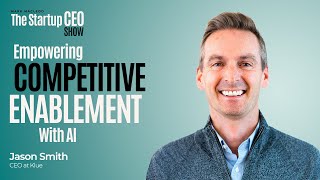
Jason Smith, CEO of Clue, built a competitive enablement platform that pulls intel from web pages, press releases, CRM notes, and Slack, then uses AI to surface insights for sales teams. He measures ROI through three levers: win rate, deal cycle time, and deal size. Smith spent 25 years in startups before taking the CEO role and navigates the tension between category creation and fitting into existing buckets.
Questions this video answers
March 25, 2024.
25 years.
Over 200 employees ("grown Clue to over 200 people").
Win rate, deal-cycle time (speed), and deal size (discounting).
YouTube (Startup CEO Show, host Mark MacLeod).
Chapters
A lot of companies that are looking at this as like, AI will have a dramatic impact in two areas. One is, like, just the operational cadence of how your employees are leveraging AI tools themselves to be more efficient. And can we have, you know, 1x employees be 10x employees with the assistance of AI enabling technology?
Welcome to the Startup CEO Show. I'm your host, Mark McLeod. In this episode, I sit down with Jason Smith, CEO of Clue. Jason's been in the startup world for 25 years, but this is his first time in the CEO chair. I learned a lot in this episode. Jason's creating a new category with his company, and so we explored how to do that. We went deep into the CEO role, as always. I learned some new terms like Sassacre, which is SaaS massacre, and CFNO, which is CFOs saying no all the time. Lots of really great insights in this episode. I really enjoyed it and I hope you do too. Jason. It's a true pleasure to have you here on the Startup CEO show, and I'd love to just kick things off right away, maybe tell folks what Clue it does and maybe give us a little bit into the origin story of the company as well, please.
Sure. Happy to. So Clue is a competitive enablement platform. We try and help companies understand what the competitors are doing, how they fit relative to those competitors, and ultimately equip them with the knowledge to navigate around them. The origin story is interesting. It is really a problem that I had at a previous company. I was running another SaaS company in town, and it had this challenge of trying to create a category and had prospects that were incredibly educated about the alternatives in the category, probably even more so than our own salespeople. And so when I kept witnessing a prospect saying, wait a minute, the competitor does do that. It. It triggered this. We need more knowledge about our competitors. And so that led to our product team creating kind of a SharePoint site back in the day that would be updated with new compete information. And it was awesome for like two weeks. And then it got out of date and so just needed something.
Nothing about SharePoint is ever awesome, but, yeah, fair enough.
Well, navigation was a whole other issue, but, you know, just keeping that thing up to D. So as soon as it's out of date, salespeople won't look at it. And it became a cycle. So I kept looking around for solutions and couldn't find anything. And ultimately the sense was, look, every company in the world has three things in common. They've got customers, they've got employees, and they've got these pesky competitors that aren't going to go away. If we could create a platform to help companies be on top of what those competitors are doing, then maybe we could help them win.
I love that. So scratching your own itch problem, you deeply felt?
Indeed.
Yeah. The Dalai Lama has like, when I think about competition tracking, I think of comparison. And then I turn to the Dalai Lama who has this saying that comparison is the thief of joy. You know, like, basically nothing good comes from comparison. I'm wondering is, is there an unhealthy amount of focusing on competitors? How do you think about that?
It's an interesting question. So the TLDR is. Yeah, I think there is. I think if you're obsessing about the competition, you're obsessing about the wrong thing. I think what I've seen is I've seen many people that I respect get up on stage and talk about ignore your competition, focus only on your customers. And I think my repositioning of that would be focus on your customers, focus on your market. Absolutely. But don't ignore your competition. Know them and understand what they're doing, because there's a number of things that they are learning about the market and are navigating and are doing and the market is resonating with what they're doing. And I think you'd be foolish not to know what those things are. And so you might want to incorporate some of them if they fit in your vision of that future. But just knowing makes a ton of sense. The flip side is also true. They're going to do a lot of things that will be a waste of energy and waste of time and resources. And so you want to bypass those potholes too. So my view is don't obsess.
But know that seems pretty practical. I like it. And when you talked about the origin story, you talked about creating a category in the previous company and I was actually going to ask about category with respect to clue. Right. You know, when I think about go to market teams, I can think of established categories, like obviously CRM, various marketing automation tools, customer support, like, are you creating your own category or do you fit somewhere?
I'd like to think we're creating or let's say emboldening or strengthening an existing category that may have been overlooked. I don't think competitive is anything. I think it's something that everybody has been doing for a very long time, understanding where they fit relative to others in the market. I just think it's been handicapped by the challenge of gathering all that information and converting raw intel into insight. So we're at this lucky moment in the world where AI is helping kind of supercharge that transition from raw intel into something that people could use. And so I, it definitely is say a new category on G2 that we would live in. Gartner and Forrester would think of it as a new category broadly today. The way that I view this is today the most important people that I can help are sellers. Every day there's millions of sellers that get the question, how do you compare? How are you different then every single day? And so we don't want them screwing up that answer, especially with educated prospects. So they're like, they're kind of the core. And what's interesting with them is if you understand them and help them, they can tip a handful of competitive deals. We call it this competitive revenue gap. Look at how much money you might be losing to competitors and how much of that should you have won. And there's always a chunk. And typically in companies at any scale, it's, it's significant tens of millions in a competitive revenue gap. So I think sellers are the ones that need it most and, and that we can attach directly to revenue. On that said, you know, you were in finance, you looked at competitors, product people look at competitors, talent teams look at competitors and you know, trying to figure out how to hire strategy teams, marketing teams, customer success teams. Your competitors are constantly circling around your existing client base. So my view is this, everybody does it. They're just doing it in isolation. And maybe if we could centralize all those insights that they are finding that there might be some cross benefit.
Yeah, it makes so much sense now you explain it. Yeah, that really does. So creating a category is something that probably many folks who are listening to this struggle with. You're not done yet, but do you have a playbook that you might be willing to share or. Hard work, hard earned lessons and forging into the bold unknown here.
Yeah, Let me give you the full secret. There's one thing. No, it is a multitude of things. Of course, I do think you have to be half crazy to go in and say I want to create a category. Your choices really are as a startup though, you're looking at an existing category that's underserved, maybe lacking innovation, and you're going in with a 10x better or less expensive solution, or you're trying to fulfill an unmet need. And so the beautiful thing in an existing category is there's demand. You can see it in a Google search. You know, there are people looking for that solution in our world. They weren't necessarily, they weren't searching for a competitive enablement platform. They were like any intel against so and so on a very specific competitive set. And so, you know, the first thing was to say, hey, there's software that can help you now. Like literally helping my previous problem. So a lot of that was content and investing in this is a real problem and then trying to magnify and be very clear about the revenue issue on that problem. So that's what gets the attention of the C suite of CROs. You've got $100 million pipeline, you're winning 20% of the deals. So 20 million, you're adding a new ARR and then maybe no decision for 50% on it, but it's like 30%, 30 million that are literally people that have budget look to you and just pick someone else. So how do we win more of that? As people put their head around it, they are like, that's obvious. Wait a minute, it's hard to find budget and you're telling me somebody had budget, they just pick somebody else. We need to tip that. So I think a lot of category build playbook is content is saying this is something that matters and ideally attaching it to an roi, to a revenue base that people can get their head around, it can feel too wishy washy. If it's like you should care about this shoelace thing and people don't because it's like whatever. If it's there is real revenue that is leaking out your back door that you should just fix with a handful of reps saying a handful of things that could tip those deals. That's one more thing. It's not like people lose business by some massive magnitude. It's literally a handful of things. Ah, we came down to like YouTube. We picked them for like these handful of reasons. So it's, it's, I think for category build it's attaching yourself to something that is big enough that it can matter and shining a big spotlight on that. And typically that is going to conferences, that is writing content. It's a long tail on kind of the macro build side. And then on the micro piece it's going and finding people that might be the innovative thinkers that click when you tell them about this and they go wow, that's really interesting. The company should know about that. Maybe I should attach my career to this. And that's generally the early people that you're going to get those 20, 30, 40, 50 apostles. Really? That you're trying to pull in to a belief that this is something that shouldn't be fixed and that they could be the drivers of that fix and maybe through that actually elevate through the organization, get more resources, get more attention, certainly be more noticed. And that's certainly been the case in our world. We've helped people actually expand their influence inside the organization by literally saying this is making a difference. And that's going all the way up.
To C suite on that. So, you know, HubSpot created inbound marketers and inbound marketing movement. Gainsight really, you know, shone a light on customer success. Are you creating like a job category inside your customers?
Our attachment was at the end of the day, who is the compete driver inside the organization? For a lot of companies, that's like a product marketer. That's somebody that if it's early enough, it's a product marketer doing five jobs. As you evolve, it's a product marketer being dedicated. And as you get even bigger into the thousands of employees, you're going to have a dedicated team helping your sellers navigate competitive deals. So that's kind of the evolution in the early days, like sub 100. It's like a single product marketer doing everything. And so compete tends to be this kind of side thing that they need to do. But as it evolves, the stakes get higher and one person can help a thousand or two thousand people. So generally, I'd say we target and talk to product marketers. They're the ones that have some degree of influence inside the organization. And more specifically, it's the compete owner within the product marketer set that we generally talk to. So in the same way that Gainsight saw cs, people start from kind of a handful to like a category, product marketing has done the same. It's grown in relevance and in value. People are starting to understand what it could do inside the organization. So it's, it's elevated really in the strategic importance, maybe a little bit of decimation in 23, with all part of the layoffs of anything that looked nice and extra that wasn't producing the product or selling the product broadly. We've seen growth in that category and attached ourselves to that icp.
Amazing. So when I hear you talk about, okay, we recognize we don't have an existing category, there isn't existing budget, we have to create both. And we're. And it's a long tail. As you said, we're going to start with content. You didn't use the word evangelize, but I'M thinking you're evangelizing in some way. Did you know and I guess more practically did your investors know? Okay, we're signing up for kind of we just have to cross the desert. It's going to take some time. And where their expectations measured as a result, they knew like they weren't pushing you on revenue right away because it's just going to take time. Was there a. Did that alignment exist?
Yeah, you nailed it. It's exactly that. I think it starts from could you imagine a world where everybody has some level of competitive radar so that they're not surprised? And I think it's not hard to imagine that that's the case that everybody's going to understand in a more almost like with the super bowl coming up, almost like the NFL headset approach of I know and try and adjust my play based on the last play done. I think we're going to have more and more of that. So that vision I think was clear in investors mind. This should be a thing. Then it's a question of how do you make it the thing and how do you get the market to wake up to it and how do you get a budget line item added when certainly in 23 it was CF. No. So that was. It's real. It was. We had so many deals that the.
Former CFO in me loves that.
Right. It was cfo. There you go. So literally the CFO would be like, no, we're just not adding anything, you know, other than plumbing. And even that I wanted to rip out. They wanted to rip out plumbing. So it was that 23 was a different world, I think for budget scarcity. Up until then I think there was a lot of more risk budget that would be willing to kind of apply to that and that's beneficial. When you're building a category and you don't have a line item in the budget, it's harder when there is massive budget scrutiny in the layoffs that you see where you're debating between real humans and another piece of software. And that's where it needs to be very much ROI based. The CF no will say CF yes if it's very clear that it's going to produce and you'll get punted if you don't. So back to the investor piece. I think seeing the broad vision, recognizing there's going to be time to build a category and convince people that this should be a must have. If I go back, I'm old enough to remember the CRM days and like we. I watch that as it's clear that it's. You don't start a company now without a CRM. But back then it wasn't so clear. It was a nice.
I remember when Salesforce launched.
Yeah, exactly. And there was, you know, we had, you know, Jane in accounting that could give us, you know, the people that we need to talk to. And there was Rolodexes and contact managers and things like that. It wasn't clear that you needed software and where it would grow. I think that's true of all categories. They start kind of nice to have and then need to go to must have. When the ROI gets locked in and it's part of the process of how a product manager would do a job or a compete person or a seller or anybody in the organization, if it becomes part of their day to day and they rely on it to win, then you're in. And I think for us we had a number of years where there was just hyper growth and we were making that, that opportunity real and making real progress. And for some companies we're very much locked in and for others in 23, you know, I call the Sassacre year. For a lot of us in the broad SaaS category, it became this moment of okay, everything. Everything other than maybe Salesforce was nice to have and so you had to defend the value in a much more specific revenue attentive way. So I think a lot of companies got surprised by that. We were prepared for it. But the scrutiny on the ROI piece was intense and I think will continue to be intense. So we've spent a lot of time talking about that competitive revenue gap, built calculators to help people kind of identify how big it is and then the possible solutions to help narrow it.
I love it. I want to start talking about you and leadership and stuff, but I just want to stay here for one more second because there's probably lots of folks listening or watching who also struggle to get budget right. We're not out of the woods yet. How do you prove roi? Do you have an attribution model? Is it just, hey, your funnel converted at x percent before, now it's X plus Y percent. You know, is it more broader like that? How do you, how do you approve?
In our case there is, for better or worse, there's sellers that adopt and sellers that don't. And so you can compare those two cohorts of those leveraging clue and clue compete insights and those that aren't. And so that's your baseline because obviously there's a bunch of external factors that can affect how somebody's doing on their pipeline and product can be that, economy can be that. So you really need to look at it on a core basis. Group A is using it, group B isn't and then judge that over time. And we have, you know, hundreds and hundreds of, we call it revenue impact analysis now where we've literally looked at those two cohorts and for us we narrowed it down to kind of three things. One is, is there a win rate difference at all those using Clue, does it make a difference? Do they tip more of those deals? The second thing we look at is time. Are they actually mitigating a competitor earlier and compressing the deal cycle at all days, weeks? Is it, is it shorter? Because if you're protracted competing, you generally can move faster. And so that is the second thing. The third thing is like, is deal size. Like literally depending on where you mitigate a competitor, you're not going to be in the 11th hour going, they're offering this lower your price, kind of getting down to the last minute price throw out. So you generally discount less, which keeps your deal sizes slightly higher. So one or all three of those things typically is what we see happening. And it's about 90% of our clients, we don't nail it with all of them, but about 90% of our clients will see an impact of one, two or three of those elements that we measure.
That's quite scientific. This sort of a B test, this a B test approach suggests to me like if I was on the buy side of that, I would try before I fully rolled out, I'd try it for a group of my sellers, do the comparison and then only buy kind of enterprise wide. If I saw the efficacy, I guess. Is that a thing?
It's been very interesting that I think we certainly see that and we also see the ones that kind of look at and go, why would I want to a B test it? If I bought into the fact that this is going to make a difference based on the 50 case studies you've already showed me with companies that look.
Like me, that's fair.
And literally we're like, if it doesn't work, you should pull us out. And so let's look at that. And generally it takes a little while to shore up content. So it's kind of like going into any company, they've kind of got a garage full of baseball bats and bikes and a littered garage that you can't park in and they need to clean out some of that stuff. And then they probably need a couple new Things to kind of clean up the garage. So we kind of California closet a portion of the garage maybe and go, hey, this is what it could look like. Here's what great content would be. Here's what a killer battle card for that one competitor would be. And then that they extrapolate of what it could look like across 10 and how sellers could use it. And then they want a California closet, the whole garage. I don't know if that analogy is failing, but it.
Well, we put California closets in here, so it certainly resonates with me.
All right, you get a little taste. You're like, okay, everything needs to be off the ground. Get rid of those bikes.
That's right.
Clean it up.
I love it. So switching gears, this is your fifth startup in 25 years, first time in the big chair. How does it differ from the previous roles? Do you like. Oh, do you like, wake up some days? Like, man, why was I ever a CEO? This is crazy. Like, tell us about the CEO role for you.
Yeah, I think, you know, so I've been fortunate to have co founders in my multiple businesses. So without holding a CEO title, I've certainly felt like I was an owner and a driver in the business. In the company that I was in last, which was a startup that grew from. I joined it at eight people and grew to about 500 people, there was clearly a CEO in charge. And I was first hired in sales and marketing, and then in 30 months took over as president. And in that case, the key difference is you cannot set the culture, you cannot set the tone. Ultimately, you can influence it. But at the end of the day, people look at the CEO for how behavior should be done. People look at their spending, their approach to attacking a market, how vulnerable they are, or how direct or confrontational they are. And so no matter what you do, I think you are handicapped by creating the culture that you might want. So in this seat, I'm able to do that. And that's probably the biggest pleasure that I've had, is that I can pick the people that I think are going to be the drivers, certainly, initially, and then imbue the people that we have picked to hire the next layer down around the value set that we're looking for and kind of create the culture of the business that you want to go into every day and be part of. So, I mean, I. I look at building businesses for two reasons. One, I want employees that are stoked about building what we're building, and that's not about big bang chairs or ping pong. That's like, I love the work that I'm doing, and it's making a difference, and I have the autonomy, the ability to do that. And the second is as customers, like when they say, look, what you've done actually really, truly helped me. It elevated in my career, it helped me elevate my career or made a difference in my time or it impacted my company in a positive way. You build it for that. So those are the two reasons that drive it. And I think it's difficult to kind of do when you're in the number 2 or 3 or 4 seat in the CEO seat, you could do it. The one thing I would say is in my entire career, I've always treated everything that I've done as an owner. So it kind of got me in hot water in my last company because I felt very attached to what we could do, what we could build. And at the end of the day, the majority owner and the CEO could go home with their soccer ball. And it was frustrating to not keep playing soccer when I wanted to have a vision of where it would go. But that's their prerogative. And I think that's the luxury that you have when you're the founder and the startup CEO is you set the tone. Comes at the flip side of you own it. If you screw it up, it is yours to own outright. But broadly, at this stage of my career, it's wonderful to be able to be unleashed and build the business that I want to build.
Amazing. Has being remote or hybrid negatively impacted your ability to drive culture?
Initially, I would have said no. Now, multiple years in, through the work from home, post Covid. Pre. Covid. Part of COVID World is I think it has. And I think there is this desire for humans to connect, and it's just not the same scheduling every meeting as it is walking by and shoulder tapping or sharing a laugh or something over lunch. There's just a human connection that you can only get when you're with other humans. And I think we saw that as a society when restrictions were lifted and we're like, oh my gosh, let's get together. And I think that's true of companies too. I think there is. There's huge resistance for change because we're all ingrained in the way we do work. I'm taking this podcast from home. Why? Because it's quiet and I can control the environment. And frankly, I am more productive from home. I'm more efficient from home. But what I miss is all of the creative spark, the human connection. The little bits and pieces that make a culture come alive. And it literally, it's. I don't know how to put a finger on it, but it is little things that add up to create this sense of these are people I want to work with beside and I'm charged by. And you kind of need to be in a physical environment, I think for a little bit to do that. Now, in our case, we said come back to work for two days on a week and the other three days work from home. And I think now we're getting through what I would call the change adjustment of, oh my gosh, I got to get up and properly shower and I've got to walk the dog ahead of time.
Did you have a mutiny on your hands?
We did, I would say for a handful, but broadly, I would say 80%, 20% were just very not happy about it. 10% of those maybe. I'm not sure it worked for them and that that might be part of the reason for departures. The other 10%, it was more about. I don't. I'm comfortable and what I'm doing. I'm not sure about the change. The other 80% were like, look, for two days a week, I miss humans and I want to be part of this great crew of people. So I'll make the adjustment. And you know, maybe there's some consideration for whatever it is, the occasional doctor appointment or traffic or whatever it is we come in. It has been interesting though, looking at the folks that have never come into an office. Like, we hired 100 plus people in Covid and we have a lot of young people and they weren't used to coming in an office. So the concept of paying for parking, the concept of paying for lunch was like foreign for them. And then, you know, the rest of us that have been doing it for 20 years and we're used to it, we're like, yeah, that's. That's kind of the way it work is. And so it's been an interesting. I don't think any company has nailed it, but I do think hybrid's here to stay. The efficiency is impossible to argue, but the human connection is as well.
Yeah, I totally agree with that. I think software developers have always struggled with offices and probably love being at home, but by and large, we're just social creatures. Right? Like being lonely actually decreases, like how long you will live. Like, we just need to be with people.
That's true. I remember reading some of those studies of community and connection is one of the longest is a predictor of a longer life.
Yeah, yeah, for sure. So you've grown clued to over 200 people. What are your biggest lessons learned along the way?
Oh my gosh, Mark, how long is this podcast? There's like a gazillion mistakes.
That's an entire podcast.
It truly is. You know, certainly in my case, and I think any, any leader that's got some degree of, of, of humility is like, you just know that you're just making new mistakes. I walked into this business with, you know, now my fifth company thinking I've made a lot of mistakes, I should avoid a whole bunch of them now. And, and for the most part, I've avoided, you know, previous mistakes, but I'm making new ones. And you're just learning as you go. Like some of the biggest. I think there's always, as you grow a company, there's this delegation challenge, this balance between how much you are providing full autonomy versus guidance versus pedantic micromanaging. There's this and how much you're willing to leave that. So delegation I always think of is like this crux of where the growth is. There's nobody that's going to do it better than the founder initially. And so this ability to release departments and decisions that are potentially game changing to very effective leaders that you've hired is a hard transition for any founder. And I think, you know, it's very easy to just say just you hire smart people and let them go. I don't think that's the answer. I do think it is. You hire smart people and everyone's going to have gaps and different levels of experience. So collectively you're trying to provide input and guidance and find that mix, that balance, maybe the balance between the autonomy and authority that they all seek, if they're high achievers with a little bit of input and some like. I've had a couple scenarios where I've let people make decisions where I felt fairly strongly that they were not going to be the right decisions. But they weren't company killing decisions. They were ones that I knew a smart, ambitious person would just not want to hear, yeah, that's not going to work. They need to go through it, they need to discover it. And then afterwards it's not an I told you so, it's let's talk about what we learned and how we do things differently. So again, it's a bit of humility that you need to approach everything with. And I myself look at it, say anytime I've got experience making a decision that creates a reflex for this is what we should do. My first reaction that I've trained myself to do is what new variables? What's new? What is different this time on those decisions that I need to think about whether it's a hiring decision, a structural decision or something as trite as. Not trite, but important, like a commission program change. So that, yeah, I would say delegation is probably the biggest.
Yep, that's huge. I would say that's a very enlightened approach to growing your leaders. The one you described where you let them make mistakes. I feel not to age you or I, because I think we're a similar age bracket, but I feel like that's something that comes with age. And I probably couldn't have done that in my 30s, but would do it now if I was managing people because I'm a wiser elder, you know, is that a fair statement? Would you say that's an approach that's come over time?
For sure. Except one thing. When I was younger, I worked in electronic arts for a very short period of time. And in my previous business that got acquired by Telus, we had been introduced through these entrepreneur of the year programs. And he took a liking to me and created this role for me. And I remember at that point straight out of university and built a relatively modestly successful business that put money in my pocket. So you have a little bit of I know better in your 20s mindset. And I think he saw that, okay, there's a smart, ambitious person here, but if I tell him what to do, it's going to be a problem. And he breadcrumb laid so many things for me in that short period. This six months really that I spent at ea where he probably listened to some of my ideas and were like, these are ridiculous, but let me go down the path. And the key was I just needed to go down that path quickly, hit the dead end, come back and go, okay, didn't think about that. And that quick iteration of hit the dead end, come back really was the most helpful. And so I got that very early in my career in the 20s. And so that helped me kind of set the tone for. When you hire smart, ambitious people, you need to breadcrumb them, not tell them unless it's existential to the company. If it's a real one way door existential business issue, then you're going to go in and make those calls. But for the most part you can let people run.
Yeah. Did you find you had to become more prescriptive during COVID Did it become more wartime for you? Or we were able to keep the same approach.
In our case, it was a. It was, you know, pure tech company doing Zooms all along in slack all along. And it was a very seamless, easy transition. We had some people that were working remote and had done some experiments in the office, like literally giving them little iPads that they could. We'd have it always on Zoom that we just had up on the office wall. So anybody remote had their little iPads at home and. And then they were up on a screen and we'd literally go by and be like, oh, there's Jesse in colonial. Hey, Jesse, how's it going? And try and create a bit of a connection to the office. So we had that petered out after we, you know, hit Covid. We didn't. Everybody didn't need to be on camera all the time, even passively. But that was a pretty seamless transition. And in terms of, you know, wartime general, I think that was really 23, you know, when it was a budget issue hitting the market more than it was Covid to me. And in fact, if anything, it was increasing the human element of a CEO leader, something that could connect to the challenges of, like, this transition and the uprooting of life that was personal and work that was happening at the time. Also, we. I was one of the foolish ones trying to raise our Series A just as Covid hit. And. And that was Super Interesting, having VCs on the other side of Zooms that were not used to zooms, were used to tables, boardrooms that you would come in and physically be there. So that. That flip and knowing that we were super experienced with that world and they were not and not used to having their kids walking in the background and am I on. Can you hear me? These moments of suddenly there was this flip of dynamic that was an interesting dynamic and something that emboldened me to say, well, we kind of know this world. We're good in it now. What about the humans that we're working with? How do we maintain the connection? And then the wartime piece came out, and our general kind of came out more in 23, where we had to be very conscious about our investment decisions and thinking very realistically about what we spent in sales and marketing in light of kind of an economy saying in SaaS in our world saying, we're not going to spend anything and that's extra. In fact, like CFO is coming in saying, we're spending 50 million in SAS, that's going down to 10. So you every department, go figure it out. What you want? Exactly.
Jeez, that's a mic drop conversation. Go find 40 million of savings.
We had clients that we had like, and the layoffs were very clear. Hundreds of thousands of layoffs. And just to be clear, like, we're 80% B2B tech focused. So we were feeding from the fire hose and the fire hose turned off, and we had hundreds of thousands of people laid off. Our icp, the product marketer, sales and marketing was hit, you know, more than most. So you had teams of 10 product marketers go to one. Or in one case, like, we have one client where our technical driver was laid off. Their boss was, and so was the cmo. And so it was like all the way up was laid off. And so you're scrambling going, well, who do we talk to about this? Because it doesn't run itself. You need somebody to fly the plane in our software. So it certainly became an existential moment for planning into 23 and 24 over. Is this ICP going to come back in full swing? Do we continue there? Where do we move? And then, of course, the other 1 in 23 was the AI comment that hit. It was a big question mark about where and how that's going to impact a lot of tech companies.
Yeah, you mentioned AI briefly. I have to imagine it could actually have a really big impact on your platform. Right. You talk about back in the day, SharePoint getting redundant after two weeks. Obviously, a premise of AI is it's continuously updating. So, like, how to what extent is AI transforming or, you know, friend or foe, you know, what. What role is it playing in your business?
So I think there's a lot of companies that are looking at this as like, AI will have a dramatic impact in two areas. One is like just the operational cadence of how your employees are leveraging AI tools themselves to be more efficient. And can we have, you know, 1x employees be 10x employees with the assistance of AI enabling technology? That's one. That's kind of an obvious. That every company needs to be figuring out how to embrace and leverage. On our case, the product is very specifically built around AI. You know, it was called machine learning before AI and. Well, that's right.
Machine learning's been around a long time.
A long time. And literally since day one, we spent millions of dollars on trying to harness millions and millions of data points about a competitor or competitors and bring that down to something that's manageable for a compete driver to convert into insight. So we literally look at every page change every pixel change on a competitor's website, every press release, every job posting, every review, everything we could get our hands on externally and all the internal stuff, right? So every slack conversation, every gong call, every CRM note, we're trying to combine all that to make sense. That needs AI, that needs support to weed through all of that mess of information to pull out and extract the good stuff. So we view it very much as an accelerant of what we've been doing and super optimistic now about being able to continue to build the compete source of truth, leveraging LLMs and being able to kind of extract better insight faster and quicker. There will still need to be compete drivers putting trust stamps and making sure there's verification loops. Trust is a big issue. When you get a response back from say ChatGPT, do you trust it? Is that accurate? It looks pretty good, but there's a piece of me going, I wonder if I should use that. I should just ask so and so, who's an expert? So we help solve that loop and then there's all the internal information that you want to supercharge against the external information and make sure that it's contextualized for that person. So those are. And then the win loss data that we're bringing in. So these are all loops that we think it's a data piece that ultimately will lead to a better insight outcome for a seller and AI will fade to the background. It's part of like saying kind of like we're in that mobile world of like, hey, I'm going to be mobile first and it was everything and then it's given. AI is very quickly becoming kind of part of like cloud computing and mobile. It's just part of the fabric of what you're delivering. And in our case we just want to deliver sharper, more precise, better trusted insights faster. So AI is like supercharger for that for us.
Do you think so? I absolutely agree. AI is just the next wave. It's just going to be embedded. We won't even think about it. And that's going to lead to just, I guess, permanent efficiencies relative to what we've experienced before. And so those CFOs cutting go to market headcount, like that's not going to go away. Do you think? Would your advice be to, I don't know, enterprise cess vendors to no longer sell by the seat because the seats are going away, you know. What are your thoughts on that?
Well, the pricing one is very interesting and if I divide kind of horizontal SaaS and vertical SaaS, I think if you're selling to plumbers or, you know, lawyers or very specific vertical SaaS, I still think seats are going to make a lot of sense. And horizontal SaaS, it starts to get a little trickier. You know, there's plenty of AI writing tools, for instance out there that are horizontal. But you know, Word and Gmail and Notion all have AI writing pieces. So as Office and so there's just going to be. So do you need a horizontal tool or the existing tools that you use in your workflow just going to be AI writing supercharged with your brand voice appropriately? I think there's questions around that. So you know, my take is on the pricing. I think it's still up in the air. I think in my view people are still going to want to go to a platform to get an insight directly that's very specific to that area. So you might go to a general AI to get some competitive insight, but you're probably going to want something more precise than the general piece because you need it for that next deal. And very specifically based on something new that the competitor's done that's not going to live in a general purpose roll up LLM that's going to need to be a compete gbt, something that we're building where you can connect all the internal and external dots and so people will be able to go and have a chat interface to access that in a precise way inside their company's compute gbd. But that compete GBD might also connect in to a more general private LLM that those employees are accessing broadly from their where do I get the, you know, the password for WI fi through to how do I compete in this deal? So I think like today where a lot of SaaS tools have search and yet there's still kind of meta level search that you could do. I think that will exist in the world of kind of chat accessible LLMs where you're going to have like specific reasons to go to the honey pot, a specific kind of knowledge base and then you're going to have a generic one, a general one. And so I think things will kind of work like an API plugin in one area and a direct path in another.
Yep, I love that. Now you come from, I guess, a sales and marketing background. You're not technical.
I'm a weird mix.
Are you?
I wish I was technical. No, but you're right. Sales and marketing and product is where I'd.
So what we're talking about here is, is technical. How do you, I guess, how do you lead and make these direction changes coming from that background, you rely on your co founder or you're like googling everything and trying to be buzzword compliant. You know, how do you, how do you navigate that?
Yeah, I think, I think like all things, especially new things, you are, you need to be a sponge of information from the technical depth arena through to kind of the business, you know, high level directional arena. So I have inputs certainly from my technical team, my co founder who is technical and we have a number of ML NLP AI folks on staff for years now that have been pretty cutting edge on that stuff and then quickly kind of rolling in the LLM kind of world when OpenAI came on the scene really with ChatGPT in November of 22. So that was so inputs from them. And then there are, you know, the business level conversations that I have with other CEOs and other folks that are kind of part of a circle that I continue to maintain contact with. How are you approaching it? What are you seeing, you know, are you seeing, you know, Copilot, GitHub Copilot actually accelerating your engineering pace or is that more hype? And so you're constantly reading through the articles that say something and the reality punch of what you're getting through your my CEO circle to understand if it's truly making an impact. I think in the AI world it's been interesting. So we had a company wide off site on site for a full week, flew everybody into Vancouver, rented the conference room and got everybody into a room. We got on stage and it was very interesting. You've got a mix of SDRs that are a year into their role through to a 20 year NLP ML PhD. So how do you talk about AI in that context? And so you have to find a middle ground. And so my role as a CEO is to kind of like all things, synthesize it down into a story, into something that's high level, that might not be technical, precise, but is enough to get the point across for the majority of people. And I joke with my, I usually precede any of my conversations around AI with like this might not be technically perfect, but it's going to illustrate the point and the direction of where we need to head. Private LLMs are kind of, I don't even know what to call them. Private to the enterprise internally Enterprise elms. We're trying to think about this moniker as more and more companies will embrace some kind of internal LLM and shove their internal data into that and where do we fit in that world as a compete Kind of GPT include GPT that's plugging into it. And GPT isn't even the right word to use for all the LLMs. It's a very specific one around certain LLMs particularly OpenAI. But you can geek on this stuff or you can be kind of high level, directional. And I think depending on the audience, you have to, you have to choose. I can, I'm definitely not smart enough to keep pace with my technical team, but I can, I can hold my own on some of the broad concept discussions and then, you know, usually do a decent job of articulating that in a way that people can understand. Story wise, analogy wise makes sense.
I love that you brought up your peer group. All of my CEOs have either a formal or informal peer group and nobody knows what being a CEO is like other than other CEOs. So just for those folks who are listening who don't have a peer group, maybe just tell us about how that lives for you and the impact you get from it.
This is one of those underrated, must do things that it's easy to miss. And I think there's levels to it. So I now have relationships with enough CEOs that we can get past the veneer, get past the headlines, get past what they would say to an investor. And this is the challenge. As a CEO, it's very hard to find a confidant that you could be safe enough with. And coaches are one. On a CEO level. I do think founder to founder, there is a code of trust that is carried forward from an investor standpoint. I've got many, many investor friends that I trust to a point, but at the end of the day, they're investors, not founders. And so I do think there is this special opportunity as a CEO, particularly CEO, founder, to be able to talk to others and go tell me the real deal, what's going on and how do you feel about that? And there's different stages of the business where you're going to have different conversations with different people. Like I might be an experienced CEO and founder, but when I'm starting and I've got five people, I need a reminder of what it's like with five to 10 people shaping a category. I need a reminder that you need to put one foot in front of another and be resilient and that it's going to look like shit one day and amazing the next. Or hour to hour, like so true, you know, Right. And then there's other CEOs that you know, now that we're bigger that I want to talk to about how they scaled it, what they've done. So I reach out to a lot of CEOs, I even reach out to my competitors or even adjacent companies to try and share whatever knowledge we can. And I'm a big believer in the more candid that you could be, the better off you're going to be within certain trust circles. So huge advocate for reaching out to fellow CEOs and then starting to progressively remove the veneer layers and get to the true core of like, tell me what's really going on.
There's so much veneer, right? You talk to people you meet at conferences or online and everybody's crushing it. And they can't all be crushing it because most startups fail. So it's bullshit. So I love that you're calling that out. When I think about what it takes to create time to have these conversations, it tells me like, well, you have, you're, you've elevated yourself, right? Very often when CEOs come to me for coaching, it's because they can't keep up anymore. And it's actually because they're working in the business where they need to be working on it. And, and they need to get themselves out of the critical path of delivery in any function. And so I'm just picturing, as you were describing it, it's not that you're sitting around getting a massage every day, but you've been able to clearly create space to have these conversations. Is that accurate? Do you feel like you now work on the business?
You know, I don't think you can ever get yourself out of the full flow and work fully on the business, but it is the aspirational piece. Look, I would say the first million is so hard. The first million, you're in it, you're in the thick of it, you're, you're cranking. I remember being, being a lawyer doing legal agreements December 31, you know, while everybody is going to New Year's Eve. And I'm like, I'm trying to get this deal over the line and I'm doing legal agreements like that. Like, these are just things that you have to do in the early days because you can't afford the $800 an hour lawyer to do everything. So you've got to figure out a couple of things. You're just in the weeds a lot more in that first million. I think when you get past the first million 1 to 10, you're starting to get a little more scale. You're getting people that you're going to bring in at various levels of seniority. You're not going to be able to afford the high level people all the time depending on your money raised. So you're going to have some diamonds on the rough, which means you're going to spend different levels of time supporting the diamonds in the rough. That will help. So you're kind of in it, but with a copilot that you're trying to race to grow into something. And in other areas you're going to hire somebody where you're like, just tell me if something goes wrong. You own that and you're going to have a mix on your team for that. I think 10 to 50 million. You start to get into a little more scale and that's where we're at, where we're able to kind of have enough people in place that are competent, doing their jobs that, you know, I don't need to be pulled into every client fire and every prospect fire. And that does enable me to work more on the business. Now that said, very early on I was talking to CEOs like I would literally create my own group of CEOs going, hey, can we get together every like six weeks, maybe five times a year where we could just openly talk about not only our business but our personal life. And this is something that I know Mark, you would relate to. But just how are you feeling? Like where are you mentally on this journey? Because it's a challenge and that worked really well for a while, but you have to put the effort in to schedule it. Without an EA to help you, it's on you. And usually you're super busy. So then suddenly another six weeks go by. So I recommend reaching out to a bunch of people in your general zone and literally booking five meetings, six meetings in advance, a year in advance and just having enough show up. So somewhere between three to six is kind of my group. And now I've got kind of two things going at this stage as we've grown it, I've got a group that is kind of guided by a CEO that does have a fully a CEO of a public company and he's helping bring other smaller CEOs together and, and it's a nice guidepost for us. And then the second is like I have standing calls with a number of different CEOs kind of every month, different folks and we just talk openly. And over the course of years it's amazing how open you get with that.
Yeah, yeah, true bonds, right? You know, because you're sharing, like you said, your feelings Right. If you get to that place, you drop the defense and just be real. And then you can share context that you can't necessarily share with even your spouse in some cases. Because nobody, like I said, other than other CEOs get what it's like to be in that chair. So, yeah, so, so powerful.
And it, I think it takes a degree of vulnerability from you first to kind of set the stage because there is a little bit of like, celebrity, not celebrity. It's. It's a little bit of like, I need to show this tough paneer and decisive CEO kind of world that I do every day and wait a minute, I'm going to open up. And so there's this level of vulnerability gauging that one needs to do. And I mean, I lead with an authentic kind of vulnerable self. I'm happy to put a spotlight on all the mistakes I've made. And I think that helps set a tone for, well, maybe they could open up again. I'm later in my career. I don't think I'd have the maturity for that. When I was earlier, I like to think I would, but I don't think I did. So that's taken time. But the earlier you can get it, the more that you really get the goods. You get the. You get the ability to actually reach out to someone too, when you're kind of like, I'm losing my mind here. I just need somebody to unleash with that's safe and that, yeah, fellow CEOs do get it both. And Aaron's busy, so it's still a challenge.
It is. You know, as we wrap up here, maybe my final question, just staying on this and the importance of balance, the importance of having a sounding board. It struck me every time that I've interacted with you that you're pretty calm and Zen and balanced. And I'm wondering, is that true? And if so, what's your secret? How do you maintain that balance?
No, I lose my mind all the time, Mark. There's plenty of me losing my marbles moments where I'm like, I shouldn't have lost my marbles. But generally, I think, again, this is the benefit of age. You start to see the war for the battle and you start to separate the two and recognize that a lot of building businesses is getting up every day. And before you leave your house or you're turning on your zoom, you've got this mindset switch of people are looking for me to lead and to set a tone. And so you have to just step into that and Then it becomes more pattern. Now the thing that I do though is I'm very binary and so I very much like I'm in on the week and I'll work late and I'll crank and then on the weekends I really try and focus on my family and my health and I love snowboarding and mountain biking and anything in the mountains and getting into nature and kind of leaving tech behind and great doing that on the weekends. So I'm kind of an all in person and on what I do, it's worked for me and did on vacations. I'm the guy that does leave work behind on vacation and truly am all in on what I'm doing on the vacation. Just like I expect people to be all in at work. I'm kind of, I believe in whatever you're doing. Like give it your all in that moment and then shift it.
Well, you know, we began by talking about what the Dalai Lama has to say. And so this feels like actually a perfect place to end because what you actually just described is being fully present. When I'm at work, I'm working. When I'm at home, I'm at home. And I think so much of our stress comes from I'm having this conversation, but I'm thinking about the emails that have come in and the slack messages and. And like I'm double booked. We actually cause our own anxiety by trying to be in three places at once. So I love that you're just all in and then binary. That's perfect and a great lesson for everyone.
I appreciate that. If only it was perfection. It certainly isn't, but that is the trying plan.
Perfection is a unicorn doesn't exist. Jason, thank you so much for being on the show. I really appreciate it.
Glad to be here, Mark, thanks.
Thanks for listening to the Startup CEO show. If you'd like to connect with me, be sure to visit my website @markmcleod me or follow me on LinkedIn, hemarkmcloud or Twitter arcmcloud. And if you want to tune in again next week, be sure to subscribe on YouTube, Spotify, Apple, or wherever you get your podcasts. We'll see you next week.
Next time.
More from Mark





The Burnout Breaking Point - How Strategic Breaks Actually Increase Productivity


Emotional Debt - How Avoiding Hard Conversations Compounds Into Company Killing Resentment


The Death of the Specialist - Why AI Is Creating a New Professional Class Called Scalers