Creating Your Dream Company: Nick Francis’ Path to Success
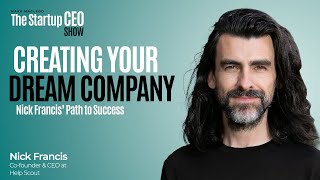
Transcript of a Startup CEO Show episode (June 3, 2024) in which host Mark MacLeod interviews Nick Francis, co‑founder and CEO of Help Scout. Topics include Help Scout’s remote-first origin and practices, embedding culture and values (including B Corp / public benefit incorporation), the role and cautious adoption of AI in customer support, Nick’s personal leadership ‘superpowers’ (customer empathy, product intuition), fundraising philosophy (profitable, intentional raises, investor alignment), and personal sustainability practices for long-term leadership.
Chapters
This episode is brought to you by Thelo. Tell me if this sounds familiar. You wake up, you take a look at your calendar and you see it's filled with meetings, stand ups, weekly check ins, one on ones, town halls. And those are just your internal meetings. Some are productive, but some are definitely slowing you down. Be honest with yourself. How many times have you thought this meeting could totally have been an email? Now consider that in the US alone, there are 55 million meetings each day and 85 to 90% of those don't have an agenda. Fellow is on a mission to solve the meeting problem by offering the only AI meeting management solution that covers every part of your organization's meeting workflow. And As a startup CEO show listener, you get 300 free minutes of AI recordings. If you sign up today, go to Fellow App CEO to start your free trial and start having better meetings.
The thing that I was trying to solve was how do I create the company of my dreams? Myself and the people involved in this company are able to do the very best work of their career. When they look back on their time at Hell Scout or when I look back in the rear view at my time building this company, I want to know that it was the best experience I had had in my career. And so every decision that we've made as a business has been highly intentional and focused on doing our best work. That doesn't actually mean building the biggest company, having the most revenues, going public.
Welcome to the Startup CEO Show. I'm your host, Mark McLeod. In this episode, I sit down with Nick Francis, co founder and CEO of HelpScout. Nick's built a really unique company. It's been 100% remote from day one. And so we talked about the formula to making remote work, especially for a company that is so deeply focused on culture and values. We talked about AI and how it's impacting his customer support solution and how he incorporates AI without losing the human touch. We talked about his superpowers and how he's designed his role and company around them. And we talked about how this is really his dream job and dream company and he wants to keep building it forever. It was a really special discussion with a really special person and I hope you enjoy it. Nick, welcome to the Startup CEO Show. It's a true pleasure to have you here today. How are you doing?
I'm doing fantastic. It's great to be with you, Mark.
Yeah, really is. And I was looking forward to this episode for many reasons. One of them was actually to see the progress of your hair, which is truly epic. And so for anyone listening, I recommend going to the YouTube episode as well and just seeing this. Is this like your superpower? Is your, are your power as a CEO correlated to the length of your hair?
I think so.
I'm loving it.
Yeah. It. My mother gave me an amazing superpower at birth, which is, which is the hair. And everybody notices it. I basically just wake up out of bed with hair like this and I'm very lucky. And so I, I try to use it as best I can to, to make things happen.
Amazing. Amazing. I gotta say I have a little bit of hair envy because very fine and very straight and in high school I was a drummer in a rock band and I had long permed hair. This was blissfully before digital cameras and social media. So no one will ever see the evidence, but I would have killed to have hair like that.
Yeah. Good for headbanging, good for all sorts of things.
This is not why anybody's listening to this episode. Maybe let's get into it. So maybe let's start off with AI which is on everyone's mind these days. Help. Scott's mission is to make every kind of customer service interaction more human, more customer centric. And given that, how do you feel about AI? Are you aggressively trying to implement it? Are you worried that we're losing the human touch? What are your thoughts?
Yeah, there's certainly a lot of discussion about how AI is going to influence customer support and rightfully so. I think it's going to be transformational for our industry. The reason why we're excited about this particular cycle of AI because there's been several different hype cycles around AI ever since we founded the company. The reason why we love this one is because I genuinely believe it's going to be a better experience for the customer. And that's the way that we've always operated our business is we want to enable customer centric companies to deliver delightful customer experiences. And when you have a self service experience with a chatbot, that just so happens to resolve your question in a matter of seconds rather than having to wait hours for a human response. That's magical. Right. So I think it has the potential to make customer support teams more efficient and increase customer delight. That's why we're excited about it. So behind the scenes it's just a tool. And I think at this particular moment in the hype cycle there's a lot of over promising and under delivering and we have to be very careful about staying true to our core mission, which is to enable businesses to delight more customers. If the tool itself is not enabling a team to delight more customers, then it just doesn't meet the bar yet. So we haven't shipped a chatbot for instance, because it's not there. We've been working on it for a really long time. But it's very important that we ship a product that's going to under promise and over deliver in terms of delight.
Do you have a vision for what customer success is going to be when AI reaches its true potential? I certainly get the speed aspect, but is it is the customer support experience is going to be fundamentally changed, do you think?
It's really interesting because if you think back to the time when we founded the business and if myself now was talking to myself 13 years ago and was telling myself about what was now possible, I'd say wow, I never would have imagined that's possible. The power of generative AI and LLMs is such an amazing tool to build with, to build products on top of. So it's hard for me to know what the ceiling is. I can only imagine. So another thing that we've said for 13 years that remains true is that great customer support will never stop being important to a business. Right. Because the customer will never stop being important to the business. So maybe what changes is the jobs that customer support teams spend most of their time doing. Maybe they spend a bit more of their time thinking about the revenue growth of the business or contributing to education one to many types of things. There's still plenty of room for teams to add that sort of value. And I can't personally imagine like we still, you know, if you jump into our customer support queue, There's a good 60 to 70% of it today that I cannot imagine AI being able to solve without human input. And so I still think we're, we're. This is this gets into the over promising part. I think we're over promising a bit what's going to be possible in this next iteration. But never say never, right? I'm not a futurist. I'm just somebody that is aware of the tools that are available now and is trying to make the best use of them to design experiences on top of those tools.
Do you still go in and answer support tickets for help scout customers yourself?
100%. You know that I love that.
I love that.
I mean that's the only way that I feel somewhat qualified to have a product vision, you know, is to be able to feel like I understand the customer that I'm dogfooding our product that I'm experiencing what our customers are experiencing on a daily, daily basis. And particularly as we've been cultivating these AI products, I've been in the queue a lot more just because I'm trying to use them every day and understand how they can add value and what we can do to make them better. So the user experience that you build on top of AI is really where the magic happens in my opinion. And that's where you can differentiate the product from, from your competition. And so that's really where we're focused is on that, that experience that's built on top of an LLM.
I had Itan Shah on the podcast recently and he's running an earlier stage company, probably not your icp, but he said that they had five support tickets in the previous year and that that was really the bar with where he was trying to go with products that you basically wouldn't need to contact support. Does that seem like an impossibly high bar to you?
You know, it depends somewhat on the business. If that makes their business successful, if their customers are delighted and doing business with that company, then more power to you. That's amazing. I certainly think that as a, as you cultivate a customer support function for the first time, if you're founding a business now and you're in your cultivating a support function, it's absolutely going to look different than it did when we first started to build our team. So much more focus on self service documentation and just writing really great help docs that would get you very far in terms of. Because now, you know, in Help Scout for instance, you can be in the queue and in two clicks or even an automation, when you even open the conversation, there's already a draft there for you. So it's, it's, it's simple to imagine at least you're not going to have to hire at the same pace like the linear pace of growth of your business. You're not going to have to grow the customer support team at that same linear pace. But at the same time, at least in our business, I can see the humans on our customer support team, which is still our second largest team, having many other value add jobs to be doing in the business.
Out of curiosity, do you encourage all of your staff to answer support tickets or is limited to your customer support team?
Yes, we absolutely do. We call that whole company support and that's where everybody just sort of jumps in and we have different shifts. So we just had a full company retreat. And so doing it in person is actually really Fun. So everybody during a company retreat has one or more what we call power hours, where you jump in the queue for an hour and you're in the same room as some of our other customer support folks. And so you can just sort of tap somebody on the shoulder or ask a question. But it's a really safe environment through which you can acquire some product knowledge, put yourself in the customer's shoes for a while, and hopefully help a couple of people. But I tend to engage at a higher frequency than most people in the company just because I feel like I have to in order to understand the customer journey.
My last operating role was FreshBooks and they made everyone spend the first 30 days in support.
That's right. And we still do train every new employee in the queue because I think it's important to know why we're here. Right. So we do a lot of initial onboarding there too as well.
Yeah, it was a great way to learn the product, obviously, learn the culture. And customers were number one. And Mike, who co founded the company, was very inspired by Zappos and how their support reps were empowered to do almost anything to satisfy the customer. And I will say that I was scared shitless. I was happily answering emails, but then I wouldn't pick up the phone. And my. This customer support manager, who must have been all of five feet tall and unlike the org chart, many, many layers below me and she's just like yelling me like, you got to pick up the phone like the next call is yours. She just kept pushing me until I did it. So good. Good on her.
That's just it though, right? It feels intimidating in there. Right. You experienced what a lot of our teammates experience. And so that's why the in person experience of actually having somebody sit next to you who's a product expert and is going to have your back in case something comes up that you don't know, that's really helpful. So that, that's been, that's been a hack that's been effective for us.
So switching gears, you know, helps help. Been remote by design from day one. And many companies were forced to become remote during COVID and have struggled. I think for many CEOs, they equate culture with, you know, and energy with kind of being in the same office. But clearly that's not necessary. You think you have people in 12 countries now, maybe more like, what's the formula? How do people. What's the formula for making remote work?
Well, yeah. So for the record, I think that you can build an amazing culture in either environment, whether it's co located or remote hybrid, is even harder, I would posit. And I'm not the only person that said that. I think that's become pretty standard advice. But you know, in terms of making remote successful, there's a number of trade offs to make because again, it's possible in either. And so some of the trade offs that, that come to mind are, hey, how am I going to simulate the water cooler? You know, the positive side of remote work is that people actually get more work done in a remote environment. I also don't think many people would argue with that one. But how do I design for the other side of that, which is just the water cooler? The social connection that basically enables people to work better together, to work more efficiently together. When they've got that sort of social connection, you can build trust and relationships and, and so in a remote environment, none of that sort of vibe happens via osmosis. Right. And so you really have to design for social connection. And so one of the ways that we've done that is the company retreats I was just talking about. So for many years we did them twice a year post Covid, we've only been able to do them once a year. But we're working our way up to hopefully in 25 we can do them twice. And. But there's a number of other ways. For instance, every 30 days I'm randomly paired up with somebody on our team to have what we call a fika, which is a Swedish term for sitting down and having coffee together. And so I'm randomly paired up with people just to hang out. Right. I'm not supposed to talk about work in a fika. And so there's a bunch of ways that we've just sort of designed it, we've wired it into the culture for people to stay connected and we optimize for video calls a lot. Right. We're not one of those companies who is over rotating on asynchronous communication. I think that shows up one way. But when I can look somebody in the eye and ask how they're doing and build a relationship, that way you get 98% of the fidelity of being in person. So that's one of the trade offs that you have to manage. Another is just the communication cadence. So I find that a remote team has to have the operational rigor of a much larger, larger co located team. So my friends at Wistia who were building a co located team when they were 100 people and we were like 25 people, we had to be more operationally rigorous than they were. Just in terms of documenting the way that everything works, documenting the culture. Like again, nothing happens via osmosis, everything has to be written down. So it forced us to be a bit more rigorous operationally, but that actually benefits us at further stages in the company. When you're into hundreds of people, that rigor really shows up as a benefit. And when people onboard with us, it's like, dang, everything is just written down, everything's clear. It's much easier for people to kind of make their way up that curve. And so if you make the trade off initially to just instill that operational rigor, then it does end up paying dividends down the line.
I believe that. Yeah. Out of necessity. Right. Because otherwise it would be chaos.
Yeah. But ultimately, like, to be honest with you, I really wish I could be in an office with my teammates. There's so many aspects of it that are so appealing to me. But the trade off that we decided to make at the beginning was talent over geography is very simple. I just felt like our chances of success were going to be greater if we optimize for talent for first.
So that was the reason why you chose remote? Just to.
That's eliminate geography. Binary reason. I chose talent over geography. And the rest of it was just you figure out the trade offs. But that's, that's effectively the decision you're making whether conscious or not. When you start a company and determine the sort of culture that you want to build. Nobody can convince me that they're choosing talent when. When it can only be within a 50 mile radius of a head of a headquarters.
That makes sense. It really does. Now you were ahead of the curve on remote. It was maybe in vision at the time, but like, how did, was that a friction point in raising capital?
Yeah, I mean. Well, the good news is we never went out to raise capital with, with, without another option.
Meaning you were always profitable?
We were always profitable. Every time we've raised money in 13 years, every time we've raised money, we've always been profitable. So that's a little bit of a strategic differentiator and just philosophical differentiator. But no doubt people thought we were weird as hell for being remote, and I get it. But at the same time, I felt like it was naive and I still do. And so, yeah, we've proven that it worked. I mean, I'm showing you the numbers that say that remote works. So if you still don't think it works, I can't help you.
Remote clients in My surepath banking days and all of them had the highest employee engagement and highest capital efficiency of all of my clients.
Isn't that amazing?
Yeah, there's something to it.
Yeah. It just wasn't the status quo. That's the bottom line. And as an investor, it's hard to make great deals when you're investing in the status quo.
I'm curious what you consider your superpowers to be and how have you used that knowledge to design your role and company around them?
Well, we've already talked about the hair superpower, haven't we? Obviously that's a given that goes pretty far. The superpower that I like to bring to the business is really just a, an enthusiasm for understanding the customer and the challenges that they may be facing. And so truly we talk about it in terms of finishing the customer sentences. If I give it enough time, I can finish a customer sentences and understand a problem at such a first principles level that I can articulate what a solution could look like and design an experience on top of that. That feels fantastic. Help Scout does not win on features. Our competitive advantages, we've done the research are ease of setup and ease of use. So our product's just easier to use, it's easier to get going. We like to say you go from zero to power user in an hour. And that's sort of the superpower of the company is being able to design products that people really like to use. And it's because of that ability to just understand the problem at a first principles level and then translate that into a user experience that feels, that feels on point and not over the top in any way. One of the mistakes that I've made over the years is because as CEOs, you're constantly told to delegate. Bring people in who have seen the movie before who have done what you're trying to do. And largely that advice is correct. However, I've noticed a couple of bugs in that advice, such that there are certain superpowers or core competencies that a business or its founders have that should not be delegated because they tend to be watered down. When you just bring in somebody that's seen the movie before, well, they might just be applying an operating playbook that's not going to be effective here. So when it came to the product vision specifically, there was a three year period in which I did delegate a lot of the, you know, I was involved in the, in the high level vision, but I wasn't involved at all in the product direction. And like the roadmap and that didn't serve the business. To be honest with you. I made a mistake by delegating that and not operating in the details at the level that I should have been operating at because that's frankly where I can add the most value. I would do better off delegating some of my CEO level tasks so that I can operate in the details and understand soup to nuts what's happening in our product strategy and how that's showing up for customers. For me to delegate that in a product led business, a product led growth level business, would be a mistake, at least in my experience it has been. And so over the last year, as we've sort of gone through that change and I've learned to take ownership of the product led motion again and realized that that's kind of one of our superpowers as a co founder group. And so now, now that we've made that change, it feels right and it feels like we've got a bunch of momentum behind it. That's not something that I plan to delegate in the future.
Makes sense if I look at Shopify as just one example that I'm very familiar with. Toby's amazing, right? If you look at the exec role that's had the shortest tenure, it's been VP or product. Because Toby will routinely dissatisfied and put a bullet into that person and then take over product. And I'm pretty sure he's running product.
Right now 100% right. And it's, it's the hardest role in this company, probably the hardest role at Shopify for a lot of different reasons. I fully acknowledge that. But at the same time, you know, Toby brings a specific sort of brilliance to that role that makes Shopify what it is. Right. And it may be difficult to be part of that motion, but it's absolutely the right call for him to be in the details like he is, at least from afar. What I've seen is that that's really the secret sauce of the business.
I'm curious, I should know this, but do you come from a product or design background?
You know what? I come from a background in which I've always learned by doing. I was never a good student. I started my first company when I was 15 and so I've always learned by doing. And therefore I don't have a CS degree or a design degree. I started a business to build websites when I was in college just because I did start coding as a kid. I was never a great engineer, but I did start coding when I was pretty young and loved building websites. And back in the day, just taking a website, you could sort of deconstruct the HTML and CSS and recreate it on your own. These days it's all gobbledygook if you view source on a webpage. But back in the day there was well crafted semantic markup where you could actually learn how to build just by looking at the code that was running a website. And so that really just set me on fire where I'm like, I could recreate any website in the world if I just spent enough time trying to figure out how it was created. And I sort of reverse engineer it. And so I've always felt like. So my degree is actually in music business and I've always felt like one of my superpowers is to work with a creative person, but I'm behind the scenes, right, so that that creative person can do their best work. At the end of the day, whatever that might be, whether that be music or whether that be a designer or an engineer, I still consider both of them highly creative pursuits. And so I always felt like I could be the person behind the scenes that was enabling them to do their best work, whatever that is. Right. So at times that's been like UX design or. But you know, my two co founders, one is the best designer I've ever worked with, one is the best engineer I've ever worked with. And so that, that vibe works for us, they do their thing and they are still the best designer and engineer in the company. And I'm, I'm kind of doing the rest, whatever that is. That just so happens to be CEO. But I really feel like my goal is to kind of partner with those creative people to help them to cultivate a space where they can do their best work. And so I aspire to be thought of as a designer, but I'm not.
Were the three of you also remote from day one or was there a period in the beginning where you were closer to each other?
We all met up in Nashville, Tennessee. So when we were first creating the product, and I will say, man, I can't imagine it would be harder to be like a three person team that's trying to build a product together and not be in the same space. Even though our goal was to be remote from day one, it really was. Our intention was to grow a remote company. When we were building, we had to be in the same room and we were just working 18 hour days to make things happen as we went through techstars and the whole thing. And so yeah, we met In Nashville, moved to Boston for techstars and that's where we just gave it everything to try to ship a product. And we're able to do that halfway through techstars and the rest is sort of history in terms of us being given the opportunity to build the company of our dreams.
Now Nashville make the dots with music. Were the three of you into music in some way?
No. So, but. Well, I will say Jared, my co founder, the designer side, the first job he ever did for me was an album cover. Okay, your album for an artist I was working with. No, it was just an artist I was working with at the time. But he's a brilliant graphic designer. So for several years Jared didn't code, so he would actually do the design work. I would code on the front end and Denny, my other co founder, would do all the back end work. And now he's a better coder than me, but for a while he was not. And so, but I was working with other musicians and my connection with Jared and Denny really kickstarted the web based work because we all loved this work and felt like because I was building websites for the artist I was working with, right. I was doing tech and music at the same time. And so. But these two guys, wow. With their superpowers, I'm like, wow, we can do, we can build some really cool things that are way beyond what I could build on my own. And so that got me really excited about the tech side. And I ended up moving on from the music business just because I felt like we could, I could make, I could spend my whole career making great art that I was passionate about and have no financial prospects at the end of the day. Whereas in tech, I think it's, it's much more of a meritocracy. If you build something great, then the rewards are there at the end of the day.
Yeah, I can tell you, you know, I run a record label on the side. If I depended on that to make money, I'd be very, very stressed out. But instead it's just a passion project, you know, so it's exactly that.
It, it, I'm still so passionate about music. Do dream of the day when I could actually have a little record label on the side and like make some of that great art. But in terms of a business model, it's pretty challenging.
It is, obviously, especially with streaming. Right. You know, music is trending to be free and is pretty, pretty darn close.
And so when I was getting my music business degree, it was not a good state for the business to be in. It just felt like a really rough period.
Yeah. I don't think it's gotten any better.
Yeah.
So I first met you at that techstars demo day in Boston and it was very clear to me instantly how human you were and how grounded in yourself you were. It wasn't this frenzy to be something you're not. And you've built this company in your own way, starting by being remote. But I could tell that culture and values mattered just from spending, I don't know, two minutes with you. And obviously I've spent time with you since then and it's very clear. But I would love it just going back to this remote a little bit. Right. Like, how do you build and deeply embed culture and values when you're. I know you got the bringing people together, but what other things do you do to make the values real and be lived in a company that's distributed?
That's a really interesting question. And it sort of goes back to the superpower that I was talking about, which is being able to understand something at a pretty deep sort of first principles level and then build on top of it. I think of culture and values at that level, whereas the thing that I was trying to solve was how do I create the company of my dreams? Or I feel like myself and the people involved in this company are able to do the very best work of their career. When they look back on their time at Help Scout, or when I look back in the rear view at my time building this company, I want to know that it was the best experience I had had in my career. And so every decision that we've made as a business has been highly intentional and focused on doing our best work. That doesn't actually mean building the biggest company, having the most revenues, going public, any other sort of goals were. Were not really in our purview. Our goal was selfishly to build the place that we wanted to work in. And so it was very internally and to build the products we were most proud of. Right. So we had done client work for six years before Help Scout. It sucked. When you ship a product, that's the best day that product will ever see, or the website or whatever it might be. We wanted to build something for the long term. And so some of those things were just baked into the DNA. You're absolutely right. And it's amazing to think about. I remember when we met so many years ago. It's amazing to think about the fact that that was part of our DNA from the very beginning, because I Still, when, when we talk about our core values as a company now and the why we do remote and all these other things, it really comes back to those first principles of how do we design the workplace and the product of our dreams. That's all comes back to those two things. And we want to attract people that are going to make us better at our craft. And that's where the talent piece comes at it. It's like, well, shoot, what does it mean for me to do the best work of my career? I have to be surrounded by people that are better than me because that's going to bring out my best. Okay, well that's pretty much the talent strategy, right? So if you start from these sort of first principles that are super simple, there's a lot of decisions that you can make that actually feel quite intuitive and unambiguous. So every decision that we've made as a company, whether it's fundraising or the kind of remote co located culture we want to build, the products that we want to make, the segment of the market that we want to focus on, all of it can be traced back to those first principles.
When I hear you talk about wanting to build your dream company, it makes me think of, well, I'm not building to flip, I'm building for the long run. And which brings up a bunch of questions, I guess first of all, how do you reconcile that with the objectives, right? You got a tier one investor and you're cap table in the form of Foundry Group, you know, who clearly don't want to be in this forever. So how did you, how do you reconcile the fact that you're not building to exit per se, with the fact that you have investors that are, you know, in the business of getting an exit.
So this is one of the challenges that I have as an entrepreneur. I'm just like, well, that sounds hard, but we'll figure it out, right? That's always been the approach, right? Otherwise as an entrepreneur, you're not going to get anything done if you try to solve all the hard things all at once. And so I'm like, well, if we, if we build a great business, then there's a high probability that this is going to work itself out. And so, but I have gotten into the nuances of that over time and it has impacted our fundraising strategy. It's the reason why we've been profitable every time we've raised money. And so we have been forced to take a different strategy, which in some ways is more challenging. Right. When there's not a finish line that's really clearly marked when you're fundraising. That, that can be. That can be difficult. Right. And, and I've started to appreciate the playbook of taking a home run swing with a business. I've. I've started to appreciate that playbook a bit more over the years, if I'm totally honest. I. I realize and appreciate the power of growth and momentum over that period where, you know, you look at a company like Slack that was coming up sort of in our heyday, and I was just looking at all the money they were raising and like, everything, like, they were growing so fast. And I realize now why Stuart had such a sense of urgency to grow that business that maybe I didn't fully appreciate at that time. So I will say that I time has really helped me see the field a little bit better. But at the same time, you know, going back to the first principles, that's not our path. And so we decided when we fundraised, hey, what are the goalposts for this investor to be successful? Right. And so when I talked to Foundry Group back when we raised in 2015, it was, you know, we'd love a 5x return on this investment. Right? Great. Then let's set the. Let's set the goalpost this number. That's the exit number that you need for me to know that I've been a good steward of the capital that you invested in the business. Okay. So those are the goal posts, and we've well exceeded those goal posts by now. Now they haven't gotten the return yet, but as long as we continue to exceed those goal posts and that number continues to grow, then we're in a good position. But we raised again in 2021, which was a precarious time to raise money, which, you know, but we didn't raise it wild terms we raised, because I know that, I know the goal posts are there. So if I raise at 30x revenue, I know that the goal posts are going to be too far out for me to be a good steward of the capital. So we raised at a 6x goal post, meaning we wanted to raise a 6x of what the revenue was at the time. And that was crazy. In 2021, everybody was raising way more money. But I felt like when I was doing that math, I'm like, I don't feel comfortable with higher than 6x, to be honest with you. We had term sheets that actually much larger, but we felt like we're optimizing one for the partners that we want to work with, and then secondly for the goalposts that make us, that give us confidence we can be good stewards of the capital at the end of the day. So believe it or not, I think that I take the investor relationship and the capital that's invested in the business. I take that a bit more seriously than a lot of other entrepreneurs, for better or worse. In some ways I'm less cavalier, which means I have a lower risk tolerance. And so for some businesses, that may not be the right approach, but for me, my first priority is to, is to deliver a great return on that capital the moment I agree to take it on. And it integrity is a big deal for me. And so to me, that's a promise. It's not a wish or a hope. It's a promise that I'm going to return that capital. And so that's dictated how our fundraising works. And We've only raised $28 million in our history for that reason. And our revenues are well in excess of.
I love it. Well, this again, I think it's just a beautiful illustration of the importance of values. If you weren't grounded in values, you would be opportunistic and take that 30x like, well, they're big boys, whatever, you know, they've got a fund, they got a portfolio, but you didn't. You chose a path that was aligned with your values. So.
Right. Sometimes the investor actually has to tell me like, Nick, you're take like, you don't have to be that. You don't have to make it that big of a deal. We have a lot of investments that we make.
That's right.
But it does feel personal and I'm always grateful that folks invest their capital in our business when they could invest in any business. And so we try to treat that with a certain respect and make sure that we can return the money.
That story tells me that you also did a good job in either picking investors that were aligned with you or getting them to adopt your values when it came to the governance of Help Scout. Because I could easily see myself enjoying. I'm on your board, I have the investment enjoying the markup that would come from that stupid term sheet in 2021. And directors have a fiduciary obligation to maximize the value for shareholders and probably would have been pretty tempting to take the high ticket term sheet. So there's. Was it. Was it a big job to create that alignment or it just kind of naturally happened?
You know this because we've worked together before, but I typically when, when I decide to fundraise, there's Like, I can count the. The firms that I would like to work with on one hand and I just reach out to those firms and we have a conversation and there's a deal to be had there. So I. We don't typically talk with a lot of like there, but there are, there's a certain number that I have a tremendous amount of respect for. And we've been very lucky to work with Foundry and now Lead Edge Capital. Such a big fan of both of them. They've been extraordinary partners. And you're right, like foundries had an opportunity to sell in 2021, they decided not to. And so these. I'm so, so grateful. Our fundraising journey, I think we've been intentional. We've taken a different path, but on the other side of it, we've had some extraordinary partners and it's nice to sort of buck that stereotype of VCs with some of the partners we've been able to work with because they're extraordinary.
You use that word intention a times now, and it's such a important word. I think too many founders just sort of get caught up in the madness and like, let the company happen to them versus them happening to the company. And so I. But I think intention is everything. Right. Like, where am I trying to go? How am I trying to get there? What does success look like, not just getting caught along the ride? So I really love that you're doing that.
Yeah. At the end of the day, you want to love what you're doing. So again, I hate to keep bringing it back to these first principles, but it really does guide every decision that we make. So I want to wake up every day, I want to jump out of bed and I want to be excited about the work that I'm doing. And so that dictates so many of the decisions that we make on a daily basis. And I think it forces us to think a bit more long term. So it's innate for me. But now that I say it, I'm like, I understand why a lot of people don't operate that way.
Another element for me, right? You're 13 years in now and you're building your dream company, your dream job for the long run. Not thinking about exit makes me think about, well, hey, if I'm doing that, I can't burn myself out. I have to be more sustainable. And so I'm wondering what you have done to make this role sustainable so that you can keep doing it now in your second decade.
I never really knew that this was going to be 13 years in and I would still love the work, to be honest with you. I mean this surpassed our wildest expectations. And so there's most definitely an aspect of work life harmony involved where I know that I can't work more than 10 hours a day for very long before I'll start to burn out. So there's certain, having that long term perspective does dictate the way that you operate, the way that you build the business. There are certain customer acquisition channels that we're just not going to really waste our time in because we feel like they're maybe not long term sustainable for us. So that is most definitely. There's no big secrets to trying to be able to sustain yourself personally as leader of the company. But at the same time, man, it does get, it does feel as though it never gets easier. So I just want to be clear, like if there's one thing I could tell myself 13 years ago, it's that there's no, like, there's no hump that you're going to get over and it's going to feel easier. Like it's just always uphill. Always, it's perpetual. And what is it Billie Jean King I think says 100% that that always echoes in my head as when I, when I'm thinking like, man, this just never stops. It's always uphill. That, that's the privilege of this work. But 13 years in, I'll just tell you, there is so much pressure on the business. How are we going to exit, how are we going to grow, how are we going to earn more market share? None of those pressures go away. And so you have to find ways of managing that on a personal basis such that you can sustain that sort of pressure and, and, and prepare for the ratcheting up of that pressure over time. And that's what I love, that's what I'm addicted to. I just love the journey of trying to, to improve myself at such a high rate, to improve my own sort of self awareness at such a high rate, my, my cape, my ability, or to learn new things at such a high rate that I can just keep up with whatever you know, is coming next. And man, I love that. As miserable as it can be sometimes I really love that because, you know, although it does get harder every day, it does get more rewarding to look back and say, holy shit, look at what we've done. I wonder what we could do if we keep going.
You have a big smile on your face as you're telling me this, which tells me you do Love it. And I'm curious, other than putting the reps in, that's the biggest thing. What else have you done to make sure you're always growing faster than your business? What other inputs do you get? And also when I think of stress and pressure, we can't just consume that. We have to release it in some way. Whether it's a sounding board or exercise journaling. Anyway, just what are the things that you do to keep up?
The most important input, at least for me, is increasing my level of self awareness and feeling as though I have an even greater understanding of myself and my own edges. For some reason I just, I, that's sort of a core belief that, that my growth is, is tightly coupled with my self awareness and my, my just how well I understand myself. And so I spend a lot of time on that. I, I have a coach that I work with pretty intensely. She's part of everything that I do because she's there to help me figure out what those edges are and hold me accountable to continued awareness and growth in, in terms of what, like what some of those shadows might be. And so, so much of it just is being aware of how I show up for people, how I show up for the company, how I show up for myself and my wife and the other people in my life and ways that I've discovered. At least over the last few years, I've gotten really good at a few sort of habits. So one it that, that I've only been doing for about a year is meditation. So transcendental meditation has been a game changer for me. Something that I do every day. And it's something that enables me to just stay a bit more grounded and a bit more aware of my surroundings. The second thing that I've done is full on like just from an exercise standpoint, I do spend, you know, six days a week I'm working out. And so the big thing that I've taken on the last couple of years that's been such a big deal is weightlifting. It's amazing as you get older how important it is to get back to like barbells and like that sort of weightlifting. And so that's been really fun for me. I'm basically in a class with a bunch of postmenopausal women and I love it. And we're all lifting weights together and that's amazing. Is it CrossFit? No, it's just like it's working with a trainer. He's a former CrossFit person, but yeah, just working with a. So it's squats and deadlifts every, every day. Right. It's just the basics. Right. It's all about longevity. And so that's been really a really important aspect of my process. I feel like I may have had a third one there, but it went away. I'll bring it back if it comes back.
Well, self awareness is everything. It's the number one thing I look for in CEOs to coach. Because if you think your shit doesn't stink, we're wasting our time. You're just not going to be open to input. I'm going to be talking to a wall. So it's the number one thing I look for as an angel investor as well, because that's what's going to enable someone to grow faster than their business ultimately. Right. Is to get all those inputs and process them right.
If a CEO hits the ceiling, it's ugly. It's hard to watch. I'm sure you've seen it.
Maybe last big topic, more things that Help Scout has done uniquely is you pursued B Corp status. You know, not everyone does that. Maybe tell us what that involves, you know, what were your goals for doing that? I think it's probably a mystery to many people.
Well, it won't be a surprise to you at this point of the discussion that it goes back to our first principles.
No, not a shock at all.
So if we want to build the workplace of our dreams, part of that is about leaving the world better than we found it. So capitalism gets a. Gets a bad name, in my opinion. And we've done a lot in America, particularly to screw it up over the last few decades. But I still am an optimist for that sort of way of operating. And so there's a right way for companies to behave as it pertains to the community around them, the environment, the employees. And when I learned about B Lab, who makes the B Corp certification, who does all of that, I remember they equated it to like, imagine it's like, you know how there's like an organic or fair trade certification that a food company can get, or coffee company, something like that. This is that sort of certification. But for a business, right? For a different kind of business who maybe doesn't even have a physical product, but wants to adhere to extraordinary standards that really set them apart from everyone else and are independently verified by other people. And from the moment I heard about that concept, I was like, that's for us. They made B Lab exists for us, for businesses like ours to attest to a different way of Operating and a higher standard of excellence. And again, the way that we treat our employees, the way that we think of our stakeholders. So, you know, we, at the board level, we don't just think of it in terms of shareholder value. We think of it in terms of shareholder value, employee value, customer value. There's all sorts of different stakeholders that should. Should be considered in all the decisions that we make as a company. And so everything that they came out with just felt like it already aligned with the kind of business that we wanted to operate. And by way of going through the certification process, it actually gave us some good ideas as to other ways we could level up in our business and the way that we operate with employees and so on and so forth. The way that we structure stock options or whatever it might be, the B Lab folks have some really great guidance in terms of what it means to be operating at a high level. So we just thought of that certification as a way to share with the world that we think about the success of our business and the success of our customers differently and in a way that feels more authentic to who we are.
I love it. Well, no surprise that you took that path. This all ties together. But I'm curious, did your. Did you find there was a positive reaction with your customers and your staff? Has it become a magnet? Is it a reason why people want to work for you and want to be your customers?
It has, yeah, absolutely. So you'd be surprised how often it comes up on interviews, how often we hear from customers that the reason they chose Help Scout is not necessarily about ticking feature boxes. It was about the company that we're trying to be and who we want to be to our customers and our ethos about being sort of customer first. And so that's absolutely paid dividends for us, but it's also paid dividends at the governance level just in terms of how we think about the success of the business. And it's been great to get, again, like a B Corp thing. If I were to go out and fundraise. You either hate it, which is great, or you love it, but it's a good way to just kind of sift through the noise and not waste anybody's time. If you're not a fan of the B Corp thing, great, see you later. But it's a good way to sort of suss out alignment at the governance level as well. And so we've seen nothing but positive results from it. We're up a Delaware public benefit Corporation. And so from a. From a incorporation status, it's it's not really that different from a Delaware C corp. A lot of people get nervous about that, but it really didn't require that much. You know, none of our shareholders really had to make any compromises that made them uncomfortable or anything. So it was all good from that side of things.
Well, Nick, this has been a true pleasure. And if I put on my old banker hat, I feel like there's infinite layers to the private capital ecosystem. And so probably at any time you could go to a mid market private equity fund, give Foundry the exit they want, reset the clock, and then just keep going in perpetuity.
And you've heard, you've heard the saying companies are bought, not sold, right? So I've always thought of it in terms of build a great business and we'll figure this out. But I don't want to underestimate the importance of doing right by our stakeholders. And so we will find that exit eventually.
Well, I wish you every success until then. This has been really great to see you again. Thank you.
Great to see you, Mark.
Hey, thanks for listening to the Startup CEO show.
If you'd like to connect with me.
Be sure to visit my website at Mark McLeod me or follow me on LinkedIn at the Mark McLeod or Twitter arkmcleodore. And if you want to tune in again next week, be sure to subscribe on YouTube, Spotify, Apple, or wherever you get your podcasts. We'll see you next time.
More from Mark





The Burnout Breaking Point - How Strategic Breaks Actually Increase Productivity


Emotional Debt - How Avoiding Hard Conversations Compounds Into Company Killing Resentment


The Death of the Specialist - Why AI Is Creating a New Professional Class Called Scalers