David Cancel: Lessons from HubSpot, Drift, and Beyond
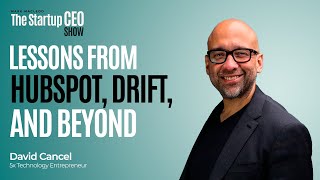
Conversation between host Mark MacLeod and founder David Cancel covering David's startup history (Performable, role at HubSpot, founding Drift), key decisions (selling Performable to HubSpot, rebuilding HubSpot product/engineering, Drift's growth and sales scaling), the sale of Drift to Vista in late 2021, and personal reflections on work–life balance, divorce, and a passion for art.
Chapters
I think there is core values and willing to like take big bets and even when it doesn't make any sense, even when the organization doesn't understand it like really being, you know, and I always call them the spiritual kind of leader of the company, like spiritually getting the company there, right? Not just goals, not just, you know, process, but like spiritually holding their hands and getting them there. I don't think I've seen that again or since.
Welcome to the Startup CEO Show. I'm your host Mark McLeod. I got a special episode for you this week where I sit down with David Cancel. David is a five time founder, founded Performable Lookery, was a key leader at HubSpot, founded Drift, on and on and he's had nothing but success. I met him many, many years ago and he was humble then and he's humble now. He sold his company Performable to HubSpot really early in the HubSpot journey and became a giant shareholder in HubSp. So we talked about that decision, we talked about what made HubSpot so successful. He then went on to found Drift, which for a time was the fastest growing SaaS company ever and had a giant exit on that to Vista. So we talk about that and then we switch gears and talk about, you know, some personal topics like how to keep balance as a CEO. He and I both went through divorce and we talk about that. It was a really great conversation. I hope you enjoy it and I hope you subscribe. David, welcome to the Startup CEO show. It's a true pleasure to have you here. How are you doing today?
I'm doing great. I'm cold, but thank you for having me.
It's a true pleasure. You know, they say good things don't happen to good people and I met lots of colorful characters in my many decades here in the startup world. And you won't remember this, but I first met you at an event in Cambridge many, many years ago, long even before I did Freshbooks and Shopify and you were already kind of on the radar screen. I just bumped into you in a hallway and we chatted and I think maybe it started Performable. Like you definitely done Lookery, but like I was a nobody and you treated me like I was a somebody and it really stood out, to be honest, like, and like I've seen you a few times along the years and you've had some crazy success and I feel like from a values perspective you're the same person. And so I, I, I appreciate that very much.
Means the world to me.
Thanks man. And so I don't know, like I would really love. There's no one recipe for startup success. Cause otherwise someone would have written a book and I wouldn't have a coaching business. But I don't know. You've done this five times. You seem to be batting five for five. And you're probably best known for, you know, HubSpot and drift. But I'd love to start with.
Where.
I first really met you was Performable. And first of all trying to figure out a thing that we still desperately need, right? Marketing attribution. But you know, you made a big decision. It was a business that was working. You had backers, you had a track record, you were solving a problem that's still not solved. So you could easily keep going, but you made a decision to sell the HubSpot and pretty early where they couldn't afford to pay for you in cash, so they paid for you. I don't know if it was all, and I don't need to know all, but I know you became a major shareholder. So talk us through that decision to sell Performable as a starting point.
Sure. I will say that, you know, Performable was my third company I had started and, and I didn't have any plans to sell it as you said. And so I had raised a series A from day one from crv and, and we were kind of, you know, we started out with marketing attribution. Kind of our insight was an obvious one today. But it wasn't at that point, which was a long time ago now, which was like in order for marketing systems to work in the future, you really had to have a unified profile. And so that you could understand that this is Mark, you know, on LinkedIn and on my website and in my email and in my, you know, and unify all those different IDs and him on Facebook and et cetera into a single profile. And that was kind of a crazy idea and was kind of blasphemy at the time in marketing, you know, because marketing was all about one to many programs. And so they were like, why would you ever need a profile? This is in the CRM, you know, you don't need it as in the one on one sales interactions. But we thought it would be needed and we thought that over time Mark, your customer, Mark would appear on more and more systems and you needed to tie together in order to have a personalized experience. So we started with Attribution, quickly turned into marketing automation and, and we would probably like, since I will say since starting the company I had always had this kind of mostly from the board of HubSpot at the time. These kind of like inbound chats that were just like funny inbound, but that were.
No pun intended.
Yeah, that they were just like, you know what you guys. You guys are doing marketing automation. HubSpot at the time was doing top of the funnel, which means website, cms and some keyword optimization stuff. You two should. We should. You guys should come together and build, you know, a pillar company in Boston because there hadn't been a, you know, a company that had gone public in Boston for a very long time at that period. Right. And so in the tech space. And so they kept poking me and poking me and I kept saying no. And then, you know, we ultimately decided to do it. We were about 18 months into the business. We had more than half of our money left. We had no. Things were going well on, you know, in all ways that we could measure it. There was really no reason to do it. But, you know, when I had met more and I knew kind of all the board members of HubSpot and were friends with them for you HubSpot and had met, spent time with Dharmesh and Brian, who were the founders, Brian Halligan and Dharmesh Shah. You know, I thought, you know, we were aligned not only kind of in what we wanted to do and kind of the boldness of kind of trying to build this pillar company, but also kind of our. Our values seemed to align and have felt, you know, that's a hard and squishy thing to always talk about. It kind of felt like, you know, when we were. We cared about the same things, you know, when we talked from. From a people standpoint and from kind of what we were trying to build and sort of made that decision easier. I will say my. I had one board member at the time. He didn't. The outside investor did not want to sell at all. He tried to. He tried to do some preemptive Series B's. A Series B offers with some other VCs that would be like. That would included money off the table that would be kind of equivalent to what the HubSpot thing was at the time, because it was a blended deal. And ultimately I decided to do it and it was. It was the right thing. In retrospect, it was a great outcome and great experience for us all.
Must have been a huge decision. I get it from CRV's perspective, right? CRV's tier one firm. You had a track record like, we picked our jockey. We've got our bet. Let's go. So I can see why they would have had dissonance.
You know, it was a personal reason at the end of the day, which usually people don't talk about this stuff. But I had a co founder, Elias, who have I started many companies with since and at the time and I had had the great fortune of having sold few companies before. So I was in a different level of comfort than he was. And he was just getting on his feet. He had three kids, you know, he was like this, he was all or nothing in performable and you know, really came down to me was that for him and some of the other people on the team, you know, but specifically for my co founder like this would be a life changing event if we did it right then. And as soon as I came to grips with that I was like done. We're doing it.
So that was really a mass. You know, on the one hand it's an exit decision, but on the other hand it's an investment decision. You're making a decision to invest in HubSpot. How far along were they then? Did you have a sense of like this is going to be a thing or was it still very speculative?
Definitely not. It was very speculative. I mean they were about, you know, they were performable, was like a 20 person company, they were like a 200 person company at the time. And they were probably, I think that year we were going to approach, you know, there was sizable, but let's say 25 million I think in AR, something like that. So it was definitely sizable. I think the mystery for us all even being in the same ecosystem that was Cambridge and Boston, was we never really understood what it was that Elspot was selling at that point. And because it was a different era, right. It was a time when products could be sold, you know, on a demo, you know, through an assessment. You weren't really, in some cases, you didn't even demo software back then, so you'd be sold on a promise, you know, these things that don't exist now, right. The free trial motion was not a thing. So from the, the reason I bring that up from the outside it was kind of opaque. You couldn't see what was it exactly that these people were buying. And, and so we didn't know until we, until we got there really until the deal was done and we were there and I started to see what this was and then I was like, oh shit, we have a lot of work to do. And again, because it was just a CMS at the time and kind of a website Grader. And the big wave that they were riding was that everyone, all small businesses, wanted to get on Google. They didn't really, but most of these people who were test early customers didn't know what that meant. They didn't know what a website was. You know, they didn't know the difference between website and Google. They just said, I need to get on Google, all right? And that's what was sold to them. So then we had to rebuild it. I had to rebuild the team. I had to rebuild every piece of software that existed. I had to get us into marketing automation. I had to get us into sales and build a CRM. I had to like do all these things, which we know we did in, in a pretty short time. In about four years we did that and then we went public. During that phase, all now kind of seems impossible. I don't really know. It seems if someone were telling me the story and I'm not going really into detail of all the things we had to do, then you'd be like, this is nonsense, they didn't do that. This is like make believe story.
So huge decision for you. But sounds like a huge game changing decision for them as well.
Yeah, a big bet. And I say, you know, I credit the board and especially Brian and Dharmesh to have kind of have faith and because I don't know if I would have had faith in myself when I was like coming to them saying I'm going to fire the entire engineering team, I'm firing the entire product team, I'm firing, we are going to rewrite every single piece of thing in this place while going, while trying to go from, you know, 25 million to 100 million plus and going public. We're going to do that all at the same time and we're not stopping. Right? And I don't know, I don't know if I would have believed that.
But they had faith like changing, changing a plane engine mid flight.
Mid flight. Oh my God. And so, and you know, they didn't know like that, you know, they were trusting me and a lot of it was because I had known the board for so long and had worked with them and you know, from a product standpoint, but you know, the people that were there that ultimately I was, I replaced. Like they knew those people, they didn't know me. And so they had to take this bet and they did so much credit to them.
I'm curious, right? So they were 200 people, you were 20. But you come in, you're running product and engineering. That's a giant part of the business. You're a large shareholder of the business. I'm curious, was there a performable culture and a HubSpot culture and they were running simultaneously, or did you integrate and become HubSpot? Or did you integrate and become like a new thing?
It's, it's. That's. I love that question. I'd say we became a new thing. And, and again, that was really. Brian, who was the CEO Brian Halligan really was, wanted to shift the culture of the company from being a, and this is kind of his thesis was from being a sales driven organization to being a product driven organization. That was he, you know, and meant, you know, a lot of internal pushback, a lot of holding, you know, your nose while doing it. You know, like, it's one thing to say to, you know, to kind of think about this from a theoretical standpoint, but, you know, you've been in a million businesses like the companies who've been able to transform themselves. You know, like it doesn't exist. Right. It's like, you know, these are like beyond unicorns. I don't know what that, what you would call them, but like, yeah, Decagorns, you know, the, the Netflix story of going from like shipping CDs to like, you know, you know, becoming an online only streaming business, like, that's actually impossible. And it's not impossible because of technology. It's impossible because of all the human resistance and all the, you know, kind of the organization has created a culture around something and has incentives aligned around, you know, one set of goals, which might be the old goal. So it's like, it's impossible. But we lived through it. And so we became one company. And that was important to me. And I took, I didn't let the performable team, which are mostly engineers and product people, even work within the same team. I broke them up and they became the leaders of the new teams that were coming in and built new teams. But they were. And I forced them to split.
Yeah, I love it. That's genius. So HubSpot is obviously still very much a work in progress, but you left some time ago. I'm curious, what is your post mortem? They're worth $36 billion today. They've created an entire category. You talked about massive scope and the roadmap, but what else beyond kind of building all of this disruptive technology is behind their success?
I wish I knew. I'd say, like, because I wish anyone knew, because then we could bottle it and reproduce it. I think there's so Many different things that go into it. I mean, I think there was timing, definitely important. I think there is core values and willing to like, take big bets, which Darnesh has been, you know, has done repeatedly, you know, and so. And even when it doesn't make any sense, even when the organization doesn't understand it, like really being, you know, and I always call them the spiritual kind of leader of the company. Like spiritually getting the company there. Right. Not just goals, not just, you know, process, but like spiritually holding their hands and getting them there. I think. I don't think I've seen that again or since.
I'm curious. Random question. Have you been. Have you ever been able to buy Dharmesh dinner?
No, it's impossible.
Actually.
No one on this earth has ever been able to buy him.
I thought maybe just sneak in a credit card.
No, it's his one. You know, he does not splurge on many things. And his one splurge is hosting these dinners which, you know, and taking people out to dinner. And it's impossible to.
To pay another one of the good guys.
Great guy. Great guy.
So sounds like you were having some fun. You're kicking ass, creating tons of value. Talk us through the decision to leave to start Drift.
Well, you know, at the time I was. I'll back up and say HubSpot was the only company where I had sold my company to. And then I had gone as part of it. And the fir before, before going to HubSpot, like, I hadn't sold companies. I had never, you know, the minute it was sold, there was no way I was going to join the acquiring company, like, ever. And so. And you know, part of that is my. My fear of being trapped, you know, which, you know, is probably a common theme of a lot of entrepreneurs I know. And so like, you know, feeling like that I've locked myself into something and so I'd have a spot. Another amazing thing about Hubsad, I'd say, was something that Brian did, which was like Brian really managed the. Managed the. All the different functional areas in a. In a different way. Right. He did not. He was not. I would never cons consider him like my manager. He never treated me like we ran. We almost like ran our own pianos, we ran our own organizations, you know, we had. And a lot of the times we'd have, you know, I would see Brian once a month, you know, at a team meeting, you know, because where we had all of us together, it was a brutal team meeting. You know, it was like a, you know, 12 hour team meeting with, you know, all the, all the leaders. But a lot of months, you know, I just ran my organization and there was no management there, like daily manager.
Did he give you that rope because you were a multi time CEO or that's just how he led his people. And so everyone got that rope.
I think I got more rope than most. I think probably because of that and also truthfully probably because I was the most product was the most alien thing to him and he had been risen up from a sales driven, you know, he rose up in sales and so like I'd say, you know, he was pretty hands on in the sales organization and I was kind of like didn't know what to make of, you know, didn't know how to evaluate and so, so he trusted me a lot and so yeah, that's the way we ran. And I never felt like I, I, you know, to answer your question, I never felt like I worked for anyone which probably helped me stay there as long as I did. I also stayed there as long as I did, which in retrospect is brief. But for me it was a long time because the minute I came in and kind of redid and got rid of the existing organization, started to rebuild everything, you know, I had, you know, my mind broke it and so now I had to fix it. There was no walking away from it. And so the time that I left, when we went public, I had reached a point where we had rebuilt all of that. We had built the CRM, we had built all this stuff and I felt like there was a lot more building to go. But like, you know, I had gotten there. Like I felt like there was a mission that was accomplished. Like, you know, I did what I said I was going to do and so, and you know, I did not want the life of being a public company kind of executive and, and that kind of for me. How did that affect you?
And sorry to interrupt, but how did that affect you in product and engineering? I can see how it would affect a sales leader. You know you have to hit quarterly guidance, obviously see how it affect a cfo, but how does it affect you?
I was a very large shareholder of the company, so in that way it would affect me. And, and I, when we were going public, you know, there was kind of these, you know, conversations with the bankers of like well, you can't leave. You know, they said the thing, the one thing that you can't say to my personality, well like now you need to commit for a number of time and you can't Just like leave in. It's like, what? I can't leave.
Give you a box with this really nice pair of golden handcuffs. Here you go. Yeah.
The minute they told me I couldn't leave, then I was like, I must leave immediately. You know, like immediately. It was totally irrational, but that's the truth. It was like, oh, what? I can't leave. Okay. And so, you know, I didn't want that scrutiny. I felt like we had, I had all these leaders in place. Many of those leaders still are leaders there, they're executives there. You know, my team is largely still there and many years later. And so I felt like I could move on. I did not have any intent of starting another company. After I left I was like, there's no more companies. That's it. You know, and, and it was only Elias again, my co founder in performable that shortly after I left, he left, you know, and I was like, don't leave, you should stay. But he was like, no, I'm going to leave if you're going to leave. And so he left shortly after and then he was, he wanted to start another company, you know, because for him it's unperformable. But you know, like he, he wanted to do it again and he was earlier in his career and so he kind of broke me down after a while to start another company. But then, you know, I was like, I only started another company under all of these conditions. And then all those conditions were met and so we decided to start another company. One of those conditions was like we'd have to have a chance of defining a new category that have to be something much bigger than just building a new piece of software. And so we really kind of like honed in on the idea which is like now everywhere with agents and conversational interfaces around this kind of conversational idea, right? Of like that the future was going to be that you were going to speak like we do with ChatGPT or many other systems now in a natural way. And not that you were going to fill out forms and do all the stuff that we had been doing in the past. And so we thought conversations, this kind of conversational approach was going to be the future. And so, and we're seeing it right now. And so that's why we started and working on the next company, which was Drift.
I feel like you told me this stat once when I was in your office, that Drift was like the fastest growing SaaS company ever. Is that true or am I dreaming?
Yeah. At that time, I'm sure there's Been many, many after that. But at the. To that point, yes. And so, you know, one odd thing that happened was like we saw this. Remember those Mary Meeker slides that she used to do the state of the Internet every year? I missed them. So Mary Meeker was this analyst who then later joined Kleiner Perkins and she would do these state of the Internet things every year presentations. And I was looking at one of those. I would religiously follow them and look at them. And one chart that stood out to me, this was kind of at the beginning of thinking about starting a new company was the growth in messaging systems.
Right.
And so meaning like WhatsApp and like, you know, Line and you know, Slack was starting at the time. And just like. And so she had this chart which was like the IRC and all these things. The beginning, Instant messenger beginning of the, you know, whatever you define as the beginning in that to like with the year at that point, which was 2014, and this kind of like slow growth that then just turned into this insane hockey stick. And basically what we're looking at was global penetration of. Of these systems. And so my observation looking at that and that was the spark for starting Drift was like, well, you know, if you were like me and been on the Internet forever and then you're second probably on being on the Internet forever. We had used things like irc, Instant messenger, all these kind of things. But the reality is that was from a population standpoint, that was a very small subset of us, you know, nerdy people on the Internet, like average people didn't use those. But what had happened was because of the iPhone largely, and those systems, like it had become normalized. And so people were used to talking to people, bots, whatever, just like having conversations and thought it was normal. Where, you know, 10 years before was like weird and geeky and like, what is this thing? And so that was the thing that we're like, oh, this is going to be normal now. And. And got me excited about starting a new company. It was really, you know, Mary Meeker's observation there.
Nice. So perfect timing. Sounds like it. All the elements kind of came together and. Right. So HubSpot, you helped transition from sales led to product led. The one time I was in the Drift office, it seemed like a really strong sales culture. It was like bang in the gong. So much energy. Sales felt like the center of gravity in the company was. Was Drift a mix of sales LED.
And product LED or like what, a hundred percent? I'd still. They'll argue we were product led from the you know, that was the DNA of myself and Elias, you know, and so we were product led. So what happened was. Well, two things. One, we started out as a product led motion freemium approach. The whole thing, right. Pre trial. And, and we were running the business that way. But one thing that I had learned at HubSpot, I mean, sorry, at Performable before HubSpot was that, that I did this experiment where I wanted to do. You know, we were also building a B testing software at the time. You know, like, so we were really thinking about a B testing. Hey, this is how we're doing touchless, you know, using a touchless approach. What about if we hire like one at that time, one salesperson. Her name was Heidi. We found Heidi and we said. And we, we see what she performs like, right? And. But would have to be like a special compared to the touchless funnel basically on every metric. And. But you'd have to be a special kind of salesperson because we didn't have anything to give them. We had no plan, we had no, no training, no collateral, no demo accounts, no nothing, right. And so really have to be an entrepreneurial type of salesperson. And so we brought in Heidi and we, we were all engineers and we sacker right in the middle of all the engineers and myself.
She's, she's a brave soul.
Brave soul. But what it was, it was remarkable because we could all of a sudden we were hearing every single call that she was making because this was still calls, right? And so, and it'd be like she said X, Y, Z, hang up. She's Chen. I said X, Y, Z plus, you know, wow. Oh, they started talking to her. So we were learning not only from the product, but also from a marketing standpoint, like the hooks that were working, like what people were interested, how she was keeping people on the, on the line. And so like it became this thing, this kind of like, you know, because I try to design all, all my teams and companies around building a learning machine. Really. So like we have, we are learning machines. So we have to like learn and observe, right? Because when you start a company, and this is where I tell entrepreneurs now, like you start a company, you have, you know, a very short amount of time that you have to learn things, right? And that's predicated on money because that's the number one killer of, of startups is that or any type of business is running out of money. And so what you want to do is. And the advantage we have now starting at the time that we do is that unlike before where you had to ship, you know, physical software or you had to sell products face to face. Like, you can learn and connect with all your prospective customers in real time. And so build a methodology around that and design your company around this idea of, like, how do I go from not having one learning loop, one complete learning loop? Let's say we want to test a product or test an idea or concept, and then go through a whole iteration, like, once a month. How do we have thousands of those in a year? How do we build the whole organization from sales, marketing, product that we are learning? We are going through a thousand learning loops in a year.
Right?
Because that will hopefully. And if we are actually studying and learning from each one of those cycles, we're improving. Hopefully, it improves our odds of success. Right? And so we learned this. We had this observation of performable. When I started Drift, you know, one thing who. People who. If you started more than one thing, one thing that happens all the time is you have to relearn lessons, right? You feel like you've learned a lesson, and then you're like, wait, why am I not. I forgot that lesson. So at Drift, it was. We started the company, we were. We were on our way. We had this touchless motion, and at some point, I'm like, wait, I didn't learn the lesson from performable. Why don't I hire one salesperson, two salespeople, and kind of a B test this thing? Why am I doing this again? And so we started to do that, and then an amazing thing happened, which was because of the nature of the Drift product. I'm sorry. The sales reps were using the product that they were trying to sell. The way that they communicated with the prospective customer about what they were trying to sell was using the tool. So it was like. So what that created was there was no need to teach them how to demo the program. There was no, you know, there was no training. Right. Necessary. And their pitch was this. Hey, look at how I do this. So another sales professional. And so because of that, you know, we hired 1, 2, 3 salespeople. We were seeing them get up to full productivity, like, immediately. And, you know, I am kind of conservative in my. In spending a nickel, you know, every nickel, which anyone will tell you, that's worked with me. And so, you know, even though three people were, like, fully productive and they were just selling nonstop, I was, like, very shy about, like, oh, should we add a fourth? This fourth gonna break. And then I add a fourth. And then my board at the time, which were all venture Investors were like, it's grow time. Start hiring. And, you know, we've all heard that before. And I'm like, yeah, I don't know. And I'm gonna go slow. And it was really, you know, I credit Pat Grady, who's an amazing investor at Sequoia, who I've worked with multiple times at HubSpot, and then Drift, who, instead of pushing me, saying, you know, sell, sell, sell. He's like, come out, you know, come out to the Bay Area. And we're just, I just want you to meet some people. And it was just like a learning tour. And so I met, you know, the first head of sales for Salesforce and that, you know, the gentleman who's running ServiceNow at the time. I met a whole bunch of gentlemen who's running Koopa at the time. All these dhu, you know, kind of like legendary figures to me, Met them all. And basically he had me just meet them and they would. They didn't know why they were meeting me in the first place. And then I would explain, here's what we're doing at Drift, whatever. And then at some point they would ask me, you know, all right, what are the sales metrics? And then I would tell them and they'd be like, what? How fast? How fast did they get on boarding? You know, how fast did they hit full ramp? 10 days, you know, and it's like, what? 10 days?
That's insane.
Insane, dude. No lies. And so they were fully productive, fully quota, attaining within the month, start month, mental. They're like, what? You know, and at some point they're like, you know, they wanted to, like, you know, they were verbally, verbally smacking me. I'm just like, wake up. It's time to go. It's go time. You must go. Like. And so then we started to really ramp up the sales hiring and. And it was great. It was the right decision. But, you know, I would say, like, as a product founder, I was like, even though I had gone through this many times, like, I was dragged kind of into it.
That's fast. That's. I literally never heard of a ramp like that ever.
Me neither. Yeah. I didn't really know what. And because I'm not a, you know, I'm not a sales guy. I've been among a million sales leaders. Like, I didn't really know what I was looking at, right? And so it was being around these people who were like, true sales leaders. And many, many, many times, you know, had done this and scaled that. They were like, what? And so they would go through everything. They were like, you have to go now. You know, playtime's over.
Are you still taking your own meeting notes? Let me tell you about an AI tool that I'm using to take meeting notes. For me, it's called Fellow. It's an AI meeting assistant. It takes human level AI notes, it tracks my action items and decisions and keeps everything in one place. Place built with security and privacy at its core. Fellow is the only AI meeting assistant that leaders trust to capture meeting notes and recordings while keeping your data safe. Thousands of organizations are consolidating tools and relying on Fellow to capture their meetings. The team at Fellow is so confident that you'll love it. They're offering an insane deal to startup CDO listeners. 90 days of unlimited AI powered note taking and recording, complete, completely free. Visit fellow App CEO to sign up today and experience the AI meeting assistant trusted by leaders everywhere. I'm curious just maybe for any early stage listeners, that first decision to hire Heidi way back, were you pre product market fit then and part of her mandate was to help accelerate product market fit or you already had it?
Well, you know, I'll say we were struggling to find if we had product market fit in some ways, if you squinted that way, looked like we had product market fit, you know and, and you know, we were all, we were lucky that we were starting that company Performo at the time that we were the whole like lean Startup. Even the name Product market Fit, you know that the concept was startup and, and so we had got to spend a lot of time with like Eric Reiss and all this stuff before the book, before any of this kind of stuff. And so we were trying to define this and luckily one of our, we met a guy through the, when we were raising around through crv. They wanted us to meet someone to validate the idea. And his name is Sean Ellis, who's like a legendary growth marketer. But he didn't have a name at this point, only people in the valley knew him as a secret thing. And so we met Sean and then Sean by the end of the call was like, I want to be involved with the company, like this is it. And in some ways the early versions and for those who don't know, Sean really created a concept of how do you measure and define product market fit? Right. And so in some ways the product that we built at Performable was the product that Sean had always wanted for himself. And at the time Sean was doing work for, for Dropbox and Zombie and all these kind of like Legendary companies and like, figuring out message testing and figuring out how to hit product market fit. So I'd say, using his definition, we definitely had product market fit, but we also had kind of thoughts about expanding the product. And so this is where product market fit kind of thing gets nebulous, because, like, you want to expand the market or you want to expand the product or you want to expand both, then when do you lose product market fit again? Right. We had it for a little niche kind of customer. And so Heidi was helping us explore how much headroom there was kind of in what we were doing. How far up could we go in terms of selling, how wide could we go on a platform? And so she really helped us through all that. We had product market fit on the core kind of offering.
Okay, last question on Drift, and then we'll move on. It struck me from the outside that you had the scale and growth to be a great IPO candidate. You had a CFO in the form of Jim, who could have credibly led that hearing a little bit about your experience. Hey. Or your reservations about HubSpot being public. Maybe I understand why you didn't take it public, but, you know, instead you chose to sell to Vista, which from my standpoint is like the most successful software investor on the planet. Maybe just walk us through that decision.
Yeah. And so, you know, when we started Drift, one of those core things that. That I meant, that I hinted at before, was this idea that we wanted to build a company that was capable being a standalone company and could go public someday if it wanted, if we wanted to, but just had that optionality. And so, like, so the kind of mission had to be that big. And so at the time that we decided to sell, like, we were not looking to sell the company again. The board definitely did not want to sell the company, definitely. But we had raised three rounds, one from crv, one from General Catalyst, and one from Sequoia, and none of them wanted to entertain an offer of selling the company. But what happened was we had a lot of in. It was a different time. And so, like, this was 21 and.
So good time to be selling.
Yeah. Oh, my God. So 21. So, like, early in the year, we had had all these inbound offers of, like, you know, let's raise. Let's raise a growth round. You know, it was like everyone was doing a growth round at that point. And so we had all the, you know, all the names of all those kind of funds that come in, like, let's do a growth round. Let's do this, let's do that. And you know, I had many friends like you did that were doing rounds at like 2 billion, 3 billion, 4 billion, 5 billion, 6 billion. Like you know, and I was like, you know, having been around this so long, you know, and talking when they would ask my advice, I'm like, I don't know if I would do it. Like how are you going to get out of a $4 billion validation? You personally, you as the founder or you as the, the team? How would you make money in this? Like do you know what you have to sell for at this point to and like how many? Like it seems impossible or it seems highly unlikely. Oh, but everyone was kind of buying into that. And so we had inbound offers that were, you know, had high value, high multi billion dollar valuations. And so I was considering it and the board was like really into that idea. And I was like this sounds crazy, it seems too crazy. You know, I was getting nervous and like this is too out of control right now from a market standpoint. And again, you can never tighten these things. I could have been dead wrong, but it had been many times before but like it just felt too crazy. And at that point a friend of a, this kind of indirect thing where a friend who had sold his company Vista and we had had inbounds from different PE firms and I said no to a hundred percent. I wouldn't even reply to, you know, I wouldn't, no email. That's it, it's nothing, no conversation, nothing. But a friend who had taken his company public and then got acquired by Vista had spoken to Elias casually and was like he had had a good experience and he was like, you guys should talk to them. And Elias came back, he's like, hey, what about this? I was like, no way, no way, no, I'm not interested. And so we, we killed that. It turns out that Elias ran into that, that person at Vista socially at something like that and he had, they had a long conversation. He came back again, he's like, I think we should take and have a serious conversation with them. Like they're trying to do something different. And you know, there was different thing happening in the market at the time. You know, private equity, you know, the standard model of buying something for almost nothing, leveraging full of debt, you know, and kind of selling it was kind of, we'll say was like not the thing that was happening at the time. You know, the, a lot of the private equity funds were feeling a lot of pressure from a lot of these new growth Investors, whether it was Tiger or, you know, CO2 or whatever, like, coming to their market and like disrupting and taking stuff. So they were thinking about, like, how did they become a growth investor and so how do they raise even bigger rounds? And so when they approach this, it was at a time, again, it's not like this anymore. It was this brief window where, like, they were acting more like a growth investor. They were doing all cash deals, they were doing no debt on business. You know, it was like, craziness. And so they approached us and they had, you know, an idea for what we could become. And I didn't realize that they had been doing a lot of work on our business for a long time, doing the standard thing of like, interviewing our customers and blah, blah, and doing all that stuff without us knowing that had built a. They already had a case, an internal case for like, what the deal would look like before any conversation with anyone in the company. And. And we got along with them and we thought, okay, it's worth doing. And, you know, I went back to the board, brought up the idea, and they were like, hell, no. No way, no way. Why would we do this thing? It's like, you know, a billion and whatever. And like, we could do like a 2, 3, 4 or 5. You know, like, we have these other offers. Like, this is dumb. And I really was. My relationship with my investor at CRV and the whole CRV team is our. Who were the first dollar in. In the company that I was like, just had the heart to heart with him. I was like, we have to do this deal and you're at the end of the day. He said, I'll hold my nose and like, you know, do whatever you want to do, but I'm not in favor. We did the. He convinced the rest of the board, we did the deal and then that closed in like November 21, within like a month.
Good timing. Yeah. Yeah.
It was the best time in my life. You know, January of 2022, it was over.
Right?
Like, we could not have done that deal for half of, you know, of what we did, maybe a quarter. It was like insane. The world like flipped upside down and so, so lucky. And it was, you know, it was great because, you know, I wanted to. I structured that deal to make sure that every. Every employee, every past employee, everyone made money on that deal 100%. So, like, that was important to us.
When, back when I was a banker, I dealt with Vista a bunch, and every time I spoke with someone, I asked them if they would send me a copy of the Bible.
Oh, yeah.
And they all just laughed at me, like, are you crazy? So I'm curious. Did you ever get a copy of the Bible?
I saw a copy. The different Bibles, I would say at first they would laugh and say there is no Bible. That's just like a rumor. That's just like, you know, doesn't exist. There is exists. They have a. You know, they have a. One of my worries going into it was like that they would be too playbook driven and that they had a playbook and they were just going to run this playbook. And I didn't have that experience. And kind of another thing that gave me comfort with working with Vista was that, you know, spent a long time talking to past and present CEOs of Vista Companies. You know, ones where bad, good, whatever, and like, and really got, you know, comfort around doing the deal, you know. And the fir. One of the first questions I was asking was about this playbook. What is the playbook? What are they going to drill me on? What are they going to make me do? Like, and. And, you know, I'd say the playbook was more like. I'd say their. Their model was more. Their mode was more of like letting us figure it out, do our things. You know, we had metrics that we needed to hit, and as long as we were hitting those things, they didn't care about any model. The model is more of like, if nothing is working and like, you know, you're struggling, like, okay, we have like this kind of like bible of things that we can do. Like, let's just go through the checklist. Almost like a, you know, pilot, you know, checklist of things. Yeah, of things we need to try and fix. So it was never pushed down our throat. I saw parts of it at time and so it was interesting.
I did.
There was a lot of really smart people there. Super hardworking, I thought.
Super hardworking, yeah.
Oh, my God. I thought we worked hard in starting companies. I was like, my God, I am freaking. They're running, you know, they're running laps around us and how hard these people were working. Crazy.
Maybe that's a great segue to maybe a few personal topics. And so on your LinkedIn bio, you describe yourself as having a quote, you know, balanced approach to business and life. And I'm wondering, is that a now statement or was that an always statement, even when you were kind of operating and grinding?
I will say it depends on you. I had my own definition of balance. So one of the things. So I will say it's been an always approach. And I'd say one of my philosophy from very early on was like, that all things have to become in balance, right? That's the natural law of the universe. But I think I thought that people were getting too lost on the definition of balance, right? And so my version of balance is like, you know, is just this pattern, which is the wave pattern. Things will ebb, things will flow, right? Like, things will. Sun will come up, sun will go down, you know, the tide will come in, tide will go out. And the meaning when, when you're at the height or the bottom of those things, you will be out of balance, one dimension. But over time, nature will make sure that these things become balanced. And so that's how I've always tried to live my life. Meaning. Like, there are times, there are periods that you're wildly out of balance from, you know, focus on professional endeavors. There are other times that you're wildly out of balance with personal or spiritual things, like, and you're letting other things fall, but, you know, not as long as you can keep coming in and out of those things and over the long, you know, the long run, be in balance for you. That's what matters, right? Never losing sight that you have to come. You have to go back the other way at some point. And most people that I would, that were, you know, especially people that were back in day blogging about this and talking about this on podcasts and focus on work, life balance and stuff, including some of our people on our team, were like, so myopic on, like, every day has to be perfectly balanced. I have to get 15 minutes for this and a 20 minute of meditation and, you know, especially when everyone was kind of like, life hacking and like, work exactly this many hours and only commute these. And they were. These were the most miserable people that I would meet.
Of course you're not in. You're not in flow.
Not in flow. Like, this is not a natural state. Nothing in nature acts this way. Like, everything is going to be exactly the same. And they thought that definition was balance. And if anything, if you mess with any of those things, then they were wildly out of balance and they were having a meltdown. And so I see that less now. But I'd say, you know, we were all kind of in society caught up with this life hacking and trying to cram as many things in one day. And I just always thought that was like, not a natural state that'll never work.
It will come to no surprises to you that Most of my CEOs are male. We're in a kind of a male driven startup world. And if I, I'm going to completely generalize here that they, they give everything to work. Out of the 0% that's left, they find something for their kids partly out of obligation and then they have literally nothing left for their spouse and no boundaries. Work just sort of happens to them. This is often like the state when they come in and finally like, okay, it. I need a coach. And anyway, you and I went through divorce at a similar time and I don't know how much you're willing to share, but I would just be curious, you know, does any of that resonate as contributing, you know, to divorce? Like, overall divorce rate is around 50%. I'm sure if I segmented it for entrepreneurs, it's way higher. Like, I don't know. What are your, what are your thoughts?
Yeah, I'd say yeah for entrepreneurs and for kind of like card charging, whatever you define executives. It's very odd. I'm trying to see if my. Out of balance. No, I'd say my coming in out of the intense kind of focus on work that I've had over many years. Although I will say I had. I've always dubbed and flowed and so like I had no guilt about doing other things and like dropping lots of work. And I was a master. I've always been naturally a master of boundaries, of like hard boundaries, you know, some would say two hard boundaries, but like very hard boundaries. And so I'd say no. That intense focus on starting companies and spending all that time on that probably prolonged my marriage.
Tell me more about that, if you don't mind.
I had a great, you know, partner and. But we ran in, we always had this mode and you only learn this kind of like in hindsight and you can kind of start to see it. But it was so obvious, you know, when you, when you look back where she did certain things and I did certain things and we almost ran in parallel kind of with a shared mission, but you know, like, like in parallel. Right. Very, very little overlap on that stuff. And so because I had intense focus here and she had intense focus on other areas, I'd say probably that led to a place where probably prolonged things because it didn't. We weren't like butting heads, you know, in those points where you intersect, like where you're forced to intersect. And so I'd say in some ways she was a great executive and I was an okay executive. And so like kind of prolonged things, I think, you know, for Me, you know, divorce, really the crystallizing point for me was really around kids, two kids, and you know, my oldest kid reaching a point where I thought they were, you know, kids can always observe and, and they know much more than we think and see all the cracks. Right. And so, but she had, she was getting to an age where I felt like she could clearly see it and, and she being female, you know, I thought, like, I didn't want this model of marriage to be her model, to be her normal. Right. And so because one thing that you learn over time is that whatever, whatever your upbringing on that upbringing experience for you is that is your normal. Right? That's your perspective. Right. And it's a very different perspective than someone who's gone through a totally different upbringing. And so. And we only get one. You get one, right. And so like, what I was defining to her by my actions and our actions in this marriage was going to become her one reference point for what a relationship looks like. And I did not want that to happen. And, and I didn't know by getting divorced if I was going to make things a lot worse or maybe make things better. I didn't know, but all I knew was like, I didn't want it to be. This is your reference point. I wanted more of a loving environment. I wanted more of that to be shown to her.
And I firmly believe that everything in life happens for us, not to us, even though it may not feel that way in the moment. And I can tell you from personal experience that my divorce happened for me as an opportunity to completely reinvent my life. I wouldn't be a coach if I hadn't gone through that. I'm curious, if you look in the rearview mirror, do you feel the same way that this happened for you?
I've never thought about it that way. Yeah, definitely. I think, you know, I think the, you know, as much as we think that we're self directed, like, things happen, you know, that we cannot explain and things are, we are forced to learn lessons. I deeply believe that. I've always said, like, you know, the universe is the teacher of last resort. And so like, ideally.
Wow, that's a good one.
Ideally, you, you are given all these chances to learn whatever it is you need to learn kind of the easy way, which is to learn through other people's experiences or learning through minor failures of your own. Like, but ultimately, like, if you don't learn them, like, you will be forced to learn them the hard way. Right. And so, so I, that says that, you know, that there Is this greater kind of order or balance to things? So you will learn these lessons. And so, yeah, I think it happened for me. You know, I don't know how much it was the universe forcing it to happen. You know, was it the last resort, or did I. Did I escape? You know, it could have been a lot more painful if I waited.
We could have done an episode just on HubSpot, an episode on Drift, maybe an episode trying to create a CEO playbook as if that could exist, and then an episode just on the personal. So I'm not doing any of these topics full justice, but maybe let's just. Last question. Because I really love for CEOs to lean into their passions and create some real estate for them. And it seems to me you have a real passion for art and you got a beautiful painting behind you. And so, yeah, just tell me about that. When did that happen? How did that happen?
You know, I'd say, well, when I. I grew up in. It happened in that. I grew up in New York City in a very different time. I grew up in. I was born in the Bronx, grew up in Queens, but spend most of my, you know, since I was 11. You know, we would sneak away and go down to, like, soho and go down to the Village and all these things, you know, when our parents didn't know. And so, like, you know, there was no cell phones at the time, no way to track you, and as long as you were home by dinner, like, no one knew where you were. And so we were as little kids, you know. My version of Stand By Me was that we were get on a subway and go down to, like, Times Square and, like, go down to all these crazy places. Very dangerous, you know, at the time. But we would hang out a lot down in. And we were really interested as little kids in graffiti. And we were all, like, you know, wannabe graffiti artists, writers. And so we would spend a lot of time back then as kids in this place in soho, which at the time was Keith Herring, as many people know, as an artist. Started as a street artist, but he had the thing called a pop shop. And it was in this old location right in soho. And it was like, you know, it was his space. And it was part, like, artist studio, part, like, store where you could buy, like, stickers or, like, you know, keep hearing stuff. And, like, so there were all these, like, creative people that were always hanging out there, and graffiti writers and stuff like that. And so we would hang out there. And so, like, that was, like, amazing. And so, like, I saw Art through street art, right. Which now has become more popular as, you know, gangsy and all these kind of street artists. But at the time, all that kind of stuff was happening in New York back then, including. Including some of his stuff later on. But, like, so I was interested in art because of that. And my brother went on. He went to Parsons, he became a graphic designer. I was always interested, you know, I was always very cool. Yeah. Interested in kind of art. And then I left New York, I moved to Boston, and I really, beyond visiting museums, I really didn't spend much time on it. And it was really when I moved back to New York City that I really dove head deep into things because for me, probably true of a lot of. Of your listeners, like, I have to have, like, you know, endless rabbit holes, right? So to be interested in. So, like, I can only be interested in things where, like, there's no end, right? Because if I can. If I can become somewhat proficient in it too quickly, then, like, then I'm not, you know, I lose interest. And so, like, art was this thing that there is no end. There is no, like, you can never learn enough of. And so I started spending a lot of time in going to galleries and things like that and met people randomly. You know, I always describe my life as like Forrest Gump. I just, like, stumbled into, like, different groups of people. And one of them, I didn't know who he was, but he was the longtime director, he's now retired, of the Whitney Museum. He asked me at some point indirectly to join the board. And I did join the board. And that's been, like, one of the most fun things I've ever done.
Well, David, this has been fascinating. Really great to see your face again. So happy for all your success. I got to say, when I. When you left HubSpot, I was like, oh, but he's going to go and be a GP at some tier 1 VC firm.
No, I've never gone over to the other side.
And then you came back for drift. And so I won't ask you to tell folks what you're going to do. And maybe you're going to do nothing because you don't have to, but it's been a true pleasure to see you, albeit remotely, again.
Well, let me know if you're ever in New York, but only when it's warm. Yeah, exactly. And then we'll hang out.
All right, My man. Thank you. Take care.
Take care, Mark. Thank you so much.
Hey, thanks for listening to the Startup CEO show. If you'd like to connect with me. Be sure to visit my website at Mark McLeod me or follow me on LinkedIn at the Mark McLeod or Twitter arcmcleodore. And if you want to tune in again next week, be sure to subscribe on YouTube, Spotify, Apple, or wherever you get your podcasts. We'll see you next time.
More from Mark





The Burnout Breaking Point - How Strategic Breaks Actually Increase Productivity


Emotional Debt - How Avoiding Hard Conversations Compounds Into Company Killing Resentment


The Death of the Specialist - Why AI Is Creating a New Professional Class Called Scalers