Ep. 9 - The Early Founder & CEO Playbook with Ex-Shopify CFO and CEO Coach, Mark MacLeod
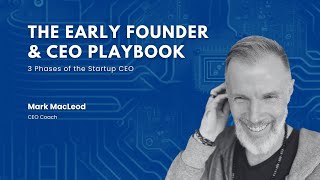
Mark MacLeod, ex-Shopify CFO and CEO coach, breaks down what founders should focus on at each stage: before product-market fit, act as a product manager and iterate obsessively; after PMF, shift to finding repeatable distribution and building a leadership team of player-coaches. Culture and lived values matter most for durability.
Chapters
Mark, maybe a, a good place to start is you and I were talking about a, a month ago and you know, you today, you know, are a coach and maybe I'll let you describe this in your own words, but from my perspective, you're a coach to CEOs and founders in the technology space, primarily exclusively. And you said exclusively. So you had said to me on that, on that call, you know, at the earliest stages of a startup, a founder and CEO in a way is not really a CEO. What did you mean by that? And what are the different phases of a startup? CEO?
Yeah, so you and I first met when I was at Real Ventures and Real was a seed stage venture fund. So often the first institutional check and in many times the first check into a company, especially with founder fuel program. On that note, by the way, Ian Jeffrey texted us today. Today was the 12th anniversary of the first demo day, so time flies. But what I would tell founders when I would invest in them as respectfully as possible is like, hey, first of all, congrats, this is awesome. But we don't yet have a company. Only when we build a product that some segment of the market embraces do we bother building a company. And so until then, you're not a CEO, you're a product manager. And what you need to do is iterate as rapidly as possible on the product until you find product market fit and you find a segment of the market that loves that product. And any time that you spend on anything else is frankly wasted time. So, you know, to that end, RealVentures, you know, we led rounds and we typically had a right to a board seat. I actually never took that board seat unless I was with a co investor that, you know, just said, hey, we want to have a board. I just felt like it was a waste of time. So I just wanted my CEOs maniacally focused on product. And what I told them is like, this is before Slack and WhatsApp. So I was on Skype. So it's just like add me on Skype, any issue, I'm a click away. You just need an attaboy. I'm a click away. Like, you know, so we don't need the board meetings. But like, I tried to think of myself as an extension of those companies, but really tried to keep them focused. And so yeah, to summarize, pre product market fit, you should be thinking about nothing but product. Once you've found product market fit, you know, it's really about finding that first channel for growth and settling into now that's when you settle into company building. That's when we start to build a team, some semblance of a leadership team. Try and figure out some repeatable go to market motion and then let's settle into making sausages. Right. You know, from the point of view of a late stage investor, the ultimate pitch is like I've figured this out, I figured out the recipe. I know exactly where to go to get customers, how long they stick around, how much they're worth, therefore how much I can pay for them. I've got proven repeatable channels to go and find lots of these customers and I've got the team, particularly the leadership team to make this recipe over and over again. So in essence I can make 10 sausages today. Give me your money, I can make 100 sausages and they all taste the same.
Same.
So an investor that sees that and then validates that backs up the brink's truck and unloads. Right. Because that is actually the holy grail of venture is when I can generate venture returns without venture risk.
I feel like at the earliest stages, you know, talking a little bit about you know, real ventures and early stage venture fund and you know, founder fuel, even maybe going a little earlier, pre seed accelerator, you know, too early sometimes. Yeah, you know, important part in the ecosystem but certainly very early. It's, you know, it can be difficult to. At least the earlier you go, you know, it's less common that you have that product market fit and that holy grail that you're talking about where it's like you've de risked an element of this and it's clear that they can start to really hit at going to market and scaling this thing. Right.
That's great.
I mean maybe you know, topic maybe for a little bit of a different. Well actually I'll, I'll ask away Mark. I mean in a very early stage startup, pre product market fit, you've sat on the VC side, you've also sat on leadership teams. You were the, you know, an early CFO of Shopify, you know. You know, you were the cfo, you know, and chief corporate development officer is my understanding at, at FreshBooks, you've done the entrepreneurial thing with yourself. You have your own record label. But from the vc, you know, perspective, what would you look for in a very pre product market fit founding team?
It's really all about people. If you get that right, like everything else is going to change, the product's going to change, the market might change. You start in down market, you move up market. But if you get the Founder. Right. They'll figure everything else out. And so I, I spent a lot of time on that. I would even in the late stages of trying to make a decision, go and get drunk with that founder because I wanted to see how their behavior changed. How do they treat the bartender or the wait staff? Did they start bragging? You know, did they, their personality change or were they real? So I sacrificed my liver for the sake of investment returns and backed out of some deals actually because of that, which is why I kept doing it. Yeah. So, and like there's different kinds of motivations and I didn't have this insight at Real ventures. I only had it after the fact. But like some founders are motivated by money or the size of a market. And I have found money to not be an enduring source of motivation. You know, you run your own business. I'm sure you're not like, if you graph, you know, you started from zero revenue, you've got a certain scale today. That scale, like your happiness isn't on that scale. I think they're, you know, so once your basic needs are met, you're kind of good. So money's not the thing. Some founders are completely in love with their product and that sounds good, but it actually results in a closed mindset. And all you're trying to do is convince the market, no, you don't understand. Like, my widget is amazing. Buy my widget. So the best source of motivation is somebody who's just completely in love with the problem, endlessly fascinated with the problem. And so now, um, I really look for that.
So you talked a little bit about, you know, at the earliest stages, you know, a founder CEO is really a product manager. And in, you know, there's a blog post on your blog and it talks about these three stages where one, there's kind of the product phase, where the founder CEO is a, is a product manager. Essentially the next stage you talked about was the distribution phase, which is kind of like finding your market, figuring out how you go to market, how do you sell this thing is there, you know, that whole element, and then finally building a team. How do you recommend founders divide their time between product development and finding product market fit and the other demands that may come with starting a really early stage venture?
Well, I would say product and product market fit are one and the same. You in that pre product market fit stage, you only want the minimum number of customers that it takes to find product market fit. So trying to establish a marketing or a growth function when you're pre product market fit is Premature. And it's a distraction because marketing or growth or whatever it is is going to want to grow because that's their purpose. But then you're by definition acquiring customers, beta or otherwise, that you know you're acquiring more than you need to. It's just input for a science experiment. That's it. Right. They just are means to an end, which is achieving product market fit.
Maybe this is actually a good segue into the next phase where it's the distribution phase and it's finding your market and figuring out how do you go to market here. Maybe feel free to shut it down. You know, maybe you get to this point and you know, there are certain networking activities that are helpful from a go to market perspective. Maybe, maybe not this early on, maybe it depends on the business. But anyways, what are your thoughts on that and can you describe a little bit more about this kind of second phase of an early founder CEO?
Yeah. So right, you build a product, you validate that there's a segment of the market that needs it. So now it's time to take it to that market. I think first of all, everybody's in sales. You're in sales, I'm in sales. Every human that needs to convince another human to do something is in sales. And so I think it's great for a founder to, to lead the initial go to market efforts and then eventually fire themselves and bring in the pros. But then, you know, because it's just again, it's still super early, you're still getting that feedback loop and so it's great just to have no layers between you and the feedback. Every issue and every opportunity in the company boils down to people. So at the end of the day, having the right people is everything. But I think the biggest issue is finding proven, repeatable channels. Right. You know, if you rely on PPC AdWords out of the gate, you very quickly become a victim of your own success and the marginal cost of attracting the nth customer starts to approach the lifetime value of that customer and then suddenly you can't grow what is very.
Important at this stage from a metrics.
Perspective, if I would generalize, and I think in the early days you're looking for leading indicators regarding usage, right? Engagement metrics, daily actives over monthly actives, things like that. You can't assess lifetime value as an example until you have a lot of history. And so I think in that earlier stage you're thinking more about survival. And so to me, I think about payback, period. I'm going to make an investment to acquire customer. How long till I get that back? Because that is the size of the leap of faith that I'm going to take here and trying to grow the business. Right. So I think it's much more, yeah, survival, you know, just essential type things out of the gate and then once you've got lots of history, you can flesh it all out. At the end of the day, lifetime value over cost to acquire is everything. Right? That's, that's the lifeblood and, and churn, you know, for a SaaS business, churn the rate at which customers cancel is the single most important metric in the long run.
How, you know, can CEOs maintain their company's values as a startup is starting to hit that scale and now they need these head ofs, these leaders. How do they maintain what's true to them as they grow?
I actually think the root of all disagreement or lack of alignment in a company boils down to a value that is not being lived or is not being articulated. So I think it's super important. I think, you know, values relate to culture and I don't know who said it but you know, culture is strategy. It's super important. The companies that I've been involved with that have endured absolutely live culture and values and it's baked into everything that they do. Like so FreshBooks is the last company I operated at and half of the performance review was values. There was a page of values and then there was a page on kind of skills and results and like you're literally rated about how you live every value. Those values and the living of them get celebrated in every all hands. We're telling stories about how the values are lived. Josh, the CEO of a payroll company called Gusto, when he's hiring senior leaders or interviewing venture capitalists because frankly he's always been in that position where he's choosing his investors and not the other way around. Goes for hikes with them, multi hour hikes. So he's not sitting in some like meeting, okay, I've got an hour to make this like super important decision. No, he like we're going to get together on the weekend and we're going to go for a hike and you know, get away from that kind of office setting and truly get to know someone in the way that I tried to get to know founders at a bar. Just more healthy.
We do a lot of work with seed series A, B startups and in rounding out their leadership teams and a lot of different founders will ask us how should we, you know, here are our core values, you know, apart from running a generic interview process, how do you go about, you know, mitigating the risk that we haven't chosen someone who fits within those values? And what I've seen work, and it also plays into this theme that you're talking about, is kind of like getting them out of the typical one on one interview. You know, like I've seen a happy hour drinks with 3, 4, 5 members of the team after or you know, a hike is a great one. Or you know, just something that's not in a, you know, four wall office and in a sort of formal setting. You've talked to me a little bit about at this phase, an earlier company, you know, see maybe approaching Series A and they're starting to build this team. What do those leaders look like? You know, they're, I take it they're not true, you know, C level executives. What, what, what do these leaders look like in your mind?
I think they're player coaches. They gotta roll up their sleeves and get stuff done. I don't like fancy titles at that stage. It should be head of whatever. You know, when I was a seed stage vc, people would come in and like there's three co founders and there's like maybe five people in the company total. And there's like, everyone's got a C level title. I'm like, this is the most ridiculous thing ever. There's nowhere to go from a C. Right. You either maintain it or you exit. So head of keeps people focused and keeps optionality. You know, you're trying to unlock rapid growth. Right. So I only work with companies that have raised institutional capital. So venture capital or private equity, we're chasing big outcomes. The big challenge for any leader, especially the CEO in that context, is to always grow faster than his or her business. If the business is doubling every year, then you have to double in your capacity as a leader every year. So regardless of whether it's head of vp, ce, whatever, right. You need people who are not at the limit of their potential when they get that role. They must have room to grow and have appetite to grow. Right.
It's a great insight. They're constantly building as a player and then graduating out of it over, over time as it necessitates within the business as it scales.
Yep.
You know, it's, it's, you know, at this stage, you know, a company and I think a leadership team, you know, there's this essentially this requirement, I think most of the time where there still is that grittiness involved. People are Going to wear multiple hats. They're going to, you know, you've got to take out the trash. Like take out the trash. You know what I mean? It's not like you're overseeing a team of 50, you know, and you have this massive function and it's a lot of, you know, people management and high level strategy. Like you're in the trenches. Player, coach. Best way to describe it, what are the most critical skills or attributes a CEO should cultivate? You know, at this stage, if you were to ring off a couple traits.
You definitely need to develop a thick skin, not take things personally because you're going to get rejected a lot, you're going to fail a lot, you're going to try lots of things that don't work. You're going to reach out to a lot of, a lot of candidates that say no. You're going to reach out to VCs who are going to say no. So you can't take that personally. That's a big one and a hard one. The number one thing that I look for in CEOs at any stage is self awareness. And that ties back to what I was saying about having to grow, the need to grow faster than your business if you're going to remain relevant. Like if you think your shit doesn't stink, pardon my french, then you're not open to feedback, right? You believe like every startup is full of hype, right? You talk to founders all the time and ask them how they're doing, like, oh, we're crushing it. Not everyone's crushing it because most startups fail. So we're lying. If you believe that, then you're not seeing the real input and the real signals. So by far the most successful founder I've ever spent any time with is Toby from Shopify. And his mantra from the earliest days was, you know, get 1% better every day. Which sounds like a cheesy Hallmark poster unless you actually live it. But 1% every day is 37x improvement in a year. It's transformative. And how he did it is he literally would go home and replay his day. He told me he could like picture it like a movie and like, I don't like how I behaved in that meeting. This was the wrong decision. I want to do this. And he would course correct. He would go through an explicit learning loop and course correct the next day. I just did that every day.
I spent a lot of time with our partners as it relates to, you know, building some of these teams and you can go out and make a Be higher, you know, or you can go out and hire elite talent and you know, for a separate conversation and how you kind of define that and everything else. But there's a, there's a McKinsey study that was done a few years back and it talked about elite talent in the context of complex job roles or job occupations. In this McKinsey study, it talked about if you replace 20% of your team with elite talent that was 800% more productive, you'd get to market on a three year project a year or two sooner than your competition. If they didn't replace 20%, Mark, you know, founder, CEO, founding team, you know, they've figure out, they figured out their distribution, they're going to market, they've built a team now, they're raising more capital, they're scaling, they're growing. You know, a CEO is gaining more attention, they're being pulled in a million different directions. How do the external pressures on a CEO change and what strategies have you seen CEOs employ to manage these pressures effectively?
The CEO job's the toughest job out there. It's why I coach a couple of VCs, just because I've been one. But I mainly just coach CEOs. And you look at all the biggest outcomes in tech, they tend to be founder led. So 100% correlation between that founding CEOs performance and the outcome of the company. Every other function has a gradual path, right? Like I was a CFO for ages, but I started as an accountant, I was a controller, director of finance, vp. By the time I was cfo, I was ready. So it's a hugely tough job. And the bigger the company goes, the more everybody wants a piece of you. So the most tactical pressure is actually on your calendar, right? Many CEOs, when they come to me for coaching, it's because they just can't keep up. They're in back to back to back to back meetings, they're doing slack, whenever they're doing emails at night, they pile into bed exhausted and rinse and repeat. So that's a thing, right? It's just being able to triage and delegate and operate at the right altitude, which is a whole topic into itself. Because oftentimes the CEOs also do this to themselves, right? They don't let go enough, they don't hire strong enough people and then therefore they're forced to, to have lots of these things. Obviously, investor expectations are huge, particularly from venture capitalists. You know, venture capital is a really powerful instrument, but also a really dangerous instrument. And Right. If I put 10 million bucks into your company and I own 20% of it, I'm expecting to get at least 30 million back. Right? And so there's got to be a pretty meaningful exit in order for me to get that. And like, you know, most of these investments fail. So the underwriting, the decision on the venture investor's part is when I do this deal, do I think it can meaningfully contribute to returning the fund by itself? And so there's huge expectations, right? Often there's so much that's written and said about how difficult the relationship is between CEOs and their investors. And it's not personal. It actually just goes back to the importance of distribution. Right. You know, most companies just shit the bet on distribution and then don't hit their growth targets and then Wonder why their VCs are upset with them. Distribution is actually the thing that unlocks enterprise value. So yeah, I mean, I hate to be dispassionate and obviously I don't treat it that way when it comes up with my clients. But like, if you're wondering why you have a bad relationship with your VCs, look inside, look at the company, look at its performance, right? So that's a huge thing. Everybody deals with imposter syndrome. That's another kind of self imposed pressure. I think imposter syndrome is a good thing. Just means you're testing your limits, you're doing stuff you haven't done before. I coach some of the most badass CEOs you would know, and they have imposter syndrome because they're doing stuff they've never done before. So it's great. I think there's a lot of pressure to balance all your different roles. The startup professions or industry is quite male. Most of my CEO clients are male, not all. And I think they struggle to balance being a husband or boyfriend, being a father, being a son, being a friend, with the demands of the startup and often don't have appropriate boundaries. And the startup will take everything. If you don't stick it in a box, it will take everything. Work expands to fill all available time. And maybe the last one, I mean, I could go on and on. We could do an entire podcast on pressures. But maybe the last one is just comparison, right? You know, looking at competition and oh my God. And like looking at social media, which of course all we're seeing is like the best 5% of somebody's life, but then they internalize that as like they're doing something wrong. And so the worst word I hear from CEOs all the time is should. I should be doing this, I should be doing that. And I just like should implies somebody else's expectations. So like stop shooting on yourself. Tell people that all the time.
Mark, you know, in, in light of all of that, you know how if you had one piece of advice for a CEO, you know, to help them remain genuine and true to themselves, what might that be like?
In no particular order. Be kind to yourself. Like the things that you say inside your head to yourself, you would never say to someone else. We're so hard on ourselves. I think founders in particular, right, they have this vision. We're nowhere near achieving the vision. How could I possibly be happy? So that's a huge one, I think, Making Time for health, right? These VC backed CEOs, I tell my clients all the time, you're a professional athlete, you have the exact same expectations on your shoulders. And what professional athletes? Well, they, first of all, they surround themselves with a team to make them successful. They've got physio, they've got performance coaches, they got mental coaches. Someone's making food for them and they sleep, right? They crush it, sleep, repeat. And they're learning, going through learning. I'm looking at game tapes. I'm doing all these things to be better, right? So really try and help CEOs realize that they're athletes and to treat themselves as such. I'm a huge fan of a Japanese concept called ikigai, if you're familiar with that. And I don't think this is an exercise you can do when you're super young, but once you're a little bit older. I did it in the process of making the decision to become a coach. All right, that intersection of what I love, what I'm good at, what the world needs, what I can get paid for, is what you're meant to do. And so if you do that, you settle into that like I am, this is my life's work, I am meant to do this. And you're kind to yourself and you have practices that enable you to keep doing this forever. You can, right? You know, as a guy who ran an investment bank and has sold a lot of companies, I can tell you many times the CEOs decide to sell because they're burnt out.
You just highlighted your passion, your icky guy, you know, for one on one coaching for advisory of CEOs, maybe I'll leave you with this final question. What do you believe is the magic behind these interactions that can drive a CEO forward?
Well, the CEO role is pretty Lonely. You don't get a lot of feedback other than your board kind of nagging on you. Like I said, it's the only role that doesn't have a functional path to get there. You just start a company and boom, you're a CEO. You know, your board, especially in the kind of early to mid days, tends to be investor dominated. And they have an agenda, right? So the feedback isn't necessarily balanced and objective. So you just need a sounding board. Right. Almost all of my CEOs have peer groups, either formal like YPO or informal, and they find them invaluable, you know, and then the right coach, like so anyone can call themselves a coach, you could call yourself a coach, right? So coaches come in all shapes and sizes. But yeah, the right coach can be game changing. I think why people choose me as a coach is because I've been on every side of the table. I've operated companies, have invested in companies, and I've sold companies for only in the Software world for 24 years. So it's just deep pattern recognition. And therefore we can have very high bandwidth, very candid conversations about anything. And very often as an example, we're talking board dynamics. I literally know who the VC is on the board, I know the personality. So we can have a very specific conversation. And so the ability to have that candid conversation. You know, I encourage CEOs to be, to be vulnerable, to be authentic, to be themselves with their management team, with their board. But there are some things you can't share, right? You know, you can't necessarily share all of your fears because then some of your best people might leave, right? So having that trusted space is really healthy and really important.
More from Mark





The Burnout Breaking Point - How Strategic Breaks Actually Increase Productivity


Emotional Debt - How Avoiding Hard Conversations Compounds Into Company Killing Resentment


The Death of the Specialist - Why AI Is Creating a New Professional Class Called Scalers