Founders Can Beat Burnout | Craig Letton CEO at Hyble Full Startup CEO Show Podcast Interview
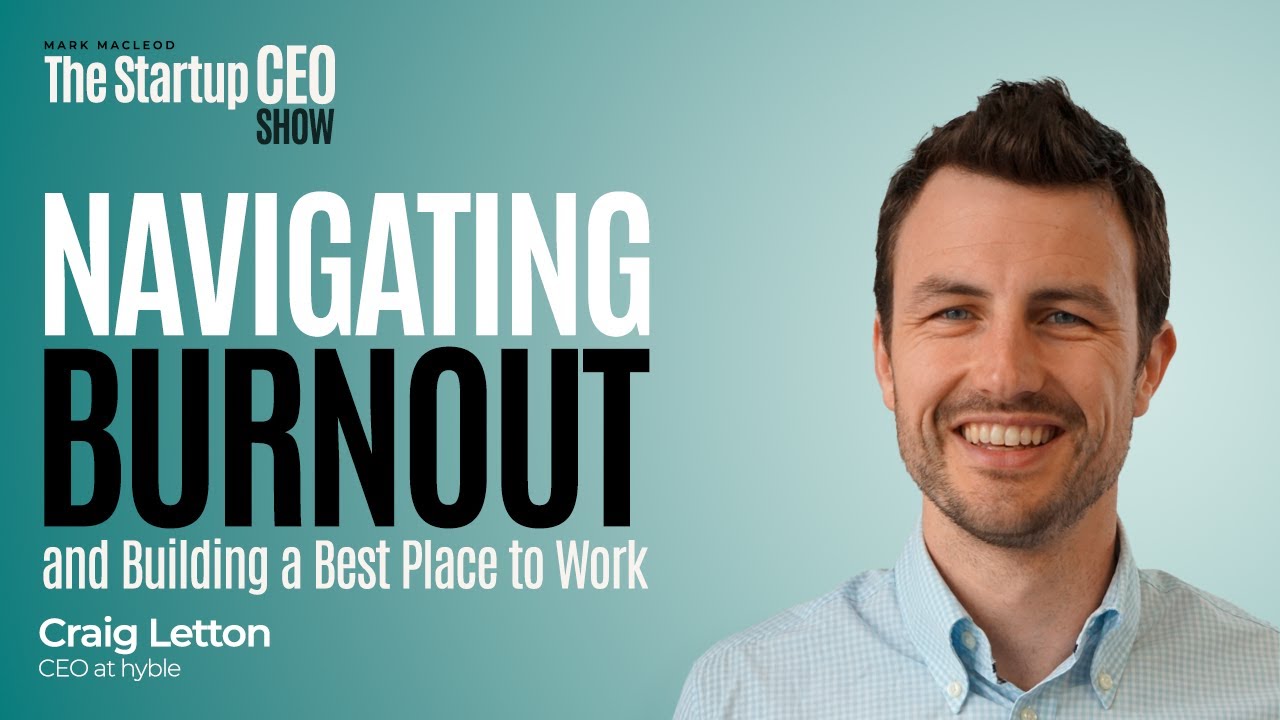
Craig Letton, CEO of Hyble, inherited his parents' print business, rebuilt it as a cloud SaaS platform for alcohol marketing, and landed clients like Bacardi and Diageo. He survived 18 months of cash-flow crisis, legal disputes, and COVID collapse by setting strict boundaries, exercising daily, and leaning on his wife and board. His team rates the company 4.3 stars on Glassdoor.
Chapters
You know, we built a product over maybe, say, a 12 to 18 month period, launched it into the market, and thankfully my thesis was right. There was companies looking to solve this problem, and we managed to do big deals with Bacardi, Carlsberg, Pernod Ricard, Diageo, all within the UK. And then we were able to expand that across Europe, going one market after another. So I think we expanded into 18 countries in less than 18 months. I moved out to the US and we began the rollout, which was a 48-state rollout of our technology with over 10,000 users. To put it in perspective, they had more users in Texas then Bacardi did globally, which was our next largest customer.
Welcome to the Startup CEO Show. I'm your host, Mark MacLeod. In this episode, I sit down with Craig Letton, founder and CEO of alcohol marketing platform, Hybel. We spent a lot of this episode going deep into Craig's experience with burnout. Many of you listening have experienced this in some ways, and Craig was really open, really vulnerable, and pretty specific about how he dealt with this. We also talked about other challenges. You know, he comes from Scotland and the access to funding over there is very different than it is in North America. This was a really great discussion. I hope you enjoy it. Craig, welcome to the Startup CEO Show. It's a true pleasure to have you here. How are you doing today?
I'm great. Great to be here, Mark. Thank you for inviting me on.
For folks listening, you can't tell because of my accent, but I lived in Scotland until I was 11. And so it's a true pleasure to have a fellow Scottish person on the podcast because there's only one type of Scots person, which is a proud Scots person. And we're very proud of our heritage and all of it. So anyway, it's a thrill to have you on, Craig. I wish I still had my accent. I actually joke with my producers that I should just pound a bunch of whiskey and like bring the accent back before this. But it's 2 in the afternoon, so I didn't bother with that.
Yeah, I can still hear a wee faint accent there. We actually have some team members from the Isle of Lewis, so I'm tuned into the accent, so I can hear it. But yeah, mine's not particularly strong either, so people will be disappointed there's no Braveheart accents here.
That's awesome. Yeah, my, uh, my wife, when she first met my parents, so you know the Louis accent, it's subtle, but they speak almost very quiet and very fast and the words just sort of like flow into each other. So my wife's got it now, but, uh, in the beginning I had to just, just, I'd sort of like just nod and wave. You'll figure it out. You know, I'll, I'll, I'll catch you up. It's all good. Anyway, that's not why we're here. Maybe, uh, for folks who don't know, uh, just take a second and tell us what your company does. Sure.
So I'm CEO of Hybel. We're a technology-enabled marketing business, specifically working in the drinks industry. So our platform helps salespeople create customized marketing materials for their customers. So those are bars, restaurants, hotels, nightclubs. And our technology essentially allows it to do it faster and cheaper than the traditional method, which is using graphic designers. So the simple way to think about it is it's like Canva, but specifically built for the needs of the drinks industry and enterprise customers.
I love it. Now I understand that this business actually goes back a long way and used to be a print business. I'd be fascinated to hear, not many companies have that, not many technology companies have that legacy. So I'd be curious to hear how you made the transition. And I guess a sub-question would be like, presumably the skill sets needed for a low-growth print business are very different from that needed for a high-growth tech business. So did you have to completely reboot? Just like tell us about that journey.
I'll give you the short version, but essentially I kind of started my career in sales and marketing for big consumer goods companies, Mars and Kraft Foods. And after doing that for 4 years, I realized that the corporate world wasn't for me. And I kind of looked up that greasy pole or the corporate ladders, if you will, and realized that I didn't want to go up that path. So, I took some time out, spent some time backpacking in Patagonia. And just by really coincidence, at that time, my parents were looking to retire from their business that they had started 10 years prior, which was you say, like a digital print business. It did have a sort of tech element to it, but they were really pretty too far ahead of their time. So it hadn't really quite gained the traction that they wanted to. So they were looking for someone to take over the ownership of the business and to run it. I was looking for a job. I also wanted to return back to Scotland. I was in England at the time. So I took over the running of the business and they actually left to sail around the world. Which they're still doing today.
Amazing. That's great.
They've been going for 13 years. So there was no handover.
Oh, here you go. Bye.
Just given the keys.
Yeah.
See you later. So yeah, I came on as the manager essentially of the business. So I spent the first 2 years kind of learning the ropes. I'd never managed anybody. Suddenly I had a whole business to run, but again, it was a small business under $1 million, 7 or 8 people. So kind of just took it over and spent the first 2 years kind of fixing it up, returning it to profitability, kind of making it a little bit more professional based on some of the learning that I'd had from the corporate world. And after 2 years of doing that, I said to my parents, I think the best thing to do is actually to sell this business. And because I just, I couldn't really see much kind of growth opportunity for it. And we tried to sell it, couldn't. This wasn't really valuable enough. We did get an offer for it, but it was very small. So I said to my parents, look, I can probably make more money in profit in the next year than we could for selling it. So why don't I buy it from you? And I will take it over and I will take it in a new direction. And the reason I kind of felt confident to do that is I saw that they had a solution, which was actually a technology solution that they'd built specifically for the drinks industry that enabled sales reps, particularly wine wholesalers, to create wine lists in a couple of minutes online, and they'd be able to print that, send it to us, and we would ship it 2 days later. And that took the kind of previous process, which used graphic designers, which could take maybe 4 weeks, maybe 6 weeks, back and forth, down to a couple of minutes and delivered a few days later. And I could see that this was adding a ton of value for the customers we had. And I thought, you know what, this could work. This is a real-world problem that I understand from my experience at Kraft Foods. And this problem exists for drinks companies all over the world. So if we could build a solution that could solve this problem at scale, this could be successful. And so I took over the ownership of the business. That has a whole story in itself. Buying a business from your parents is very difficult.
It's not in the standard startup script at all.
Yeah. Negotiating with your own parents over their baby, which is the business, and you are also their baby. Very unusual dynamic. I wouldn't recommend it, but we managed to get through that. I took over the ownership of the business and the first thing I did was shut down the printing operation. We did it in a month. Sold it all and transitioned to a cloud printing model where we send those orders to printers all over the world. And what that enabled us to do was to globalize, serve as any market in the world, just plug into a printer in that country and off we go. So that gave us the kind of platform for scale. And then the second thing I did was the technology we had at the time was built in a way that we had to have a separate instance for every customer. So we had to rebuild it pretty much every time. And if you had one bug, you had 10 bugs. It just sucked. And we were doing that with an outsourced team in India. And I was very frustrated with everything that goes with managing an outsourced team. So I said, you know what, if we're going to do this, I'm going to build a team here in Edinburgh, in Scotland. I'm going to build my own development team and we're going to build a product that could be scaled so we can just replicate it over and over again. And that's exactly what we did. So we went out and bear in mind, we had no money because I just used all the money in the business to buy it from my folks. So this was done on an absolute shoestring. So yeah, so we did this with very little money and actually started up a a small dev team in a place called Codebase, which is an incubator in Edinburgh. And started off with just two of us, me and our CTO Chris, and then built it out from there. And we built a product over maybe, I say, 12 to 18 month period, launched it into the market. And thankfully my thesis was right. There was companies looking to solve this problem. And we managed to do big deals with Bacardi, Carlsberg, Pernod Ricard, Diageo, all within the UK. And then we were able to expand that across Europe, going one market after another. So I think we expanded into 18 countries in less than 18 months.
Complete transformation.
So really through total transformation. Yeah. The business was completely different from what I took over. And we've just kind of been on that growth journey for the past, I don't know, 7 or 8 years really, just building on that success, mostly through globalization, winning new customers, expanding the product. And that kind of brings us up to kind of recent times, which is our expansion into North America.
What is it about this industry that gives it needs that, like, a canned, that can't service? What are the bespoke needs here?
Yeah, well, the first one is we're dealing with very large enterprises and these are multiple billion dollar businesses based in many, many countries around the world. So they have specific enterprise needs around budgeting, reporting, controls, approvals. Integrations, all security, all that kind of stuff that you kind of need to build from the get-go. It's quite hard to reverse from a B2C business into an enterprise business. Obviously someone like Canva is trying to do that right now, but it's a hard transition to make. But we started in that place from the beginning. The second part is there's a lot of legal and regulatory controls within the alcohol industry, and particularly how alcohol is marketed. And those are different by country, and they're also different by state. Or province in Canada. So our system is built to handle all those different regulatory environments from the outset. And then we also provide the full service. So we provide the technology, but we also provide the customer support, the customer success, the implementation, but we also manage the print fulfillment as well. So we also have a huge network of printers where we manage the order all the way through to the delivery. So it's really much a one-stop shop. We're not just providing the tech, but the tech is what enables the benefits for the customer.
There's a few topics I want to hit on. Let's talk about funding for a second, right? You know, 'cause when I, I'm trying to imagine you, you were backpacking, you take this business over from your parents, you know, you're probably personally not swimming in cash. The business isn't swimming in cash, and now you are trying to serve these giant billion-dollar companies and like, it's hard to bootstrap for SaaS and Often one of the decision criteria for a large enterprise customer is like, hey, well, this, does this vendor have the balance sheet to like be around in a year? And then I couple that with, you know, you're based in the UK where the amount of capital is far less, you know, for, for companies like this is far less than in, in North America. So it just, how did you navigate all of that?
Yeah, I think with regards to trading with big companies, when I took over the business, we had contracts with some big companies. So my mother and father had done a great job of securing those. And that gives you a really great proof point. You only really need one, right? And for other customers to feel comfortable. And so I guess I had a bit of a head start in that respect. And I'd also spent the previous 4 years of my career managing big customers. So working for big multinational CPG companies, but my account was Tesco, which is the biggest retailer in the UK. Walmart.
Yep. Big grocery store.
Yeah. So I was used to dealing with big customers. I spoke their language. I knew kind of how they operated. I understand the organizational politics structure and all that stuff. So we were able to navigate that pretty well. And to be honest, I still have never had a customer ask to look at our balance sheet.
Come on.
In the 13 years I've run Invisys, never.
That's amazing.
Which does kind of blow my mind. And then in terms of funding, you know, as I said, we had no money, like none. We, the way that I financed the buyback was through a bank loan and using the profits of the business to buy them out over time. So we were left with nothing. So the way that we kind of funded this development really was A, profits.
How about that? And B, yeah, all sorts of funding.
Yeah. But the second one was government grants. So the Scottish government in particular is very supportive of entrepreneurial companies. And we were able to actually secure a lot of grants that weren't 100% funded, but part funded. That enabled us to hire developers and build on that. And again, it was quite a gradual growth at that point, but in 2017, '18, I think we grew 100% in a year, albeit from a low base. But I quickly realized that we couldn't cash flow this any further. We'd maxed out our invoice financing facility, we'd maxed out the grants. I was like, we're going to grow ourselves to death here. We're just massively underfunded. So that's when I started looking at the idea of taking funding for the first time. And the challenge that we had was that we were not a new business. Which meant that we didn't qualify for a huge number of venture funds or VCT funds as they call them in the UK, because we were older than 7 years. So we didn't qualify for certain programs like EIS, which allows investors to put money in and it's very tax friendly to do so. We didn't qualify for any of those funds. We weren't big enough for even the lowest level of private equity. It wasn't necessarily a unicorn opportunity that the VCs were looking for. So we had such a small slice of the market to look at. So we were looking very much at growth equity, and we ended up getting sort of two term sheets in February 2020.
Oof, good timing. The world was just starting to fundamentally change then.
Exactly.
Yeah.
And I was actually in Vancouver, of all places, in March 2020 when everything fell apart, right? The borders were closed, the NHL closed, this market closed. I headed back to Scotland and we went into a really very challenging period because obviously all of the hospitality accounts closed, right? All the restaurants, nightclubs closed. Our customer base just disappeared.
I will say my alcohol consumption went up considerably, but yeah, that was at home.
It wasn't just you. Yeah. Yeah. What we call off-premise, which is like retailers, stock, the shares went, you know, the sales went through the roof, but unfortunately in the on-premise where we work, decimated. So we lost between 80 to 90% of our revenue overnight for about 3 to 4 months.
Wow.
And we hadn't got that funding yet. So that's a whole nother story about how we survived that. But towards the, in August 2020, we finally secured that first round of funding. And folks in North America will laugh, but we raised £2 million, which in dollars is maybe $2.5 million or something as our first ever round of funding. And that money actually got us through COVID. It allowed us to keep the foot down, keep investing in the product, keep investing in the team. And we ended up actually growing the business 40% over that 2-year period, despite having 7 months of no sales.
That's great.
So that money allowed us to survive, really. And then since then, we've taken 2 subsequent funding rounds to fuel our growth, both each of £2 million. We've taken £6 million of equity total. Which is probably smaller than the average seed round in the US.
Yeah, it is.
And you know, that shows you can do a lot with a little. You can, yeah. And we've had no choice, so you've kind of got to make it work. And we have taken a bit of venture debt as well, which has been really helpful. You know, as you become profitable, you can start, or close to profitability, you can start doing that. But I wouldn't advocate for this type of funding model. I refer to it as the drip feeding model. It means you're constantly up against it. You're fundraising all the time. Over the last 4 or 5 years, I've probably spent a third of my time raising money for Mark. It's not time well spent. I'd be better selling. And the analogy I use is it's kind of like going to the bank and asking for a loan to build a house, but they'll only give you a loan to build the basement. And once you've done a good job of the basement, they'll allow you to build the first floor. So it's pretty stressful. And it means you can't invest quite as long-term as you'd like to. But it is what it is. It was a situation we were in based on the maturity of the company. So if I had to do it again, I'd liquidate the company, start it as a new one, raise a different type of capital.
But good for you. And was it the bad cap, but were the investors in the UK or did you cross the Atlantic?
Yeah, no, our investors are called the British Growth Fund. Okay. So it's one of the largest and most active investors in the UK, specifically looking at kind of businesses that are more mature, a little bit less risky, much less risky than a typical VC would look at. And they're The 5 LPs are essentially the 5 biggest British banks in the UK. So they operate a little bit more like a bank in terms of how they work and their risk profile. So it's worked for us. If I did it again, I'd maybe do something different, but it's, you just get scrappy and you figure things out along the way.
Are you still taking your own meeting notes? Let me tell you about an AI tool that I'm using to take meeting notes for me. It's called Fellow. It's an AI meeting assistant. It takes human-level AI notes. It tracks my action items and decisions and keeps everything in one place. Built with security and privacy at its core, Fellow is the only AI meeting assistant that leaders trust to capture meeting notes and recordings while keeping your data safe. Thousands of organizations are consolidating tools and relying on Fellow to capture their meetings. The team at Fellow is so confident that you'll love it They're offering an insane deal to Startup CEO listeners: 90 days of unlimited AI-powered note-taking and recording completely free. Visit fellow.app/ceo to sign up today and experience the AI meeting assistant trusted by leaders everywhere. I don't want this to be a chronological discussion, so I'd like to go to a really important topic. And you know, you and I have chatted before and you've talked about your journey going through and to the other side of burnout. And many people listening have gone through that or are currently going through that, or hey, something's wrong, but they haven't diagnosed it yet. I'd love to just turn the floor over to you, like story time, just like walk us through that.
I think like most people running a business, they've been through some hard times and COVID was one of those that was 2 years of really challenging times for the business. Buying, as I said, buying the business from my parents, that was brutally painful, left some scars. But I would say the last kind of 18 months to 2 years have probably been the hardest of my 13-year journey. And to kind of provide some context for that. So as I said, we were kind of growing organically at a decent clip. We got to about, say, £5 million of revenue back in, say, '22. And during the COVID I actually, through some outrageous networking and some serendipity, I managed to get in front of the biggest customer in the world for what we do, which is actually the largest wine and spirits distributor in the US, a company called Southern Glazers. And it's a $25 billion family business. I think it's the 10th largest private business in the US. So it's a phenomenal business operating in almost all of the states in the US, plus Canada and the Caribbean. So phenomenal business. And for us, that was the ideal customer profile. I literally had it written down as our ICP. And I managed to get introduced to the son of the owner, and they were looking for a product just like ours. And they'd been doing this with another vendor for 15 years, and prior to that, been doing it in-house, and they were doing it all manually. And they were looking for some technology that would enable them to really kind of make this more efficient, increase their speed to market, captured data, all the benefits that we provide. And this opportunity was roughly 10 times the size of our next largest customer. And was in the US where we didn't operate. And we couldn't, at the time, we couldn't even go there. We weren't allowed into the US because of COVID So one thing kind of led to another and we ended up doing 4 proof of concepts in Arizona and Florida to kind of prove out that our technology would be adopted. And then we went through an 18-month tender process against their incumbent vendor.
And who must have been very firmly entrenched, I assume. They've been there for a while. That's tough competition. Yeah.
And they were the market leader. There was nobody else in the market. And I think of the top 10 distributors, they probably had 60 to 70% share. And so, Yeah, this was a major incumbent, but they had failed to invest in their technology, in their service. In fact, they'd offshored a lot of that and they'd failed to invest in the relationships and they got complacent, which created an opportunity for a wee company from Scotland to get in there. And I knew at the time that this was an opportunity of a lifetime. I'd spent a lot of time researching the US market. I'd done a couple trips over the years and I knew that this was our our one shot. That was our mentality at the time. And we took the view of going to go big or go home, right? Let's make this happen or we fail. And so as we're going through that 18-month tender process, we also had to invest in the business in order to be able to deliver it should we win it. And obviously I was always confident we would, and my confidence increased over time, but it was never guaranteed until that contract was signed. But we couldn't wait till then. We decided to rebuild our technology. So we rebuilt front end of our application based on the feedback from those proof of concepts. That was an 18-month process built on a brand new progressive web app platform. And it was intense. We had to build out a supply chain because obviously we manage the prints. We had to find the suppliers, do all the integrations, get that set up, build the team, tax infrastructure, finance infrastructure, all that stuff you need to do to set up in a new market at scale. We had to build while running the tender process with no guarantee that we would win it. So, as you can imagine, that takes quite a bit of investment. So, we did put in another round of investment and we just doubled it, doubled down, doubled down. And we really were all in. If we didn't win that, we were toast. So, as you can imagine, that increases your stress levels a little bit. The good news is we won it. I moved out to the US 3 days later with my family. So, I've got 3 young kids. So, my wife and I moved to just near Boston. And another member of our team moved out and we got started on the rollout immediately. So that was kind of July '23. And by October, November, we began the rollout, which was a 48-state rollout of our technology with over 10,000 users. To put it in perspective, they had more users in Texas than Bacardi did globally. Which was our next largest customer. So this is just epic levels of scale. And I was very conscious of the Andy Grove phrase, more companies die of indigestion than starvation. And we were at real risk of that. And bearing in mind how little funding we've had, we were on a tightrope the whole time. So by the time we got to say October time, I was like, the revenue's coming quite fast enough to catch up with the cost base that we had built. And we were starting to run out of money fast. We were burning cash at quite a rate. And I could see we were going to run out of money by quarter one the following year. And while that happened, while that's going on, so we're doing the biggest rollout ever that we've done. I've moved my family to the US, so the kids are settling in at school and all the challenges that go with that, like finding a car, getting a driving license, all that. Stuff, and also doing a ton of travel around the US and back to the UK. We had a couple kind of what I would call black swan events happen. So these are the types of things that do happen in a business, but just infrequently and usually outside of your control. And like most British companies entering the US, we made some hires that didn't work out, some senior hires that were expensive that didn't quite go the way we hoped. We ended up getting embroiled in two lawsuits, neither of them were kind of our fault, but we got pulled into them. We'd never had a lawsuit in our entire history.
The US is a little bit more litigious than the UK.
Yeah. Yeah. We found that out pretty quick. And then unfortunately we had a bereavement. One of our C-suite members had a tragic bereavement and he obviously had to step out of the business. For some time. And as a result, another C-suite member jumped into his shoes and then had to take some time out. So at that point, we didn't have a CFO, we didn't have a COO, we've got months of cash left, and we're trying to run this rollout. So it was a little bit, kind of felt a lot of weight on my shoulders, as you can imagine. And we had no guarantee that we were going to be able to raise money, even from our existing investors at that time. If you looked at our business through a spreadsheet, you would have said, this is not a fundable business because we were losing a lot of money. But I and our board had huge faith in the business because we had just signed a multi-year contract with this huge customer. They were ripping out their incumbent as we went. You know, there was no real way back and we had a huge amount of faith in our ability to deliver it. So we had to kind of look beyond the spreadsheet and just keep faith in the business. So we had a number of things that sort of crises all happened at once during a time when there was already a lot of pressure on the business and on the team and on myself. And, you know, that has an impact on you physically and mentally, whether you like it or not. And I think, you know, some of the way that that kind of manifested itself for me, and I'm sure a lot of people listening will have been through these periods and felt the same thing, but it's just this kind of constant feeling of exhaustion. The analogy I use is kind of like when your phone runs out of battery and it goes into extreme power save mode and the apps start closing down and it goes black and white. Your body kind of starts doing that as well, and your brain. And so I just felt exhausted all the time. All, you know, I'd get to midday and I'd be like, I need to go for a lie down, I'm just destroyed. And also physical exhaustion. You know, on a Thursday or definitely a Friday, I'd be asleep at the same time as my then 2-year-old. I'd be in bed by 7:00 PM, totally done. Saturday would be a write-off. And then maybe on Sunday I would feel a little bit of energy and be able to do something. So you're just constantly drained. And then mentally, your brain starts to go into some dark places. Because, you know, I think they use the phrase kind of, I think Elon Musk made it famous, which was like chewing glass and looking into the abyss. And that, I mean, like, it couldn't sum up that time better. You know, the abyss was our lack of funding, our, the potential for the business going bust imminently. And the glass was all these challenges that we were having to work through simultaneously. So I was working around the clock, you know, early mornings, late nights, weekends, you know, with a young family, with a young family. Yeah.
In a new country. Yeah. Yeah. Jeez.
It's hard.
It's hard.
And, um, you know, your brain starts going to go into dark places and I've kind of learned a bit about psychology. I'm absolutely not an expert on this, but you know, the people are familiar with kind of fight or flight, but there's also kind of freeze.
Yeah.
Like a deer in the headlights, but there's also a kind of a fourth stage where you can't, your body just kind of gives up, you know, almost like if an animal was about to be eaten by a bear, it would just roll over and pretend it's dead just to minimize the pain of dying, you know? And that's where you, like, burnout is not, from what I understand, is multiple stages. And, uh, and I was kind of going through those stages, um, and getting towards the, the, the severe end of that. And, um, you, as, as the kind of CEO and the owner of the company, you're thinking about the impact on your team, right? You're thinking if this fails,, you know, we've got people down in Miami that, how are they going to get home? How are we going to pay them? You know, we're going to be letting down customers, suppliers, you know, we had close to 100 people at that point. There's 100 jobs going to go. And when you start thinking about that, and I said to my wife, I remember saying like, I'd say there's about a 20% chance here that we're not going to get funded and this is going to go bust and we're going to have to get our asses back to Scotland. And I said, look, I can't think about this because I don't want to think about plan B because I need to put all my energy into plan A, but I need you to make the plan B for going home.
How did react to that? You know, I talk to many CEOs who are very, very comfortable with risk, but their spouses may not share that risk appetite. So yeah, how did that go?
Yeah, I mean, she's always been incredibly supportive and she's been through these dark times with me before, you know, having been through COVID and everything. And we were looking down the barrel almost all of that COVID period, particularly until we raised that funding. So, you know, I think she's got a lot of faith in me and a lot of faith in the company and our proposition. And, you know, I believed in it. I believed we were going to pull through and find a way and make it work. And so yeah, she, she was incredible. Um, and I think, I think that's so important, having that support network, whether it's your friends, your family. Um, my board were incredible. Our chairman was just wonderful at this time. One of our board members actually jumped into the CFO seat for several months, helped us with the fundraising process and helped me run the business. He jumped in having really not had much exposure to the business at all and obviously came in at very short notice. So I'll be forever thankful for him. And then the wider network, you know, other entrepreneurs, mentors, everyone. So when things are dark, that's when you have to kind of call on those people for support. And thankfully I had plenty of people that were willing to help me. So yeah, it was tough. And it was very circumstantial, right? It was not— a lot of this was stuff that was either outside of my control or things that if they went away, I wouldn't be feeling that way, you know. So, you know, the good news is that we were finally able to raise that funding. Um, it was extremely painful. There is a hole in the wall of my previous rental house as a result.
Oh my God.
Um, yeah, it got quite intense. And we were— there was a couple kind of solutions that kind of helped us through from a business perspective. We were able to get some support from that customer, which was incredibly helpful.
I was going to ask about that. That seems to make sense. Like they're pretty invested in you.
Yeah. And that was an idea that came from a fellow entrepreneur. He just said, why don't you ask your biggest customer and your biggest supplier for help? And I did. And I'm very grateful that they did. And that helped us get through that time. I also made an investment in the business myself. So again, I've not taken any capital out of this business. And the very little bit I have, I put back in, as did my mother., and as did one of our board members. So again, we're going in and putting even more into this. And I think what we also did is really just like got tight on the business, got tight on our costs, you know, made some hard decisions. And we then, because we were struggling to kind of get the hires that we wanted in the US, we actually took some of our best people from the UK and shipped them over to Miami. And that made a huge difference because those are people that we knew, people we knew we trust, they knew the business, they had the right culture, and we rely on them to get the job done. So that really helped. But most of this was just grinding it out, right? Just keep on going, keep on going, a massive team effort. And, um, and we got there. Um, but I think some of the things that kind of helped me through that time, because it was, you know, in total almost 2 years of struggle, um, there was a couple of things that I kind of really made a difference for me. And you've written about this a lot, and it's about what gives you energy and what are renewable energy sources that you can keep going back to. And I think that's different for every individual, but for me, that took the form of mountain biking, which is my favorite pastime, skiing, going to the gym, working out. People might say, oh, well, you're exhausted. How could you go and do those things?
It gives you energy.
I would say it gives you energy. And they might have been quite slow rides and relatively, you know, not that intense workouts, but that I felt better afterwards. Right.
Is it fair to say, sorry to interrupt, but maybe in the worst of this, you just didn't have boundaries. It was just all work. And what I'm hearing now, kind of, as you start to recover, you're creating some boundaries. You're making that time to go for a mountain bike ride, whereas maybe in the past you didn't.
I think so. I mean, I think it's fair to say for that entire period, there were no boundaries. You know, I was, you know, we've got people all over the world, UK, the US, Australia. I mean, I was I could work 24/7, and I practically was and had to. You know, there wasn't a lot of choice in the matter, at least that's how it felt at the time. But I started carving out time for myself, particularly in the early morning and/or Friday afternoon, to go to the gym, go for a bike ride. And I took the mentality that like, I'm kind of in a fight here, like a fight for survival. I may as well embrace it and tap into that kind of competitive nature that I have. And sort of embrace it. So I would do things like, you know, I'm a big rock guy. I would find rock music that really, you know, stirs my soul and gets me fired up, things I would listen to before a lacrosse game or rugby game. And I would tap into that and just get that kind of fight mindset in my head. And I'd use motivational videos. I'm a big Arnold Schwarzenegger fan. I would watch his motivational videos and get me fired up.
Love Arnold. I just listened to an audiobook of his and he narrates it, so it's Arnold for 7 hours.
Yeah, I've read that book. It's phenomenal. And he's got a brilliant mindset, brilliant. And a lot of that just feels natural to me, that kind of stuff. And a lot of it comes from sport and the mindset that I've kind of built through playing contact sport for a very long time. And I think It's really kind of finding those energy sources and just going to them and using them and leveraging them and going to kind of some of the mental tricks that I would play. So, a lot of the time, I'd wake up every morning and my brain's saying to me, "Get out of here." It's kind of moving into flight mode. There's dark thoughts coming into my head. Your body's like, "I'm under strain here. I'm getting killed here." This is This is grim, just run away. That's what it's trying to say to you. And every morning I'm saying, I ain't gonna run away. Like, I just have to lean into this, keep on fighting. And, um, one of the expressions I kind of kept saying to myself, I would almost say it was a mantra that I actually did write on by hand on the wall, was run the ball back. And that came from, um, when I was young, I used to play rugby back in Scotland. And, um, I don't know whether I was taught this or it just became natural, but anytime we were scored on And so it's similar to American football. If there's a touchdown or try behind your try line, I would take that ball and I run it back to the halfway line. And for me, that was a way of saying to the team, let's keep going, right? You know, we could be 10 points down, let's keep on going. But it also sent a message to the opposition that said, I ain't going to stop. No matter how many times you score me, I'm going to keep running it back. So I kept kind of just going back to that mentality. Like, no matter how many times I get kicked down, I'm just going to keep running it back, whether you like it or not. And I think for me that was really helpful, but there's only so long you can sustain that. And after about 18 months, I hit a bit of a wall. Thankfully that we had by that point completed the majority of the rollout. So the business pressure was reducing and we thankfully were also able to raise a round of funding. I think kind of this time last year, April. April time, which again took a bit of pressure off and the revenue started to catch up. The plan that we had foreseen and the revenue that we foreseen coming started to pull through and the business started to perform as we had expected, a little bit later than we expected, but it started to come through. So those business pressures started to reduce and therefore I've started to relax a little bit and have a little bit more time to myself so that maybe on a Friday afternoon I could go for a bike ride or I could start putting in some of those boundaries that I hadn't had for a long period of time. And as that kind of developed over time, I started to feel a bit more like myself, but I would say it probably has taken till now from October last year when I hit the wall to feel like my normal self. So yeah, it was pretty, pretty full on, but we made it through. And from a business perspective, you know, we grew the business 96% last year in 2024. And we hit profitability in November and we've maintained it through till now. And to put it in perspective, I think Q1 last year, I think we turned over £1.6 million and lost £1.1 million. This year we did £4 million of revenue and made £427,000. And you know, Yeah, just a complete transformation. And I, as I said, I always knew it was there. I always knew it was coming. It was just a case of keep going, keep delivering. And, and, you know, again, at the end of the day, it's not just me, right? There's a team of 100 people here pushing in every single day to make this happen. And that growth will continue. We'll get another 50% growth just from that one account this year. Um, we'll remain profitable. We've doubled the headcount and it's now created just an incredible platform for growth. I'm now going after new business and I'm able to go into these accounts like I did yesterday and say to customers, we've just delivered this ginormous rollout with the biggest player in the industry. And actually it's been incredibly successful. We've got all the metrics to show that, all the evidence, and that just makes it a hell of a lot easier when you're selling to have that kind of proof of success at scale. So from a business perspective, it's totally been worth it. We're in just an incredible position right now, and I don't want to speak too soon because some other crisis will come up before we know it, but we're in a great position and I'm feeling 1,000 times better than I did this time last year.
That's understandable. Listen, I really appreciate you sharing story. And I'm curious, like, when you were going through that, were you able to, to name it? And like, were you communicative? Like, were you speaking with your wife and like, hey, this is where I'm at? Or you're just like in the dark cave by yourself?
No, I, yeah, I was very open with it. And my wife has actually just finished a 3-year master's in counseling. So I'm patient number 1.
Yeah.
And she has a very high level of empathy. And so, yeah, I was very open with where I am and the support I needed. And even though I wasn't necessarily telling other people, they could see it. Like, my mom came over to visit and she was like, Craig, you don't look too good. And this is the point where I was starting to feel a bit better. I was like, you should have seen me last month. Yeah. Yeah. I was like, how do you know I don't feel good? And she said, I can see it in your eyes.
Yeah.
Yeah. And I looked in the mirror and I just looked kind of gray, you know, like, yeah. My eyes look kind of dead. And I was just exhausted mentally and physically and emotionally. But, you know, I didn't stop, I kept going, right? And we made it through the other side. And so, you know, that's why the reason I was kind of wanted to speak about this because like this happens to most business owners, right? It is super hard to do this and sometimes stuff happens. That is outside of your control, that like COVID.
I will add for many founders, they don't, like you knew it, you knew what was going on. Many don't, they just, they normalize it. Oh, I'm just stressed all the time. I have no energy. I'm constantly like in fight or flight, but I guess this is just what it means to be a founder. Like they just think that's the price of admission and it's not necessarily, right?
Yeah. And I think, you know, I've suffered with burnout many times, unfortunately. So I do know the signs of it. I know how my body reacts. I know when it's sort of starting. So yeah, I was very cognizant of it. And I think what helped as well is I did have some help from a therapist at the time, and she kind of taught me some of the basics of the psychology around it. And then it started to make very logical sense, you know. At the end of the day, we're just human beings. We're animals, right? We have very primitive responses to stress. And once you start understanding that, you're like, okay, I get it why I feel this way, right? It's logical. And then you can start doing something about it. Um, so at Haibo, we're— I'm very open with our team about this. They've heard this story, um, we talk about this a lot because it impacts members of our team. When you're growing almost 100% year on year, this is going to happen to a number of people within your teams. You've got to look out for it, you've got to support people, and you've got to have those mechanisms in place to help them. If it does happen. So I think a lot of people don't talk about it because they either don't understand it enough to, as you said, to know why they're feeling the way they are, or they're too scared, right, to talk about it. But for me, I say to our team, this is a sign of strength if you can talk about it, because then we can go and fix it. We can help you and we can put the support network around you to get you out the other end.
Whatever you're going through, naming it is actually very disarming. Like, it starts to reduce the burden. Right? Like, oh, I'm stressed. Oh, I feel fear. Like, I'm afraid. Like, just naming it really takes a weight off. There's like a lot more to be done, but it's a really crucial first step.
100%. Yep. And I think what was helpful for me is because my brain's quite logical and analytical and understanding that I was feeling the way I was because of the circumstances I was in. I was like, okay, I get it. It's not a weakness on my part. It's not anything really to do with myself. The situation I'm in.
Oh, like I said, thank you for sharing that. On a much lighter note, let's switch topics. And your company has won a Best Places to Work award. And I'm curious, like, what does that mean to you? Not meaning what is the significance of the award, but like, you are trying to create an environment that's great to work at. Like, what was it that you set out to design? And, you know, in your mind, what does it mean to create a place that is great to work at?
Yeah, well, I think probably like a lot of founders, the kind of culture that I've tried to create here is based on a lot of the things that I didn't like when I worked in corporate companies. And one of those, for example, is when I worked in those businesses, there was very much a mold that they wanted you to fit into. And I didn't fit into that mold and didn't want to. And I actually thought that created a lack of diversity of thought. A lot as a result. So at Highball, one of our values is authenticity. Um, you can probably tell from speaking to me, that's just the way I'm built. Um, and you know, I like people to show up as they are, right, and be themselves. Um, and we, um, I was actually saying this to a colleague of mine last night, like, I look for talent in the places that other people don't. Um, because I think society can often judge people, um, and people get overlooked If there is a corporate mold and you don't fit that mold, you're going to get overlooked. And some of our best people are people that do not fit that mold, that probably would get overlooked for some societal reason in other companies. And for us, that diversity is actually our greatest strength. And that enables us to build a really incredible team, but also for people to feel comfortable to express themselves honestly and trust each other. Because if people aren't being honest and authentic, you can't trust folk. And therefore, and everything in business is based on trust. So a lot of what we've done is really built around, where do I want to work? What type of company do I want to work in? What makes me feel good? What do I want to be there? And we're sort of rebelling against some of these corporate ways. And the big one for us is something that you've written about a lot, is humility. It kind of comes naturally to Scottish people. We're almost humble to a fault. But for me, humility is one of our values because I think the biggest kind of blocker to many people's growth and learning is ego. Because if you think you know it all, you're not open to learning, you're not open to growth. So the biggest thing we look for when we hire people is somebody that's humble, that's open to saying, I don't know everything, I don't get this, I don't get that, but I want to learn and I want to get better. So we have a bit of a rule around no egos, right? We do not hire people with big egos because we just know it doesn't work. So it did take me probably a bit of time to get to the understanding that at the end of the day, your company is just a group of people and it's based on the quality of those people, how hard they work and how well they work together. You know, you can have the best product in the world, but if your team sucks or is dysfunctional or hate each other or not enjoying themselves, then it's for nothing. So over time, and particularly in the last couple of years, I've invested much more of my time, but also company's resources into improving our culture, building out our people team, building out the structures around compensation, benefits, HR programs, maternity leave, paternity leave, all these other things that are really important to people. And as a result, I mean, you have, I think, 4.3 stars on Glassdoor. I think we had a 76% engagement score from our team. And we monitor that quarterly. We're constantly looking at how we're performing on that. And if we've got problems, we get the feedback and we address it. So it's, for me, it took me a while to realize it, but people are your number one asset. So why would you not invest in that? You know, and I'm always shocked about how many companies don't and treat their people crap.
It seems so common sense the way you describe it, but it's not actually common. Yeah. So I like that. Yeah.
And I think when you, a lot of, we've had, I think we're up to 8 boomerang employees now. So those are people that have left and then come back. Come back, some shortly after, kind of weeks, months, sometimes years. And that's because, you know, a lot of time you can think the grass is greener, and you also think that you kind of get used to the environment that you're in. And they come back because of the culture and the people. And that's what they tell us. And also, we've had a lot of people join us who have had really bad experiences at other companies. And when they tell us what happened there, I'm always shocked to hear the type of experiences that they've had. Because that's just not normal with the way that we work. So we're not perfect, we're always improving and getting better, but it is a huge priority for me. And I think sometimes it gets overlooked, unfortunately, in the name of revenue or profits or product. And at the end of the day, it's all about people.
I love it. Hey, final question, Craig. So you became CEO 'cause you were looking for a job. You don't come from a technology background and you're running a technology company. You weren't in Silicon Valley where you could be surrounded by mentors and whatever, and just osmosis. Like how have you trans— other than just putting the reps in and crossing the desert, what have you done explicitly to grow yourself so that you can be the best leader for this business?
Well, I mean, I am not a technologist, right? I couldn't write a line of code to save my life. That's just not me. But what I do know is I understand the problem we're solving very, very deeply. Not only because I was that user, but I've spent 13 years working with our customers day in, day out. So I understand it very deeply. I understand the industry very deeply. There's probably, just through the time spent, probably few people that understand customer marketing in the alcohol industry quite as well as I do. And that compounds over time, your learning and your experiences and your network. But in terms of technology, for me, it's just a way that we solve this problem. This problem used to be solved by graphic designers and large groups of people. It's now being solved by technology, which enables the sales reps to do it themselves. It's really just a solution to a problem. So it's not— I look at from that perspective rather than a product as being a thing in itself. Because what I saw a lot, in particular when we worked in the incubator, is people creating technology for technology's sake or creating a solution and then looking for a problem. We started with a problem, right? This product started out as drawings for me, and we didn't even have a designer. And from the very beginning, we built that with customer feedback. We took those drawings to customers and said, like, if we built a technology platform that looked like this and did this, would you buy it? What do you like? What do you don't like? What features do you need? What requirements do you need? So from the very beginning, I was kind of the customer interface, I guess. I didn't know it at the time. I never heard of the word product manager, but kind of that's what I was doing. And then we had our CTO, Chris, who's still with us today. And I would turn around to Chris and say, customers ask for this, can we build it?
Yes.
Okay. And it was just that interface constantly. And we still do that today. We're still taking prototypes to customers, still getting that feedback, still listening learning to all the time. So I've learned enough technically by spending time in the same room as other developers, learning the code, show me how this works, show me how that works, to understand the basics, to be able to kind of at least understand what they're talking about. And then I think in terms of learning, I'm a voracious learner. I'm a total business nerd. I love business. It's fun for me. It's a hobby. It's a passion. And so whether whether it's podcasts like yours, which are excellent, whether it's books, magazines, LinkedIn, blogs, I consume it all. I probably consume hours a day of business and industry content. And I just view it as, again, my brain's like a sponge, right? If I can fill it up with lots of useful information, it might not use it today or tomorrow, but see, in 3 years' time, I might go back to that bit of information and use it. And again, that comes back to that kind of growth mentality, right?, how can I be better at what I'm doing? Um, and as you've talked before, you know, if you're a CEO of a company that's growing 100% year on year, you need to grow at 100%.
That's right. At least 100%.
Yeah. So I like, I'm always investing in myself in that respect and I just see it just the same as I would sport, right? If you want to be an elite athlete, you got to train, you got to practice, you got to work with, play with the best players.
What you've just described as we wrap up is a another example of a boundary, right? One is making time to go mountain biking, to do those things that give you pleasure, give you energy, help you decompress. The other is to carve out time to sharpen your craft, to learn, to get better, right? So you could eat, you know, the company could consume all available hours if you let it. So I love that you, you carve out that time. Yeah, I really appreciate you sharing this journey, Craig. I had some sense of it because you and I have chatted before, but I really appreciate how open you were, and I know many people who are listening or watching are gonna resonate with a lot of what you shared. And congrats on all of your success. Yeah. Well deserved.
Yeah. No, thank you very much. Appreciate the opportunity and hopefully our conversation today, if it helps one other founder or CEO, then we've done our job.
Exactly. Hey, thanks for listening to the Startup CEO Show. If you'd like to connect with me, be sure to visit my website at markmacleod.me. Or follow me on LinkedIn @TheMarkMacLeod or Twitter @MarkMacLeod_. And if you want to tune in again next week, be sure to subscribe on YouTube, Spotify, Apple, or wherever you get your podcasts. We'll see you next time.
More from Mark





The Burnout Breaking Point - How Strategic Breaks Actually Increase Productivity


Emotional Debt - How Avoiding Hard Conversations Compounds Into Company Killing Resentment


The Death of the Specialist - Why AI Is Creating a New Professional Class Called Scalers