From Burning Man to a $100M IPO with Nicholas Reichenbach
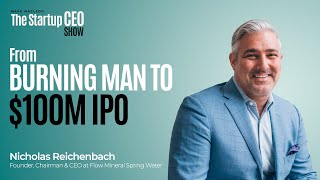
Nicholas Reichenbach founded Flow Water after conceiving the idea at Burning Man in 2013, building a naturally alkaline water brand from his family's artesian spring. The company raised $120M, went public on the TSX for roughly $100M, and served 20M customers before restructuring toward profitability.
Questions this video answers
2013
About 4 million liters per day
About $250 million
2021 (TSX IPO)
About $120 million in less than four years
Chapters
I have to say, they made the right bet because in hindsight, 2020, but we also made the right bet because, like, you can't really compete with Coke and Nestle and other companies unless you have something. David and Goliath, you know, you have to have something behind you. And we had Tetrapac behind us to be able to actually go out and build this as a sc.
Welcome to the Startup CEO Show. I'm your host, Mark McLeod. In this episode, I sit down with my friend Nick Reichenbach, founder and CEO of Flow Water. Nick came up with the idea for this company at burning man, and 11 years later, he's still living it. And we talk about how he's built a consumer brand and a leading company in a really mature, crowded category full of giants. The role that celebrity endorsements has played in growing his company. Benefits of Spring Water, the power of positivity. You listen and watch this. You'll see he's just like a deeply positive human and known him for years, and he's just always like that. And so this. I really love this conversation. Nick and I also have a deep shared passion and history in electronic music, and so we chat about that a little bit as well. I really hope you enjoy this episode. Nick. Welcome to the Startup CEO Show. How are you doing today?
Thanks, Mark. I'm doing great.
True pleasure to see you. I feel like this podcast should actually just be about our shared love of electronic music, but hopefully we'll just actually bring that in.
We could talk for two hours on electronic dance music or more.
100%, which actually brings me like, let's just jump right in and talk about Burning Man. My understanding is you came up with the concept for Flow at Burning Man. So, first of all, I've never been to Burning man, and everyone tells me I need to go. It just seems like so much effort. I want to just sort of parachute in and, like, parachute out. But, yeah, tell me first of all about Burning man, and then tell me about how you came up with the idea for Flo.
So this would have been the 11th anniversary if I. If I went to Burning man this year. I went in 2013, and I was going to go this year because it's my 50th birthday and all my friends wanted to go this year, so I agreed to go. I said, okay, let's go. We had a camp and everything. And then four of them said, wow, we can't go for the whole week and we're going to just come for three. I said, no, no, it's not like that, guys, you can't just show up. You have to work, you have to build camps, you have to contribute to the community. Anyways, I said, you know what, we're going to go to Ibiza instead.
Oh wow. Amazing.
Perfect.
Perfect. When's that going down?
That's going down in two weeks of September 5th and then just going back in the day. So happens on my birthday that Sasha is DJing. And so we're going to go see Sasha, which is one of my favorite all time, you know, artists.
Yeah, I went to see him actually not New Year's Eve, December 30 last year he played, played in Toronto. I went, yeah.
So Burning Man. Yeah. So surprisingly, I had never been to Burning man before. Given my past past career in concert promoting and electronic dance music. I'd never been to Burning man, never had an opportunity to go. I was living in Europe, so no one really even knew what Burning man was in Europe at the time. And then, you know, fast forward 2013, I'd sold one of my tech companies. I was living in Silicon Valley, as you do a video chat company actually like this, before this existed.
That's super.
And, and I was kind of living out my sentence there. That's a whole other story.
And.
I was done and I was like, okay, what do I want to do with the rest of my life? And a really good friend of mine, my roommate from London, England who used to be a rave promoter as well, said, well look it, if you want an epiphany, let's go to Burning Man. I go every year, got an amazing camp, you get your freebie, which is your one time that you can go without doing a lot of work.
Okay.
The first time you're mulligan. And so I went and stayed with some beautiful English people all living in Silicon Valley and they hosted me at their camp and I brought down about at least 60, 70 liters of Avion. And so when I don't drink flow, I drink avion. And there's a reason for that, is that the chemistry of avion is within 5% of flow. So it's a high quality mineral water. Avian's a 200 year old multibillion dollar brand that has beautiful mineral water from the French Alps. And I happen to grow up on a very large artesian mineral water spring in South Bruce County, Ontario. Mild May, that's where I'm from. And it releases about 4 million liters a day. So it's a very large spring. It's probably as big as Avion. It's bigger than Fiji by far, so. And it releases just a beautiful, high quality still mineral water. I've been drinking it since day one. And so when I don't drink that, and I drank that exclusively until I moved out of my town, went to university and when I was 17, so I drink avion. So I brought all my avion to Burning man and I'm riding around in the desert as you do, totally dehydrated for multiple reasons.
Yes, Fill in the blanks.
And I was like, I was drinking. The first thing I thought of was the water's hot and it tastes like plastic. And I said, this plastic's leaching in my water. And. And I'm drinking plastic right now. It's disgusting. And I said, this has got to be really damaging to my health. And. But this was way before anyone had ever even mentioned this concept called microplastics. Like, this is in 2013. No one knew what microplastics were. In fact, I don't even think sustainability was on anyone's mind. Maybe that maybe like a very, very, very small group of people. And then the eureka moment was after spending at least 14 hours at robot art.
Yeah. Oh, what a great camp. That's amazing. As you do.
As you do. And I was coming off of a very long journey and the sunset was coming up. And then I just had this moment where I was like, wow, I really should take my family spring and create a sustainable water company that really honors the mineral water and the quality of the water. Because it is a superior water. It has superior hydration benefits, minerals inside that have magnesium for electrolytes, calcium for your acidic levels in your body, and put it in a compostable, renewable plant based resource package. So I lived in Sweden for three years and that's the home of Tetra pack. So in Europe, Tetrapac has a household penetration of almost like 96%. So everybody drinks Tetra packs. And I thought to myself at that moment, I'm like, wow, I wonder if I could put this in the coconut water package, because I know it's all made from plants. It had a plastic cap on it. Anyways, Eureka moment. I'm like, okay, you know what? I'm going to do this. I called my wife and I put all my recycling at the cell tower where they put all the bottles. And I was like, oh my God, this is disgusting. There's a mountain of plastic. And that was only at that time, 70,000 people for seven days, right? So imagine 360 million people for 365 days.
Yeah.
Like an unimaginable amount of plastic. So I called my wife up and she. I said, look, I know what I want to do. I'm going to take my family's artesian spring and make the most sustainable water company in the world. And she said, nick, are you still high or drunk? And I'm like, maybe, possibly, maybe, but it's a good idea nevertheless. Uh, and that set me off on this journey, and I. I guess, you know, back to the start of it. I've. I've always been worried to go back to Burning Man. I. I don't need another epiphany.
No, you don't. So I don't know. It feels like you were born to do this. Then you're saying this. This is like literally a spring that's been in your family or just meaning your family had access to it because.
It was in the town going for five generations. And it's on a. A land that's 25 acres. It's called Blue. Blue Lake Springs. And the spring artesian condition, artesian, means it comes out of the surface of the earth naturally. The artesian condition, there's 12 artesian conditions, one big borehole, and it's all lined with limestone, white stone. You can see it. And it comes out turquoise, like Lake Louise. So it looks like a little mini Lake Louise. And for those that don't know Lake Louise, it's like turquoise. And that's why our package has turquoise here. And this package design is actually the topographical map of the spring wrapped around the. And so, yeah, we, you know, we. We said. We set out to. To create that. That company using this beautiful artesian spring. And. And it's been one hell of a ride.
Yeah, I bet.
Serendipity has been the only word to describe the series of events that have unfolded to get flow to where it is. And that's what makes it a little bit magical.
Okay, tell me about that.
I'll start off by saying my last name is Reichenbach, which is a Swiss German name. And the definition of Reichenbach means strong flowing stream.
No way. The chances of that.
Yeah, what are the chances of that? Like, literally, it means to have a strong flowing stream of water.
Yeah.
And so that's my last name. And my father's license plate to this date is called Outflow.
Come on.
Yeah. So he has a license plate called Outflow because he loves to fish. And he fishes all, like, all the floats.
Right?
He fishes all the flows. And then on top of that, I grew up in the Water business because my father started one of the first water companies in North America. In 1981, he bought a bankrupt beer company in the town next to us that had a beautiful artesian spring called Formosa Springs. And he bought it out of bankruptcy and they converted it into a water company called the Formosa Springs Water Company and started bottling it in 330mil still and carbonated green glass to go against Perrier, because Perrier and Avion were the only two companies in Canada. And in the US there was only one other company, two other companies, Polar Springs and Mountain Valley Springs. And everyone thought he was totally crazy. Who's going to drink water out of a bottle? Like, what are you talking about? Well, no, this is mineral water. And anyhow, long story short, they built that company up and they sold it to a beer company that converted it back into a beer factory that still manufactures Formosa Springs beer. So during 81 to 87, I was, well, let's say 6 to 12 years old, you know, very informative years. And I grew up with that around me. So that was always in the back of my mind to like. And we had this beautiful spring that my father wouldn't. Wouldn't even touch. And so, yeah, then it brings me to like the present point, which is that water's been in my DNA for a long time.
Very cool. Yeah, you were born to do it. Now, my understanding is the water is alkaline. Is that true?
Yep, it's. It's alkaline, yeah.
And a big yoga guy. And through yoga I've been exposed to this thing called Ayurveda, which is kind of the original Indian holistic medicine. You try as a human to purview what they pursue, what they call being in a satvic neutral state where your body is actually your cells are alkaline. And my understanding is like cancer, like none, nothing bad can survive in an alkaline environment. So maybe just briefly, like, maybe I've answered my own question, but what are the benefits of drinking alkaline water for that are listening.
There's two types of alkaline water. There's manufactured, industrial, processed alkaline water, which basically it's called ionization. And it's electrocuting the water and they put synthetic minerals inside so that when they electrolyte sort of the electrocuted, it kind of folds a charge and takes acidity out of the water. I don't. There's not a lot of science behind that. Japanese have been using it for many, many, many, many, many years. So I'm sure that there is something there. But there's not hard, hard, hard science around what, what that is there. And then there's mineral water. And mineral minerals that naturally occur in water are very unique in the environment. To find a mineral spring that you can abstract and drink is extremely rare. It's at less than 1% for sure of all springs. And I've been searching for flow springs in North America for over a decade and only found three that are actually classified mineral water. That's why Avion 200 year old company is around, because mineral water is hard to find. And mineral drinking minerals has health benefits and there's science backed health benefits. The two, the minerals that we have high concentrations. Okay, I can riff on these things though. The two that we have, our calcium and magnesium calcium in our water is attached to a bicarbonate and when you attached a bicarbonate to the calcium, it is calcium bicarbonate. Calcium bicarbonate is the same, acts the same in the body as sodium bicarbonate, which is baking soda. And so when you drink flow, you're drinking like you can make ice cubes and you can see all the calcium bicarbonate come out of the flow. And so when you drink flow, it's like drinking an Alka Seltzer. What our grandparents used to do is they take sodium bicarbonate, put it in with water, stir it around, drink it. It would get rid of a headache or muscle aches and stuff. It's because it removes acid from your stomach, converts it into base and removes inflammation from your body, your head, all of that stuff. So drinking flow is like drinking a natural Alka Seltzer. So we have 20 million customers that drink flow regularly and 65% of them buy it because it's a naturally occurring mineral water with the attributes of alkalinity. And then the second one is we have a lot of magnesium salts in the water and we almost have as much electrolytes as Gatorade with no sugar or anything. So when you think about the magnesium, magnesium actually allows your body to absorb the water molecule faster. And it actually sustains and it allows itself to hydrate fast for almost five times faster than normal water. So those two attributes are the number one and number two attributes of why people drink flow. But when you drink flow for a long time, not even a long time, a short time, you fall in love with the taste too. So I mean the taste of flow is silky and smooth. It's got lots of minerals inside it. No sugar, no nothing, no industrial processing. We treat our Springs like the eighth wonder of the world, right? Completely sustainable. My promise to my father was that I would never take more from the earth that was given to us. And then the second one was I wouldn't build a factory in our hometown because we want that. So those are the two promises I made. And I'm, you know, and we, we appealed that by being actually the highest rated ESG stock and beverage in the world. And we're one of the top five B Corp. Certified companies in the world, regardless of their industry or sector. Like Patagonia 7 Generation Flow. We're all in a group of very small companies that really kind of are breaking the mold on sustainability. But at the end of the day, it's quality, it's mineral water. And that's the number one reason why flow's special.
Amazing. I love that. Yeah, I didn't realize it was as, as beneficial as that. I have to say I woke up violently hungover today. Far more so than I would normally be on a weekday. It was a good night last night. Great friends. But I've been pounding flow all day and I feel like a champ.
So maybe that it actually does do. It works for any sort of dehydration moment. I used to take Zantac, which is a US drug to get rid of acid reflux. But when I launched Flow, I've been drinking flow so much, I have no stomach problems whatsoever.
Cool.
And so I think there's a, you know, we have thousands of testimonies of the health benefits associated with drinking flow, but at the end of the day, it's the highest quality still mineral water sold domestically in North America in an environmentally friendly pack like boom, boom, boom.
I love it. So, you know, you came from the software world and very often in the software world, you're creating a new market. You're talking about Avion, a 200 year old company. So you enter an already crowded market that presumably felt like they had everything they needed. So I don't know. How did you succeed? Talk to me about entering into a crowded market and carving out some space for yourself. How'd you do that?
A very good friend of mine, in fact, guy who ran the camp at Burning Man, Michael Burch is his name, he said to me, and I never forgot it, he's like, Nick, there's only two things that an entrepreneur needs to be successful. Tenacity and ignorance.
Yeah, I love that.
He's so right. He's somewhere. Who in their right mind would go up against Coca Cola and Nestle and all those companies Trying to get into the water space. Wow. Like, that's, you know, that's a little bit ignorant. Yeah, I had no clue. And if I had known what I knew now, I wouldn't have done it. So there you go.
Okay, that's fair.
There you go. Like, oh, my. Dude, you kidding me? I never thought in. I never thought in a million years that this company would take $250 million to build. I thought 20, and that was a big number back then. So this is. This is the 10th year anniversary of flow. And so, yeah, like, it. It took 10 times as much capital, 10 times as much resources, and we are literally here. And. And now it's like. Like there. So, yeah, it's been. It's been great on a multiple level, but, yeah, it's like the amount of effort it takes to actually do that with the competition, it requires certain things. Forget about the entrepreneurial stuff. You need that craziness to begin with or you wouldn't do it. But what we built the entire premise of the company on was the fact that we had my family sprinkle. I knew it was incredible water. And when you drink it, you feel it. It makes you feel good. It is a. It is the. It is the water of life, right? And so you got to have a great product, and then you got to have a point of different. Different, differentiate, differentation. And ours was sustainability. Nobody was talking about sustainability. There was only one company in the world at that time that was putting water in a carton, which was called Box Water is Better. And I tasted that product, and I said, no one's gonna buy this product. It tastes like a milk carton. Because a water connoisseur, to someone that really loves water, it is about taste and about the quality, right? But taste is the number one attribute in premium water. And so I said, no one's going to drink out of a carton of water if it tastes like a cardboard box. So I actually cold called the CEO of TetraPak multibillion dollar company, $14 billion Swedish company, and Carmen, who was the CEO of North America, got her on the phone, and I said, can you put my mineral water inside the coconut water vessel? She said, well, no. No one's developed the inner liner that would protect the taste of water. All we have is juice. And juice will actually. Water will go right through that juice liner, and it'll taste like a cardboard box. I said, well, would you consider getting a new liner specifically designed for flow? And she said, yes, we will. So we went. We went into R D in Germany, but it took six months. And they developed a liner specifically for water for us. And we launched that as an exclusive in market. So it allowed me to protect the water inside and the taste and the quality. And the second thing I said is, they had a plastic lid. I was like, I can't have a plastic lid. We gotta change this. And so they actually. And we were first to market to launch a biocap made from sugarcane. And so we kind of went into market with that. And that was. That kind of brought us into a spectrum of. There was no one playing in that field, but yet all of our retail partners, like Whole Foods and Loblaws and all that stuff, they were seeing what. What. What I was seeing, which was consumers just. They weren't into plastic anymore. You know, like, I talked to, like, one of our. Our best buyers at Metro, which is a Canadian retailer, Charles. And Charles was like, yeah, you know what? My family doesn't use plastic at all. Serum. My wife's like, got rid of every single thing in our fridge. There's no plastic. So he's like, yeah, we're going to list it. And so it's kind of like meeting that product market fit at the right time. Mark. This was a product market fit, day one. Boom. And that's how we kind of forged our. Our business.
I love that. Now, convincing a $14 billion company to produce a custom thing for you, is that based on charm and wit, or did you have to commit to, like, minimums? Like, was it a giant leap of faith for you as well? Tell me about that.
Serendipity, Right? Yeah. Because, I mean, who in their right mind would bet on a small, nothing, nobody company? And Carmen does not lack in vision. She was extremely forward for her time in a very large company, but they had identified water as a strategic category. But they couldn't convince anybody to put water in a tetra pack, Right? And so first they tried to sell me $7 million worth of equipment. They did their job. They said, okay, so we'll do this if you buy a plant. And I said, I'll buy the plant, but first we gotta prove that we have a market. You gotta come with me in this ride as partners. I can't do this alone. I will be there to finance and to develop this as it goes, But I need someone like you to come along and actually help us scale. Build it. And scale. And not only did she agree to do the R and D of the new liner, replace the cap, and bet on flow as being the stalking horse into water. They injected $100,000 worth of non equity capital before we even launched the company to help us market the company. And they said as long as you say that, as long as you match our sustainability messaging and that we build this together as the most sustainable water format in the world. We're in and today just to still today they're our largest financial partner.
Okay. I was going to ask, is it a. It became a strategic relationship as well, like they got on your cap table.
Oh, very strategic. I just got off the phone with the CMO this afternoon talking about what we're going to do in 2025 and they still finance and co finance a lot of the sustainability efforts that we're doing. They do all the R and D. They spend hundreds of millions of dollars on R and D. And we're at the, at the beachhead of what they're doing because like no one thinks of juice and thinks of sustainability. No one thinks of oat milk and thinks of sustainability. When you think about water in plastic, you think about sustainability. So they bet on us, we bet on them. And it's been a beautiful partnership, one that will carry itself through for many, many, many decades because we're just at the forefront of this whole global shift and it's happening faster and faster every year. So they became our largest financing partner and they made a bet on us. And I have to say they made the right bet because in hindsight, 2020. But we also made the right bet because like you can't really compete with Coke and Nestle and other companies unless you have something David and Goliath. You have to have something behind you. And we had Tetrapak behind us to be able to actually go out and build this as a scale.
This episode is brought to you by Fellow Velo is the only AI meeting management solution that covers every of your organization's meeting workflow. Go to fellow app CEO to get 300 free minutes of AI recordings and start having better meetings. Do you want to run this company for decades? Is this, is this your legacy company?
That's so funny, Mark. Honestly, you're like reading my mind.
It's the beard I stroked.
You such an advisor. Now we'll get into that.
Yeah.
So up until like last year, I would say that because we took the company public in 2021.
Yep.
Which has always been a dream of mine to do. So, you know, check mark on that. I didn't realize how painful it was going to be, but it still was a very good experience. Before that, I had like the regular entrepreneur hat on, okay, let's build it and sell it. Okay, let's build it and sell it. Valuation this, valuation that, raise money. This raise money, you know what I mean? Like we, we've lived this whole, our whole lives, you know, and I had the regular entrepreneur hat. It was like, this is my 11th company and I'd done it many times before and this was the format, like let's get, you know, Silicon Valley format, you know, boom, boom, boom, sell. And then I went public and realized that my liquidity was not going to come from going public and, but it was an excellent mechanism to raise a hundred million dollars at a 6.1 times forward multiple. We hit it right at the right moment. That little bit of that was lucky and serendipitous. But after that three year painful journey through the devaluation of the company back to where it is today, which is peanuts, I was tasked to turn the company around, which meant get it out of burn and into turn. It's like get it out of burning and into profit journey, you know. And so I hired a cfo, Trent, very experienced, savvy cfo. And Mark, you know, like there's, there's, there's two people that like really matter, the CEO and the cfo. And if they have a great partnership, boy, oh boy, watch out, watch out. Right though those two people like the, are the cornerstones to progress and management. And so I hired a new cfo. We went in and we transformed the entire thing. It took us 18 months to do that. And now we announced to the market that we're going profitable this quarter, which is August, September, October for the first time in 10 years, $250 million later and we're going into profitability. We've got a very, very clear path. And I just recently, two weeks ago, because we're doing our off site planning for 2025 and meeting as a group and celebrating our 10th year anniversary is flow. I said to the team something that's been on my mind for like six months. I said guys, girls, people, humans, coworkers. I said, we for the first time ever, don't have to think about a short term strategy. We don't have to think about a midterm strategy. In fact, I don't want a single person talking about a quarter's results anymore. I don't want a single person talking about a year. I want the long term vision of flow redefined for us to run this for generations.
Amazing.
And that was a real fundamental shift in myself because there is no Exit for me on this one. I think that this, if we do our job, we could have a very, very positive impact on the world around us. And prosperity is one attribute of success.
Yep.
And I think that, yeah, I think I'm at this point, I'm a lifer.
I love that. That's amazing. Not too many public CEOs say that we don't need to think about the quarter. I feel like there's so much pressure. I feel like Wall street is. I realize you're public in Canada, but. So Bay street is driven by quarterly guidance.
You know, I wish I had owned that thought, but Jeff Bezos gave it to me.
Okay.
He told me, I watched an interview with him and he said if I see. If one of my executive team comes in and talks about the quarter, they're fired.
Wow.
Give me the, give me the three to five year vision of what you're doing or you're out. You know, it's kind of like, yeah, you're right. And they're not talking about the quarter. The quarter is an afterthought. Let's talk about how we can change the world together.
That's. I love it. And you know, when I, I'm generalizing here, but when I think about access to capital, so building a new company at any category in Canada, obviously, first of all, we have less access to capital relative to the States. But then I think the capital understands business to business companies far more than it does consumer. So how hard was it to raise, you know, for a direct to consumer brand here?
You know what I mean? We've been doing this for a long time. I've been raising venture capital and deploying venture capital for my entire career. And I play in consumer most of the time. So I make video games, music concerts, you know, I play in consumer. And now I have lots of product companies. Not just flow, simply Protein, which is a protein plant, pamphlet plant based protein company.
That's one of your companies? Yeah, well, yeah, I eat those all the time. That's good.
Now you got, now you got some do. We just launched a tortilla trip. Oh my God. You got to try it. It's incredible. So the access to capital in Canada is embarrassing.
Yeah, that's it.
I feel so bad for every entrepreneur that has to go through the pain of starting a company in Canada because it's so difficult and the investment community is just not difficult there. So it's like you got to beg, borrow and steal from your family, friends and everyone around you to actually just get something done. And Then even when you get something done, when you need more money private, there's no private equity for consumer stuff. There's no venture capital for consumer stuff. There's stuff for tech like you did for years, you know, and, and it's still not like remotely. I think it's 20 times less than the US per capita. And so knowing this and, and, and I, I was living in New York. I lived in New York for nine years. So when I started Flow, I was still living in, in Silicon Valley. And then I moved back to New York and so I'm very familiar with the US landscape and all, all that stuff. Coming back into Canada, I took a completely different approach to flow or it wouldn't be here today. And so I put the first four and a half million in to flow with my friends and family, but really just me and my business partners, you know, I mean I got lots of great business partners and they're like, okay, let's go, let's, let's do it again. Boom, boom, boom. And you know, get the first four, 4.3 million into the company and really start to get the, you know, NVP proof of concept, all of this stuff done. And then very quickly I realized that I, and back to the whole point, I thought it was $20 million, not 50. So I'm like, okay, so how do, so how are we going to get it to the next level? And then one of my advisors worked for the TSX for a company called Shorcan. And Shorcan was acquired by TSX because they had a product called the TSX Private markets. And so the private markets platform was a pre IPO platform that allowed for accredited investors and retail investors to invest in companies pre ipo. And so we really leveraged that platform like no one else had ever done it before. Mainly it was used for real estate reefs and real estate funds, private companies that were trying to build large equity pools. But we were the first consumer product on there and we got a lot of PR from it. We got Josh Donaldson, if you remember him, he was the third baseman player for the Blue Jays.
Oh yeah, yeah.
He won the MVP of the MLB Eastern League that year. He was a float customer and his manager said, hey, you know, Josh loves you. And he's, you know, he's only doing Samson and he wants to do a campaign with you guys. I'm like, who's Josh Donaldson? You know, I don't play baseball. But I said, you know what? I love his hair. He had great hair. He was a good looking guy. And he obviously was the MVP of the mlb. And that year he was number three. There was Drake, Rachel McAdams.
Okay, yeah.
And then Josh Donaldson. That was the top three celebrities. And so I was like, you know what? We have no money. He said, he said, that's not about the money. Just loves Flow and. Okay, all right, okay, so we give him some peanuts.
Yeah.
I offered him equity. He should have taken it, but. But he didn't. And he still drinks Flow today. And we love Josh. And we shot him with a Nike instructor. And I said, look, all I'm going to do is make you beautiful. For all of our yoga moms. We gave him a haircut, shaved him up, shot him like a beautiful training boom, boom, boom. And then we call it Mind, Body and Flow. And we launched that campaign which coincide with the TSX private market. At the same time we did our consumer campaign, we launched our investor relations campaign, and then we went what I would call institutional retail, which is not a typical move for a startup. No one does that. So we just said, you know what? Let's prepare our time bomb three year IPO strategy. And earlier on, started auditing our statements. I hired my first cfo, Matt Hore, who came on and he just started getting the business in check. And then we just, we hired canaccord, Echelon, PI, couple other banks. We got all the banks, Stifel, everybody. And everyone started pooling money and there was like 5 million, 10 million, 15. And then all of a sudden we had built a platform on the TSX private markets to raise $120 million in less than four years, which.
That's amazing.
I don't know about many others.
Yeah, I've never heard of that.
I never heard of that either. And it was very successful. And then ultimately we topped it off with $100 million IPO on the TSX. And Bob's your uncle, as they say.
Wow, that's huge. I love it. Huh? Does that program still exist?
No. They created other exchanges like Neo and the TSX Ventures, and it was just a moment, Mark. The right strategy with the right people at the right time, and then obviously the foresight to be able to actually grab a hold of it. But yeah, it was, it worked extremely well. And I think we were almost the last company to utilize that platform before they consolidated it into tsxd.
So another example of great timing on your part. Great timing.
And it never happens like this. You know, you could do 10 companies like this and the timing never works out. And you're like, oh, Shit. But serendipity in life has a lot to do with success.
So I've known you for a long time, although I don't see you that often, but you always have a very positive aura about you. And so I'm wondering, do you feel like maybe that contributes to this serendipity?
110%. 110%. Look, I say to everybody, there's only two ways you can think positive or negative. What do you want your reality to be, like positive or negative? Because like you're going to think positive, you get positive, you think negative, you get negative. It's just as simple as that. You know what I mean? And the other thing about energy and your positive outlook and things is darkness will always be around you and it is always around you. And the only thing that ever gets you to light is your vision to see the light. And so my mother coined it best. I have the ability to consistently to draw a white rabbit out of a black hat. And that's it, man. You just gotta. If you believe in what you're doing and you truly believe that it's a positive thing, and hopefully it is, I mean, you don't need to be delusional about it, but if you believe in that enough, the universe will fold around you.
Yeah. Amen. I love that so much. That's very, very cool. Yeah, we only experience the world through our subjective lens. Right. There's no objective experience of reality and optimism is self fulfilling and pessimism is self fulfilling. So. Yeah, I completely agree.
I'd rather be delusionally optimistic than passively seeing.
Yeah, yeah, I love it. So back to celebrities for a minute. Just, you know, for any of the. Anyone who's watching or listening, who's building a consumer brand. So you did the thing with Josh Donaldson. The first celebrity I remember being associated with Flow was Gwyneth Paltrow. And yeah, I'm just curious, like, what's your retrospective on celebrity endorsements? Do they work? Is it worth it?
In my previous career I was a music concert promoter, music labels, all that stuff. So I grew up with like artist management and loving that art form as well. And I've done lots of deals, like licensing deals and all that stuff. So that's been in my past. And then when I moved into tac, I did ringtones games and then console games. Like it's kind of evolved entertainment products. So I've always been having to deal with all the IP ownership throughout my career, publishing, licensing and so like I've licensed everything that you like, from Marvel to Indiana Jones to New York Times, crosswords to every music artist that I know of. And so I'm very familiar with that world and I love it. I love engaging and being around it. But I didn't intend for it to happen at Flow at all. We just started launching it. And then I got cold calls from Josh Donaldson, his agent, and she was so nice, and she called me from la and I was like, oh. And she knew I had no idea who Josh was to begin with. She kind of laughed at. You have no idea who he is? I'm like, no, I don't. I have no idea. And back to this whole serendipity thing, because it's kind of like maybe it's my energy that's like, attracting this. But the first thing that happened after that is one of our advisors, John Toner, who was the guy who orchestrated the TSX private markets with us. He shared a limo driver with Shawn Mendez, and he didn't even know this, but there was a empty Flow container in the back of the limo one time. And he's like, how did you get this flow? He's like, oh, Sean drinks it all the time. Sean, man, he's like 16 years old. He drinks it all the time. And so Sean wrote a letter to Sean's father saying, I'm involved with the company. He still is a large shareholder. I'm involved at the company. We know Sean drinks this, and we'd love just to support him and send you some free water. And if anything, you ever need anything, let us know. Two weeks later, Andrew, his manager from New York, calls me up and says, hey, I'm Shawn Mandez, manager. Thanks for the letter. Oh, hey, Andrew. And so then Sean, from an early age, 17, 18, started investing in Flow. Yeah, no. And he's a very large, passionate shareholder, Flo. And so we started working slowly together to build that. And that just came organically. Before Sean was Sean. Right. He was still Sean, but, I mean, then he became a very large artist, as he should. And then. Interesting how these things kind of domino. I went to my publicist, who, Natasha Kaufman, who's an investor and shareholder of Flow as well, and she was Fiji's publicist beforehand. Then she drank Flow for the first time. And we're attached by the hip. I love her. And she's amazing at doing all sorts of things. Every. Every consumer brand needs a great publicist. That's rule number one.
What. What does a publicist do?
Oh, man. Like, they. They. They connect, press, they connect people, they create Stories like what we've been able to do at Flow was is. Is why Flow is Flow. And so the first thing that we did after Sean, we're like. I was like, oh, that was interesting. I said, but you know what? I never want to pay anybody to be an endorser of Flow. Either they love Flow or they don't love Flow. And we're either working together as a partner. We're not. I said, I've done tons of endorsement deals. They're cheap, and I don't want this brand to be cheap, and I don't want to be involved in just writing people's checks. And, like, it just. It doesn't seem authentic to us. And I said, so why don't you find us a couple really great investors that will work with us that are influencer celebrities? She said, okay, who are you thinking about? I'm like, well, Justin Timberlake and Jessica Biel would be perfect. I'm like, well, they're power couple. And, like, you know, that would be great. Next minute. I know. Two weeks later, I'm sitting down with Coldplay and the manager, Dave and Joey and another guy, and I'm like, in the office. And Dave happened to be from Ottawa, Ontario, and we got on from day one, and he was like, I don't know if the guys are. You know, they never do. They don't do this. I think they may have done one endorsement deal in their entire career, and it lasted two weeks, and then they ditched it all because they're not. That's just not their thing. Then they're real people. He said, I don't know if they're going to be interested in it. He said, but I am, so I'm in. Dave jumps on, invests in Flow and starts to build it. And he said, just send a couple pallets to Coldplay on their tour, which was the last part of their tour in 2018. And it was Vancouver, double show in San Francisco, show in la, double show in San Diego. So we sent Palette, Palette, Palette, Palette. After the San Francisco show, Dave calls me. If he's like, oh, the band wants to meet you in San Diego. Okay, I'm coming. So I went down, met the band, and basically they fell in love with Flo and they're part of the company, and they invested money and helped us build this whole thing. And, you know, next thing, next stop, Gwyneth Paltrow. No obviously connection there. So Gwyneth obviously started drinking Flow, and Chris has a desert household all the time. And then so Gwendolyn came on and she was launching GOOP at the time. And it just built it, built it, built it, built it naturally. And then we went into the last campaign we did with our celebrities, which was all of the pre IPO investors got together and we did a one whole large campaign, kind of like the United colors of Benetton 1 with Russell Westbrook, Shawn Mendez, Halle Berry, Taboo from the Black Eyed Peas. Awesome guy. Awesome guy. And Hannah Brockman, which is an influencer, beautiful person. And they're all investors, so I didn't pay anything for anybody. They all love Flow and they still, every single one of them love Flow today. So celebrities in Flow is just a byproduct of them loving the product. And our strategy is completely organic, but also it's one of which they've all written checks. Yeah. Which is like, never heard of either.
No, never. In this sort of Kardashian fueled influencer world. Right. She's like, oh, here, let me do an Instagram post for like, I don't know, some stupid amount of money. So I love this.
I tried to get Kim to write a checkup. It was close. She loves flow. She loves Flow. She has it in her fridge and all that stuff.
So I'm curious, this was initially a family led business. Now you're publicly traded. What. How is your role, how's your day to day different, you know, now. Now running a public company.
I tried to move to executive chairman.
Yep.
It didn't work very well.
Okay.
Yeah. So when we went public, no pressure really, but let's hire a professional CEO and all that stuff. But I quickly realized that my energy and flow are connected. And so like a lot of the momentum and passion all originates from me, but also I get a lot of passion from it. And so we're symbiotic in our relationship. And so that did. I tried to like kind of go, okay, let's see if I could take a step back up, down and out of the driver's seat and into the passenger seat. That it didn't work very well for the brand, for the company, for the employees, for the culture of it. And I mean, this is North America and maybe the rest of the world operates different, but we're entrepreneur led companies and if we're not, they're strong entrepreneurs that started them for a very long time. You know what I mean? And like, that's our culture here and that's what makes us so successful globally. And never underestimate that level of passion and commitment that we have towards excellence and like, and that's what's carrying us through. So that's my day to day, man. And I think I. I think I'm a lifer now.
I love it.
Yeah.
Yeah. I mean, you were literally born to do this. Look at your last name, for crying out loud.
And I didn't even come up with the name Flo. My wife did, okay? She read that book, Flo from Polish or Czech? Czech author, Dr. Miguel. And I don't want to pronounce his last name. He wrote a book on the flow state, and she wrote it and she's. Oh, Nick, you got to call your name. Your company Flow. Our company, because we're married. So our company Flow, she said, because it means the flow of water, but it also means the flow of energy, the flow of everything. Right. The flow state. Being in happiness and being in this. And I said, first of all, there's no way that I'm going to be able to acquire a trademark that is four letters that means flow of water. Flow of all that. Like, that's not. That's not gonna. I said, but I never say no.
Yeah.
So I'm gonna go after it. Guess what? I acquired it.
More serendipity. Jesus.
1,200 Canadian dollars.
Wow.
Can you believe that?
Well spent.
I mean, who buys a trademark flow for mineral water for $1,200? You can't even trademark anything for $1,200. But I bought it, and it was limited. And then I spent a million dollars afterwards.
Yeah, of course. Well, maybe as we wrap up here, Nick, let's end where we began. Before we went on air and electronic music and. Tell me about driving people to and from raves on a bus.
Yeah, it was funny. I was with some of my friends and partners three weeks ago, and we were listening to music late on a Friday night, Colorado, and I was trying to school people, like, oh, yeah, you remember this track? Remember this track? And then I said, here's the first track I've ever listened to. It was called Age of Love.
Oh, yeah, sure. Yeah. You know, remix of that track. That was such a good track.
It's such a good track. And then we put it on and I was like, Everyone was like, what is this? It's like techno. It's like, you know, aggressive. And I was like, oh, boy, do that. That's not the bumpy house music that it was. But I listened to my first Age of Love in 1987. And so he was, you know, he was studying in at umbc, and then we. He's like, oh, dude, you got to check out this rave music. And I'm like, okay, yeah. So I'm from a very small town. I'm like a thousand people. There's no, like, very, very small town. And so I started listening to this and wow, this is. This is really good stuff. And got into the initial rave movement in Toronto. And I lived on.
In.
In Southampton Sowell beach on Lake Huron. And when I was just before I was going to university, I started listening to this rave music, and I was on the beach. I was like, you know what? I'm going to open up a clothing store called Rave New World. So I borrowed 1500 bucks from RBC Entrepreneur Grant of such a loan, and then I got a credit card that was big from CIBC for $800. And I went to Kensington Market in Toronto and bought all the sundresses and army boots and like bikinis and all this stuff, jewelry and all this stuff. I opened up the shop and then I called all the rave promoters in Toronto, which was Robbie from Cyrus, which is Jungle Better Days Production, which was Ashley and A Bunch, but I called them all and I said, look, I want to run buses to your raves on the weekend from Sable beach. Give me 10. Give me half off the tickets. And they gave. No problem. Sobble beach, you can take the tickets. No. So they gave me 50% off the ticket. So I was making $10 per ticket, like $20 a ticket. And then I would rent a bus for 40 people, and I'd make about $10 each person on the bus. And then we would go up every weekend to the raves and I'd make like 800 bucks. 800 bucks in 1991. That's a lot of money, man. It was a lot of money. And anyways, it just. It kept on going from there. And then the bus tour stopped. I went to university in Westrund in Ontario and London, and then we started throwing parties.
Amazing.
And then the rest is history.
Wow, that's wild. Wow. You're bringing me back. A buddy of mine, Mike Stein, started Pleasure.
Oh, dude. Mike? Are you kidding me?
Yeah, I went to high school.
Oh, I love Mike. Oh, Mike and I have such a long relationship. Oh, yeah. How's he doing? Do you hang out with. Do you see him?
He lives in Berlin now, so. Yeah. But, yeah, and my. My best buddy, still my best friend was the guy who got me into all of this. And anyway, so, yeah, that's. That was my world.
Mike. Oh, man. Many, many nights with Mike. I. I would love to talk to him again. Anyhow, you and I have some. We have some catching up to do.
We do.
On Junadip. Red Rock. Let's go.
I mean, that seems like a perfect place to end. Nick, this has been honestly, a true pleasure, and thank you so much for the water. I've been pounding it some music right after this is done, but thank you so much.
Please. Ben, that's great. Have a great weekend.
Yeah, thanks, man. All right. Hey, thanks for listening to the Startup CEO show. If you'd like to connect with me, be sure to visit my website at Mark McLeod me or follow me on LinkedIn at the Mark McLeod or Twitter armacloud. And if you want to tune in again next week, be sure to subscribe on YouTube, Spotify, Apple, or wherever you get your podcasts. We'll see you next time.
More from Mark





The Burnout Breaking Point - How Strategic Breaks Actually Increase Productivity


Emotional Debt - How Avoiding Hard Conversations Compounds Into Company Killing Resentment


The Death of the Specialist - Why AI Is Creating a New Professional Class Called Scalers