From Clinic to 600 Employees: Jane App's Entrepreneurial Journey | Alison Taylor Startup CEO Show
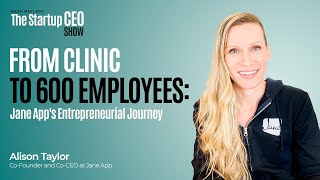
Alison Taylor co-founded Jane App after building a clinic in 2011 and launching the EMR software in 2014. The company grew to 600 employees while staying profitable, using minority financing instead of aggressive VC funding, and focused on keeping churn low and costs conservative.
Questions this video answers
2011.
2014.
About 600 employees.
JMI (private equity firm).
Todd (referred to as now their CFO).
Chapters
And so we just said, don't do that to us as we don't want to spend more than we make. So we do an operational forecast that's like we're really going to make, we're going to meet it. And then if there's upside, there's upside and we're not going to stop working. It's not like we're going to be like, well, that's enough everybody, we're done. We made our forecast. So we've always done that and we've hit our numbers every year. Be really thoughtful about your business, know your numbers and stick to it and explain why, because you do know it better.
Welcome to the Startup CEO Show. I'm your host, Mark McLeod. In this episode, I sit down with Alison Taylor, co founder and co CEO of Jane App. Allison and her team have built the category leader when it comes to practice management and scheduling for clinics. I see them all the time myself. As a user, she's built a company with 600 people. It's been profitable every single year of its existence. So we unpack what made all of that possible, how they're so capital efficient, talk about their funding journey. They raised some private equity a few years ago and we talk about what it's like to lead a 600 person while being the parent of three teenagers. I really hope you enjoy this episode and I hope you subscribe. Alison, welcome to the Startup CEO Show. It's a true pleasure to have you here today. How are you doing?
Oh, great. Thanks for having me.
Real pleasure. We were catching up before going on air and back when I was a banker, I was trying to chase you down because you had a really amazing capital efficient company and I am certain every VC and PE firm was trying to do the same and you finally said yes to one of them. So that's definitely a thing I want to explore. But maybe just to kick things off, maybe just tell folks what JNAPP is and what the origin story is of the company.
I've had a hard time building an elevator pitch for my own company. I think you're always too close to it, but I, I'll just tell you the story of where it came from and then that kind of helps. So I opened a healthcare practice in 2011, multidisciplinary healthcare practice in North Vancouver. So it's massage and physio, Cairo midwives, acupuncture counselors. It just had eight treatment rooms and kind of offered a lot of different services. And while, while I was opening that practice, I was looking for software Specifically for online booking and electronic documentation like the medical charting for all those different types of practitioners. And nothing was out there at the time actually even still that could service like that number of different types of practitioners. And then also that was connected for online booking at the time. And my now co founder Trevor, he was, he had a design agency and he was doing my website and building my brand and helping me name the practice. And I just kept showing him all the options and just complaining. And so this is like, I mean if you're ever part of software, you understand scope creep. So immediately the project had scope creep. And he was like, well okay, let's just add it to the website project. And so he quoted me on that and. And then we ended up developing and building out the electronic medical records part and then the online booking and it was part of my website, so just like hosted on a Mac Mini in my clinic for a year and a half. And then other people started seeing it because the online booking is very like public facing obviously. And so right away people started seeing it and saying, hey, what are you using? And can we use it too? And so at that point it was a year and a half later and my practice was kind of up and running. There's only so much you can do in a brick and mortar. You run out of space and once it's at capacity, you kind of have nothing else you can do. So I was getting bored. I don't like steady state. And so I was looking at franchising. I was like, well, I have a software, I have a brand and I had other practitioners that were asking about different places. I literally went to the library and got like franchising for Dummies. Do you know, do you remember that Dummies series?
I remember for dummy series for sure.
Yeah. I think I'm really aging myself. Not only did I go to library and I get a physical book, but it was, that's the book I got. There was no like, let's just search online and find like 10 tips for opening a franchise.
Exactly.
It probably was, I like paper books anyway. And then he was like, well, people were contacting me and they were contacting Trevor. And so he just messaged me and said, do you want to kind of turn this into something? And I was like, yeah, let's do that. So then we built, we had to make it a complete system because in retrospect this was the decision we made, but it seemed like there wasn't a decision. But a lot of people just launch an add on service like we could have just launched it with what it was, but both of us thought that that was just not even. Not even an option. And we knew it needed to be a central record keeping system that was. There was only one. You didn't need a second system because I was using another system for billing and all the, like, invoicing and all that side of things. So we built that all out and then launched it in 2014. So that's a very long story, the origin story of Jane. But then now it's. Now we're used. Around the world, we have 600 employees, which is like, kind of shocking to me.
Yeah. Does that blow your mind?
Yeah. Well, we thought it was going to be a side hustle originally. So the original business plan had literally 20 staff. And it was just like, oh, it's an app. It just runs itself. Like, do you remember back in the day, everyone was like, just build an app. It's so like, it's just free cash flow and you don't have to do anything. You put it out there. Turns out that's not true. You need. Actually, no, that's not really how it works.
So I have to say your. Your origin story on the topic of billing reminds me of FreshBooks. You know, that's. That's how they got started, right? They built an invoicing tool for their design clients, and their clients were like, hey, can we get this Toby from Shopify? Right. Built a store because the. The tools were useless. And then people are like, yeah, that's amazing. Can I use that?
Well, this is what I. I'm like, literally, if there wasn't a gap in the market, we wouldn't have started Jane, because I would have just bought whatever was. I was actually looking for a product and it just didn't exist. And so I do think that sometimes some people are like, what should I do? Like, I'm an entrepreneur and I just want to start a business. I always think that's an. It's such an interesting path instead of starting just because there's a need that you like, that you have that's not filled.
Yeah. Scratch your own itch.
Yeah.
Does your clinic still exist, by the way?
Yeah, you know what? I still, like, for 10 years, I had it while I was still running Jane, which made me kind of an absentee owner for the last few years. And then the midwives took it over.
Amazing.
Yeah. So now it's a woman's health clinic. So I just kind of like passed it over. They took it on and it's now it's up and running, they're doing great, you know, and honestly the first year was really difficult for them. You always think that what you know is easy and they'd never run a practice before. And I'm like, oh, it's not hard, just take it over, no big deal. And they sort of jump. Had to like sink or swim in the deep end and now it's going much better. But it was good for me to watch them and hear their struggles and remember that that's what all of our customers go through when they open a new clinic. Because to me, I love running businesses, so it's not hard. But these healthcare practitioners, it's like not their favorite thing. It's really challenging.
Right? Yeah. They open a clinic because they have a passion for whatever their modality is and they want to help people and they know nothing about invoicing, taxes, whatever, administration.
No. And they're, and they're owner operators, so they're always doing their day to day work during the work hours and they're not having to do all the administrative work around that. I'm just so passionate about helping the small business community, especially in healthcare. FreshBooks is similar small businesses, this is not what they want to be doing. It needs to be easy. I always say, like when they use Jane, it's the most hated part of their job. So the fact that we have any delighted users at all is shocking because they don't want to be doing the work that they have to do when they're using Jane.
Where does the name come from, by the way? Jane.
Yeah, I know I get called Jane half. Like I respond to Jane now. But I always think that's funny because I'm like, would you name. Can you imagine naming, like creating a software and calling it Mark and then walking around and like here's Mark and then being your name, like wouldn't that be weird?
Yeah, it'd be a bit higato. Sickle.
Yeah. It seems a little strange to name it after yourself, but we did a whole naming exercise. We knew we wanted it to be something that was like simple and easy to remember. And most of the competitors out there were sort of just clinic names smushed together like Clinic Sense and clinicmaster and Practice Perfectly. There was just like these. So people often wouldn't even remember what they were using. They would just say it's in the system or in the software. So we wanted it to be something easy to remember, something that people would actually use. Like they would say Jane's name all the time. And that it was person like we wanted to be like a helper in the practice so it would be. Feel like a staff member almost. So it was someone that was part of your. Your team. And so we ended up with Jane. Easy to use, easy to spell, easy to remember.
That's smart.
Yeah, it kind of worked out. It's not my mom's name. Her name's Margaret. Margaret would have been too hard to smell. I could have. We could have eggs. Oh, really? Maybe Mags would have been good, but yeah. And then also it's because it's multidisciplinary. Most offers are also. We had to have something that wasn't. Didn't pigeonhole us into disciplines, which is also surprisingly effective in one. If you want to talk about our growth story and why we were so interesting to people in the investment scene, part of it is just because of our TAM being so much broader than most single discipline softwares. So.
So, yeah, that's very true. So let's. Yeah, let's talk about like, maybe let's talk about the funding journey. You know, you. You skipped venture. I don't know if it was entirely bootstrapped or if you had some friends and family, but, you know, you were presumably profitable for a very long time and then ultimately did a private equity round with jmi, which is a great shop, by the way. I really, really love them.
They have, I think, one of the best reputations of any investor ever. Like, I don't think you ever talk about them in. In the community and you don't hear great things. And that's been our. With the humans there. It's just such a wonderful group of people.
Yeah. Really classy, like strong values.
Yeah, I agree. Really stick to their values. And it's funny because investors are so weird with like, you have to be in the same city as your office, which is crazy. Like, you travel for work most of the time because all your investments are all over the place, but you can't travel to your home base. That's like weirdly not allowed. Anyway, we've had a few investors that have had to leave JMI to go to other firms because they've moved cities and they're so heartbroken to leave. Even though the investment world is quite incestuous, people jump around all the time and it's not a big deal. But the ones leaving jmi, so they're really heartbroken. Anyway, a little plug for JMI for all your listeners. We like them.
So I'm curious, did you. Did you try and raise venture or did you back earlier on, or did you intentionally skip it? And if so, just tell us about that?
Yeah, well, I mean, it's great. We started with the origin story because it gives you some sort of background into the way the. The kind of mindset we had going into starting Jane. We didn't know anything about the tech world or the software world, so Trevor and I had both ran small businesses. And. Have you ever run a small business yourself?
A chain of skateboard and snowboard stores back in the late 90s. Wow.
Very cool.
Not on my LinkedIn, but yes, I have.
That's very cool. Yeah. So you know what it's like to run a small business. There's like, no one's just giving you money when you don't make money. Like, there's literally never a time where you're like, oh, I'm losing money. And other people, like, here, just, I'll give you more money so that you can continue to lose money and grow your business, which is strange. So we. We both grew from small business, which is like, you have to make money to spend money. And if you think about opening a practice, I had zero revenue to start. So you're convincing practitioners to join and. And you're slowly building up a caseload. And so we knew what it was like to work with not a lot of. And you have to pay your bills, and then once you make more money, you can buy more things. And it's kind of like. It's how we work with our individual lives as well. So for the first few years of Jane, we were just really operating in that same. This is just a. It's a business. It has to make money to spend it. So we would get customers, and then Trevor and I would. Would fight over who gets the next employee. So we'd be like, oh, we can pay someone. We have salary. And then it would be like, do you get someone to help you, or do I get someone to help me? And then because Trevor's like, design, product, and dev all in one and support, obviously, and sales will scale a little bit faster on the human side, I would pretty much always win. So I would get a lot of the hires early on. And then we grew like that. So we've been profitable since almost the beginning. And we still are, actually. We. We haven't had an unprofitable month, I don't think, since we started.
That's wild. Just amazing.
So we didn't pay ourselves, though, we should say for the first few years, because we both had our own businesses that we were still working from.
So it's so counter to the standard startup narrative, right, which is, you know, have to raise money right away, you have to burn. So it's great to see these counter examples.
I think there's some people that depending on what you do that like if you're in like medical device or like certain industries, it's just like that's not an option. If you have to produce a product you obviously need to burn before you're going to be able to sell. But yeah, I think in SaaS and in the, the world we were in, it was a possibility. And so we just, we were lucky that we could do it that way.
Is it fair to say then you didn't have specific reservations about venture? It's just, you're just, it was just your core beliefs like a business should make more than it spends and we didn't need it, so we just didn't. Or whether did you have specific reservations about Venture?
Well, we, it was never a goal or we never really knew anything about it. And then. Well, I like, I do remember my mother used to tell, she told this like parable, I don't know, I don't even know when she told it to us or why, but about a baker that was selling loaves of bread and they were losing 5 cents for every loaf they sold. Like it cost them 5 cents more to make it than to sell it. And someone was like, well, what are you going to do to this baker? And he's like, oh, it's fine, I'll just sell more loaves.
Yeah, that's the venture capital model right there.
That story just like stuck with me. And every time people talk about venture, that story comes into my brain and I'm just like, oh, don't worry, we'll just sell more. And the weird thing is it actually works in venture because there is like a whole game you can play where people make a lot of money and it all works all the way until ipo. And then if you can't figure out your path to profitability, there's distributed risk. All the retail buyers end up basically holding the bag. So there is a game that works for people. If your, if your whole goal is just to make money off of hype. But I think a business should make money. I think that's what a business does. I think if you want to create like a legacy business, like a long term, stable, healthy business, that it should have profit because all the things that they teach you to do as an entrepreneur in the like growth at All Cost World is actually the opposite of what you have to do if you IPO and you become a public company. Very strange that they're totally not the same skill set. Like you have to be able to predict your revenue very like accurately. You have to be able to storytell and, and ensure that you're going to have profitable growth. And that's not what the, the investor world tries to force you into or pressures you into. So they're not really interesting and all the same. But no, we didn't know anything about that world. And then we actually, we started having investors just like analysts. You know, they just like cold outreach. What is this? Like, I'd never heard of this. I think we got on a. Ready to rocket. Do you know Ready to Rocket?
I don't.
It's a local Vancouver list. I don't even know if it still is around, but they just kind of compile local companies that they hear of and they put them on this list and it. And that list sort of gets scraped, I guess by the investment world. So we started getting this outreach and I love learning new things. So I would just take like calls and be like toe like I'd like, what are you asking us? And they would ask us questions and I would like learn about what kind of things they wanted to hear about. And I just thought it was fascinating. I actually asked one like when every, when people join your firm, is there a book that everyone has to read? Like, how do people learn about how to be investor? It's called the Business of Investment. Now the Business of Venture Capital. Apparently it's very dry. I would not recommend it. And then I learned about IRR and all of the things and I'm like, oh, this is actually very basic math. It's not that complicated like what makes someone successful in venture. But it was all just interesting. Like we weren't. We still didn't want any capital. And then we, we went and did the New Ventures BC competition and we literally only did that also because there was a cash prize. We're like, cash? Yes. Like most of these competitions, there's no cash. But this had a cash prize. And we were like, every dollar was important to us. And so, so that's where we. We were linked with a mentor, Todd, who's now our cfo, which is. We were so for. It was just so for fortuitous that we ended up linking with him and he taught us all about SaaS metrics and we had to present and we had to pitch as if we were getting investment, which we weren't. And. And so we came second. So we won a cash prize for that. So it all, all put us on the scene and we built these relationships with certain investors and just learned about it and then what actually happened. This is a very long story to get to the point is we had inactive founders, so Trevor's original agency had a couple of other founders. And when we started Jane, we just divvied up the pie. Like the way you do a small business, like 50 50, like between. Yeah. The people in the room basically. And then the way that the work ended up, you know, just. You never can't tell the feature. And this is not the same as small business. And we ended up needing to exit them, but we couldn't afford to buy them out. We'd built these relationships with some investors in the community so we just like arm's length connected them. So that's how we ended up on the investor train. It was, it was just, it just had to happen. And then once you do that, you're. You're in a new story. So.
So that was. The JMI deal was literally to buy out those inactive.
No, that was earlier with some. With local. We had those Pender and then Arthur Ventures is a firm out of Minnesota. This was early back before it was. There was only a few people looking outside of the valley at the time like, or their thesis was outside of the valley. And we just were looking for real like personality matches and people who were just going to leave us alone. Like we were quite rude. I think we were like, I don't. We don't want your. We don't want you involved. This is just a necessary evil. And looking back, I'm like, that's terrible. Because they've been so helpful and lovely to us. There is a really positive, lovely way to, to have investment as part of your company. If you're thoughtful about the type of people that you bring on and the way that you interact and how you communicate. So. And then from there is. Yeah, then we did a second another round just before COVID because we thought there was going to be a market crash, which there would have been had Covid not hit the bubble was just. The tech bubble was really insane. We thought there was going to be a market crash and we thought if we had cash we would have a lot of opportunities. And then Covid hit. So then the market, especially for companies like Jane Sword and then we have a real focus on the US for growth. And then we also learned about the benefit of the portfolio companies and JMI has these wonderful other companies in their portfolio that have been so helpful, mentoring and giving us advice. And so then we did another round with them. But it's mostly just been not primary, mostly just secondary, which is. Is what most people are doing. But weirdly, it doesn't get announced like that.
Well, first of all, I love, you know, reflecting back to when the analysts started inbounding to you. I love just how curious you were. You weren't like, oh, those are analysts. Like, I'm a CEO, I'm not going to spend time with them. Like, you went in with curiosity and you also sought to get some value. I think there's a, there's a lesson there for people. Right? Like that's. That was your MBA in venture capital.
Oh, totally. It's all available to you if you just ask people questions. Those analysts, that's so smart.
Yeah, yeah, for sure.
Even JMI is always, oh, is it okay if, you know, our analysts come, we're like, of course. They're like our favorite people. They're the ones that actually crunch the numbers for us and give us helpful data. We're like, we'd rather that they come than you come. Or like, yes, please bring your analysts.
What has made Jane so capital efficient?
If even it's. I mean, some of it. So much of it just goes back to the origin of where we came from, where if yours, if you're only able to spend the money you make, you're very careful about not losing your customers. So a lot of companies start with, especially in that growth at all costs. You start with just like dumping money into top of funnel, which I didn't know any of these terms before and I hate using them. They're so like offensive. I always think of a customer heard of themselves being talked about like this. It would just be like so offensive. Like, oh, we just, by the way.
Even just the term user.
I know, it's just like so awful. It's like, I just don't like it. I'm really fighting against this right now in a growing team because you have to silo people into your org chart. You ship your org chart no matter what, and you have to make your org chart divided into specialties. But then it creates this ridiculous and totally artificial divides which we can always talk about later about. Anyway, so we started from the very beginning on Churn. We could not lose customers because otherwise we couldn't pay for stuff and we had no other money to pay for anything. So we were really, really obsessed with Churn right from the Beginning, we kind of, we kind of flipped the way people normally do it, I think, which is much more logical if you think about it. Like, why put people into something that they're just going to like, leave? It's so much work and effort and cost and then you're not really benefiting from it. And we've continued to do that. So we really, really make sure that we want to keep our customers so that they have to be delighted, we have to have an amazing product that fits them and, and then we have to build from there. And then we've continued to just feel really strongly about not spending more than we make. So even now we budget for the year ahead and we don't over forecast. We, we do a operational budget. And we've had to explain this to our investors all along the way because they always do, you know, they always take your, what you say you're going to do and they haircut it. You know this. So what do you do as an investor? You're like, okay, well, clearly you're not going to do this. Like, this is a ridiculous forecast. You're just giving us all these rosy numbers. Like, I'm looking at the data, this seems unobtainable. And then internally, you, you write, you, what do you call it? You haircut it. And that's what you underwrite it to, right? You, you haircut it and then underwrite to a lower number. And so we just said, don't do that to us as we don't want to spend more than we make. So we do an operational forecast that's like, we're really going to make, we're going to meet it. And then if there's upside, there's upside, and we're not going to stop working. It's not like we're going to be like, well, that's enough, everybody, we're done. We made our forecast, so we've always done that. And we've hit our numbers every year, which creates a very happy board. Weirdly, they like, they, they tell you to push your numbers, though. They used to. They don't do it to us anymore. But they say we need to push for a higher forecast. And we'd be like, we don't want to. This is what we think we're going to do. And, and then when they would say, okay, fine, we're accepting this. And then you would go through the year hitting your numbers and they'd be like, you're hitting our numbers. This is amazing. So happy. And we're like, yeah, but we wouldn't be.
If we, if we had, if we had raised the forecast. Yeah.
So I always. It's one of the pieces of advice I try to give people is like be really thoughtful about your business, know your numbers and stick to it and explain why, because you, you do know it better.
Hey, that. Those are wise words for sure, right? Because then you're not feeling bad about yourself every day of the year.
Well, if you want to have a nice happy board every time you meet, hit your numbers. So that means you're setting your numbers. So don't set numbers you can't meet.
So simple, yet so true.
Right?
Are you still taking your own meeting notes? Let me tell you about an AI tool that I'm using to take meeting notes. For me, it's called Fellow. It's an AI meeting assistant. It takes human level AI notes, it tracks my action items and decisions and keeps everything in one place built with security and privacy at its core. Core, Fellow is the only AI meeting assistant that leaders trust to capture meeting notes and recordings while keeping your data safe. Thousands of organizations are consolidating tools and relying on Fellow to capture their meetings. The team at Fellow is so confident that you'll love it. They're offering an insane deal to startup CEO listeners. 90 days of unlimited AI powered note taking and recording completely free. Visit Fellow App CEO to sign up today and experience the AI meeting assistant trusted by leaders everywhere. I'm curious, maybe like I think lots of people, for better or worse, have like an informed opinion about Venture. And I think maybe private equity is a bit more opaque and I'm wondering maybe if you could share for folks we already know JMI is an amazing firm, but maybe just like tell folks about your experience and what kind of value you get from them and yeah, just maybe just demystify it a little bit.
Maybe I might need your help first because I don't actually know the difference between Venture and pe. Like it feels like these firms are all overlapping. Like when you.
There are definitely overlaps. Like so I'll, I'll give you my take. So Venture is really first of all invests at all stages, but stereotypically gets in much earlier. So much closer to the beginning. And they're trying to find really big outliers like the home runs, the Shopify, the Metas, et cetera. And they're willing to tolerate lots of failure to get there. Right. If I have 10 investments, maybe two of them will work, two will break even and the rest will be zeros. Right? So just chasing outliers and so that actually creates a lot of misalignment. Right, because they're pushing you to take all kinds of risk. And, you know, I literally had a tier one VC tell me once, and I quote, I'd much rather my CEOs go into a brick wall at a hundred miles an hour trying to hit escape velocity than play it safe. Right? So that's Venture. It comes in different shapes and sizes. I'm completely generalizing, but that's Venture. And so you're playing the portfolio game, and you're really hoping that one or two huge home runs make the fund work. And so most of your investment dollars actually are, are lost. And, and so some funds perform really well, but overall the asset class actually doesn't perform very well. And so now let's talk about private equity. So private equity typically gets in later, not chasing home runs, looking to double or triple every single thing that they get in. And therefore completely aligned with founders. Right? Because they need every single one of their investments to work. The venture decision is fundamentally a leap of faith. Like if I had written, if you had raised a seed round, I was your seed vc, it's like, screw it, I believe in Ali and her vision. Let's go. Right, like, that's basically the investment decision. Whereas, like the GMI decision, they're dotting I's, they're crossing T's, they're looking at cohorts, they're talking to customers. They probably do a market study like, so way more diligence because each, each investment needs to work. And then, you know, the, there's no question that VCs add value. But I think if I stereotype, PEs tend to have a systematic program for adding value in one of two dimensions. One is corporate development. So we're going to help you buy a bunch of things and build a bigger company that you could have built by yourself or another is operational excellence. Right? We're gonna, we have these people, these operating partners, and they're gonna help you run your company better, you know, so whereas Venture doesn't necessarily have those kinds of value add functions, which doesn't mean they don't add value, but it's just like they haven't staffed it out in their companies.
That's interesting. I, I didn't realize that that was sort of the divide between VC and pe, because we did, we looked for V, I guess we looked for VC funds that operated like PEs. So when I said like we, you look for someone that suits your style of growth, we knew we didn't Want to do like, go big or go home? Because we didn't want to go home. Yeah, I mean, there is the go big or go home has two sides to it. And you have, you know, I think people just assume the go big will always work, I guess, in that scenario, but it doesn't usually because it's a risk. And so we knew. And it's funny because we're talking to another firm right now, we tend to try and do. We. We do investment every kind of year and a half, two years we have. We let our whole team participate in secondaries. And usually you have to always be working on the next round so that your existing investors have an option to. To return their funds. Like, you have to respect the work that your investors do as well as build your business. And so these are two different things. As a CEO, you have to be doing at all times, even if you're not raising primary capital anyway. So we're talking to these funds, and I'm talking to one right now, and they do both. And so they do the kind of, that huge home run kind of style. And then they also have the other side and they call it durable compounders.
Okay, I love.
And we're like, okay, well, that's very unsexy. And I love that because we're not, you know, like, our goal whenever we were going into a fund was never to be the winning horse like that. So much pressure is put on that. That company to totally return a fund. You never want to be the loser, the loser. You want to be like the middle child where you're just, you know, you're just doing your thing. But we always look for, even with VCs, we were looking for companies that were really like, we just want. All of your companies have to do well. You can't be pushing for that because that's not how we want to grow the company. And so we're not going to be aligned, like, as. As founders and leaders of this company. We're not going to be aligned with you if you're telling us take risk and go big or we're not going to be happy with you. So one of the reasons I think we've always had such great relationships with our investors is because we were super clear about how we wanted to grow the business. And we were. We didn't, like, we talked to some, like, some of those early funds that did want to grow like that, and it was super clear we weren't aligned. We're like, no. Like, we should not work together. And then we Also didn't take the highest price ever because we knew we had to return like so. And we also asked what's your, what do you underwrite to what are, what's your return expectations? And so if they're like well three to five and three to five, like you have to go grow three to five tens in value in three to five years, we would make sure that it matched our, the plan we already wanted to achieve. Yeah. If you have alignment right away, it's like so much easier to have good relationships. But we felt we had, we had the early VCs that operated the way that you're saying PE firms operate.
Interesting. Yeah. No, I believe that, I believe that, you know, those are, those are two broad generalizations. But there's always lots of like flavors. Right. And what you're highlighting in this dynamic. Right. Is the power of being profitable because it gave you optionality and you didn't have to take the money.
I know we always have choice and even right now we're just like okay, well we're just going to wait till the valuation. We need to return. Like and we don't really mind when it happens. We're not in a rush. We don't have a zero. The first time I learned of a zero cash date, Trevor and I were like, what is that? People are going to literally run out of money. They're going to run out of money and they know the date that's going to happen. And we just, we just couldn't. Like Trevor, I just constantly looked at you like what is happening here? Like this is, this is so strange. I think when you live in it, sometimes you don't recognize how strange it is really until you. And even sometimes like we had, we had an interesting conversation as a board a few years ago where we were talking about rule of 40. This was before profitable was sexy. So we pushed for our profitability the whole time. Obviously everyone was like, spend more money, stop being so profitable. And we were like, we think it's important. But I was saying, okay, let's talk about Rule of 40. Because Rule of 40 was invented by an investor. All these things are always invented by investors. Yeah. Which doesn't. And did you. They've reinvented a new one now. Which I laughed so hard when I saw it because they were like, you know what, we're going to invent a new one where actually growth is more valuable. So we're going to give that a multiplier. And I was like, you want not.
Self interested advice at all. It's totally objective.
I know. I was like, that's so funny. That's because you're recognizing that the original rule of 40, which is better for an actual healthy business, it's not actually what the market is paying for. And so they're like, we need to adjust the rule of 40 so that it, it's weighted towards growth, which is what investors pay for.
I will say for what it's worth, in my experience, single biggest driver evaluation is the rate of revenue growth of a company.
Well, of course it is, but that doesn't mean it's a healthy business. So I think it's like it just depends on if you're optimizing just for like short term return. And I'm not saying that's true for all companies, but like, honestly not everyone, like very few people are Shopify like people. So actually, you know Sean Silkoff from the Globe and Mail, he has, he has an interesting take on like we don't need more Shopify. We need more like durable compounders.
Well, you got one in your backyard. Clio.
I know. So Clio. We're also like Clio's little sister. So we benefit greatly. We're a great example of how an ecosystem benefits all the companies around because they've built this story in Vancouver and we're like this pattern matching. We're the same type of company but for a different market and we benefit from their experience and they're so generous with their advice and Jack's so lovely. And then anyone that sees their story isn't interested in them. They're like, oh, you're just like that. And then you're. But you're earlier so we can just be part of the story earlier. And so it's when you think about the benefit of San Francisco and that this sort of just like osmosis of information that happens and Vancouver's starting to build a little bit of that and you know, and Shopify would have built that in Toronto and it's really cool. Canada's got a really awesome scene coming up.
Let's talk about that for a second. If you're up for it. I do want to come back and keep.
Sorry, I'm a jump around or.
No, that's great. And I know you're, you're on the record about talking about how Canada is a great place and like I literally today met a Canadian entrepreneur who is a Harvard and Stanford grad. Complete overachiever. You left the country. I hosted or facilitated the CEO forum in the Cayman. So a few weeks ago and One of the founders, really successful Canadian founder, left the country. Like, there's a lot of folks who are frustrated because we actually think the best and the worst thing about Canada startup scene is its proximity to the US because all we do is compare to a thing that's 10 times our size and. But then you've got folks like Toby and Harley who are just really kind of banging the wagon of the bandwagon rather of like, Canada is a great place to build, the best place to build. So, yeah, tell me, tell me your thoughts.
I think people, they. You tend to not appreciate what you have, you know, and it is true. Grass is always greener on the other side. Although, to quote Justin Bieber, please quote Justin.
This is a first on the podcast, by the way. There we go.
Grass isn't always greener on the other side. It's greenest where you water it. See the Y. I don't even know if that's his, but he said it in one of his songs.
It's good.
It is good. Justin Bieber is also right. If you. Have you watched his documentary, he's like a talented guy.
Oh, it's crazy talented. Yeah, yeah, for sure.
I think that there's a lot of things about Canada that people don't appreciate. And I wonder actually, with the. There's. You can make decisions based on like just the financials. Like we could move from B.C. to Alberta, our headquarters, and save a lot on tax. But I also am like, yeah, but I'm from BC and I would like to support the BC ecosystem and we're creating in jobs and you know, there's something about, like, do you want to contribute to this or do you want. Or do you not want to? Like, so kind of our place in that and you can make it better. I think actually the CCI is doing a lot of good work there lobbying for Canadian tech companies. And maybe we're not as strong as lobbying for tech as like they are in the U.S. but that's fine. Just, this is our country. Let's. Let's be a player in that, in the world. So I'm super proud and I. And the same thing that I was saying before about like Clio being here has given us a lot of advantages. If we. If everyone keeps leaving, then you're never going to build strength in our Canadian ecosystem either. So you're kind of. It's a bit, I don't want to say it's selfish, but it is a bit selfish. It's a bit selfish to say, like, it only matters Whether my company is taxed at the lowest rate possible, which is basically the only reason you're leaving. It's just financial.
It's not the only reason. It's come up in my conversations. It is a reason. I think part of it is. Well, actually, practically speaking. And this is, you know, I'm in Barbados. Part of it is the weather.
Oh, sure.
But part of it is being surrounded by, you know, truly great. Like, it's, you know, like, you talk about, like, the role, like, Jack has had on you, Right. Imagine if you were in a city with 50 jacks, right? That's the amount of inspiration you would get.
And I don't know that we've been limited. I did. As a Canadian, I didn't really understand the power of, like, the Stanford alumni or anything until I started. We got connected to this. The Lazaritis program. I don't know that. And Jaff, who, he ran this whole mentorship program there. And this is early in Jane's story. We didn't know anything, and we got connected to all these stories. And it is shocking, the power of the network that comes out of San Francisco. But I think that we have to stay here to build that. We are now part of that network. One of the reasons I said I was like, I should do this podcast is because I, like, I want to be one of those people in that network that creates, you know, strength in our Canadian ecosystem that says we can do this here. And so we need to tell those stories, too. Even though we don't tell her, we don't like to be super. I mean, we're just busy. It's just hard to find. But everyone always comes out to Vancouver and, like, how come there's no networking at night and there's never any. Like, there's no social things. And we're like. Because we're all spending time with our families and, like, going up the mountain and, like, I don't think that that's a problem. We still can connect with each other different ways, but it's not the typical work all the time kind of vibe. But that's okay. We just have to invent it in our own Canadian way. It's still powerful.
Well, I would argue you can't a B test this, but if you did work all the time, I don't think you'd still be in year 5th, year 11 of this company.
I know. And you know what? We're just adding a sabbatical. Eight years. We have so many employees that are above eight years. And then we were looking in our HRS software, like the human resource software or whatever it is. And our software doesn't even go above 10 years. So we're like where are the rest of our staff? And they're like, oh, it's because they don't think people will even last will be here for 10 years. So it cuts off at like nine.
How hard would it have been when we put a double digits in the software? Like come on.
It's like a Y2K problem. And so we were. Because we were trying to figure out how much would it. How many people would be on sabbatical if we add this. And then we were going to this view and it was like where is everyone else? And they're like, oh, it's because we have people beyond 10 years. So fascinating. Yeah, lovely. They've been with us since Dayne was teeny and now as a. And we're still small compared to where we want to be but. And then I think being Canadian too, like you really get to test your product in a, in a friendly market and then you can launch into the U.S. the proximity to the U.S. is so helpful because you have access. A whole very similar market, same language. It's one of the things I think that keeps the Australian companies. It's hard like zero. Making it globally is like, it's tricky.
You know, very tough.
The Australia, New Zealand actually has a super strong tech scene. Like really, really good softwares and like that. It's hard for them to sell. They more frequently sell into Europe.
Europe, let's wait.
But we're, we're one of the only Internet like our ability to sell into the US is just, it's so shocking. We have this huge, huge market right next to us. So I think it's. And then the competition for us to start our businesses in Canada is so much lower. There's less competition for us to start in this local market. So friendly.
Well, I don't pretend to have canvassed all the healthcare providers but like in my limited world, like my therapist is a Jane customer, my physiotherapist, my ayurvedic practition, like I'm using it all the time.
Oh well, you're going to like this was a problem we didn't know we were going to have. So we're launching a patient app because you probably have like four Jane logins.
Same email and password for all of them. So it's not very secure.
But I know. Well, this the secret. The secret is your. Well, it is secure as long as it's a strong password because they're all stored in this. Like, if we're going to. Yeah, it should be secure. But we are launching a patient app, so all of your appointments are in one place. But we didn't realize that that would be a problem. Like, who knew this was a scaling problem? We didn't anticipate.
It's a champagne problem.
It is a champagne problem. I always, I'm like, there's still problems. Everyone's like, well, good problem to have. I'm like, yep, that's still a problem we need to solve. So let's.
You'll never not have problems. Shopify's got problems. Meta's got problems.
Oh, of course. That's why it's the best job in the world. If you're someone that gets bored with steady state, you should start a company. There's never, there's never a dull moment.
So let's talk about that. Right? So you're. I don't know if it was your first foray into business, but like you started a clinic which is very, very different from running a 600 person company. I've very clearly seen through this discussion so far that a big strength is just curiosity and then just these principles, right? We're going to run this company to be profitable, which meant you're in control of your own destiny. But like, what else did you do to transform yourself into the CEO of a 600 person company? Who by the way, just said, basically, I'm closer to the beginning than the end. Like, I still want to keep going. Like, I'm fascinated by that.
This question gets asked like so many different ways and it's hard to sometimes understand yourself well enough to give a good answer. But there's a couple of things that I think are part of the story and why, why it's worked. I was just listening to a book called Positive Psychology. So I actually have an English degree and a minor in psychology. So I'm really, I'm not a medical professional myself. I. Which is, which is not always well known, but it was, the book was talking about how there's. I don't know if this is an accurate fact. I should fact check it. But that in the general population, 70% of people are pessimists and 30% are optimists. And it makes sense. There was like evolutionary wise, pessimism is prioritized. You are scared of things. You don't get eaten by animals. But it made me. And, but it was saying, but optimism is really rewarded in the business world because you Kind of have to believe things are possible in order to try things. And if you're a pessimist, you're more likely to think something's not going to work out. And if you're an optimist, you're more likely to think it is. And so I think. I think I'm like, I am an optimist. I'm a realistic optimist, which means when I look at an opportunity, I say, what's the worst thing that could happen? And if I'm okay with that, then I'm willing to try it. But I'm not a, like, mortgage your house, put your children on the street kind of person. I'm not a high risk, but I am a realistic optimist and I believe anything's possible. And I think there's always a better way or we can figure it out, or, you know, there's always something. So I think part of it is that I'm an optimist. So even opening a practice, I'm like, oh, I could probably do that. Like, I could. Like, I think I just generally believe I can do stuff because I'm an optimist and because I also am fine if it fails. Like, if it. So the other thing that pessimists have is that they. Failure is a lot harder because optimists are better at reframing for the positive. So if something doesn't work, you're better at seeing the lesson if you're an optimist or reframing and saying like, well, it could have been worse than that. So at least this didn't happen. And so you don't get as. As kind of stuck in failure if you're an optimist as you do if you're a pessimist, because pessimists tend to be like, well, that worked out, but, like, wait until the next thing, it's going to fail. Typically reframe even the positives into negatives. And it made sense to me that only 30% of people are like this because it's surprising to me how many people aren't like that. Like, you're always trying to help people see that, oh, I think we can do this. This is going to be great. And it's not Pollyanna. Pollyanning is when you don't see the negatives where you're just like, you say, everything fine, but it's not. And it's not that you're just good at framing your negatives and framing your positives and being positive. So I think I'm that And I'm also generally a learner. Like you said, I really like learning things. I like learning anything and everything is interesting. And then I like bringing things from one world into another world. So where I was saying before, I think parenting and running a business are very similar. And I can read or listen to a talk on anything and almost always find something that I think is interesting and relevant that we can bring back to the business. And I think that's also something that's slightly unusual from what I hear. So seeing those parallels and linking things.
Together, you brought up Jack. Do you. Do you go out of your way to Talk with other CEOs or mostly seek your own counsel?
It depends. I think if we have a specific operational challenge, we'll try to ask for advice from people like, who do you know that would be able to help us understand, like, what they did in the situation or. So we're. We were launching a platform strategy. So we want to. That was last year. We were starting to build out the basics for that and we're going to be. Allow people to build onto our environment. And. And so we were like, well, who can we talk to about that? And point, click. Care has a massive platform strategy and in the similar space, healthcare and everything. So we'll connect directly with people. But interestingly, the people you want to connect with more frequently, you want to connect with the CEO just to get the connection to the person who did it. So CEOs don't really know very much.
Don't tell them that.
Including me. That's the hardest thing about scaling a company. It's so sad. Like, I remember years ago, Trevor built out this org chart imagining what the future of Jane could look like. And I literally cried because I was so far from the customer, I was so far from the things that I loved to do at the time that I'm like, I'm gonna hate that job. Like, I, I love answering the phone and talking to our customers and. And then you have. You do so much more through influence as a company scales. And that's a completely different skill set that you really have to learn how to. How to work through influence instead of through direct work. And that feels less valuable to me.
But I'd love to talk about Trevor. So you're 11 years in. What has been the key to having like an enduring and presumably healthy co founder relationship?
Co founders. I know. And co CEOs, which is the part that people find usually most.
I didn't know that. Okay.
Co CEOs. Well, we became co CEOs, remember I told you about that new ventures competition. And before that we didn't have a CEO. We didn't talk about titles. We were just building this. There was no titles. And the fort that form for that competition had a CEO line. Like you had to put who's the CEO of your company? And we were filling out this form and I'm like, what do I put here? And I'm like, oh, I should have just put myself in retrospect. I'm like, I should have just filled it in and sent it in. But like we, we were running the business together and so we kind of looked at this form and I was like, well, he's like, well, you can't be my boss. And I'm like, well, you can't be my boss. Like, that is just not going to work. We're both not like, have a boss kind of people. And then we really thought about what does a CEO do? And it's like it makes decisions on the direction of the business and makes sure that you know all the things. And so I'm like, well, we do that together. So we just put both our names. So that's how we became co CEOs on this form at the very beginning of, of Jane's story. And then it's always been true that we've always made those business decisions together. And, and when I think about why it actually works so well, it's because we're very values aligned. So we, we do disagree on things. Usually around like it's usually around product, which is where customer and product overlap. Like, is the customer voice being heard? Well, that's sort of where I will start. We'll have disagreements, but as far as how we want to grow the business, all of those things completely aligned. So yeah, being really values aligned I think is really important with a co founder.
Sorry to interrupt, but was that a coincidence or do you two figure that out up front?
Well, we worked together on the opening of Canopy, the clinic. And then we've known each other actually a long time. So we knew each other even before that. And no, I don't think we sat down and were like, are we values aligned? But it just. Values is just how you make decisions. And so it became, it just becomes, I think, clear. But it's similar to what we were talking about to whether or not you're finding the right partner in an investor. You can ask all the same questions of a co founder, like, what kind of are you looking to grow? Like aggressively grow? Actually, this is where I most frequently see founders have differences that ruin their relationships.
That's what happened at Shopify. Toby wasn't the first CEO. Right. It was Scott Lake.
Yeah. What do you view for the business future?
They had a distant agreement. They were not aligned on whether to raise venture or not.
Yep. It's how do you want to grow this company and how do you want to treat the customers? How do you want to treat the team? It's actually, there's not, it's not a very long list. But if you agree on all of those things then I think because this is what we, we say growth, but not at the expense of our customers or team. That's it. It's like, it's pretty easy. It's like we want to grow as fast as we can, but we're not going to grow in a way that, that is negatively impacts our customers or our team. And as long as everyone we're working with agrees with on that and we can explain the why. Oh, we can't grow. We can't do that because. And it. And if you can say that another way actually, which is growth, but not at the effect of, not at the expense of our culture or our brand.
I love that I'm writing it down. That's really good.
Yeah. And culture and brand are what you need for long term successful growth. And if you have great culture and brand, I do believe you can have a profitable growing company. So growth is just actually an out, an output of all the inputs. Like it's certainly not easy but if, if people are aligned on that. But some people don't want that. They just want to pull dividends, have a lifestyle business. They want to. Don't partner with someone if you're. If that's what the plan is for them and that's not your plan. It just is not going to work well.
So speaking of not easy, maybe my final question, you were telling me before we jumped on that you have three teenage children. So tell me about how you balance running a 600 person company and all the transformation that goes along with that and you know, raise a family.
Yeah, you know what, we actually lost their dad a year and a half ago. So I'm like very much solo parenting, which has been quite a journey over the last year to experience grief and loss and really solo parenting, three children. So yeah, it is a lot of things. It is a lot. And I think especially as a woman, I often get asked how do you. Sorry, that's my 13 year old. He's off from school today. He's not normally so I like, I just love them. I just love it. It's like, the best thing ever, having kids, so enjoyable. But I often get asked, like, how do you do it all? And it used to bother me because I think Trevor didn't get asked that question, even though he also has children. And I used to get kind of chippy about it, which was not helpful, because then I realized, you know what? It is hard. So I'd be like, thank you. That is a great question, because it is actually really challenging. Like, as a mom, you kind of always feel like you're failing at everything because to be like, the ideal mother, your parenting is your first priority, and to be the ideal work or your work is your first priority. So it's like, there's no winning that game. Like, literally no winning that game. It's just not even possible to have both things as your first priority. And so as soon as I recognize that that's not a winning game, I just said, I don't care what the rules are anymore. Like, I don't care what people think. And I just need to be really comfortable with how I do both of those things. But I think ideally, men also get asked this question because it is hard for men, too. I'm like, dads also have to balance being a parent and being, like, an employee or a worker or a boss of a company. And I think that that's the direction we're going. And I think true equality will come when everybody feels equal. Pressure to be present at home and present at work. That's like, true equality. Not when I don't get asked that question, but when men ask that question. So I'm no longer getting all chippy about it when people ask, because I'm like, yes, thank you. It's super hard.
It is hard.
And it's especially hard because men don't get asked that question, and that's. They don't get asked because the social expectation on women is still the. That home is their responsibility. And so until then, it will always be harder for women until that actually becomes an equalized role. So, yeah, working women right now, we're doing a lot. Like, there's a lot of responsibility, and that feels. That can feel tiring. But I also wouldn't give it up. Like, I, you know, it's. I think for. I think it'll be shift. It'll shift over the generations, and that's just where we are right now as women and men. And then I think men are also having a really difficult time right now because the role based expectation of men as providers, protectors is also at risk. And we all scaffold ourselves in our understanding of who we are based on these, like, these roles that society gives us. And I think that men who, especially when women are becoming the providers and the protectors, like in the modern world, that those roles aren't as necessary. I think men might be struggling to figure out where they fit and how they're valuable still. And I have a lot of compassion for that. I think that's really hard. And then what happens to a lot of men in that space is they get depressed and then these poor women are now supporting depressed husbands who aren't helping. And I'm like, it's so. It's just a really fascinating time in society and culture. So we'll see what happens there. I think we have to just like keep pushing through and women are just having to do a lot.
I gotta say, Ali, that's a really profound place to end this conversation. I feel like we could have done a conversation literally just on that.
Just on that. I know.
I think it's that important and that fundamental and I don't know. So maybe that's gonna be chapter two. But I really wanna thank you for making the time. I know you're super busy, you're about to hop over the Atlantic Ocean, and I'm so thrilled for all of your success. So my Spidey instincts many years ago told me this was a special company and it seems to have turned out that way. And so I'm really, really happy for you.
Thank you.
Hey, thanks for listening to the Startup CEO show. If you'd like to connect with me, be sure to visit my website at markmcleod me or follow me on LinkedIn at the markmcloud or Twitter arkmcleod. And if you want to tune in again next week, be sure to subscribe on YouTube, Spotify, Apple, or wherever you get your podcasts. We'll see you next time.
More from Mark





The Burnout Breaking Point - How Strategic Breaks Actually Increase Productivity


Emotional Debt - How Avoiding Hard Conversations Compounds Into Company Killing Resentment


The Death of the Specialist - Why AI Is Creating a New Professional Class Called Scalers