From Startup to IPO: Lessons from Q4 Inc's 18-Year Journey | Startup CEO Show Podcast Full Interview
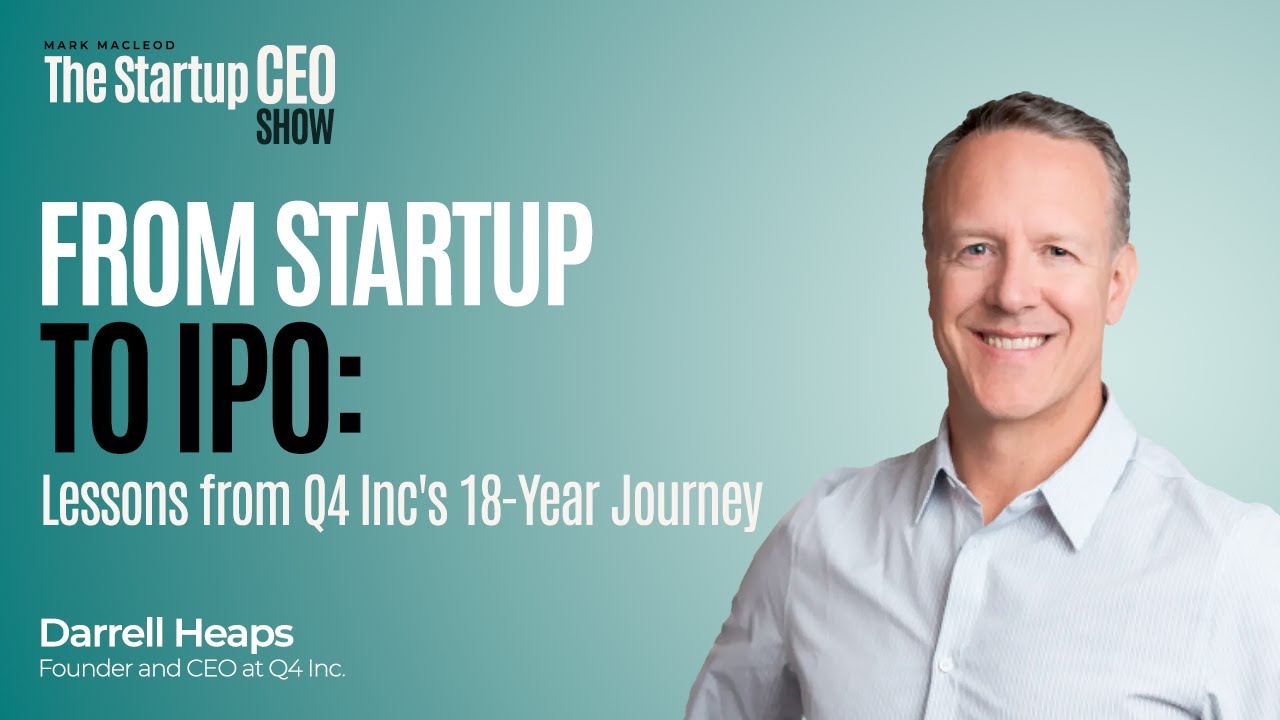
Darrell Heaps, CEO of Q4 Inc., traces the company's 18-year path from bootstrapped startup to IPO to private equity ownership. He discusses early fundraising choices, the role of venture capital, strategic acquisitions, and the pressures of being public, offering advice on building resilient teams and navigating activist investors.
Chapters
There's this great saying that I love, which is, "It never gets easier, we just lift more." You know, if I was doing something I'm really passionate about that I love, it's unlikely I'm going to be going to burn out from doing that. So with that is always about this idea of setting goals that were far enough out that it's going to be meaningful to achieve, but not a slam dunk. So challenging myself kind of every day and challenging the company to be able to continue to grow. And I love that mentality, which is a great way to just look at life, I find, which is If I find myself, if I'm challenged and I'm striving for something and I'm engaged, then I'm not going to burn out because I'm welcoming the challenge.
Welcome to the Startup CEO Show. I'm your host, Mark MacLeod. In this episode, I have Darrell Heaps, co-founder and CEO of Q4 Inc. Q4 powers the investor relations platforms for almost half of the US publicly traded companies. Over their 18-year journey, they've been angel funded, venture funded, they went public, and now they're private equity backed. So I explore this whole journey. We go deep into what was like to go public, you know, if you're ever thinking about that, and then what he's like on the private equity side and how he grew as a leader over all of these different chapters and phases of the business. Lots of great actionable learnings here. I hope you tune in and enjoy the episode. Daryl, welcome to the Startup CEO Show. It's a true pleasure to have you here. How you doing today?
Oh, very good. Thank you so much for, uh, for having me on the show, Mark. I appreciate it.
Yeah, I've wanted to have you on for a long time. When you and I first met in person, I think it might even been in the first month that I started my investment bank. I had a temporary office in Liberty Village and you were just down the street.
Yes, I remember.
And I guess you were already Many years in then. And I guess first of all, just to set the stage for people who don't know, just tell us what Q4 does. But then, yeah, I want to get in. I got lots of questions.
Sure, sure. Yeah. I mean, I do remember that back, back in the day in, in Liberty Village. It's one of those things. It's, it feels like a long time ago and yesterday all at the same time.
That's right.
So Q4 is a SaaS platform that public companies use to manage investor relations. So, and for, for those that don't know what investor relations is, it's a function inside of every single public company that manages all of the communication and engagement with, uh, primarily institutional investors, but also retail holders. But it's, it's primarily like an institutional, uh, focused role. And we provide a platform that manages, uh, all the outbound communication as well as all the engagement with investors. So think of like website products, events products, on the external and then all that managed internally on a CRM and analytics and now all of that wrapped in AI. And the profile of the business, we've got about 2,500 customers today. We, about half of the S&P 500 run on Q4. So although a Canadian company, very much a US business and it's been that way for quite some time.
2,500, that, yeah, that feels like, I don't know what the total number of, public companies are on big board indexes, but that feels like decent coverage.
There's about probably 5,000 notable public companies in the North American market, including the US and Canada. There's— the number's larger as you get smaller, but so we have a pretty sizable market share in the US market.
That's that. Are you focused exclusively on North America?
We are not. So we are— we, I would say we're global as we have customers in about 120 countries around the world. But primarily US would be the dominant segment. And then in Europe would be a segment in Europe as well. But we're certainly trying to grow and take those 120 countries and do a lot more business across those. But today would be dominant by the US market. And then the others are more emerging markets for us.
So as we discussed, you know, you and I met over 10 years ago and you were already several years in and you're in year 19 now, I guess. Is that right? Yeah.
Founded it in in the fall of, I mean, they incorporated it in the fall of 2005. That was like the incorporated entity, but the real, really point where it started would've been the following year in the fall of 2006. So yes, 18 years coming up on 19 this fall.
So my, my big question is like, how have you personally like lasted this long and not burnt out or I don't know, gotten bored or distracted or failed or just like exited, like, you know, there's so many paths that you could have taken and yet you're still here. So I'd love to love your thoughts on that.
I think when I set out to create the company, it was very much based on a, on a belief that there was an opportunity to build a large and durable business if we could sit in between companies and institutional investors in the, in the public markets. And if we could have a solution that provided an essential service that sat in between those, that would be something that you could theoretically kind of build forever. Uh, and I was really influenced. I mean, I've read a lot of books over the, over time, but when I was starting Q4, I read a book called Built to Last by, uh, Jim Collins. And that was really inspiring in terms of really finding the, the core kind of demand, uh, dynamic and being able to build something that could last for a very long time. And so started out doing that and then it's, um, it's really been many different chapters. So when I look at the. The founding story, the startup, the early startup, the scale-up, going public, now private equity. You know, each one of those chapters is a very different story. And I've always been very motivated by setting goals, setting goals, being goal-oriented and striving to test myself and the company in terms of how far I could take it, how far the company could take it on its own, because when you start to build something, it does get to a point where it has a whole, it's its own organism, if you will, in terms of its growth. And so I always found that, you know, I think burnout comes from either being overwhelmed for a particularly long period of time and you just feel like a sense of hopelessness, I can't get out of it, or simply becoming bored. You know, if I was doing something I'm really passionate about that I love, it's unlikely I'm going to be going to burn out from doing that.
Correct.
So with that, it was always about this idea of setting goals that were far enough out that it's going to be meaningful to achieve, but not a slam dunk. So challenging myself kind of every day and challenging the company to be able to continue to grow. And that's kept me engaged at every stage of the business. But I would say, you know, the founding story is very, very different than what it was like 5 years later, than 5 years later. And we've had opportunities to sell and to exit, but in each step, I always felt that there was more to do. And I wanted to be able to see if the company could do that. There was this great saying that I love, which is, it never gets easier, we just lift more. And I love that mentality, which is a great way to just look at life, I find, which is if I find myself, if I'm challenged and I'm striving for something and I'm engaged, then I'm not going to burn out because I'm welcoming the challenge.
No, I love that. That's really good advice. I'm curious, are you a generally competitive person? Like this notion of goal setting, you fueling you? I don't know, did you play competitive sports when you were younger or anything like that?
I did. Yeah, I grew up being, being an athlete was a big part of my kind of early life, like teenage and early 20s. So I was a competitive skier. I was a mogul skier, and that was a very, very formative part of my life, which was very, very orientated to goal setting and doing the work and getting better and progressing, etc. What I always found the difference between those two things, like setting goals in an athletic setting, in a lot of cases, it was much, much easier than, than business. Because in, at least in my athletic career, there was only me. So it was just a measure of, of how much better can you get. And there's, there's thousands that have gone before you. So the coaching regimen, the, the guidance, the technique, et cetera, all of that is pretty well known. You just have to be sacrificed, put the work in, and hopefully you have the right enough DNA to get you to that level. When you transpose that into the work world and building a company, there are so many vectors that you don't control. There's so many dynamics, human dynamics that you have to learn in terms of how to evolve, that it's not just about one person. It is about a team and then a bigger and bigger team with dealing with like a million different inputs that are changing constantly. It, it's been a lot of learning over the years in terms of how to, how to adapt to that.
You kind of alluded to this when you were talking about How you lasted this long, but you know, basically doing work that you love, you're going to keep going. Like if you're fascinated by it, right, you get energy from it. So I'm curious, like over the years, have you explicitly designed the CEO role around things that you love around your superpowers, or have you just, I'll do whatever needs to be done, whether I like it or not?
I would say that that has been an evolution. That in the early days, in the early days, you do everything because you have to do everything. And the, you know, you're kind of chief get shit done officer. And that can mean, you know, the floor is dirty, it needs to be swept to, oh, I gotta pay this bill or I gotta chase this money or I gotta close this deal. But over time, you know, that changes. But I would say it probably took me maybe even, I would say like 8 or 10 years into the business to really understand that to take it to the next level was about delegating more effectively, that not being, not being the heart of everything, being able to, to really leverage a team, lead a team, lead the business in a very different way. And that was a critical point. That's why I look at that kind of 2015 kind of timeframe. 2015 is when we'd really bootstrapped up until then from 2006 to 2015 was, was really, we had some angel money very early on that I raised, but then from like 2008 to 2015 was running on our own cash, being scrappy, bootstrapping. And then it was 2015 where it took first venture money. And that's when the business really accelerated. Then it was about like raise, acquisitions, raise again, acquisitions, raise again. And the business grew exponentially. And that was in line with also my own evolution in terms of like how I was running the business and how I thought about the CEO role and what good looked like. Because prior to that, it was more about, okay, I think I've got a lot of capacity, so I can be the driver of every single function in the business. But that becomes very limiting as the business starts to grow. You become the pinch point. And so expanding and changing has been a key part of that.
So that's, that's important. Like that's a pretty long period before taking on institutional capital. I think many founders think, oh, I just need to raise kind of right away. Were you a services shop in that early period or you just, you just, whatever you got, you launched something and you just kept it small to start so you didn't need to invest a ton?
It took a while. It took probably 4 to 5 years for us to figure out the model. To figure out like what, what is the business that we're actually in? Because when I started it, I had no idea what investor relations was. So I came from the web side of things. I had two companies before that were really like web design development shops. And so worked with lots of different companies, but it was build for hire. You know, like come build this project. Okay, here you go. It's going to be this much, pay the money next. And when, when I started the Q4, knew that there was this demand between companies and investors and, and we could sell them a, like a web content management system to manage their website, which was the first product, but didn't understand who the buyer was, didn't understand what their motivations were, what mattered to them. So it took, um, from like '06 through till really like 2010, 2011 for us to change the business model. And that was the period where it got redefined as, uh, IR is what we're going after. That's the customer. This is the value proposition. We know this is going to work. And, uh, and then I always felt I had been a part on the peripheral of a number of different financings. So I sold my, my first company. I sold it. Uh, I was in my early 20s. I did okay. It wasn't like retirement money or anything, but it was, it was a good cushion, uh, kind of early on. Um, and during that period and the second one, I saw, I was on the peripheral of fundraising and I have some friends that had gone through some fundraisings too and heard some of the horror stories of VCs and, and I was really cognizant to not take any external money until I was really confident that we can pour gas on this fire and we're going to be able to deliver a return. Because if you, I just felt if you take it too early and you haven't proven it out, You are gambling and, uh, and there's a risk there that, um, that it's not going to work. And then if it doesn't work and you have outside money, we all know what starts to happen then. So I was really cognizant to make sure to, uh, to wait until we knew what we were doing. And it was actually a market catalyst that happened. So one of the, at that time, the largest competitor, um, sold to the second largest. And felt that there's a dislocation that's happening in the market and we can really enter here and get a lot of market share quickly. And so that's what caused the, it was that at that moment, okay, we have the product, we know what we're doing, the market has changed. Okay, now, and that's when we then started this process of like from 2015 to 2021, we did, well, like basically 3 major funding rounds, 2 bridges in between that, went public. And acquired 5 companies. So it was just like, phew.
That's a lot of legal bills in a short period of time.
Oh no, we're, uh, I've got a lot of friends on the legal, a lot of friends at legal firms and accounting firms.
Yeah.
Um, and consultants, uh, along the way. So, but it was once we felt we had that, then it was like, okay, as hard as we can go. And, uh, and I'd also built a lot of relationships in terms of, um, other companies. So that ability to roll up, like raise and roll up, really helped us deliver exponential growth from those periods. Like the company didn't really grow a lot until 2010, 2011. And then from that point it was, it grew much, much faster.
I'm curious beyond just hanging on for dear life, once you took on that capital, you started acquiring things, you hit kind of escape velocity. What did you do to make sure you were always at least one step ahead of the business, right? If the business is doubling, you know, you're at least doubling.
That's always something that I believed and have said is like the key thing that a CEO needs to do and a founder is to evolve faster than the business. And because if not, then you become the, the pinch point, you become the element that's slowing things down. So I am I always try to be in constant learning. So I think that also comes from an athletic background as well, like in terms of constantly evolving. And so I'm reading and studying on my own, but then also through mentors. Mentors have been very helpful and different mentors along the way and different mentors for different things have been helpful. I found that working with some of my early investors was also very helpful. So I would really lean into the boards. So I, I always felt that boards were something that I wanted to be very open and candid in terms of receiving feedback on my performance and what's working and stack rank me against your other CEOs and where am I strong, where am I weak, and trying to be very, very open at all times in terms of my performance. Because I mean, I always, I never fashioned myself as being perfect, but try to be open and not defensive about feedback. And when you get feedback, it truly is a gift. I know that's kind of a cliché thing to say, but it's trying to really take that and use it to grow. And, and then it's hiring external. So there I've, we've hired some, I've had coaches for myself during different periods. I've had coaches for my team. So my executive team and also running the executive team and myself through, this is not officially what it's called, but I'll call it group therapy, which is, you know, getting in a room like at an offsite, but not just talking tactically about the business, but really trying to understand, human dynamics, personalities, how to work well with people, how to lead with, with, uh, like strength, but empathy is, uh, those are all skills that acquired along the way. But it's, um, it, it's challenging, like, and, and I, I don't want to profess at all that once we hit that, that first initial growth phase, that it was just some straight line. Like it was, it was filled with, uh, with some, uh, unexpected successes. And some near-complete failures and burnouts and, you know, some crazy situations which thankfully we navigated through them. Some of those were market-inflicted, some of them were self-inflicted, just poor decision-making or too much risk taking on or a system not being built out well enough. So it was a period of engaging on learning, but also learning from mistakes and trying to recover quickly. Leaning on everyone that I could.
Love it. You know, first of all, I love the humility with which you approach this, right? And like you're welcoming feedback. Not everyone would. I'm curious with the investors, right? You said specifically like you wanted the feedback, you wanted the ranking. Were you transparent with them? Like, like some CEOs hold off on sharing their fears with the investor because the investor might freak out and, you know, in the extreme replace them, you know. So did you ever worry about that?
The one thing in terms of like being open to humility, I think I always fashion myself as being very coachable and that's a strength that I always want to, I've always wanted to be good at that. So and I think that comes from the kind of like upbringing and sports early on and knowing that if you want to be good, you have to get feedback. You can't invent, you can't make it up on your own. So I think that's where that came from. And then it's a delicate balance in dealing with the board and investors. So while I was always very open to feedback, I would do it in a constructive way, being like I am and letting them know I believe that I'm coachable. I want to be coachable. So I'm going to ask you, what do you think? I would ask things like, Can you tell me what do you think I should be doing more of and what do you think I should be doing less of? And what would you describe my strengths and my weaknesses as? And like, and extract that feedback out of them. But I would never share my insecurities, my anxiousness, my weaknesses that I, my perceived weaknesses in any way to any board member or any investor ever. And that's a recommend, that's an advice that I've given to many other entrepreneurs that Um, and I've told a number of them, you feel like that, call me, call me and commiserate with me. And you know, I can, you can cry in your soup when you call me, but do not, do not project that to your board because they're there protecting their money and their investment. And if you are crumbling in front of them, even if they say you're, they're your friend, their priority is managing their money. Um, and not you. And if you become a liability, then you'll have to be dealt with. So, it's, it's, uh, but I think you can do both. I think you can elicit feedback from a position of strength, um, and a position of development, which is in their interest. Um, but, uh, to make sure that it's not, uh, yeah, if you have a hard day, don't call your board member. Um, you know, call your wife, call your friend, uh, call, uh, uh, talk to your dog. No, I'm just kidding. But you know what I mean?
No, for sure. Right. I mean, VCs have this thing called agency risk, right? They're not, They're not, they don't have their hands on the steering wheel. They succeed through the agent, which is you, the V, like the CEO that they back. You actually generate their returns or not.
Yes.
Right. And so they get very nervous if they start to doubt that agent, right? They start to act in very self-interested ways.
Yes, absolutely. Absolutely.
I really like that notion of group therapy. It's so needed, right? Like it might be a little bit different in this remote world now, but basically we spend more time with like, certainly with co-founders, with other leaders than we do with our spouses, right? Most of our waking hours are spent working and that relationship has to work. There was one when I was, my last operating role was at FreshBooks and there was one offsite in particular where we brought in, first of all, everyone did this thing called StrengthsFinder. And on our desk was like listing kind of our strengths and people knew how to work with us in that way. But we had a facilitator and did this big assessment where he showed each of the execs how to communicate with each other and where we were not communicating with each other. So it was like a, yeah, it was a really valuable exercise.
Yeah, that's, uh, um, early on in that process, sort of doing, um, uh, like personality profile. So there's one called DISC. There's, there's a bunch of them that are out there. So it's not to say this is like the be-all end-all, but it just helps to characterize the personality traits of certain individuals. Like, and then it allows you to understand when you know someone's personality trait, how can you flex so that you work well with them? Like, for instance, some people are very like myself, so I would be classified as a— so D in DISC stands for dominant. Which means that that is like ready, fire, aim. So that is like, go drive forward, move quickly.
Perfect as a classical founder, probably every founder.
And it's just like, it doesn't matter if it breaks, we just gotta learn. And like, there's no time for analysis, let's just act. Um, and then you have someone which like a, um, uh, an S or a C, like C is considerate. And a C is something like if you get in a brainstorm meeting, and it's like, here's all the data, let's make decisions. They are going to say like, let me— I just want to absorb it. I want to think about it. Let me sleep on it and I'll come back. And in my early days, that would be a terrible meeting. That would be a meeting where I get frustrated and be like, come on, like, come on, Bob. Like, why? Like, let's move. We got to make a decision. And that would create tension. And that would— I wouldn't get the most out of that, that other individual. And they would then recede and think, well, maybe there's something wrong with me because I can't make a decision. On the fly. But when you flip that and you say, okay, that's great, I'm going to— I'll step back. We don't have to make a decision today. We can make a decision tomorrow. Think about it, do your work, and let's come back. We'll have a follow-up and then we'll make a really good decision tomorrow. And when you do that, and there's a bunch of different personality types, when you do that, it really enables people more and allows them to flex their strengths. So if my strength is that I'm going to move quickly, I'm going to make decisions, there's a vision, let's go. My strength is not, let me get into the like fine details of the data and analysis before making a decision. If that's someone else, they're gonna drive a better decision by enabling that. So that like diversity of personality, diversity of approach is something which, which does drive better performance. Um, and that was a real turning point. And that's what the, the kind of the, the group work, that's one of the pieces, which is to really understand personalities and understanding how to work.. And, and building those muscles to, like, step out of your own personality. So, like, for myself, being dominant, being like, let's make a decision, to be like, okay, like, I'll pause, even though everything inside me is like, don't pause, make a decision now. But saying, like, I'll step back, let the process work. And then when you see that happening, that's, that's one of the elements that, that really helps. And the other with, with, like, group therapy with leadership teams is it's amazing how much you don't know about your team members. So you recruit, you bring them on. What's your background? I can tell you like everyone on my team at any point in the stage exactly what they've done, who they've worked for, what they've achieved, et cetera. But there was a point back, it's not the same now where I couldn't tell you like, do they have kids? Where did they grow up? What, what makes them tick? Because it was just like, you are another piece of this machine. So bringing that human element also gives you more empathy, um, in terms of, uh, how you lead. And I think you end up getting people that will, uh, go to the wall more. They will seek resolution rather than conflict, um, when they know each other because it'll be like, oh, like, you know, if you and I don't know each other at that level, there might be points where we will like knock heads quicker. But if I know your background more and I know your personality, I'm going to be a bit more forgiving in situations and we're going to work better in time. And I found that that helps management teams just get through hard times easier. And you don't get into situations which is just like the, like bullshit human dynamics of people bickering. And you know, and it's like, we're not, there's nothing you get in those situations of people that they dig their heels in or they get defensive and you're just like, This is a colossal waste of time. And then you gotta, then you gotta try to deal with that. So I've always tried to be on the front end of that, of set the right environment so that no matter how chaotic the world is and how crazy this, the, what we're trying to work through, whether it's good or bad, um, that, uh, you're able to not have humans get in the way of that, but actually leverage each other. And that was all that, I mean, I didn't know that when I didn't know that for, for a long time. That took, that took years to be able to figure out how to do that. And I would still say that I'm a, I'm a student of all of that versus a teacher.
Yep. That makes sense. And by, and long may you think that, right? Because then you'll, that old Zen proverb, right? In the begin, in the, yeah, the beginner's mind, there are many possibilities and in the expert's mind, there are few. So may you have a beginner's mind for a long time.
Yeah. And I would say too with that is that, you know, and we know this, but no two humans are the same.
No, definitely not.
So no, and no management team is the same. We think about like the team dynamics and how people work. That is constantly learning because every single person is very unique and how they interact with others is unique. So it's, it's, uh, whatever worked, you think like, oh, I did this before with the team and it worked perfectly. So then try it with a new team and you're like, oh, that didn't land at all. It's, you know, humans are complex. And so it's constantly learning.
I'm guessing over the 18 years, you probably just staying on your leadership team, we've, you've probably had to reboot it a few times. And I'm just curious how you've approached that and any lessons for other founders, because it's a universal thing, like not everyone can keep up. And so at a certain point you have to. You have to top-grade that, those people?
So I would say management team turns over about every 5 years. I would say the business, it doesn't exactly line up like this in my experience, but it's every 3, 3 or to 5 years is a new chapter. And that is either through that there is exceptional growth or there's some external thing that happens or there is a challenging period where you're not growing as much or what have you. There's always, it seems to go in these, in these cycles in terms of evolution and always being open to the fact that I love this. This is a saying too. I didn't make it up at all, but you know, what got you here is not going to get you there. Not necessarily going to get you there and being able to identify where is the weakness. I've described my role as like part of my role is hunting for weakness, which is just looking at every part of the business always and being like, which part is not evolving fast enough? What is slowing down? Who is performing and not performing? Or just simply they don't have the skills. And I would say most of my, not all, but a lot of the turnover on the management team is not because someone wasn't trying hard or didn't have, didn't have the knowledge, et cetera, but they just didn't know enough to take the company to the next level. And, and then you get into a decision point where you're like, okay, either we're going to, we're going to invest in this person and we're going to go along the journey with them for the next 3 years to get them there, or we're going to trade in order to unlock the growth that we need to. And that's something that, that evolved over time for me as well, which is I think of the business as a, as a professional sports team.. And when I look at like, what does it take to win? And this is how I've talked to people for a long time too. When I talk to someone about making a change, it's not because there's something wrong with you, you as a person or you or your skillset, et cetera. It's just that I need a stronger right wing to win. We're weak on the right. It does it. It's not working as well, but we want to score. That has to be stronger. And I think I can trade and get a better right winger. To be able to score more. That's not a, it's not a question of your value or your personality. It's just that, you know, if we want to win, we have to trade and we have to keep building the team. So I think about that in terms of, in a, in a kind of, uh, from a sports analogy. And that is, that served, uh, me well and the team well, because everyone knows as well, like we're all in a role until there is a way to, if there's a trade that can take us to the next level. That trade should be made.
I love that. Yeah. I mean, a lot of startups talk about we're families and that's BS. It's the wrong analogy. Of course we're not families, right?
I, yeah, I would never, I've been asked that in the past being, you know, do you think it's a family? And I would say I'd never ever describe the company as a family. And the reason for that, I mean, I love my family, but you don't choose your family and you don't, your family is not there to win. Yeah, you know, like that's a very different dynamic. That's a very different goal set, et cetera. So it's not about family and it's not about love because you can have, I mean, there's been lots of friends that I've made over the years working at Q4 that don't work at Q4 anymore, but we're still friends. For sure. And that comes from also trying to be very And this takes skill, this takes evolution over time as well. I'd say, you know, some of the, the early people that I let go out of the business are probably not, uh, friends, but I got better at it over time. Um, and that also helps just being upfront in terms of people's performance and what the business needs. And so, because it's clear, it's not like you just wake up one day and go, yeah, you know, Bob's not cutting it, so time to trade him. You know, months and months ahead that that's not working. Mm-hmm. So trying to be above board and professional and make sure people know how they're performing and what the business needs so that when it comes time to make a trade, it's not surprising. Yep. I wouldn't say that that's always gone perfect. Like, I don't want to play that off, but you know, you strive for that.
Yeah. You know, going back to this observation, right, that people spend most of their waking hours working. When you're not crushing it, you know it. Right? You feel it, right? And so it, it actually sucks to be in a role that where you're not crushing them, you know? And so I've let lots of people go and it sucks in the moment, but every one of them has gone on to crush it somewhere else. They found the right role, the right stage where their skills are the right fit and they're way happier, you know?
Yes, absolutely.
Yeah. So let's switch gears. You know, I forget the stats, but it's somewhere between 4 and you may have a better stat, but what I've heard is between 4 and 7% of venture-backed companies IPO. You're one of those. And so this is actually rare to have somebody who most, most of all, first of all, a lot fail, obviously. And then, but then the, the exit path, the dominant exit path is, is acquisition.
Yeah.
And so I would love, yeah, your retro on the public experience. Yeah, I think folks would love to learn from that 'cause we don't get to hear from folks who've taken companies public all that often.
Just, just tell the story. Is there anything particular that you wanted to start with?
Yeah, no. Yeah. Tell, tell us about like, I guess the decision, the process, and, and what was life like as a public company? 'Cause my sense, like one of the reasons why I left FreshBooks is Mike was starting to threaten about, hey, maybe we should go public. I was just like, I have 0% interest in being a public company CFO. I'm gonna go do something else. Now they clearly haven't gone public yet, but like they were thinking about it, you know? So yeah.
It's funny how you, you, you position that as threatening to go public.
Deeply threatening.
So it was always part of the plan to, to go public. And one of the, motivating factors of that is when you consider what it is that we do. So we serve public companies, and I always felt that, and as a goal to say, like, to get there as a long-term goal, the BHAG is to get the business to a scale that we can go public. And that was the BHAG for many years. And so I also believe in that too. You've got your, like, your short-term goals and how's that going to build, but it's also like, I want to win a gold medal., and, uh, you know, when, uh, at some point in the future. So having that long-term big goal is, is really key to motivate everyone. And it was also that if we could get there, we would, it would be an incredible input to our innovation because being able to like eat our own cooking and, uh, use our own tools and learn from it would give us, uh, a tremendous input. And I actually said the words many times that I want to feel the pain of being public.
Mm-hmm.
Mark, I gotta tell you, I did not know what I was asking for.
Careful what you wish for.
Uh, it was, um, so, so that was the, that was the motivation. And then we, we'd gone, we'd gone through our Series C. We did our Series C in 2018. After that, we did 2 more acquisitions. We grew a tremendous amount. We grew like crazy in '21, and we were looking for the next step. So we were still in a mode of, uh, a burning, so we needed investment. And we started doing a dual track talking to, you know, kind of growth equity firms and some PE, more growth PE. And then also starting a dual track of like, what does it look like to take the business public? Going public for us, it was a bit, you know, the goal was always to get to like $100 million in ARR and then take the business public. When we went, we were not at $100, we were more like 40, 45, something like that. And so it was early, but when you look at it, I mean, the valuations were very high. This was like in the early part of '21 when we first started the process. So we're looking at our best multiple we've ever seen, highest valuation. The most efficient way for us to raise capital would be to go public. We could raise more at a higher number and achieve this fact of us getting public and being able to to operate as a public company in terms of our innovation. And so we started that process and we went down that path and we were able to finally get that deal done in the fall of '21. And coming into that, the market was already starting to sputter. So this is when the rates were— there was considerations around rate. They hadn't raised rates yet, but it was coming. There was a lot of talk about the market being kind of like overheated in the ending part of '21. So we went out on October 21st of, October 25th, sorry, of 2021. And 5 days later the market topped and then the announcements came out, Fed raising rates and the whole market just started to slide. And the thing that's the statement that we've all heard is a rising ocean floats all boats. Well, that goes both ways. So when the ocean is depleting and it's, you know, it's receding 10 feet a day, all those boats go down 10 feet every day. And I think that's what was really eye-opening in being public at that time is that all the benefits that we have on the upswing, when the market is selling off like that, it is really just to, you have to hold on. Uh, and the not having the experience in being a, a public CEO during that period, it's very difficult because the stock price is something that you're very pegged to because everything leading up to that is all about what's our valuation, what's the round, what's next? You know, you're, you're focused on valuation a ton and now you go public and you've got a live indication of your value every day. Um, and I wanted to piece of advice I got from, uh, a veteran in the space and it's very, very sound advice. Was, uh, F the stock price. Uh, do not look at it. It's not a measure of value. It's always going to change. Focus on your fundamentals. That's everything. It's an easy piece of advice to hear. Living that was very difficult for me because that was the scoreboard. So I think that took new muscles to be able to figure out how to be able to operate. But the first like 6 months of being public while the stock's sliding, just really, really tough, some of the most stressful, uh, period. But out of that, we did learn a tremendous amount, uh, about being public, about investor relations for real. What does it take, uh, in terms of engaging with investors and with analysts and the whole process, and where are the real pain points and the challenges? And I would say most of our product suite today has come out of that period. So when I look at 3 years later, all the roadmap we've committed, like we have a much, much better product now that really delivers on hitting on these value points. So that all worked out quite well, and the business is substantially more profitable because one of the realities of being public too is, you know, we had to pull forward profitability targets, we had to optimize the business, we had to really narrow our, narrow our focus, prioritize. And so the health of the business during that process really improved dramatically as well. Um, but then for us it was the, uh, you get into a dynamic where you have like your long-term holders are all very, um, uh, bullish on the company long-term and it's very much as the market corrects. Like we had the challenge, not only the market selling off, so we get that downdraft, but our customers we sell into are also being affected by the downdraft. So our ability to sell becomes more challenged and we're getting hit by the macro of the declining market. So it's like a double whammy in terms of our ability to really deliver outsized return. So, you know, you come into a situation where you're like, well, we can, we can keep our head down, continue grinding on fundamentals, and at some point in the future, we will be able to see our valuation reflect the value of the company more accurately. Or we can take a step and, and do look to do something with a private equity firm. Take the business back into private, partner with private equity, and continue building that way. And so that's what we chose to do. And so that's been the next step in the journey. Before talking about private equity, that's what the public journey was like for us.
It's good advice on the stock price, and I'm sure it was very difficult. I don't know if he still does this, but in the early days of Shopify being public, If Toby caught anybody looking at the stock price, they had to buy donuts for everyone in their team.
Oh really? No, I didn't. I didn't hear that. Yeah, he was really against it.
He's like, it's a poor judge of valuation in the short run. You know, his outlook has always been long run. And so yeah, he was very against it. I'm curious.
That same guy also said, F the lawyers. So that was, there you go. Which was, that came as the same bucket of advice. Yeah. Yeah. Both stock price and lawyers. And I was like, okay, perfect.
Sounds like some hard-won lessons on the part of that advisor. I'm curious, how, how was employee engagement in that period when the stock price is tanking? Like, did you find it was hard to keep people motivated?
I think everyone sees it for the same thing. So, you know, you look at it and there's a good rationale as to why it's happening. And, you know, the key guidance to anyone is, because now a lot of people are liquid in their holdings. So before that, you know, no one sees valuation and you certainly can't sell. So my advice during the whole period was always to hold. And it was, what's really important is do not sell because you're going to lock in the loss and it's like the worst thing to do right now. So every, you know, just believe in the business. We're going to be able to keep growing, this will deliver a good outcome. And thankfully that happened. So I think the, and at the end of the day, as we went through the whole thing, you know, people, a lot of people in the business did very well during those two transactions, the go public and the take private, as long as they held through the trough.
Sure. I'm curious how much of your time moved to investor relations versus operating the business during that public period?
So that's one of the things that was, it's quite interesting is that, and one of my pieces of advice for anyone that's looking to go public is that you really, when you do it, you create a second business. And the second business is the business of being public. And so you have your operating business that you do, which you, you know, make widgets, make money, et cetera. You have that, which has to run exceptionally well. I would say the, when you think about execution of the business, you want to be executing at your, like, World Cup level when you go public, because that's where the results of the business are crucial. That no matter what you do, if you have good results, then you have a lot of opportunity. If you have bad results, you're going to be, you're going to feel that pain. So operating the business is really important to have the team in terms of executing. And then the other side is being able to make sure that You have the ability to run the public company, and running the public company is spending a lot of time, especially in the early days, of educating analysts, like educating banks and analysts, research analysts, so that they're writing and covering your company. Hopefully that you have coverage. You know, there's a lot of businesses out there that have no coverage. The analysts and banks don't pay them any attention. That's another challenge. But if you get that attention, is engaging with the street to be able to make sure that banks are covering you and marketing your stock. And also spending a lot of time with investors on telling the story, you know, us coming to market, we don't have a lot of peers. It's not like we're just like another, you know, company coming into a well-known space. We're a very unique company, unique business. So spending that time to really educate and build the brand within the investment community takes time. And whether that is the CEO doing that or the CFO can also do that. They don't have to be the same, but someone needs to be spending time doing that. So for me, I was spending a lot of my time doing that, both because I felt like I was, that it was a good fit for me from a role perspective, but also because I wanted to understand all the inner workings of the market in a way that we had been an observer of up until that point. And versus being able to be a participant, which has been beneficial in terms of my learning and the company's learning, but it, uh, it certainly is, you know, it's a bigger bite to do it. Um, and I think public companies are, um, I really do believe that the public markets are the, the most, one of the most amazing inventions of humanity. Um, and it is the best and most efficient fundraising mechanism that's ever been conceived of. I mean, you know, you talk about like crowdsourcing, The public markets are crowdsourcing on immense AI-driven steroids. Like, it's, and it's insane how big it is and how much money there is. And when it works and you're positioned well and the ocean is rising, it is an incredible funding device. That's what we had planned when we went public. It was going to be to do that. And then we had the ability to, um, you know, raise, acquire, and continue to scale. Now the market moved the other way on us. Um, but the, um, I think it is an amazing vehicle to, to do that, but you have to be, the business has to be ready to execute on it. Um, and so I think in, um, in today's market, that means more scale, more profitability. Um, but that's not always the case that, you know, the, we see public companies, the amount of companies going public now is, is not as much as it was, uh, in like '21, which was like a peak year. Or 22, but that all comes down to valuation. So as valuations rise and as public company valuations rise, the public markets will always swing much more emotionally than private markets. 'Cause private markets, there's no liquidity. You, you know, you're locked into private companies, so they don't move in, they move in like in step functions.
That's right. Once every 12, 18, 24 months. Right.
So yeah, but in, in the public companies, that's what leads the way. You see valuations rise, that's gonna happen first in the public markets, then show up in private. If history proves private goes even further and then drives even higher valuations in public, and then all of a sudden it's a great idea to go public and all these companies go public because the pricing is right. So I think we're just, we're in a, one of those cycles.
If you look historically, I think one of the other issues here is just the amount of capital in the private markets. There's just layer upon layer, right? We hear about venture, they occupy a disproportionate amount of our mindset. But that's just one part, right? Like you mentioned, like there's growth equity, there's private equity, there's layers of private equity. Like one private equity sponsor flips it to another, flips it to another. In my last year running SurePath, I had heard that there was $2 trillion of dry powder in like the private equity space focused specifically on software companies. Like, Yeah, that's a great reason to not go public, right? Because I can just keep resetting the clock on my cap table and not have to do the quarterlies and the compliance and yeah, I can just keep going for a long time.
Yeah, absolutely. I mean, it does work with the fact of being larger. Like I would say to go public in the US today, we went public on TSX, but if you would, if I was going to go public again, it would be on a US exchange. And I would say the minimum is, uh, $400 million top line, probably 30% profit margin. So you're generating like $100 million in EBITDA. Um, that's the kind of scale that starts to work because you want to be well north of a billion in valuation, uh, to be able to attract institutional investors, to be able to qualify or even screen to get into many of the funds out there. Yep. Um, and so it does make sense that private equity is the step to get there before going. Um, but again, I think that, that, um, that does change with valuation that I think you would see because that private money was there in '21, but you saw a massive amount of companies go public because I think there is value in liquidity. So being able to, um, you know, at some stage in the company, um, the next turn being like, let's deliver liquidity to all shareholders does come. So I think the evaluation will be there, but I mean, private is a, is, is massive. There is no doubt, but I do think public will, will always have a very solid place in the, in the world's markets.
So you've checked all the different investor categories. You've had angels, presumably in that bootstrap period. Yes. You've had VCs, you've gone public. Now you got private equity. Maybe tell folks about your experience with private equity. Again, they might know a little less about that than, than venture.
I think, you know, when you look at, um, venture, so venture is typically, this doesn't fit with everyone. And in today's world too, if you look at venture, like A, A, B, C growth, and what's the difference between venture and growth equity, a lot of it gets quite mushy.
Yep.
Um, they're not like, everything is not kind of, so my characterizations will not be, um, accurate in all cases, but to generalize, venture is about, um, is all about growth, uh, and it's, and it's about spreading your bets. So if it's the classic thing, which still holds, if you've got a fund, you're going to do 10 investments. One is going to be a crazy return. 2 or 3 are going to do pretty well and like 6 or 7 are going to fail. And so you go out there. And so the dynamic with venture is like, welcome, you're in the fund now, swing for the fences. We are going to get as much. So it's a distributed bet. And the, there is less, very way less operational rigor that comes from venture companies into portfolio companies. So they would, you know, you're going to report quarterly. You're going, it's all about top line growth in particular. And the, the help that you get from those firms is, is not a lot. It's not a ton. Now, some will say, well, we're really entrepreneurial friendly and we're going to help a lot. And here's everything we do to help you. In my experience, um, they're not very, uh, in connected to the business operationally. Um, and that's fine. That's good because also a lot of the companies that are taking venture money, all that stuff's being built and it's all immature anyways. So, um, there's not a lot of refinement. It's really about just like, do, can we get onto this lightning rod of growth? Um, private equity is a different approach, which is concentrated bets. Like core thesis, concentrated bets, and focus on operational rigor and excellence to deliver superior profit margins and deliver on a thesis. So most PE is going to look at an investment opportunity such as we're only going to do one investment in this space. We are going to execute this thesis and it's going to deliver this outcome in 3 to 5 years. And that outcome is going to be a 3x return. Or something like that. Whereas, you know, venture, they're going to say, we'll do all this stuff and we'll get one 20x return and it'll pay basically for everything else. So it's a very, very different approach to risk. It's much more systematic value creation. Um, and it is much more operationally driven than, uh, than venture. Um, so the, they all have a place in the world as well because PE is not a good fit for a Series B company. You know, if you're, or if you're early in product market fit or scale out, PE is not going to look at you because there's too much risk in the execution. They want to build on top of an established platform and an established business and look at how do we, how do we execute our thesis, which might be drive organic growth or might be acquisitions or might be maximizing profitability or whatever the thesis is, but they're going to look at making those concentrated bets. Applying their rigor, their expertise, in a lot of cases more embedded in the company, or a much tighter kind of like operational cadence. And with the intent being, we're not here to drive a 10x return. We're here to like deliver this thing to deliver that return. And I think, I think that's also why you see a lot of private PE firms do quite well over time because they are very specific in terms of the bets they take. And also the way they manage risk.
I like that. No, it's a great distinction. Super helpful. I think one of the classic criticisms of PE is like their focus on cost cutting. And so you can take a thing that's really good and it's death by a thousand cuts and, you know, do the dividend recaps and all of that stuff.
And there is an element of that for sure where, and that they're not all the same at all. So there is just like, you know, not all VCs are the same. But there are like growth-oriented PE firms. There are ones that are pure arbitrage and leverage, which are exactly that, which is just like cost out, maximize profit, and then either run that for a long period of time to maximize cash or trade it for a higher EBITDA. I think that's the key thing in understanding that if you get involved with PE firms is really understanding what is their, from a firm perspective, how they approach making money. But then also the key thing for your company, what is their thesis and how does that play out? How are they going to get paid? What are the key elements? Because you want to make sure those things are aligned. If you're like, you know, we're at X and my vision is I want to get it to 10X and then do something, and we're going to need a bunch of funding rounds to get there. Well, you certainly don't want to get involved with with a, with a cost-out PE firm that's looking to leverage EBITDA because you're going to be at odds with them. So I think there's, and in some cases, I think those are the right things to do with, with business. You know, you get to a certain point with businesses that it is, what are they here for? And at what point, some businesses at some points, it now is the time to maximize dollars out. And at other times, it's being more strategic to get to larger scale. Um, but just being, I think that's the key thing is like, it's, uh, no matter what, they're being very explicit on their end as to why and what they're intending to do. So making sure you have alignment is, uh, is the key thing.
That's such a key word, alignment, right? So important in any long-term relationship, be it personal or a business.
Yeah. Oh, that's where all the problems come if you're not.
If, you know, if you and I are co-founders and I want to run right and you want to run left, it's not going to be a good time. Right.
Like, that is absolutely true. There is— I've always believed very strongly in that, in alignment. Alignment and values are, are the key kind of like underpinnings of a good functioning team and partnership. But it's— you got to constantly work at them because they, you know, like if assuming that like if we're in business together that you and I are aligned. Yeah, we're probably aligned when we start, but if we don't constantly like reset that and make sure we're aligned? You probably aren't because again, like, you know, my world that I'm living, the view I see, what I'm experiencing is not the same as, as you. So the, the likelihood that we're continuing to be fully aligned is very, very unlikely. It's more likely that things are happening like, uh, so, uh, always like resetting and checking in I think is something which is really important in early stages with, uh, I had a co-founder for the first, uh, like 3 years. And so learned that well that it went like, yeah.
Yeah. So is that where, that's where the group therapy offsites come in, I guess, or just recalibrated?
Well, they came, that came much later. So I'd love to say that I learned my lesson earlier on. I didn't, it was, those didn't come until, yeah, probably like 7 or 8 years into the business.
Well, Darryl, you know, there's so much more I could ask. And of course I always put together a list of topics and I never 100% get through them. I really appreciate you making the time and I don't know, I feel like maybe you just need to go public once every 3 years, get your roadmap, go back private again, like you just go and learn what it's like to be a public company and then come back.
Yes, absolutely. Well, the other thing too, when we went public, taking it private, we also had an activist on our deal, which was another whole masterclass of learning about like you're trying to get a deal done in the public markets and you have an activist against you and how That all works. Yes. I didn't ask for that one. That one was, uh, that was crazy, but that was another huge set of learning.
Awful. That, that shouldn't exist. I remember, I remember that with Shopify as well, just publishing stuff that was just like flat out wrong. Right. And somehow it's legal.
Yes. Yeah. Well, that's the, the crazy thing is the, uh, the activist doesn't be held, doesn't have to be held to any sort of truth where the, they can just spew rumors basically and make, make stuff up. Whereas the company is, you know, has a fiduciary duty to be truthful and disclosure laws and et cetera. So it's a very, it's a challenging battle to be in. You feel like you're fighting with one hand behind your back. Thankfully we got through it. Okay. Obviously, but, but yeah, it was another, another big set of learning.
Awesome. Well, I'm going to be cheering you on from the sidelines and excited to see where you take the business. Thank you so much for making the time to come on.
Thanks, Mark. It's, it's, it was an honor to be on the show. And I've listened to a bunch of them before. Please keep it up. It's super engaging content, probably because, you know, being a founder and CEO, it's like just right down the fairway. But I really appreciate the time today. And thanks so much.
Thank you. Hey, thanks for listening to the Startup CEO Show. If you'd like to connect with me, be sure to visit my website at markmacleod.me or follow me on LinkedIn LinkedIn @TheMarkMacLeod or Twitter @MarkMacLeod_. And if you want to tune in again next week, be sure to subscribe on YouTube, Spotify, Apple, or wherever you get your podcasts. We'll see you next time.
More from Mark





The Burnout Breaking Point - How Strategic Breaks Actually Increase Productivity


Emotional Debt - How Avoiding Hard Conversations Compounds Into Company Killing Resentment


The Death of the Specialist - Why AI Is Creating a New Professional Class Called Scalers