Maximize Your Exit Strategy: Tips for Founders with Andrew Gazdecki
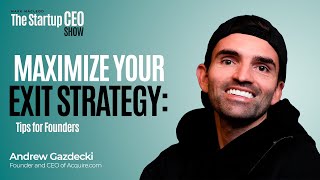
Andrew Gazdecki, founder of Acquire.com, a marketplace for buying and selling startups, shares what founders need to do before selling. Clean financials, documented processes, and running a competitive process matter more than most founders realize. Most SaaS companies never exit profitably.
Chapters
This episode is brought to you by Fellow. Fellow is the only AI meeting management solution that covers every part of your organization's meeting workflow. Go to fellow app CEO to get 300 free minutes of AI recordings and start having better meetings.
When you run a marketplace, you need to have a really, really loud marketing engine or go to market engine. What I mean by that is you need to have both sides of supply and demand filled up. And so in this case, it was businesses and then it was buyers. And if you don't have either one, then you don't get either one. So no business wants to list their company on a marketplace with no buyers, and no buyers want to sign up to a marketplace with no businesses. So it's this chicken and egg problem that we had to solve at the same time.
Welcome to the Startup CEO Show. I'm your host, Mark McLeod. In this episode, I sit down with Andrew Gazdecki, founder and CEO of Acquire.com. if you want to sell your SaaS business someday, you're going to want to listen to Andrew. This is what his business does. He's built the largest marketplace connecting buyers and sellers of SaaS businesses. This discussion was really a masterclass on how to sell. With some sobering stats. Only 4% of SaaS companies cross 1 million in revenue. I was surprised by that stat. Lots of goodness here. I hope you dive in and enjoy this episode. Andrew, welcome to the Startup CEO Show. How are you doing today?
Doing good. Thanks for having me on the show, Mark.
Yeah, it's a real pleasure. I've been meaning to have you on for a while. Despite the fact that LinkedIn tells us we know 166 people in common. I only kind of came across you because you were pretty prolific on the Internet and that's like this guy's like speaking truth every day and telling CEOs kind of how it is. So I got to get to know him and so I'm just going to dive in. That kind of brings up really, I guess, the first area I'd love to explore with you, which is how you've built this kind of brand that you've built online. And this audience you got like, you're approaching 100k followers on LinkedIn, you're over 230k on Twitter. How did you go about that and did you set out? Are you doing that to. That's top of funnel for acquire.com. you know, tell. Tell us about that.
Put simply, I just started posting consistently.
I'm just showing up there. How about that?
Yeah, it's like, it's not that complicated. But when people ask me, they're usually surprised at how little time I spend on like writing social content and stuff. And I always say the when you do your best work, you're typically enjoying it. When you enjoy it, you're consistent. When you're consistent, you're going to see results. So for context, for people that may not know me, I just post simple startup tips on LinkedIn and Twitter like once a day. Sometimes they're right, most of the time they're wrong. But they're usually like reminders for myself or things I'm going through or things that I'm dealing with in my business. But there was no like initial plan, like I want to be an influencer, I want to have a big social following or something like that. It was just I like sharing these tips. Hopefully they're helpful to one person. And that's probably my favorite thing is when I get a comment that says something like I really needed this today or I completely agree. Thanks for sharing this. You know, you kind of like really reach someone wherever they're at in their journey building a company. But in terms of, you know, the business benefits, it's definitely undeniable in terms of, you know, we sell to specifically startup founders, entrepreneurs and so that content resonates with startup founders and entrepreneurs. So it definitely helps with the business. And I'd say it's probably one of our, our top customer acquisition channels definitely.
So you're helping people and into turn helping you, which is really good. And the beautiful thing about what you're, you're sharing is it's timeless and evergreen. Right. There's always somebody who's never heard that. Even though for you it's a reminder, you know.
Yeah. If you follow me enough, you'll definitely hear me talk about like sales at some point. That's probably my favorite topic terms of how important sales is when you're a founder, entrepreneur, CEO, whatever. So. Yeah, I agree. I mean you can also just talk about the same thing and reword it 50 different times as well.
And it's funny that sales is the thing you focus on, you know. So I coach CEOs of Venture backed companies that are at scale and when you're a CEO running one of these multimillion dollar things, there's sort of endless demands on your time and you could do 100 things and feel good about the day. But I always ask my CEOs how many of those things were actually on the critical path of unlocking growth. Because especially if you raised venture capital, growth is the thing that you're solving for, right? You know, it's the magnet that attracts more capital, ambitious talent, customers, and, you know, ultimately acquirers. So, yeah, similar. Similar focus there. Now, you are not a reformed investment banker. How did you come up with the idea of creating a marketplace to sell technology companies?
Interestingly enough, I kind of was scratching my own pain point, I guess you could say. Before this company, I bootstrapped a SAS business, about 10 million in recurring revenue, and sold that to a private equity firm and went. When it was happening, I remember, like, I had no idea what I was doing. I had absolutely no education around, you know, acquisitions or how to get acquired or if I was even doing it correctly or maximizing the exit. And when the transaction closed, I remember like five or six, seven, Like a good amount of friends texted me or called me and said, like, you got acquired? Like, how did that happen? What was due diligence? Like, how much was, like your legal fees? And I just, I don't know, I thought going through it, everyone else maybe knew this stuff. And so that really opened my eyes. I remember that being like a light bulb moment, like, oh, huh. And I always say, you know, there's hundreds of books on marketing, sales, fundraising, hiring, but maybe like two or three on the most important part of the founder's journey, which is arguably the exit. So I just saw a big, you know, hole in the market for startups looking to sell their businesses or get acquired, so thought, hey, this could be cool. And when I launched it, being honest, I didn't think it would have that momentum or get to where it is today. And so to my surprise, it took off relatively quickly, and here I am.
That's amazing. Yeah, I mean, there's so much written about how to raise capital, and yet entrepreneurs still struggle, especially in the current environment. But generally there's, to your point, very little written about how to sell your company. It's just this black art, right? A friend of mine, many, many years ago, this guy named Basil Peters wrote a book called Early Exit. And it's like one of the few books on how to do the kind of bread and butter exits that really represent the bulk of M and A. Right? We read TechCrunch and we see these kind of giant, you know, multi hundred million dollar acquisitions. But those are actually very, very rare, right? The vast majority are.
You know, one thing that I've always thought is interesting about acquisitions is, you know, we hear about the big strategic acquisitions like you were just describing. I imagine but the majority of acquisitions, at least from my vantage point, are typically private equity financial buyers. And I think a lot of startup founders and entrepreneurs don't realize that, that you're probably going to sell to private equity and the goal should be strategic. I don't want to rain on anybody's parade but you know, the stars kind of have to align. You got to build these relationships really far out. And private equity was something interesting to me because I built a startup thinking I was going to sell to GoDaddy or you know, J2 Global or Endurance International. Those are the strategic companies. We were always trying to knock down the door. We got close but didn't successfully get through there. And then I remember just discovering private equity and being like, oh interesting. Like these are businesses that just buy a bunch of other businesses. This is cool. And so for, you know, startup founders listening, just understanding that, you know, swing for the strategic buyer. But understand when you read those headlines like you just said, Mark, I agree, that's definitely the outlier. And then the norm is typically a financial buyer.
Private equity 100%. Yeah, you're bringing me back to my old world. So before I became a coach, the last thing I was doing I was running an investment bank. Those names you brought up like GoDaddy, Endurance, our investment bank focused on SMB software. So we knew these buyers super well. Endurance bought like 80 companies. Very prolific acquirer. But to your point, private equity is a huge buyer. There's 2 trillion of dry powder in the mid market private equity space alone. I did lots of PE deals in my banking days. Very credible buyer with strategics. I don't know, I feel anyone building a company, I would love your thoughts on this. There's only a handful of truly strategic buyers for that company and like they're not waiting for an investment banker to pitch them the idea if they're really interested, like you know, like they're in touch with you, you know, and so if you're not getting those inbounds already, there's not really a strategic market for you today. And that's why to your point, you know, you, you got to build, build those relationships in some cases, you know, many years in advance.
Yeah, I would say with when it comes to strategic buyers and I've never done a transaction personally with strategic buyers, like sold a company to him. But I mean before you start a company I think you should have a general idea of like who this could be a good buy for or an acquisition. There's a really good book on this topic. It's called Strategic Entrepreneurship by John Fisher. And he just talks about, I think he built, let's call like 10 or 12 different startups at least like 6, 7. I don't know the amount, but he sold all these two strategics and he, he describes a different view on entrepreneurship where you basically think of your company as a puzzle piece that can slide right into the giant puzzle of another corporation and you build the company with the intent to potentially sell to those businesses. But I mean, even if you say they're strategic buyers or your company would be a great fit, it doesn't always work out. I'm sure. Mark, you heard this a lot. Cause I used to say it like, hey Godaddy, you should buy my company because you have 5 million small business customers and if you just plug your company in, times it by our monthly subscription plan, you'll make this much money.
Easy, right?
But yeah, no, it's a lot harder than that because, you know, strategic buyers, you know, they're typically working with, you know, other stakeholders in the business like their, you know, product officer, figuring out what is the roadmap should we build this or should we buy this. And so timing also is a huge factor. So I agree. I mean, yeah, you should definitely have your strategic buyers outlined and at least have like a short line of communication with them just over email. Just that's what I would do. At least I would have like quarterly emails going out to people that I thought were strategic buyers. I got on the phone with, you know, like some of the names that we talked about. GoDaddy. I met with Endurance in Boston, met with Web.com in Florida, got close with between Web.com and Deluxe at one point, but turned that down because I had a little bit more gas than tank. I was kind of young. But my point being is I at least tried. I tried to get the conversations going, the relationships built. So if you have strategic buyers mapped out, I think just quarterly updates would be a good way to go about it.
And so just to bring that down to kind of actionable steps, would you begin with the corporate development people or were you starting somewhere else?
I would typically go head of corp Dev. That was the person I would reach out to. But depending on company size, I think you can go CEO. But I would also kind of email everyone, if I'm being honest. I would email like the CEO didn't hear from him too often or her chief product officer or head of product. But those were the three I typically targeted was CEO who's ever in charge of product and Then definitely corporate development maybe. Let's take a step back.
I'd love to learn more about acquire.com. it's funny you said but you didn't really know how successful it would be. But I feel like the domain that you have suggests that you had some ambition attached to it because it's the perfect brand for what you do. But curious to know. Yeah, how does it work? How do you build supply, how do you build demand and how do you create liquidity in this marketplace?
Yeah, so it's a marketplace where you can buy and sell startups. So pretty straightforward and fun fact. When I started the business it was originally called Micro Bar and then we ended up dropping the micro and that's when we bought. Yeah, that was a buzz too, right?
I totally remember that now. There was like a lot of people talking about it.
Yeah. Because the, the brand affection that we had with Microcar was pretty high and so the idea I had behind it was we needed to have people fall in love with the new brand. So I did this kind of like slow rebrand. We made it kind of funny where we'd share like logos. One was designed in like papyrus and I kind of just have something to talk about with the rebrand making it like humorous and bringing people along for the ride. But the reasoning for that was we started to help larger startups get acquired and so we made the shift to push up market with that. And that was the main purpose of the rebrand. But in terms of how the marketplace works, again pretty straightforward. We target startups specifically in the high six figures to seven figure range. Once you get to about eight figures, it's probably when it makes sense to work with an investment bank, you have the resources, you have the capital. So we'll typically work with a company that's raised a little bit of funding, either bootstrap, generally profitable and also typically SaaS. But we do have categories for other startup types. And then on the buy side we work with a number of private equity firms, some strategic buyers and then a lot of just high net worth individuals, second time founders, other executives are just looking to buy a company and essentially plug themselves in as CEO. And feel free to interrupt me if I'm just going off mark, but I'll answer other questions too.
No, it's great. I'm loving it.
And then in terms of the supply and the demand. So when I first launched Micro Choir I knew was going to be kind of like a marketing, like it like when you run a marketplace you need to have a really, really loud Marketing engine or go to market engine. What I mean by that is you need to have both sides of supply and demand filled up. And so in this case it was businesses and then it was buyers. And if you don't have either one, then you don't get either one. So no business wants to list their company on a marketplace with no buyers, and then no buyers want to sign up to a marketplace with no businesses. So it's this chicken and egg problem that we had to solve at the same time. So that's kind of challenging. And so what I thought we needed was a really strong brand narrative and brand story, one that resonated with startup founders and entrepreneurs and buyers all at the same time. So when I initially launched microaguire, the. The brand positioning that we had was kind of a David versus Goliath brand position where we championed for bootstrap founders during a time when everyone was raising venture capital, because again, those were the businesses that we would predominantly help sell. And so the opposition was really effective in terms of making a name for ourselves in the market. And then fast forward to today, you know, how we create demand is, you know, lots of, you know, social marketing, paid marketing campaigns, podcasts like this, just basically always marketing the business and always telling our brand story. But to get it started was kind of fun. I cold emailed a bunch of different startups and buyers and VC funds and accelerators and private equity firms to try and get the marketplace, you know, seeded, so to speak. And that little spark helped us quite a bit in the beginning. So when I first launched the marketplace, we had probably about like 20 businesses listed or something. And when we let the buyers in, that was enough to at least get them excited and have them talking to other buyers. And that's when the word of mouth flywheel started picking up.
You know, when I think about the decision to sell a business of any size, it's a big decision and sometimes it's forced upon me because I can't raise money or. But, but sometimes it's a choice. And I have to imagine there's like a high trust barrier for me to now trust this marketplace to sell the thing that I. My baby. Right. That I've been working on for, for years. So I'm just wondering, was that a thing? And if so, how did you overcome it?
Absolutely. I would say trust is probably one of the biggest factors when people are looking to work with us over again an investment bank or a business broker or a different marketplace or a competing service. So we, we heavily work with the Businesses that we're helping sell and we really try to tap into showcasing startups that we've successfully helped close. Really celebrating acquisitions. We have a marketing strategy that's kind of similar to, I would say Nike, where we celebrate getting acquired, we celebrate when businesses sell, we celebrate entrepreneurship and really highlighting our ability to help company sell is what drives a lot of the trust. But when you also sell your business, some other things that are always on founders mind is, you know, security, privacy. You obviously don't want your team or sometimes your investors or your customers finding out. So when you list on acquire, everything is private. Every buyer signs an NDA. You have full control and access to whoever views your company's private details. And then also when you're meeting with buyers, you want to know that these are legitimate buyers and they're not going to waste your time. And so we're able to verify their funds, we verify their id, we make sure that you're only speaking with qualified buyers. So a lot of that kind of adds up to create a healthy ecosystem and also helps transactions occur on a marketplace. But trust is definitely one of the top things that we're always trying to increase with people that we work with.
Cool, that totally makes sense. I'd love to maybe begin like an open ended kind of, I don't know, masterclass style discussion here, right? You've sold your own business. You now oversee a marketplace that sold hundreds of businesses. You had one tip earlier, right, in terms of, with the strategics to begin building those relationships early. You talked about how you did that in your case, I don't know, maybe walk us through what, how should founders be thinking about preparing, you know, for, for an eventual sale of the company, whether it's to a financial or a strategic buyer. What are, what's the, what are the steps? What's the checklist?
I would say the first step is figuring out that you want to sell. That's a big one.
That is a huge one.
Just saying, hey, you know, this is the time to sell the business, really committing to it. And before you, you do that or when you get to that point, just take it, take inventory of your company. You know, see, do you have everything organized? Do you have a internal company wiki? And this can be a good process for you to kind of audit your own business. Do you have a clean P L for financial buyers to look at? Because you're definitely going to also speak with financial buyers. You should also speak with strategic buyers. So I would, you know, figure out you want to sell. Step two Is, you know, start organizing your business in terms of your SOPs. How does sales work, how does customer support work, product work, and then also understanding the typical documents that most buyers are going to want to know, such as, you know, what is your churn, what is your growth rate, what is your profitability, where are your expenses? So just having a clean P and L can make all the difference. I've seen a lot of startups try to sell and they kind of get stuck at these certain points. And I just tend to tell them, you know, if you, if you're going to do this process, you want to start it on the right foot and not kind of be backtracking, getting materials. You want to start it with all the materials that most buyers are going to need. You don't have to have 100% of them because most buyers will have different requests at different points, but at least have the basics in order. So start there. And then once you have all the basic materials down, that's when you're going to want to do, you know, buyer outreach. So you're going to want to start reaching out to buyers, making a list of private equity firms, the strategics like we were just talking about. And ideally you want to build these relationships in advance. So depending on your situation, you know, if you're going for a strategic acquisition, you're going to want these relationships built up for quite a while. And then financial bars can be a little less dependent on a relationship, but it helps. So depending on the size of your company, it know, it might make sense to start reach out, you know, a year before, just lightly kind of creating the relationships, just having a single call. Another example would be the private equity firm I sold to. You know, we had spoken two or three years before, and so when I felt like selling the business, we had already had a little introduction call. So that helped, you know, a good amount when I sold the business. And then just understanding how an acquisition works, you know, what, you know your goal should be when you actually start a formal process. So I would recommend, you know, reaching out to all the buyers at once. When you actually kick off a process with the goal of getting multiple offers at the same time. Because when you get multiple offers at the same time, you can have them competing against price or terms and then understanding that this is how you increase your valuation or negotiate things like all cash on close or additional, you know, earn out components, whatever is important to you. And that's, you know, that's kind of the, the main part of it. And then you sign A formal offer called a letter of intent. And once that happens, that's when you move into the fun part called due diligence. And that could take you three to six months, depending on the buyer. So you want to be prepared for that as well. So having a good, you know, law firm by your side can make all the difference. And I'd recommend even an advisor or mentor to kind of help you as well. So you don't, you know, pull your hair out or get super stressed as you're going through this really stringent process. And yeah, if you do all that correctly, I mean, hopefully at that point, you know, you're safely going through due diligence and you got an acquisition price that you're comfortable with and you can sell your business. And that's a super oversimplified version of it, but that's kind of the high level.
Yeah. Thank you. There's lots of, lots of goodness there and lots of things that might be non obvious to founders. I want to just maybe pick it one or two. Like one being the notion that you shouldn't even go to market until you've dotted your eyes and crossed your T's. You didn't use those words, but basically line up all your materials before you hit go. I feel like lots of founders sort of hit go and then they get a diligence request and scramble to pull it together and then it just doesn't go smoothly. Right. Because they're, it's like, I don't know, changing an airplane engine mid flight versus getting all the maintenance done up front. Yeah.
The problem with that, and I'd love your opinion on this too, Mark, but you know, when you get that diligence request, the buyer is kind of giving you a subtle signal of, you know, I'm, I'm grading you, like I'm gonna devalue your business if you mess this up. And the same is true with investors. So there's a lot of parallels between selling your company, in my opinion, and also raising venture capital. You wanna control the timeline. You wanna, you know, make it a competitive process and you wanna be prepared. So when a buyer asks you some simple questions like I don't know, do you have an org chart? Or you know, again, I'm gonna use a P and L example. Uh, do you have just like a 36 month P& L broken out with expenses? And if you can't produce that quickly, they're gonna immediately know that if you told a story like I'm talking to five different buyers, it's like no, you're not, because this is step one stuff. And so you kind of showing your cards and then you slow down the process and, you know, you lose momentum so easily if you do that.
That's right. Yeah. This goes back to trust for me. Right. You know, you had to build trust for acquire.com to get both sides to participate. But selling your company is selling trust. Right. If I buy shares of GoDaddy today, I can change my mind and sell them tomorrow. If I buy some random startup, I'm stuck with it. Right. And so, yeah, it's a huge. There's a huge element of trust there. A big part of that is, yeah, you want to know that management is on top of their game. So being diligence ready is definitely a thing I could picture. I don't want you to disclose your roadmap, but as you were kind of describing that process, I was picturing in my mind areas where you could add value long before the ultimate kind of exit transaction. Just in terms of how to govern yourself, set yourself up. Here's, you know, templates for this, that and the next thing. Here's like a hosted data room, like all here's recommended law firms. Like, I feel like lots of ways for you to add value along the journey, should you choose to.
Yeah. Do you want to hear the acquire.com process and how we kind of solve some of those problems?
Yeah, please.
So the big one to start is finding buyers. So that was a challenge for myself, and I didn't know who was legit and what was their background. Do you have any, you know, information on these people? Do they actually have the funds?
Right.
Some are more obvious, some are not. Like, obviously GoDaddy has the funds. And typically most large B firms, you can Google if they've had a raise recently. But when you listen, acquired.com, we give you access to thousands of different buyers immediately. And so before you go live on Acquired a. Com, we also have templates that you were describing in terms of. Because we want to make sure that you're successful. And so we want to make sure you have the best impression for buyers when they sign then EA and they get access to your data room if you choose to grant them. And so we'll help you prepare initially in terms of, you know, there's a big document called a sim. I'm sure you're familiar with this confidential information.
I'm breaking out in a rash here. I've got ptsd.
Yeah. So we'll help put that together with you. We'll Also recast your financial statements so everything is in, in good order. So when you meet with buyers and then we'll actually take, we'll go through the database. We have about 500000 buyers registered on acquire.com so depending on your business, we'll go through our database and we will specifically email those types of buyers that could be interested in your business. So we have data on all these buyers in terms of what they're looking to acquire, what they're most interested in, size, industry, you name it. So we'll proactively reach out to those buyers on your behalf. So as soon as you go live, you're immediately in front of thousands of buyers specifically interested in your type of business. And then we also have tools that help streamline the legal dog creation process. So letter of intent, asset purchase agreement and also escrow as well. So we help with the closing aspect and then along the way, you know, if you need legal help, we also have a number of different partners with legal partners. So those are probably the main areas is, you know, really helping. Sure. That you're prepared and that you're meeting with the right buyers as quickly as possible and you're running a good process with these buyers and you're not reaching out to businesses or firms that may have zero interest in your company.
Wow, I didn't realize you did all that. So are you like a tech enabled investment bank? Is there like a, a bunch of people doing things as well as the actual technology?
Yeah, it's definitely a combination of the product and then also M and a advisory. So when you go to sell your company again, as you already know, Mark, I feel like I could speak, you know, some investment bank speak. But it's a very emotional process. You know, regardless of the technology you have, you're always going to be nervous. You're going to be wondering, did you do this correctly? And you literally just need someone in your corner that you can call sometimes at midnight because you're super stressed out and you can't sleep or you just want to make sure you're doing it all correctly. Like when you get on a call with a buyer like and they're asking for, you know, certain, certain, they're asking certain questions that you just can't pick up really quickly. You want to be able to bounce off, you know, an advisor that's been through this process with you. And so we do provide that service at aquaticom.
That's amazing.
This episode is brought to you by fellow. Tell me if this sounds familiar. You wake up you take a look at your calendar and you see it's filled with meetings, stand ups, weekly check ins, one on ones, town halls. And those are just your internal meetings. Some are productive, but some are definitely slowing you down. Be honest with yourself. How many times have you thought this meeting could totally have been an email? Now consider that in the US alone, there are 55 million meetings each day and 85 to 90% of those don't have an agenda. Fellow is on a mission to solve the meeting problem by offering the only AI meeting management solution that covers every part of your organization's meeting workflow. And As a startup CEO show listener, you get 300 free minutes of AI recordings if you sign up today. Go to Fellow App CEO to start your free trial and start having better meetings.
A big part of my decision to become a coach is I was doing it already. Like I was basically a therapist, just with a different business model. And CEOs would come in, you know, CEOs will come in. I had like two really nice. I'd like this nice setup where we could sit. I had a decanter with single malt whiskey because somehow that just promoted open conversations and they pour their heart out and we talk about it. And there's so much emotion, first of all in the decision to sell, but then second in the process itself. And it's like you can't a B test an acquisition decision. I can think of companies that I went back in my operating days, we sold a scalable storage software company that was putting storage clusters into like all the server farms as Facebook was growing. So like we were growing linearly with Facebook and we had a great exit. Investors made a 10x return, but who knows, maybe be a billion dollar public company today. We never know, right? So it's like there's no, like I said, you can't a B test. You can't try it out and be like, that was a bad decision. I shouldn't have done it. You know, it's a binary thing. And then I just find if there's drama, like in the fundraising process of drama or friction shows up, it's so easy for the investor to just be like, I'm done. Because deals are like street cars. If I miss this one, another one's coming along. I don't care, I'll just bounce. But I find there's way more tolerance for drama in the acquisition process, particularly with strategics. And I've literally seen, I was never this way as a banker, but like, other side just literally pounding the table, throwing Things at me, like stuff you would never see on fundraising. And then you think that my client would be like, oh, my God, that deal's dead. But then they came back as if nothing happened and closed the deal. You know, just like super stressful. And then for. For that founder who's kind of picturing the exit closing and picturing the Ferrari they're going to buy or the house by the lake. Yeah, just super emotional. So do you do any of that yourself or do you have just advisors who've kind of been there, done, I got the T shirt, who are part of your team?
Yeah, I do it myself. And then I also have a team that coaches founders on the full acquisition process every single day. And yeah, I mean, we also see that stuff too. When you said therapist, I kind of laughed because it's a big part of our job. I mean, you know, think picture this. You know, you get a letter of intent from an amazing buyer, and then you sign it, and then you get a month into due diligence and the buyer walks away. And you're like, what do I do? And so we have to step in and, you know, help the founder. And obviously there's ways to prevent that. And. But it still happens. You know, buyers can walk away at any point. A letter of intent is not a legally binding document, aside from the exclusivity or something like that. But once they walk away, that breaks. So acquisitions are tough. I mean, you can do everything right, get to the ninth inning and have the buyer walk away. Unfortunately, they could find something they don't like. So, yeah, I mean, we, we're there to help, you know, founders. That's again, a big break. Reason why I started the company was acquisitions can be confusing and scary and hard to navigate. So trying to bring more of a data driven approach to that whole process, I love it.
Are you like a registered broker dealer like acquire.com?
No. So we don't do stock transactions. We only do asset sales. Okay, so I'm not registered to do security sales of any kind, but we are registered to do asset transactions. And maybe another fun fact for you, Mark, is Most acquisitions under 10 million bucks are typically asset sales. Very rarely do we see stock transactions unless it's way above that. And that's typically above the market value that we deal with.
Right? Well, you just saved yourself a whole bunch of headaches anyway, my tiny little investment bank. We were 66. Sorry, six people with an 88 page compliance manual. It was total brain damage.
We've looked at it, becoming a broker, dealer, but oddly enough, to just participate in asset sales you have to be a registered real estate agent because it's regulated under the department. Yeah, it was a regulatory issue that I found right when I was launching the business. But if you take any sort of commission on the sale of a business. And the reason for this is prior to software companies most businesses were brick and mortar. And so to sell those types of businesses, you know, it's just call them small businesses with a storefront. You would need some sort of real estate education. And so that's why you have to have a license to advise on those types of businesses.
Again, I'm kind of in the startup, the venture backed startup community and I feel like that world is very focused on the, what they read in TechCrunch, you know, the metas, the Shopify, the canvas, you know, the big names, now the open eyes. But I'm wondering if you have maybe seen a different world that people don't know about. My impression is, is actually the vast majority of SaaS businesses don't look anything like those companies I just mentioned. And they actually look more like those brick and mortar companies. It's just that they sell software. Do you have any thoughts on that? You know, is there just like this whole universe of small bootstrap SaaS businesses out there that people don't know about?
Yeah, it's definitely not as glamorized or glorified as, you know, the companies that have raised capital. But I call it the long tail of SaaS. So I believe it's 4% of startups reach a million in revenue and then I think it's 1% reach 10 million year in revenue, annual current revenue. This was a report by Charmobile. It's pretty good, you should check it out. Oh yeah, but yeah, I mean picture this. So I'm describing businesses where, yeah, you can call them small and lifestyle, quote unquote, but a SaaS business making 6,7 million a year, the founder owns the whole thing that's going to sell for, let's call it 20 million bucks on the low end.
Yep.
I'm oversimplifying things again on a high level, but that founder is going to walk away arguably more personally than a typical three co founded venture backed company that's been through a few rounds of financing. So I think it's a, it's a very interesting market and I think we're going to see more of it as startups become easier to create. Distribution is kind of, you know, the, the one factor that determines if a startup is going to scale or not scale. So it's definitely interesting because you see a lot of businesses that are just so simple, but also extremely hard to create. So I don't want to say it's, it's easy, but you definitely get the sense that, you know, it's a lot more achievable rather than trying to create a billion dollar outcome, which is not easy, that, you know, it's extremely hard. It's a billion dollars in enterprise, a lot of zeros. But you know, I think if entrepreneurs were just honest with themselves, I think a lot of them would be perfectly happy, you know, bootstrapping a business, getting to a $20 million exit. And so that's the type of customer that we work with. And it's definitely an interesting market that isn't necessarily talked about as much as the venture backed market.
I used to tell founders all the time they would ask me, how do I think about like my number? What's, what's the number I would sell for? I was like, first of all, that's not my place to tell you. But I would say generally speaking, if you put 10 in your pocket, you're good, you don't have to worry about money, your life's changed, you can think big, do whatever, do nothing. I always thought of 10 as a number. So yeah, selling for 20 is absolutely life changing, that's for sure.
I love what you just said because I say something similar too, which is, you know, for your first business, I always recommend creating some sort of service company. And then for your second business, bootstrap a sellable asset like a SaaS company. And if you're successful with that and you exit the business for, gosh, five, $10 million. Okay, cool. And then go lay on a beach or swing for the fences that second time.
That's right.
Or I guess the third time. Because when you run a venture backed business, you're going for such a large outsized return, sometimes you'll be a lot less stressed out if you already have, you know, your life kind of in a good position financially where you don't have all your eggs in one basket. And so that could be an interesting path. And plus, you're more experienced, you've already built a business, you aren't going to make any of the early mistakes. But I agree. I mean, yeah, if you're complaining after $10 million, I don't, I don't have any advice for you.
No, that's right. No, nothing's gonna make you happy. Yeah. I had Hiten Shah on The podcast maybe a month ago. And he was saying basically, if you're solving for personal wealth, don't raise venture capital. And obviously he sees the outliers that disprove that. But just on a probability basis. It's just like you said, that stat about the number of companies that reach, like you said, 4% reach 1 million. I'll bet nobody thinks it's that low.
Right.
I meet founders all the time who talk about building a billion dollar company and I'm like, that's unlikely. Maybe let's take it one zero at a time. So yeah, those are pretty sobering stats, that's for sure.
Yeah. I mean the stat to become a billionaire company, I believe is 0.01%. So that's one in a thousand and that's of funded companies.
Yeah.
So it's no easy feat. I mean, absolutely, you should go for it. But I think when you understand the odds or I'm a very analytical person, I like to look up statistics and stuff like that. So I've always found those stats interesting and passing as well. And I think if you look at that maybe objectively, you might think about how you finance your business a little differently.
So the venture world was a drunken orgy in 2021. Anyone with a pulse was raising stupid amounts of money. We came back down to earth as interest rates went up. I'm wondering whether you benefited from that in any way. Are there kind of orphaned VC companies who can't raise more capital, who came onto your platform or are you still stuck to kind of your bread and butter? Mostly bootstrap businesses.
Yeah, we've seen quite a few venture backed businesses. Nothing like in the series A or series B range, we kind of stop at the seed, the seed round. But we have seen a good number of those businesses. But candidly amongst our buyer pool, which is the majority are financial buyers, so they're looking at profitability immediately. And so for a lot of those businesses, when they start working with us, they're typically really difficult to find buyers for. And what I mean by that is they're typically losing money, they're, they've stopped growing. And so when we have a number of other profitable businesses that we're also helping sell, they just don't fare too well. So we do see them. I think we've had a handful of success stories, but I think maybe the learning lesson there is if you go to market, like understand what buyers are looking for and today it's profitability and that's a big shift from 2021 and 2020, when we were seeing pretty ridiculous multiples on revenue, I remember that it was good times. But now it's definitely shifted towards everyone's looking at profitability and really trying to figure out immediately how am I going to see a return on investment from this? If it's not obvious, you know, your buyer pool is going to be limited.
Do you have any thoughts on like the tiny capitals of the world running around, probably buying lots of companies that look like your companies? What do you think of that model?
Yeah, we work with tiny. I think it's great. I think what's been most interesting since launching Microacquire Acquire.com is in the past, private equity would typically not play in the sub 5 million range. And we've seen more and more private equity firms coming up that will look for companies in the $1 to $3 million range or 3 to $5 million range. And there are specific funds just going after vertical SaaS in that revenue range. I think that's been really interesting to see in five, six, seven years ago. I don't think that was around. Maybe you saw it. I wasn't running this company. And yeah, I think they're very interesting models and essentially what they're doing is they're just looking at really nicely ran typically calm, low growth, profitable SaaS companies and paying, you know, 5, 6, 7 times on EBITDA. I think that's a very attractive private equity model.
I'm assuming those companies don't live by rule of 40. Is that true?
Not all the time. I think that's a good rule for any company. But when you're, when you're selling to those, you know, types of private equity firms, typically your growth rate is going to be lower. So you're almost always in the 40% profitability margin, not so much growth rate. So I guess in a sense, yeah, but it's always skewed towards the margin, not the growth rate.
A lot of founders I speak with think that to maximize the value of the company, the thing they need to shoot for is top line growth. So I think what you're saying here is to really open up the buyer universe, you know, there's like a meaningful probability your buyer will be financial, not strategic and therefore you should be at least, at least have $1 profit as well. Is that fair?
Like not say so or at least. Yeah, or at least a straight line of profitability, like being able to, you know, show we could become profitable or you know, this is sustainable growth. Like just don't spend $5 and make $1, right. That's not gonna work.
No, no, definitely not. So sometimes we have no choice but to sell. But. And so in those cases, it's simple, okay, I gotta sell, but when I do have choice, what are your thoughts? What should founders be thinking about to help them arrive at a decision that, yes, now is the time to sell my business?
Well, right off the top of the bat is, does anyone want to buy you? I think founders drastically overestimate that thinking that I used to do this. I would just take our revenue and just multiply by ten in my head, be like, anytime we want, we can just sell for 10 times revenue. And I was pretty off the mark on that. And so I think, you know, understanding is it a good time for buyers to actually make a serious offer on your company? Maybe you just got some inbound interest or something like that. That can be a great signal. But it doesn't mean that after going through due diligence and really looking at your company closely, that they would actually buy the company means there's potentially interest. So they're here. You know, I, I would figure that out first, but let's assume you have optionality. There's maybe a couple of strategic buyers you've spoken to lightly, and you're profitable to some extent. So a private equity firm will probably make a bid or something like that. You know, I think the decision to sell, you know, really comes down to what's most important to you. And like you said, there's a number, but there's also things like have gas in the tank. Are you still excited about this? I candidly sold because I was just tired. I'd been in the business for nine years. I started when I was 21, sold it when I was 29. So you could just be at the point where, you know, you built the business as far as you feel it can go. So timing can be a huge aspect of it. I've seen a lot of businesses where they should have sold. Like you described a situation where you sold a business at a great time, and there's, there's stories where it goes the other way around. I don't think enough entrepreneurs think of that, where things are going great, and again, you could sell now and see a great outcome. And if you wait three, four years, you could just get completely disrupted and the business can go a completely different way. So there's always that risk. But I would say just kind of walking through, you know, how you're feeling about the business. Are you still excited about it? Is the number amount you would be selling at something that gets you more excited or would you be willing to, you know, do something else with your life? Because I think a lot of founders don't realize too, when you sell a company, you're going to go through a different emotional roller coaster where you, like I meet a lot of founders where you have almost like an identity crisis because you've built a lot of your identity into the company. And so once the team is gone and your day to day looks a little different and sometimes you have too much time on your hands, you know you're going to miss your company. And so, you know, really asking yourself, is it the right time to sell? I think is super important. So like you kind of touched on. It's a, it's a very emotional and personal decision.
That thing that you said, right. I sold my first business in part because I was tired is I think the number one reason why people sell because they were, they're burnt out and, you know, they could theoretically replace themselves with another CEO. But there's a few problems with that. One is this is my baby. Like my identity is completely wrapped up in it. It's hard to imagine the thing without me. I may or may not be employable and then all of my net worth is in these illiquid shares. So what am I supposed to do until that thing sells? You know, so if I look back on all the businesses I helped sell as a banker, burnout was the driver.
For most, I would agree.
Yeah. Such an important point.
Yeah. It can be a combination of they want to cash in your chips, but then at the end of it, or the core of it, it's typically, I've taken this as far as I can go, I happily step aside.
I think something, I don't know if this resonates with you or not, but something I've seen is even with a life changing outcome that founders often regret the decision to sell afterwards because they sold thinking, well, I built this one, I got it to a certain amount of revenue, I know what I'm doing, it'll be even better next time. But market success is actually out of your control. So much of it is luck and timing and it's rarer. To your point, again, 4% of businesses cross a million. SaaS, businesses cross a million in revenue. It's a lot rarer than people think to create commercial success to figure out, go to market. And so I've seen multiple instances of somebody starting another company doesn't work and then they realize, fuck, I should have never sold that thing that was working in the first place. Wondering whether you've seen that in your channels with, with, you know, helping folks sell companies.
Yeah, absolutely. I think, you know, everyone's different, but it's, it's common and it's understandable too, because as entrepreneurs, like, you're literally doing this every waking hour of the day. And then once you sell the business and depending on who you sell to, you may be doing absolutely nothing. Like, I sold again to a private equity firm after I negotiated this aspect, but after 90 days I was, I literally just started another company.
Amazing.
So I had nothing to do. I should have taken a break. I should have, you know, reflecting back, I kind of went through that personally. But no regrets, you know, selling, you know, my business. I think it was a great outcome, great experience. But yeah, I mean, it's, it's definitely a. Something that every entrepreneur goes through to some degree and some more than others. One interesting thing that we see a lot at Acquire is, you know, instead of entrepreneurs starting new companies after they sell their business with us, they'll typically become a buyer. I'd say that's more than 50% is, though sometimes it actually causes problems. Like we're doing. We have one transaction on top, mine right now. Entre is going to do very well. He's going to make several million when it closes, hopefully soon. And he's made two offers on different startups during due diligence. And I kind of have to keep listening to this, but I have to tell him, like, hey, you got to wait for the first transaction close. And his, his Twitter profile has already changed to like acquired founder, buying SaaS companies now.
Oh my God. So he is totally.
I think that's been an interesting change.
He's cursing himself, sorry, I'm not superstitious about anything except for deals. So I don't know. That's stressing me out. Just.
Yeah, I don't, I don't, I don't recommend it. But I think that's been one interesting shift I've personally seen. And I think obviously it has to do with the business that we run. But instead of, you know, starting a new company where you kind of have to grind your teeth and chew to product market fit and beg and claw customers to sign up and try your thing, your product, you can just buy product market fit, you can buy a business at maybe, you know, half a million or a million bucks or something like that. And it's just gone through the hardest years to get it to a point where it's just Starting to make customers happy. And this business is owned by an entrepreneur that only likes a 0 to 1 phase, has no idea how to scale the business and they're selling it. And so those are interesting opportunities. So. But yeah, roundabout way of saying every entrepreneur goes through something when they sell their business. Yeah.
Well, as we start to wrap up, you know, maybe to one observation and then one final question. So my observation is you strike me as a very grounded human and I'm trying to picture myself at 29 years old putting eight figures in my pocket. I don't think I would have been grounded. I think I would have had like a two year long party. So kudos for, for, for that on your part. But as we you want to know.
Can I give someone a shout out?
Yeah, yeah, please.
I'll give Christian Friedland a shout out. He, he was a small angel investor in my first company and he always had this rule that he would tell me about and he previously sold a company for I think like 50 million bucks. Company called build.com is like home Depot online, but when you sell a company, basically don't spend any of the money for a full year. So don't touch it, let it sink in. And I thought that was some of the best advice because yeah, I've also seen entrepreneurs, you know, kind of start just buying random stuff.
Yeah, yeah, that's right. That's sound advice. I love it. And then, yeah, maybe final question, you know, so you've got a pretty big lens now into this kind of smaller end of the SaaS market. What is the state of that market? What are you seeing? What is, what's the outlook?
Things are looking good. I would say it's definitely picking up in terms of people starting these types of businesses. People, again, I'm kind of biased when I view this market, but I would say I, I'm seeing more and more entrepreneurs that may have ran a venture backed business and they're realizing that that wasn't the path for them and so they're now bootstrapping a different business or with the changes with technology, I'm starting to see different companies being created and scaling up much faster to a few million in revenue. So I think it's probably a really good time for people to think about bootstrapping a company or just raising a small amount of angel financing or seed funding. So I'm optimistic.
Well, good. Well glad to hear that. Well, I've really enjoyed this conversation, Andrew. You've been bringing me back to my banking days, which is good and bad. I loved it. But also there's a little PTSD there. So yeah, it's cool that your service exists and I'm sure certain that this conversation is going to be illuminating for everyone listening, especially folks at the earlier stage who still have all of that optionality. So I really appreciate you making time.
Yeah, thanks again for having me. Mark.
Thank you. Hey, thanks for listening to the Startup CEO show.
If you'd like to connect with me.
Be sure to visit my website at markmcloud me or follow me on LinkedIn @the Mark McLeod or Twitter arcmcleod.
And if you want to tune in.
Again next week, be sure to subscribe on YouTube, Spotify, Apple, or wherever you get your podcasts. We'll see you next time.
More from Mark





The Burnout Breaking Point - How Strategic Breaks Actually Increase Productivity


Emotional Debt - How Avoiding Hard Conversations Compounds Into Company Killing Resentment


The Death of the Specialist - Why AI Is Creating a New Professional Class Called Scalers