Now-ish: The World According to Jason Fried | The Startup CEO Show Full Podcast
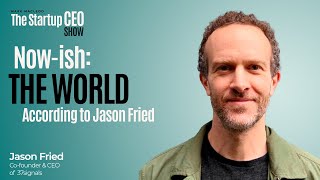
Jason Fried, CEO of 37signals, explains why his company stays small and profitable instead of chasing venture capital. He argues for a "nowish" approach over long-term planning, keeps teams lean, and gives employees unscheduled eight-hour workdays. Fried credits co-founder alignment and intuition-led decisions for 37signals' sustainability.
Questions this video answers
1999 ("we started our business in 99").
About 25 years (he refers to being in their 25th year).
Everyone has about an eight-hour day to themselves (unscheduled/time to do work as they choose).
June 17, 2024.
Chapters
Don't look to big complicated companies to run a small company. Look at maybe a small company to run a small company and don't take the wrong lessons. And if you're new at a company, let's say you're a startup and you're starting the thing up and you used to work at some big consulting firm, and big consulting firms have big teams because they could bill a lot more when they have more people on a project. Don't take those lessons into your small little business.
Welcome to the Startup CEO Show. I'm your host, Mark McLeod. In this episode, I have the great pleasure of chatting with Jason Fried, co founder and CEO of 37signals, someone that needs no introduction. I've been a follower of Jason's for a very long time. Jason's an independent thinker and that absolutely showed up in our conversation. We talked about the importance of balance, not overbuilding, how profit is normal for companies, power of simplicity, the good and bad of venture capital, personal branding, and so many more topics. I thoroughly enjoyed this conversation and I hope you will too. And I hope you subscribe. Jason, welcome to the Startup CEO Show. It's a true pleasure to have you here today. How are you?
Hey, Mark, nice to see you.
Yeah. So I've been a fan of yours for a very long time. First came across you when I started advising FreshBooks way, way back in the day. And it's funny, both of you have similar origin stories, Right. Basecamp was an internal tool kind of that grew up inside your agency. And that's exactly what happened with FreshBooks as well. Both have gone on to be, to matter a lot. First of all, still around have staying power. Both are big companies. And that brings up my first question for you. Like, does vision matter? Like do we just over attach too much importance to vision or should we just get going?
Right. For me, I can only speak to me. I don't really have a vision, like about like a long term vision. I'd like to like keep doing this for the long term. But what we were going to do, we started our business in 99, like where it is today. Had no idea, had no idea what it was gonna be like five years ago or five years prior to that or five years prior to that or 5 years prior to that. So I, I don't, I don't have like, well, 99 we're gonna be this and by 2024 we're gonna be this. Don't think that way. I don't think that way. I mostly just think about now. Ish like now and then, like the next few weeks.
Is that the title of your strategy document, now? Ish plan.
But I like, I like that, I like that idea of nowish. That might be a good book name actually. Or think about writing another book. Maybe, maybe I'll use that. But I have a sense of direction, of where I want things to go and which direction we're heading. But it's not a vision. I wouldn't call it that. There's some principles that we follow. Like we want things to be simple and very utilitarian and we don't want to follow a bunch of trends. We want to do what we think makes sense. And small teams, some of that stuff. That's not a vision as much as it is practical day to day. Yeah. I think some companies though, like, I mean, if you're, if you're building a rocket ship to Mars, like, you gotta have a vision that's different. It's a, that's a different level of thing. So I think you gotta find out what works for you. But works for me is like nowish.
That's what we're seeing. Yeah, I love it. So you've invented these terms over the years, like Stay ups or Jomo, Joy of missing out. And so you clearly think independently. I'm wondering, how did you cultivate that? Were you always that way? Is it just. Let's just take a contrarian stance. Where does that come from?
Probably ignorance. Like, I, I don't, I don't pay that much attention to in my field. I don't pay much attention to what other people are doing. I pay a lot of attention to a lot of things in, in life. But how people do things doesn't really interest me as much as like what works for me and for us. So I think the fact that we're based in Chicago, we're not, we're really remote company, but we started out in Chicago, far away from the Silicon Valley scene. Helped quite a bit because we weren't, we weren't influenced by that world. And, and you know, you can, It's a vortex. It's like if you're close to it, you get sucked into it and you just kind of, they're all. This is a broad generalization, but I was gonna say, like a lot of those companies are all the same and they, they work the same way, they're after the same things. Growth is the tribe is a primary thing. The method in which they get there is kind of very similar. The products are different, but like the techniques. So we we didn't live there. We're on an island out in Chicago essentially. And, and I just wasn't paying attention. I still don't pay that much attention to the industry.
That that's like. You just illustrated Jomo.
Yeah, yeah, there's Jomo. Like the joy of missing out. I mean, thing is like I don't feel like I'm actually missing out in that case. I feel like I'm just looking in a different direction and there's a lot to see somewhere else. So it's not like I'm not seeing anything that I like. I just am seeing different things and looking to different things for inspiration like nature, architecture, small local businesses. I just prefer that stuff to like other tech companies.
Do you make a lot of time for reflection, to just allow dots to connect?
I don't make the time like it's not deliberate but, but I leave the time for that to happen. I, I think I try not to be. In general, I'm not very deliberate about how I use my time. Like it's not like I, I set aside two hours to write or I set aside an hour and a half to contemplate or some of that. It's more like I write when I have something to say. I think when I need to think about something. I have a lot of space in my day for things to come to me. I mean things always come to you, you don't. My point of view is like you don't get to decide what you're going to think. The things bubble up but you need to be aware and have the time to allow those things to bubble up and to be aware of those things and go, oh yeah, there's something interesting there. So I would say the way I do that is just by having not, not, not a rigid schedule. I have a lot of free space during the day and everyone at our company does. It's a fundamental principle here is that everyone has about an eight hour day to themselves and if they work to do, but it's not pre scheduled by anybody else. People have their own data themselves to figure out how they're going to use it. And for me a lot of that is, is, is gaps to let things come to me and then to work out those things in those moments. It's. I like I can't be creative at 3 o'. Clock. Like if it's 11am or 11:42 or whatever. Like whenever it strikes is when I have to kind of take it.
Yeah, sounds very Taoist.
I've heard that it's It's a very. Well, it could be a lot of things, I suppose, but for me it just works. I'm just gonna, I'm just gonna say it works. Whatever, whatever you want to call it or whatever the influence are. And they're are many influences from a variety of different things, many of which I don't even know. But it works for me. So that, that's what I do.
It brings up for me something you said in a recent conversation with David Perel. I hope I'm pronouncing his name correctly. I'm a big fan of the written word, which is also one of the reasons why I was drawn to you early on. And, and, and therefore I follow David. And you know, he said something along the lines of, you know, whenever you go against the nature of things, you battle unnecessarily. And what you've just described here is sort of going with the flow. And I think a big part of that is the fact that you actually leave space. Right. I think so many people think like they can't do that. Like, you know, when I start coaching CEOs very. I asked to see their calendar and often it's just slammed, right? And I was like, when do you think? Like, when, when do you do email? When do you do slack? It's like at night. And like, you brought up creativity. It's hard to create when you're stressed. And anyway, I'm just wondering, like, so you do the space. The space thing is so powerful. I wonder if you have any other practices to deliberately tap into intuition and create a flow state.
Yeah, I mean, part of it for me is that I am very much intuition gut based and driven. So because of that, I don't, I don't set up systems that would push against that. So like I said, I mean, I'm kind of repeating myself on this one a little bit. But I don't, I don't have a rigid schedule. I don't have a process that's so rigid that I have to do everything the same way. Things have to just kind of come to me and then I have to sort of find them and flow with them basically to make them make any sense for me. So a lot of our decisions that we make are intuitive based or intuition based. David and I will have a conversation about some. David, my business partner, not David Perel, but we'll have a conversation about something and just kind of make a call based on how it feels to us. It's not like, well, let's pull out. This spreadsheet in the database and let's look at all these things and let's look at 300 pieces of customer feedback and let's weigh all these things and then make a decision based on how it all weighs out, like what the scale says. All these things are part of it, but there's also a bunch of other things that are part of it that we can't really quantify, but that we feel and we make a call. So I think that is a practice in a sense, which is just trusting your gut and being very comfortable with that process. I think if I was comfortable with that process, but I did something else because I thought it was the wrong way to do it, that'd be a problem. That'd be like pushing against as you were talking. Like, if I'm like, well, my gut says this, but because I'm supposed to follow this process that we laid out here in these 12 steps or whatever it is and do that, like, that would feel wrong to me. I wouldn't feel satisfied and I wouldn't really enjoy the work. So I think another fundamental point is to get to a place where you, you can enjoy the flow and not overthink things. Yeah.
Did you and David arrive at these principles together? Was this. Part of what brought you together is you each already had those independently. How did, how did that all evolve?
Yeah, this is another thing, kind of like the vision question. Like, it just, we didn't know this ahead of time. It just sort of happened. And I think we've had different points of view over the years and sometimes they convert. You know, it's like the time is like, it's kind of like this and it converges and it goes and it converges. And so like, sometimes we like, are really on, on the same wavelength. And other times, like David. There's been times when David's very data driven or has been very data driven. And I think he's sort of coming around now to, to like, more intuition again and feeling that out. And I think we started out very intuition based and we got a data scientist. And so since we had a data scientist, we had all this data. And so now that we have this data, David's very analytical. He likes to look at the data, understandably so. And I think that that was maybe driving some of his points of view for a while in a way that was very helpful for him. But, like, was different than the way I do it. And I think now we've kind of converged again, which is nice. We, we have, I think basically we see things 90% the same way, which is. Which is good. There's tons of overlap, and then there's some headbutting here and there. Right. That's kind of a good. To me, like a pretty good mix. You know, it could be 80, 20, whatever it is. But 50, 50 wouldn't be good. And less than that, I think is. Is pretty tragic for business.
Yeah.
I've seen a lot of partnerships and business just go south because people just don't agree on. They don't agree on more things than they agree on, and then it's just. Everything's a fight. And that's just not a. It's not pleasant. I mean, like, this work at some level needs to be pleasant and sustainable.
It's huge. For you, it's a third of your day. For many people, it's a lot more. So.
Right.
Yeah. Ideally, it'd be very pleasant.
Right.
Should give you energy.
It should be. I mean, like, we should all do hard things and challenging things, but, like, some stuff's got to be easy and some stuff's got to. Much of it should feel pretty good if it's just like, suffering because forever, I don't know, that's not really my. There's enough of that in the world, and in everyone's world, I don't really want to go to work to do that too. So I think the word. Always say that again?
No. The word I'm always on the lookout for with my clients is when they say, should. I should be doing this, I should be doing that. I'm like, says who? That word implies somebody else's expectations. Like, where does that come from?
Like, that's right.
What do you want to do?
That's right. Yeah. And if the should's coming from you, it's like, yeah, I know. I really should do this because I think I should be doing this. That's a. That's a good should. That's a good shit.
Yeah. Yeah.
So anyway, I think. I think that we've. We've developed our way of working together over many, many years. But there's enough deep common similarities and points of view that are. That are shared that allowed us to, I think, persevere through all the moments that would normally break up a business. Yeah. Like, if David was really all about growth and wanted to get as big as possible, and I would want to keep things small and, you know, grow steady, like, that just wouldn't work. If David was about making a really super complicated software and I was really about making simple stuff that Wouldn't work. You know, if David wanted to build a huge team and I wanted to keep the team small, it wouldn't work. There's all like that, those fundamentals that are really at the deep, fundamental molecular level of a company, essentially. You have to believe in the same physics, in a sense, in order for you to be able to have conversations.
Yeah, it's ideology. It's funny. Like the super early days of Shopify. And I'm sure you know this because you knew Toby kind of from the beginning. Right. He wasn't the original CEO and he and Scott actually disagreed on just that very thing, like how fast should we grow, should we raise capital? You know, so they just didn't have aligning ideologies.
Imagine if, if, if that just continued, like Shopify would not. It wouldn't be able to be what it was today. It would just be one big fight. It does. Shopify doesn't look like a fight. It looks like a wonderful, happy thing. Not a fight, you know, so, yeah, you got, you gotta. You gotta fight. Sometimes that's totally good to polish the rocks, basically, but you gotta be left with something in the end. You've gotta be left with the beautiful polished stone. It can't just all be dust, like the too much fight and the whole thing falls apart.
So staying on David for a second, you guys are in your 25th year, and I'm just curious what you've done to maintain the relationship.
I think there's probably a number of things. These are my guesses. One is we don't do the same thing. So David's technical. I'm on the design side, so I'm more on the product design side. He's more on the engineering, technical side of things. And that's nice because we can't disagree on those fundamental things, really. Like if we're both programmers, you could just imagine arguing over the same thing too often. So he stays in his realm, I stay in my realm. Of course, we cross over to some degree. He crosses over more to mine than I do to his because I'm not technical. And he can, of course, and anyone can give feedback on design and product, but we kind of respect our own areas of the business. And then we have this overlap, which is like how to run a business that we're very much aligned on. So there's not a lot of disagreement there. And then I think there's. I'll speak again. For me, I can't speak for him, but I deeply admire his skills and his ability to do what he Does. I'm in awe of it half the time. And I think in any good partnership, you need admiration, you need to admire your partner. It can't just be. You can't look down on them. You can't think they're not pulling their weight. You can't think whatever. Like, you got to really like, wow, I'm lucky to be able to work or be or whatever with someone like this. That's important. And I think a lot of partnerships that I've seen in business have a lot of jealousy, not admiration, or someone's like, this person's not pulling their weight. I'm doing everything around here. What the hell are they doing? Like that. When that seeps in and you have resent, that's resentment. You know, it just, it's, it's over. It's very, very difficult to make that work over a long period of time.
Yeah, yeah. Those are cancer cells. You know, you leave it unaddressed, they just grow. And then small things become big things and there's no turning back in every relationship on product. You know, I watched Elon Musk take over Twitter, seemingly kind of decimate the engineering team in order to kind of reduce burn, and yet the product still works, the service is still running, features are getting added. Which makes me think, do you think most especially kind of venture, institutionally funded startups or scale ups that just over build or they're just trying to do too much because clearly the company's still around and you've probably taken a different approach. So I'm just curious what your thoughts are.
Yeah, I do think most companies are too big and they don't benefit from the size. Some, some things have to be larger. Like if you're making a lot of hardware and, and there's very complicated stuff. Yes, okay. But software in general, which is. Yeah, software in general, which is what we do and what Twitter is and what other companies are, many companies like, they do not need to be anywhere near as big as they, most of them are. There's a lot of inefficiency. Teams are too large. And because the teams are large, you need more, more other people to support large teams. You need a lot of other process to support large teams. When the team is large and everybody's in the loop, that becomes hard as well. There's miscommunication. There's, there's, there's, there's a whole bunch of things that happen that like just become hard and, and that shows up in the products. The products don't evolve as fast as they should they get. They, they get, they get calcified, essentially. They get kind of stuck and hardened in ways that, like, they're not as fluid and they're not changing the right ways. There's a lot of people's pride built into these things, so they can't change. And I think what, what Musk did at Twitter is one of the great case studies. Aside from all the other things that come with, with some people's perceptions of Elon Musk, the fact that you can walk into a company, I mean, there's a lot of pain, obviously. Like let. What do you let 8,000 people go or something? Or, I mean, that's hard for. It's very hard to do, which is why it's not done in most places. The fact that he was able to do that in public and do it and make it happen and probably overcut in a few places and show that, like, again, regardless of what people happen to think of Twitter and whatever is on there, like, the service works and it's been getting better. The product is much, much better than it was three years ago. You just have to. You got to pay attention to that reality. Like, whoever's on there, whatever they're saying, okay, fine, but the product is good and it, and it works. And it was never really down. And it's a testament to the fact that small teams and understanding what was really necessary to run something, it's an art form to figure out how to do something that way. And most companies in most places would never have the guts to even try that. So I really admire that in him, in what he did. Even though of course laying off a lot of people is painful. And a lot of people, you know, depend on that, and they have mortgages and all that stuff is obviously hard. But his job was to save the company from, you know, his point of view. So, like, he did what he had to do. And I admire that he made that decision.
This episode is brought to you by Fellow Tell me if this sounds familiar. You wake up, you take a look at your calendar, and you see it's filled with meetings, standups, weekly check ins, one on ones, town halls. And those are just your internal meetings. Some are productive, but some are definitely slowing you down. Be honest with yourself. How many times have you thought this meeting could totally have been an email? Now consider that in the US alone, there are 55 million meetings each day, and 85 to 90% of those don't have an agenda. Velo is on a mission to solve the meeting problem by offering the Only AI meeting management solution that covers every part of your organization's meeting, workflow, flow. And As a startup CEO show listener, you get 300 free minutes of AI recordings. If you sign up today, go to fellow app CEO to start your free trial and start having better meetings.
At the beginning of our conversation you talked about how Chicago kind of sheltered you from Silicon Valley and that kind of default kind of venture capital type thinking. And I mainly coach the CEOs of venture backed startups. And VC is powerful but in the right circumstances can be transformational. Shopify is a great example of that. But it also can cause a lot of damage and significantly increase failure rate of companies. And I think I meet so many founders who think of venture as just the default path. This is just how you build a startup. And my sense is, is you're actually, you know, pretty anti VC and so I'm wondering if you would just share your thoughts and give maybe founders another perspective to think about.
So I, I'm anti VC when it comes to raising money early for a business that doesn't have anything yet. Like I think the idea that people feel like they need to raise a bunch of money to start a business, I, I don't understand that. Unless of course again like you have massive capital expenditures and you're going to build a factory and, or whatever, or you're in biotech and you need to do 10 years of research to launch a drug. Like a different story if you're making B2B accounting software. Come on. Right, so that's what I'm opposed to. I think like Shopify would probably would not be Shopify without the cash they eventually got, many companies wouldn't be either. And I think that those companies had something going and then like that was accelerant for them and that's what they wanted to do. So there's obviously a place for it. 100% investors are not evil. I don't, there's none of that. It's more like too much money at the wrong time. Too much money too early I think is a real danger and potentially a wildfire for a lot of companies and they just, they burn down because of that. So my sense is to keep things as sort of small as you can initially, as light as you can initially, keep your costs in check, do what you can with a few people, not, not many, and make something, have something, get to profitability as soon as you can and then you have some leverage. Like you've got a working business, you don't need other people's Money, which is a good place to be if you're asking for money. It's a bad place to be when you desperately need it. And if you don't have it, it's over. You're going to take a bad deal, you're going to give up too much. You're in just the wrong position. And remember, you're asking for money from an incredibly financially savvy investor. Anyone who's in the VC world knows what the hell they're doing with money. They've seen everything already, and you have no leverage and you're not probably smarter than they are. So it's a bad place to be to ask for money early on when you don't have anything to show for it. So I get something to show for it then. If you feel like it's important, then definitely consider that option. But yeah, that's generally my take.
Yeah, I completely agree. I think folks kind of go down that path too early and it's not an informed decision and they have no leverage. Mike at FreshBooks, every time he raised capital, he talked about taking the business through a dolphin dive. He was profitable. He'd raise some money, go, burn, come up to a new trajectory, get profitable again. The dives got bigger each time, but every time he raised, he was profitable.
That's the place to be. You know, if you can be there, I would say that's the place to be.
Your concept of, you know, working in small teams and breaking, breaking stuff down until a team of three can do it. And, you know, you don't have a lot of meetings. So I'm just kind of staying maybe a little bit on the contrarian thinking thread for a minute. And so many companies do the opposite. You know, they have these giant teams and there's nothing but meetings, and people don't get actual work done during their prime hours. Like, where did they go wrong? Like, what, what's, what's going on here?
I'm stumped. I really am. Like, I, I, I don't know, I don't, I don't understand it. Like, I really literally don't understand why you go in that direction. My only insight here would be Earth insights. Even the wrong word. My guess is, like, people who, they're carrying something along with them from a previous experience and they thought that that's how you have to do it. Like, they worked somewhere else and that's how it was done, so that's how we're going to do it. Or I thought that's how you're supposed to do it, or, or I'm a small company, but I'm, I'm, I'm trying to emulate a big guy. Facebook's really successful. So let's. How does Facebook do? Well, they have big teams. Well, yeah, they've got 50, whatever, thousand. I don't know how many people they were working on, but like, yeah, whatever it is. Whatever it is, right. It's like, don't look to big complicated companies to run a small company. Look at maybe a small company to run a small company. And, and don't take the wrong lessons. And, and if you, if you're new at a company, let's say you're a startup and you're starting the thing up and you used to work at some big consulting firm and big consulting firms had big teams because they could bill a lot more when they have more people on a project. Don't take those lessons into your small little business, you know, So I just, I just think there's like this continuum of, of experience that people bring with them from a previous experience that does not apply to the current experience. But they can't break the, the chain. They, they just have to continue down the path because that's just how it was always done around them. This is an advantage of, of being ignorant, like I mentioned to you, or naive or, or a beginner's mind. Essentially. You're like, I don't know what the hell I'm doing. I have no idea how to do this. So what, what, look around. Like, what seems to make sense? Well, we need a programmer and a designer and maybe another programmer. Like, that's all I need. That's all I'm going to get. That's all I need. That's all I want. Versus, like, we need a team of 14 because the previous company I worked at, we had 14 people doing this.
Yeah.
Two very different outlooks. And so I think one is much healthier than the other.
Yeah. I feel like to the extent that you have benchmarks, they should be now ish. Benchmarks. Companies that are just a tiny bit ahead of you. Not companies that are, you know, giant. Because it's just different, different worlds.
I think you nailed that. And, and this is advice I tend to try to give to people, which is like, don't ask me about what it's like to start a business. I haven't started a business for 25 years. Ask someone who's started one six months ago. Like, they, I don't know if they're doing well or they're not, but their, their Knowledge is way more contextual, way more current, and it's way more applicable to the situation that you're in. I am not in that situation anymore. So whatever I tell you is a memory, right. And it's a dream. And so the best case scenario of what I can remember, right. Versus like someone who's just dealing with like, making payroll again, because it's hard. And, and whatever is going on, like, that's much more real for you. So I don't look to, like, I think the idea of looking to very famous success stories is actually a terrible path. Actually, in many ways you're better off looking at people who are just dealing with the same stuff you're dealing with right now.
I completely agree with that. You know, first of all, they're two different worlds. But second, success is a lot rarer than we think, right? These outliers, like, they're just.
Yes.
On a probability adjusted basis, they're just. They're so rare.
They don't exist. They basically don't exist. Right. I mean, all things considered, they don't exist. So to try to like, emulate something that essentially doesn't exist and you don't even know what parts worked and what parts didn't. This is the other thing that people often get wrong is they look for lessons and the lessons have nothing to do whatsoever with what, why this company worked. It might have been timing, it might have been the name. It could have been a, a particular partnership that happened or some other brand happened to adopt something and they made noise like he. Who knows, who knows really why? And it's always a combination of things and timing and all this stuff like, and, but, but you look at it and go, well, they, because they follow this process, they're successful. Or because they raise a bunch of money, they're successful. Like, you can choose to pick and choose whatever you, you please, but it doesn't mean it's right. It doesn't mean it has anything to do with the story. I think you're much more able to relate to like the guy down the street who's, you know, dealing with the stuff that you're kind of dealing with at the same time. Because then there's kind of a lot less guessing. It's more like really practical, utilitarian, in the moment now. Ish. Stuff that you're dealing with and they're dealing with. And it's. The chances are it's going to be a lot closer to what your reality is than looking at what Jeff Bezos did in 1999. Or something to start his business or whatever it was.
This brings up for me kind of the importance of peer groups. Like all of my CEOs are either part of something formal like entrepreneurs organization or YPO, or just something informal because then the people that. Two reasons. One, the CEO job's super lonely and truly only other CEOs kind of get what you're going through. But then they're probably getting that now ish feedback that they need. Right. Someone's just a few yards ahead of them. Super. Do you, do you have one of those? Or have you ever, have you ever been part of a group like that?
I've never been part of a group like that. I'm not really, I'm not a group kind of person. That's not any verdict on those groups. I'm sure they're incredibly useful actually. But I, I, I don't know. That's not my style necessarily. But I, I Talk to other CEOs or founders that I know, but very informally. There's not like a regular conversation, but like a, I know a bunch. So we just talk occasionally about stuff whenever something comes up. And I'm happy to help others if they have questions and I get a lot of emails from people and I answer and stuff like that. But I can absolutely see how that would be really, really valuable. It is a lonely position and it's a hard one, especially for a CEO who's not a founder. And if the founder is still involved, that's got to be a very, very hard, small subset of CEOs that have a different kind of challenge too. So I think it's really important to your point to find people who are really going through what you're like. It's one thing to be CEO of a company, it's another thing to be a CEO of a company under a founder who's still present. It's another thing to be a founder CEO. These are different things. And I can imagine like surrounding yourself with three or four people who are in the exact same kind of situation you are is very, very helpful. So I would support that. I just never really got involved with that.
Cool. So I'm curious with the balance that you espouse and that exists in the company, eight hour days, 40 hour weeks, you actually have time to have a life. I'm curious, like, are you attracting a different talent pool? Are these like people who come from the venture world and have PTSD and are now here to recover from their trauma? Like what, what's the demographic?
Some people have been through that world.
Others.
Know they don't like it to the, in the first place and it's, it's hard to find in like a stable company that's not VC backed in a sense. And so they kind of want to work at a smaller company that has a big impact that's stable, that's going to be around and they can like sync, you know, they can grow roots here in a sense. But yeah, some people have been, have worked or have worked at not even the VC thing but I've worked like at huge companies in the past it just like or consulting firms and just found like they, they can't really, they don't have an impact. They don't, they, they, they don't have. Their actions like are just sort of swallowed up by the, the, you know, the size and scope of the organization they're in. So they're doing the same kind of work but the work doesn't seem to mean as much. Not like deep personal meaning as much but like just, just one of 6 billion things that the company does, you know, versus like you can come here, we've got a handful of products, got a small operations team, customer service, Everyone knows everybody. We only have humans here. You know, like, like, you know like everyone, everyone can do work that, that's going to be noticed and that has, that does play a part and is important and if it went away it would be missed. I think that's one of the other things that happens in big companies is like you feel like if I just didn't show up to work for a month like nothing would really change around here. Like at our company, people, everyone we have here, like if they didn't show up for a month like you would know they weren't there. And I think some people really like working in a place like that. I certainly would.
And do I want to talk about something your dad said? He says you can't go broke when you make a profit. I forget the exact words but something like that. The common wisdom in SaaS, you look at the OG SaaS company Salesforce, they were giant before they turned a profit because the strategy was I want to acquire as many annuities as possible I E Customers where LTV is higher than cac. So I'm just going to keep reinvesting and burn my way to greatness and eventually I'll be profitable. So I'm just curious, do you think this sort of profit first approach really works? Only in a, a market like yours. You know, you serve SMB. It's kind of horizontal, sort of mathematically impossible to run out of. Tam if I was going after, I don't know, Fortune 500 or consumer, am I forced to raise capital? What are, what are your thoughts on that?
It's an interesting question. The way I look at it is much broader than, than like, than that. I would say pretty much every business on planet earth runs like ours, which is like you got to make more money than you spend or you go out of business. So I think the outliers are the ones that do it the other way. And for me it's almost like they have the burden of proof to say, well, it's worth losing a bunch of money for a long time to make this work. Because the way I look at the world is like every business on Main street in your town, they either make more money than they spend or they go out of business. And so I don't feel like I have to answer in a sense or make the case for the other way because most businesses are. This is like business 101. Really. Of course there are examples where companies have, you know, lost. Amazon's another famous example, lost a bunch of money for a long, long time. But you know, those, those companies were able to raise a lot of money from the public and had a lot of trust and, and, and had a great leaders who could make the case that we're going to be misunderstood for a long time and this is going to work out in the end. And they had a lot of experience and xyz, you know, and, and you've got to also, so you got to have that too. You got a certain charisma. You've got to be able to sort of like change people's perceptions for a while. Mark Benioff is one of those guys, Bezos, one of those guys, you know, that kind of thing. Right. So it's possible. Clearly. Clearly is my, my general point of view on it though is that reinvesting everything back into your business, whatever you make, and putting it back in every year after year after year after year, you're just doubling and tripling and quadrupling and quintupling down on the risk because the chances are your business isn't going to work. Like that's just the reality of the world. So I, I'm a fan of taking money out of the business as I go, not putting it all back in and realizing like, well, can we get paid for the effort we made this year and for the success we had this year? Hopefully, let's get paid. Let's take some of that risk off the table, put it in our account and like, great. So if all this thing, if this thing falls apart and goes to hell, like, at least we were paid for the work that we did in a sense, you know, we got to enjoy the fruits of that labor versus, like, I'm going to keep piling and importing and importing and then 18 years from now I'll get. The fruits of my labor will pay off. Like, yeah, it can happen. It can happen in a huge, massive way. But the chances are so infinitesimally small that it just seems like the odds are so stacked against you that it's a bad bet. Even though sometimes long shots come in. That's how I look at it. Maybe I'm just more practical, perhaps, and less of a dreamer in that way, but I'm fine with that.
No, it makes complete sense. You know, it's funny. Amazon's a great example. I haven't segmented this out, but I actually think it's a pretty shitty business and AWS is the only thing that saved it. But I haven't segmented out to see what pure, you know, the core business looks like.
But yeah, yeah, I don't know either. I looked years ago. I mean, AWS is a juggernaut. Huge, massive business. And the same thing is true in many ways with Google, like search, you know, advertising revenue is essentially covers up all the things that they do that don't produce a profit, you know. And this is, this is. It's funny because these things are like fractal in a sense. Or, you know, like, generally that's how it is. Everything's kind of hits, business. There's one, one or two great songs in an album. I mean, some albums are of course full of them, but most are not. You know, a company might get one or two hits. We've had like a couple hits. We've made, I don't know, all in a dozen products, kind of, you could say. And we've had a couple hits like, this is how it Goes. So there's nothing, like, wrong about that. And Amazon's probably in a really good position because they have AWS and they made it happen. It wasn't lucky. Like they saw something early and what was cool about what they did with that was that, of course, like, this is not an obvious. I mean, think about how strange it is. We're not used to it, but how absolutely bizarre it is that Amazon, the place you get your whatever from.
Toilet paper.
Toilet paper, let's say what Was compute. Yeah, was the pioneer, absolute pioneer in cloud computing.
It's so bizarre.
It's so completely bizarre. Which is what's so beautiful about it also is that a company like that saw an opportunity, they understood that, hey, we're building this infrastructure for ourselves. Other companies are going to need this too. Let's make this a product that we can sell and use also. I love that. And anyway, it's a great story, but it's also incredibly rare. To your other point, you know, we talked about earlier, like these are extreme outliers. It's basically zero, you know, so correct to look at that and go, we could be that. Like, it's just, it's, it's, it's a, it's a, an odd thing to bank on, I would say.
And very not nowish.
Yes.
To keep.
But again, hey, long shots pay off sometimes. I mean, you know, 501 bets can happen. You know, it happens obviously. So, you know, so someone, someone's going to point to a success story and go. But look and go. You're right, it happens. Absolutely happens. My, my sense is like, you're probably better off finding better odds. And your, your, your bet may not pay off. 500 to one or thousand to one. But what if it pays off 80 to one? That's pretty damn good. Or 30 to one. Amazing. 10 to one. Amazing. Odd. Five to one. What a great payoff. You know that these are great payoffs still relative to a thousand to one to a thousand X and no, but like five x Amazing. And, and that's a lot easier to achieve. So that's enough like go for that.
Yeah, the man. As we start to get into the final, final minutes here, I want to come back to you personally and mentioned I first saw you in person kind of way back probably 2009. And you know, you were a bit of a celebrity then and, and still are. And there's lots of folks kind of building their personal brand these days and CEOs are posting on LinkedIn and just wondering what you think of all that. Is it good? Is it necessary? Is it vanity? What are your thoughts on all of this personal brand stuff?
It's probably all, all the above.
So good.
It'd be disingenuous to, to suggest that vanity doesn't play a role. And yeah, we're all, we're all a little bit like that. I, I think if you have something to say, you should say it. The worst though, is when you don't have anything to say and you still say it. That's the problem. So when you see a lot of people posting a lot of stuff that's sort of like dribble and sort of formulaic and like I'm gonna use the word content, you know, optimized just for SEO and like all these, it's like, that doesn't appeal to me personally. If you, if you're a CEO, founder or whatever, whoever, a designer, anywhere, whatever it is, if you have something to say, say it. Absolutely. Go say it. Please say it and say a lot of it if you have a lot to say. But make sure you have something to say and not just something to sell. I think when you just have something to sell, it's pretty obvious and, um, people will listen to you for a little bit, but they'll stop, they'll stop listening if you're just hawking stuff. If you're genuinely sharing a point of view that you think is useful with no strings attached. I think you've got legs there, but otherwise you're just going to fall over. And I think that's, so that's my answer. I, I, I do love, I think it's a great thing, but it can also be a bad thing. It depends on what you're, what you're doing and why you're doing it.
Funny on content, right? And you talked about how everything's hit spaced, right. An album maybe has one or two songs that are really good. I think even within a book there's a segment of it that's really an amazing blog post and that's what it should have been, but then they just blow it up into this thing to create a book.
This happens all the time, right? Yeah, yeah, this happens all the time. And I think that's why a lot of business books specifically are like, they're too long by half, you know, and, you know, but that's also just the book industry and how the book industry is. And like, I remember we've written a few books and like, length is important because it's got to be a certain thickness. So when it's on the shelf, people think it's worth the money and all the things. So there's a whole thing around that and I, I get it. So that, that's sort of how, how it has to be.
I'm curious, just staying on personal brand for a moment. Like the number one thing I look for in CEOs to coach is self awareness, which actually correlate highly with introversion and humility. And yet I meet so many CEOs that just drinking their own Kool Aid. Right. And believe their own hype. And I'm wondering what you have done to stay grounded and stay humble and not get caught up in all of, like, you're highly visible. Your companies, you know, have had a huge impact. Like, it could. It could have been easy for you to just start drinking your own Kool Aid.
Well, first of all, I appreciate that that's your impression, because I, you know, I don't have a good point of view, like. Right.
You can't.
It's very hard to see yourself in that way. But thank you. I try. I'm sure I've drank some Kool Aid along the way. And there's moments when you get a bit full of yourself. It can. It happens. I always return to the feeling of things, and I don't feel good when I'm that way. And so I can feel myself when I get like that. And that's how I know it's not right for me.
Yeah.
So that I don't. Ability. I don't know what it is that. That sense of paying attention to how it feels to be a certain way has, I think, hopefully kept me honest about it as much as possible. And sometimes you've got to go over the line to feel it and then you pull back and. And so I'm sure there's instances of me going over the line. I hope I just don't stay over the line. That's. That's the best I can do.
I love it.
Yeah.
Final and most important question. I watched a podcast of you earlier, and you were in this exact spot, and I thought I saw a set of drums behind you. So I'm wondering, are you a drummer?
Yeah.
Oh, look at that. Nice.
I'm learning.
Yeah. Okay.
So drums is something that I've always. I've always been interested in the drums. I dabbled on and off over the years, and I just had a turn 50 and I'm like, you know what, if not now? When I was like, I love it. I love it. Like, I got. Let me do this. Let me just do this. I bought a kit that's too good for me. I mean, it's an electric kit because I live in a house and I've got a neighbors and family and stuff. And I'm like, you know what? I'm going to do this. I'm going to commit to learning this. And I love it. And I'm a very beginner, but it doesn't matter. I just. I love it immediately. Which is interesting because I played guitar for a number of years on and off, and learning guitar was not satisfying to me. It was actually pretty hard and it didn't click. I can play, but it. Sucking at the drums is fun. Sucking guitar was not fun. So that's. It kind of just tells me, like, I'm on to something with this for me, so it feels right. And I'm. I'm very much committed to getting better and learning this. And it's. It's a great, great thing.
I love it.
I see you've got some pianos or something in the background or.
Yeah. I actually run a electronic music record label, so if you ever popped a little white pill and went dancing all night, you were probably dancing to the music that my label releases. But way back, not.
Not gone dancing while on it.
There you go. Yeah. So way back in the day, I was a drummer in a rock band in high school and I had long permed hair. But this was blessed before digital cameras and social media. So nobody can see the evidence.
I can picture it. Yeah.
Yeah, yeah.
It's funny, actually, the employee we have who I think lives somewhere up near you is also a drummer. So you guys should.
There you go.
Get to know each other.
Yeah. One of my CEOs actually has a kit in his office, and sometimes he'll just go and wail on it and just release some stress.
That's what it is for me. This is. I'm in my office, kits right behind me. And, you know, I was actually. I'm going to write something about this because I had a thought. Like, practicing something is actually not about starting. It's. It's about not stopping. Like, if I would have just not stopped, I would be good by now, you know?
Yeah.
It's like. It's that side of it more than the. Like, you just got to start. I. I think it's. You just not got to stop. I mean, it's a double negative, I suppose, but that. That's what I'm kind of trying to do here. So I've been. I've.
Been.
At the very least, I will find 10 minutes a day to play, and I've been doing that every single day. So that, that. And you just, like, you will get better. Ten minutes a day, you will get better. Just. You can't help but not get better. You might plateau at some place where you need to really put in more time, but at least you'll be getting better. And. And that's been very satisfying.
You know, you brought up a key word. Right. We. Which is practice. Right. And anything that we refer to as a practice, like a meditation practice, a yoga practice. The point is you never arrive. You just keep doing it. Right. It just becomes a daily habit and that's right. So hopefully drumming is the same thing for you, right? Yeah. You'll never arrive and you'll just. You. You just do it for the joy of it. You're not trying to get to be. I don't know if Neil Pert is one of your drama. I just doing it for everyone.
Yeah. I have no interest in ever joining a band. Like it's not playing with either other people even is not my interest. I just want to. I just like to play and that's enough for me. So hopefully I'll. Hopefully I'll get to the place where I'm proud of my playing.
I love it.
Yeah.
Well, Jason, thank you so much for making the time. I've really enjoyed this conversation and. And I look forward to seeing what is happening now. Ish for you and the company in the future. Hey, thanks for listening to the Startup CEO show.
If you'd like to connect with me, be sure to visit my website at.
Markmcloud me or follow me on LinkedIn @the markmcleod or Twitter arcmcleod. And if you want to tune in again next week, be sure to subscribe on YouTube, Spotify, Apple or wherever you get your podcasts. We'll see you next time.
More from Mark





The Burnout Breaking Point - How Strategic Breaks Actually Increase Productivity


Emotional Debt - How Avoiding Hard Conversations Compounds Into Company Killing Resentment


The Death of the Specialist - Why AI Is Creating a New Professional Class Called Scalers