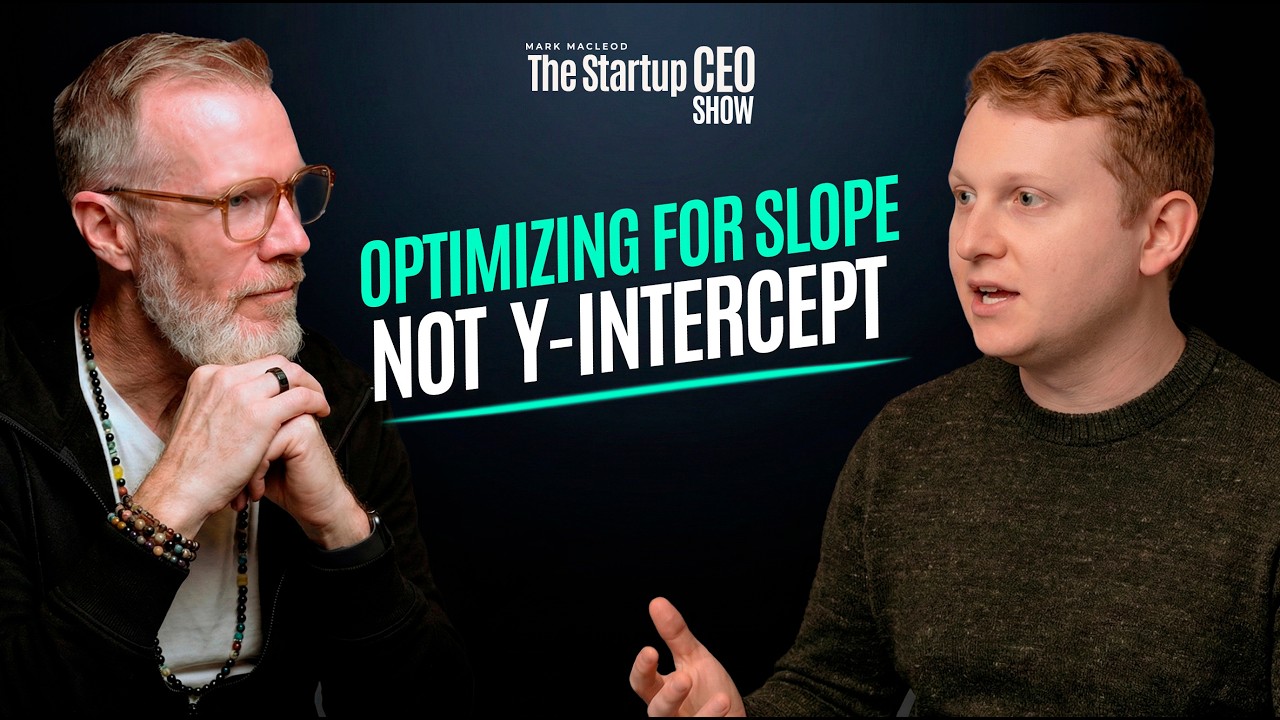
Justin Hurlick, CEO of Pine, chose early jobs for learning over salary, calling it "optimizing for slope." He hires for mission alignment over credentials, and raises capital by finding investors whose thesis matches the company, not just the sector.
Chapters
In this clip from The Startup CEO Show, Justin Hurlick, co-founder and CEO of Pine, offers some great advice to people who are early in their career about how he chose his early career roles, not optimizing for money or title, but really for slope of learning and how that set him up to be the really strong CEO that he is today.
You're, you're generally not gonna attract those people, right? Because I, I know where those people can go., and you gotta dig a bit deeper and you gotta find, does the mission resonate with them? Does the essentially risk upside, resonate with them? And can I convince our employees in a way of saying, hey, look, yes, this might be riskier than working at Amazon, but what's the worst that's gonna happen? If you are amazing and you're a great talent, you're either gonna do really well here and Pine will succeed, or Pine won't succeed, but you're gonna be fine. You're gonna be able to find that Amazon job again. They're still gonna be around in 2 years, right? So some people resonate with that messaging. So I found that successful. And then in terms of capital, VC, we have a mix of Canadian and US capital. So that has definitely been a challenge. It's about finding, again, the right match. We don't go to a fund that tells me to specialize in B2B SaaS. It's not a good use of anyone's time to go to that company. You need to find people that can resonate with the thesis. And even if that's restricting your universe of potential investors, you gotta be kind of careful.
Alignment. Alignment is everything.
Yeah.
Hey, final question, Justin. So like you, I also studied business and finance. And I thought a couple of times along the way about starting a company, but maybe it's because I'm a Type A, anally retentive Virgo. But I was like, no, like to start a company, a tech company, I need to be a product or, you know, technical person. And I'm neither. I'm curious, like, this is fintech, so it, it, you know, it leverages your business background. I'm, but I'm curious, like, other than just putting in the reps in and making mistakes and figuring it out, how have you developed yourself to have this more broader set of skills and particularly around product?
If I look back at, at my career, one of the things I'm, I'm quite happy I did and grateful I did was I was rather intentional with the companies I chose to work for. So my first job in California was actually as a software engineer. Um, and I was not a very good software engineer. I was the barely acceptable level of software engineer to kind of commit code. And with like AI tools today, I'm much worse than the AI. Um, but every time I went to a new company, I thought, how is this developing me towards, towards where I want to go? And particularly the last startup I went to before Pine was a company called Instabase. They're still doing quite well, but they're in the AI document processing industry. I had a few offers at the time I was looking to make a job switch. I had ones that were much bigger companies that offered much higher compensation opportunities, but I intentionally chose the smaller company that I thought had a, they say like, are you optimizing for y-intercept or for slope? And for me, I really wanted slope. I felt that if I want to run my own company, I should get as many reps in doing as many different parts of the business as possible. And where I'm going to get that experience is at another earlier stage company. So I joined Instabase as the first product manager, which was very exciting. And I was very fortunate in the sense of that's where I met my co-founder, Jonathan.
Hey, thanks for listening to the Startup CEO Show. If you'd like to connect with me, be sure to visit my website at markmacleod.me or follow me on LinkedIn at The Mark MacLeod. @MarkMacLeod, or Twitter @MarkMacLeod_. And if you want to tune in again next week, be sure to subscribe on YouTube, Spotify, Apple, or wherever you get your podcasts. We'll see you next time.