Pine's Mission: Making Homeownership Affordable for All Canadians
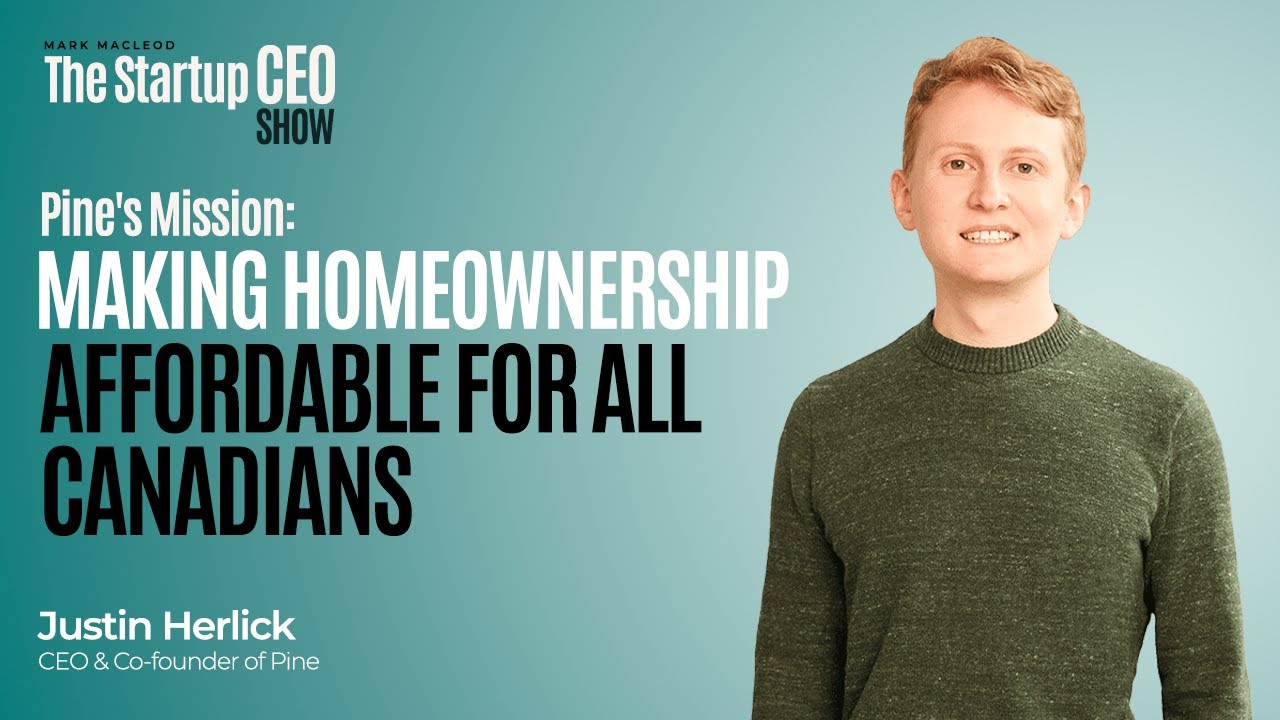
Justin Herlick, CEO of Pine, built a digital mortgage platform in Canada after working at Blend in San Francisco. Pine originates and underwrites mortgages to bank standards, then sells them to banks, competing through lower costs and transparency. He aims to save Canadians billions while expanding into home search, insurance, and warranties.
Chapters
We're potentially saving Canadians, even clients that don't go with us, through the forces of competition, tens of thousands, hundreds of thousands of dollars, in aggregate millions of dollars, because people are finally getting competitive rates on their mortgage renewals, which is like, I think, 70% of the market over the next 2 years. So huge. So it's a giant market. You know, they say there's a couple trillion of Canadian mortgages outstanding. $800 billion a year is the number that most people use of mortgages and renewals. It's interesting, being an ally in that market can mean 5% market share, right? Not like 50% market dominance. But even if you get to low single digits, you're creating a multibillion-dollar company. And that's before you layer on any of these other really antiquated industries like finding your home and getting home insurance and home warranty and selling. You can imagine that this really spirals. And what I tell people and what I tell our investors is, look, I think the Canadian fintech market is by definition a market of outliers.
Welcome to the Startup CEO Show. I'm your host, Mark MacLeod. In this episode, I sit down with Justin Herlick, co-founder and CEO of digital-first mortgage platform Pine. Pine targets Canadian consumers, and Justin is based in Canada, but he spent many years in San Francisco, and those, those years really informed him and really, you know, set him up to be a world-class entrepreneur. So much so, in fact, that he recommends that people spend a little tour of duty in San Francisco. In this episode, we unpack that experience and how he was really intentional every step of the way in terms of what he wanted to get out of that experience to set him up to be a great founder. We talk about how he's building this company. You know, you think about buying a house, it's the most important transaction in your life. So how does he build trust with the consumer? We go into that and many, many more topics. I really hope you enjoy the discussion and I hope you subscribe to get more episodes. Justin, welcome to the Startup CEO Show. It's a true pleasure to have you here. How are you doing today?
I'm doing well, thanks for having me.
Real pleasure. For those who don't know, maybe just let's start off and just tell folks what Pine does.
Pine's a Canadian-focused fintech on making home ownership affordable to everyone. So we offer a variety of products. Most people know us for our online mortgage product, but we also offer a home search as well as access to realtors in our network.
Well, home ownership is a thing that Canadians love to fixate on for, obvious reasons. And so we'll get into that, but maybe I'd love to start off actually by leaving Canada and talking about your time in San Francisco. And, you know, SF is a pretty unique, you know, part of the world. And I'd love to know what impact the time that you spent in SF had on you.
Yeah, it had a huge impact. So I spent the years of 2016 to about COVID till 2021 working, living in California in San Francisco. And I had a really great experience being involved in a lot of fast-paced moving startups. Uh, and I was fortunate enough to see, um, one of those startups go public. So pretty much from the beginning of just getting product-market fit to Blend going public, I, I was able to be on that ride, which was really exciting. And so I'm Canadian. I grew up here in Toronto. Um, and my background was originally in business finance, but I found myself working at technology companies in the Bay Area., and I found myself working at a company called Blend. And what Blend does is they provide a technology system to a lot of mortgage lenders in the United States. So big banks that most people have heard of, their customers are like Wells Fargo, US Bank, BMO Harris, and they allow those companies to compete with more digitally, uh, native companies like Rocket Mortgage on providing an online financing experience to their customers. We're a, a B2B2C company. And what I got to see from the time period of like 2017 to 2021 was the entire US mortgage market shift from kind of old school analog PDFs and going into branches to online consumer finance. And that was a big shift in the market and it happened relatively quickly, happened in a few years. And as a Canadian, my kind of takeaway from that was there were a lot of things going on in the world, especially in fintech and consumer finance. And Canadians are not always getting the benefits of what's actually available out there because it's, you know, it's a big world, a big market. And that kind of shaped my journey into starting Pine.
That's massive. I'm curious what, other than escaping Canadian winter, what led you to go to SF in the first place?
Yeah. So it was funny. Like my, if I go back and I kind of think of my personal journey, I was originally really dead set on working on Wall Street. I was at Queen's, I was in the business program there. Everyone really pushes you towards like finance careers. So that's what I thought I wanted to do. But I had essentially an eye-opening experience. I worked at one of the big banks trading floors here in Toronto, and I realized that, you know, as, you know, exciting as that job can be for some people, it was not the right career path for me long term. I didn't think that I would be successful working on a trading floor. So particularly I was on the interest rate derivatives desk, which is Essentially part of the bank that helps other financial institutions, whether it's a central bank or it's a pension fund or an insurance company, hedge their interest rate exposure, which kind of comes full circle to running a mortgage company. But after that experience working on the trading floor, I want— I kind of reflected inwards and thought, okay, you know, where are my skills and what type of environment will I be more successful in? And for me,, I really enjoy creating new things, which doesn't always happen at a bank. Um, and I really enjoy more flat, um, management structures. So management structures that allowed people to, based on merit, climb very quickly and have a big impact as soon as they possibly could. And, and I found, at least in traditional organizations, you typically get assigned a very small scope of work, and over a few years you, you build that up and you, you are able to have a bigger impact. So knowing what I knew about myself and knowing what I wanted to prioritize, I said, where can that be the right environment for me? And it was a very obvious choice to move to California. And this was, you know, this was in like the zero interest rate period. This is when companies were getting giant funding rounds with not a lot of traction and then figuring out what to do with that funding round. So it was all signs kind of pointed me to move to California. Now there's a lot of difficulty in doing so and there's a whole visa process that you have to manage, but I was able to get through that. And kind of once I landed in California, I was able to find a few other roles. But getting over there was a challenge. But for me, Canada's always been home and always somewhere I saw myself long-term.
Got it. So notwithstanding the fact you're working in tech at the center of tech, but you always knew you wanted to come back here.
I always knew that I was going to come back to Canada. I think if you look at, you know, there's a lot of Canadians in the Bay Area and obviously there's like tons going on right now.
It's 400,000 apparently. Yeah.
Um, the ones that I knew at least always had this final goal of returning. Like the Bay Area is a very, very hard place to survive long, long term. Like, yes, it's beautiful and the weather's amazing and there's lots of activities and recreation, but it is one of these cities that's transient. Like people come and they go. Um, and what I found at least living there for 5 years was the people that stood there the longest were Bay Area locals, like natives that or like people who had grown up in the Bay Area, they were the ones sticking it out where, you know, there's this kind of joke amongst people working in San Francisco and in the US that everyone in San Francisco is moving to New York and everyone in New York is moving to San Francisco and they're just crossing each other. And I definitely had a lot of colleagues do the back and forth. It's kind of a grass is always greener situation. But for Canadians and for someone like myself, I always knew that Canada was home., and I wanted to just essentially gain experience that I, I didn't necessarily view as possible in the Canadian market.
How did that change you?
Well, it opened my, my mind up to a very different way of doing work. I think like the, you know, the stereotype is move fast and break things, and you know, we're in financial services at Pine, so we don't necessarily take that to its full extent, but the core philosophy there was one that really resonated with me with which was generally action over inaction is the right decision and doing something versus analyzing is the better choice. And you'll learn through doing and you'll learn through making mistakes. And that was like fully embraced, I found, by startups and scale-ups in the Bay Area. And, you know, if you look at Canada, we have a number of great companies. Pine's trying to make a positive impact on that, but we don't have as many breaths and we don't have as many companies playing on a global stage. So in the Bay Area, I really found that it was an environment that empowered people at the beginning of their career to have huge impact right away and to, you know, take this philosophy of the faster you can go, the more you can get done. And it's kind of interesting, right? Because I'll go off on a little bit of a tangent here, but if you're venture funded as Pine is and as all the companies I worked for were, by definition, almost, you're not profitable and you're getting large sums of money upfront with the purpose of spending it. Like, no investment manager, no VC wants to give a company $100 million and then hear that that company parked it in GICs and just lived off their interest indefinitely, which they could do. That's not the goal. The goal is to take the money and to create something. And I think they really embraced that, like, type of mentality and there's a lot of downsides to it as well. But it, it kind of framed the way I look at problems of you want to approach things fast and hard and you want to achieve as much as you can in the quickest amount of time period to justify getting what was essentially risk capital. Like when a VC puts money into a startup, they're saying, hey, I want you to take big risks. And I hope you, you know, as the founder and employees of this company accept that, that that is the outcome we want. Right? So I think there's a lot of online discord these days around like, should companies take VC? Like, are you prepared for that? Like VC often means that you can achieve a really great outcome, but a lot of people kind of down the preference stack for those who don't know preference stack is like if you raised $100 million, typically you have to at least return $100 million back to your investors before you, you get any of the upside, which is not, you know, a one for one investment. It's a preferred investment. But anyways, the consequence of that is that you have to be willing to take the high-risk scenario, right? And sometimes it's a mismatch where people take VC money and they don't know what that means. But for me, I've always understood that as, hey, we're going on this path and that's the path that we have agreed upon. And one of the risks of that might mean an outcome that's zero, right? But that's, that's the reality. And I'm totally okay with that. And I'd rather have a small shot of doing something big than a for sure shot of doing something small. Um, so there's kind of a lot of things that go into that, um, mindset, but I've tried to take all of those Silicon Valley ideas, bring them to a Canadian market while also understanding that the Canadian business environment is a culturally different one significantly. And I told this to a lot of my American peers. So, um, how I got into Pine specifically was when I was at Blend, we tried to take that product, which was a product that was sold to bigs. And we tried to get the Canadian financial services industry to embrace it. And we had some moderate success, but we didn't quite have the success necessary to justify having a standalone Canadian product. You know, there's overhead costs to supporting a different version, and, you know, eventually we determined the market share we weren't going to be able to achieve. So we exited the Canadian market. But what I always told my colleagues is you can't just run into a Canadian environment, a Canadian business setting, the way that Americans like to do business is very different. Americans, in my opinion, are far more straightforward. They will tell you their impressions of you almost immediately. Like if they don't like you, they'll tell you to fuck off. And they'll tell you 1, 2, 3 reasons why your idea is terrible and it would never work. And they'll just be very blunt. And that's great if you're used to that. But for Americans coming into Canada, they think they can take this like charging headfirst approach. And we've seen this, right? A number of companies have entered Canada and left. Specifically in my industry, um, you know, Rocket Mortgage recently announced that they're not going to be operating in the Canadian market anymore, and they're the biggest mortgage company in the world. Um, it's a different business environment here for sure. Uh, so what I've tried to take is essentially the work ethos and the mantra of a Silicon Valley startup, but understand that we're operating in Canadian financial services, which is a very, um, different type of business atmosphere than the US.
Oh man, so much goodness there. You know, I used to go to US, to go to SF pretty regularly. In fact, when I ran my investment bank, we had an office there and I was there every month. And I always left thinking I'm not moving fast enough. There was just so much hustle. Now, that being said, if I look back, on, you know, all the companies I've been a part of in one role or another. No question, speed is the primary strategy, primary tactic, all else being equal, getting somewhere faster tends to be more valuable. But there has been a lot of waste along the way. And sometimes I call it like ready, fire, aim. I aim after I've already like launched the bullet, you know, and the reason why Startups die is 'cause they run outta cash, right? You can keep fucking up as long as you got cash. So there are underlying causal reasons, but you keep going as long as you run outta cash. And then you brought up that pref stack, right? And often that pref stack is accumulated unfortunately as a byproduct of waste while you're trying to move fast, right? So it's tough. It's tough to get the balance right, you know, 'cause sometimes you run really hard right and then realize, oh shit, I should have ran left. And then by the time you get to the right spot, you, you've just burned through a ton of money. So it's tough. I don't have one prescription. There isn't, you know, one recipe here. It's just an observation about the challenge of living up to those expectations that you referenced, right? You know, I want you as a VC, I want you to take risk, right? I had a tier 1 investor tell me once that I would rather my CEOs go, I'm quoting, go into a brick wall at 100 miles an hour trying to hit escape velocity rather than play it safe. Right. So like that's the mentality, right? Just shooting for outliers.
It really is. And I think that's, that's the way the, you can call it a game. The game is set up, right? Um, and I'm fully for it, right? When you, when you take money, which is a business relationship from an investor, there should be very clear expectations of, you know, what you are going to achieve with that money. And, um, VC money is often put in before the business model is proved, right? So it's much higher risk. But that means that they want a higher return. I think where you've seen a lot of mismatch is in the fallout that that has potentially on other people that could be impacted by not everyone realizing what type of environment they're in. So let's take an employee and, you know, there, there could be many employees that join a startup from a traditional industry because they're excited, but they don't realize that the people behind that company, the investors, they want them to run in, or they want them to succeed in launching the application.
They want it to run through the wall, not into it.
They want to, but I think in their head, they, hopefully the founding team understands what's going on. I think that's most important. Like I've embraced that, you know, this is the scenario of outcomes that are possible. And I like to tell all employees that Pine, we're shooting, we're going to be great and we're going to create generational company and we're going to have multiple products and we're really going to succeed. But an outcome, an outcome is that we're unable to succeed, right? And you have to be able to embrace that rather than like what you hear a lot about is like these zombie companies that they're able to keep themselves alive one way or another, interest, because they have a lot of cash or they get government grants or they get refunds and they're able to cut costs. I don't really have much interest in running a business that way. Um, but I guess some people might come into this as an employee or as, as another stakeholder and, and not totally understand the, the dynamic that is driving the company forward.
Right. I love that. So let's dig into that a little bit. I guess first of all, on the notion of risk, so you're comfortable with it, you know what you've signed up for. How do you struggle sometimes to be authentic about that with your team, like to fully share the lows, not just the highs? Like, yeah, what are your thoughts on that?
So my personal philosophy is that on your leadership team, and this is not to say this is the right philosophy, this is just my philosophy, the leadership team should be fully embraced in the highs and the lows. And if there's a critical, you know, issue that is on the horizon, um, but could be sensitive for whatever reason, the leadership team should be fully aware of that, right? And the reason they're on the leadership team is because you trust them as mature adult leaders that can live and operate knowing the risks that they're essentially getting onto. However, you might have many employees between your leaders and your individual contributors. You don't need to share every high and every low. Well, you should share all the highs, that makes no sense. But you don't need to share every low. You should make them aware of the swings in the business. Yes, we had a good quarter, we didn't have a good quarter, what can we reflect on? But not every problem needs to be, you know, in the same way that I internalize them, internalized by everyone on our team. And what I find is that works really well when the company is doing well. So Pine's been fortunate that I think every single quarter since we launched our products, with small adjustments for seasonality, has been an up quarter. And that's very exciting, but I've definitely been at startups that had that journey. And then eventually you plateau or you actually do have a down. And, and you know what I say is it's easiest to keep morale high when everything's going well. It's, um, it's much harder. And I've been in those situations at other startups where you do have periods of difficulty or, you know, in some situations you have the whole business just doesn't work out. Right. And, um, keeping morale high in those situations is, is much harder than Fortunately, what we've been on our path so far, zooming out, you know, if you looked at any individual week of our business, you'd say, oh my God, this is chaos, which it is. But if you zoomed out and took like a quarter basis, things have generally gone well despite the challenges that are going on in the market.
Are you still taking your own meeting notes? Let me tell you about an AI tool that I'm using to take meeting notes.
For me.
It's called Fellow. It's an AI meeting assistant. It takes human-level AI notes, it tracks my action items and decisions, and keeps everything in one place. Built with security and privacy at its core, Fellow is the only AI meeting assistant that leaders trust to capture meeting notes and recordings while keeping your data safe. Thousands of organizations are consolidating tools and relying on Fellow to capture their meetings. The team at Fellow is so confident that you'll love it They're offering an insane deal to Startup CEO listeners: 90 days of unlimited AI-powered note-taking and recording completely free. Visit fellow.app/ceo to sign up today and experience the AI meeting assistant trusted by leaders everywhere. So the inspiration for this business came from Blend, and I understand Blend was providing technology. It wasn't actually lending. Are you— you are actually lending as well, is that correct?
That's right. So the inspiration came from when I was working at Blend. We tried to get the Canadian lenders, so the big banks, one of which we already had as a customer in the US. So we thought it would be easy to cross-sell into Canada, which was not the case. We thought, you know, hey, we can bring this software, everyone in Canada is going to embrace it. Why would they not embrace it? We have, we essentially were processing $5 billion mortgage application dollars with mortgage applications a day. In the US, we thought, okay, of course we can support Canada, um, but there's the realities of, of kind of the business environment here. So my takeaway from that was, isn't it a shame that because the incumbents don't want to embrace the more flexible way of doing things, which is to do things online, that Canadians as a result don't have the breadth of products that are available to them in other other countries, particularly in this case, the US. So when I came back to Canada, I said, I'm going to start this. And at the time, no one had really done it. Now there's a couple similar companies to us, but they all have their own kind of direction. But my takeaway was rather than try to offer the software to a bank and make like, I can tell you, so Blend charges roughly $80 to $100 per loan. And if a loan funds, that's their business model. And Blend has about 1/3 of the US market using their system, but their market cap is hovering around $1 billion. Rocket Mortgage, on the other hand, I think has somewhere between 8 to 10% market share, so way less, but they do the whole thing and they're worth about $30 billion, right? So there's a lot more value in taking that customer end to end. So when I came back to Canada, I said, okay, why don't we take a different approach this time? The problem still exists, which is that Canadians can't do their mortgage online and they can't handle anything related to their home journey online., but let's start our own brand and build a consumer business around offering a better home lending experience. And if we're successful, we'll have a lot more impact than just offering a software package to other players.
Way back, I'm not even going to ask how old you were at this time, but my first startup I was CFO for back in 1999. We, uh, it was an electronic signature software company. It was basically DocuSign too early. And I was trying to do a big deal with LendingTree, who may or may not still be around, but they were passing leads to banks and to your point, getting a small amount of money. And my pitch to them was embed our electronic signature and hand off like a signed origination, which is going to be way more. But then, yeah, Rocket Internet, I guess, or Rocket Mortgage takes it all away and then actually completes the mortgage. And I guess presumably syndicates off the mortgage and then just kind of keeps going. So certainly makes sense to capture more of the value chain. What are the realities of this, like in Canada? Like when I think of mortgages, I think of the big 5 banks. It's like, did— is— am I right in thinking that they represent the bulk of the mortgage industry or is there a whole, a whole other opaque market that I'm just not aware of?
So they do, and there's a few ways to look at the industry. So there's who is essentially working with the customer, and that could either be a bank rep, it could be a mortgage broker. Those are kind of the two big categories. The category that Pine's in is somewhat of a combination. Then there's who is underwriting the mortgage and then who is holding the mortgage. So at the end of the day, the banks hold the majority of mortgages. They also fund the majority of mortgages. But at the top layer, you have bank reps and you have independent mortgage agents and mortgage brokers that shop around on behalf of their clients. But to say that the market is dominated by the big 5, big 6 Canadian banks is an entirely accurate statement. I— the number changes based on some holdings, but it's somewhere between like 80 to 90% of mortgages end up on their balance sheet at the end of the day. And even a company like Pine, where we are the lender, in the sense that when a client comes to us to get a mortgage and they fund their mortgage, it won't say, you know, Green Bank on their title. What it'll say is Pine. Now behind the scenes, we don't take deposits in from investors, so we don't collect capital. We are working with the banking system to provide the capital for that mortgage. Now a lot of our mortgages actually end up in the Canadian Mortgage Bond Program, So the CMHC will actually buy them and package them and sell them to domestic and international investors. But we have, we work with the banks because they have the capital available. And this is a fintech model that a lot of companies take because, you know, we want to stay asset light. We essentially want to be able to scale our business without having to raise more equity. So we could do a billion of loans or we could do 10 billion of loans. And the amount of equity we would need sitting on our balance sheet wouldn't change because our model is to not put our own money into our mortgages. But that doesn't mean we're not the lender. We're still the lender because we're adjudicating, we're making the final decision if that client's approved or not. And when you get your mortgage, we're still the relationship that you maintain. So after your mortgage funds— and that's the big thing that separates us from a broker— after your mortgage funds, you, you have a, you have a mortgage from Pine and we service and we handle all your interactions. Where with a broker, they'll probably say, hey Justin, I took you all the way to the finish line and then Scotiabank was the one who funded your mortgage. So you now have a mortgage with Scotia. If you have any questions after the fact, like you want to prepay or you want to change your frequency, you got to go to them. I can't help you. But we, we can, we, we have that whole relationship.
So tying this back to Venture funding and expectations, right? You think about venture's a business of outliers, right? If I have a portfolio of 10, I expect 1 or 2 of my investments to deliver all the returns. And so my decision to invest in you is through that lens, like, can you be an outlier? So like, if Pine is an outlier, what impact does it have on this market? How does it change the market? How does it disrupt the market?
So our vision is to support Canadians with all of the steps associated with buying and owning a home. So that's finding the home, and that, that can start anywhere from, you know, a week if you're moving really fast to multiple years of thinking about buying. You then need to actually purchase, and most people do one with a realtor, and then you need to typically get financed. Most people need a mortgage. And then eventually you'll need to sell that home, right? And then there's a number of things that happen in between there, moving, insuring, protecting your home. When we're successful, we'll be a huge outlier in the sense that we will have impact on all these different pieces. What I really hope, and one of the things I've already started to see, is that we bring more competition to a market that needs it. So I've already seen the impact, and I won't say it's all us. I think it's a combination of us being competitive, challenging companies. This year, in 2025 renewal cycle, because in Canada people renew their mortgages, we've seen that typically when you get a mortgage renewal, your lender, your bank will give you a very high rate and then hope you kind of just sign it. And they're banking on that being a high-profit event that happens and you don't want to do all the paperwork. Well, I think because of the number of new market entrants, banks are actually fighting for their renewals. They're saying, hey, hey, hey, let— before you go somewhere else and switch, we can offer you a much more competitive rate than the one we sent you in the mail. Forget that rate. We didn't mean to send that. And that means we're, you know, having a small impact, but we're potentially saving Canadians, even clients that don't go with us, through the forces of competition, tens of thousands, hundreds of thousands of dollars, and aggregate millions of dollars. Um, because people are finally getting competitive rates on their mortgage renewals, which is like, I think, 70% of the market over the next 2 years. So huge. Uh, so it's a giant market. You know, they, they say there's a couple trillion of Canadian mortgages outstanding. Um, $800 billion a year is the number that most people use of, of mortgages and renewals. Um, and being an outlier in that market, it's interesting. Being an outlier in that market can mean 5% market share., right? Not the 50% market dominance, but even if you get to, to low single digits, you're, you're creating a multi-billion dollar company. Um, and that's before you layer on any of these other really, uh, antiquated industries like finding your home and getting home insurance and getting home warranty, um, and selling. Uh, so you, you can imagine that this really spirals. And what I tell people and what I tell our investors is, look, I think the Canadian fintech market is by definition a market of outliers. You have a few breakout companies, particularly on the consumer side, and those breakout companies, um, like Neo, like Wealthsimple, like Koho, they're really able to defend a brand position in their industries and capitalize off the fact that people know who they are. And sell multiple, multiple products in ways that I don't believe are really possible in other markets, or particularly in the US. Because what I found in the US was the market is so big and there's so much opportunity. If you offer one product and you try to step outside your well-defined lane, you bump into a competitor that knows that part of the product much, much better than you do, and it becomes a lot harder to become a multi-product experience. Now, there are still even more breakaways like Robinhood, which is I don't know their current market cap, but very high, tens of billions for sure. And they offer multiple products. But in Canada, what you find is there's not that much venture funding for consumer finance. The companies that can get to scale, to national scale, are really able to break out in ways that are, I think, outlier opportunities for VCs that can see that. But the challenge is on the other side is, you know, there's a lot more VC in the US than there is in Canada. And I think The most successful companies are able to attract that money. It's very hard for people to wrap their head around the Canadian market. How big is the scale? How good are the margins in Canada? How does this compare to, you know, a market I know in the US? This is, I find, really hard in mortgage because the Canadian mortgage market and the US mortgage market, while they look similar, have very dramatic differences in profitability, like the things you need to do to scale, how you run the business. Very, very different. And I find that some investors will not get up to speed on the, on the thesis, on the concept. And they'll just say, you know what, I don't want to talk about this. This is kind of like, I have my pre— I have my notion. This is what mortgage is. And yes, it's a big market, but I don't like it. And I'm going to just opt out. And that happens sometimes, which is fair. But, um, it's a challenge to create a company like Pine.
If Pine was 10x or 100x bigger than it is today, Would you suddenly find yourself competing against the banks you partner with today? Is there like a coopetition kind of dynamic here?
So I'd say we already have a coopetition, um, which is healthy. So the banks essentially will do mortgages multiple ways. They will acquire mortgages from other companies, which is like more of a capital markets transaction. That's, that's essentially what happens with us. And they do this with many of the companies that they compete with. Um, they will get through their branch network, they'll get through their essentially independent commission sales network, but it's captive, and then we'll get it through their non-captive broker market. So they're already competing with themselves multiple times. Uh, it's just the market is so big and there are so many different paths to distribution. Um, where we are currently succeeding very well is the consumer profile of This is kind of— people always think, oh, is it an age thing? Is it— I say it's really not because you have to be a certain level of financial ready to buy a home in Canada. We know how expensive it is. So we're not getting these like 21, 22-year-olds. The reality is they're not ready to purchase a home in most cases. What we are getting though, and what I can say is like the profile that has really resonated with our user base is very clear. It's I feel financially competent. I like to be in charge of my own finances. I like to know that I'm getting a good deal and I don't need my handheld that much. Now, mortgage is a huge, huge transaction. So, so even the most financially ready people still want advice and, and make sure everything's working. But the, the people that gravitate towards Pine are people who like to manage their own finances and people who like to be in charge of their financial decisions as opposed to being like really kind of pushed in a certain direction. So most of— here's a really easy example. Most people who come to us already have a pretty strong inclination if they want a fixed or an adjustable rate mortgage, right? And we will support them in whatever decision they want for themselves. We'll tell them what we think, but ultimately it's a personal decision with respect to their finances, as opposed to coming in saying, hey, I just need advice, which way should I go? That's not really our customer base.
Now, are you going to give them— so I'm whatever, I show up, I apply online. Are you giving me a bunch of offers, one of which is yours, or you're just, here, here's our offer?
So we present first and foremost our offer, right? And we're very upfront about that. We say, hey, um, just like a bank's not gonna offer you another bank's product, we say we represent Pine and, and here is the product. We've really optimized this product to be great for you. In small cases, we are able to offer other lenders' products, and if that's the right decision for that client, we will do it. We'll even tell clients when, hey, like, like there are certain mortgage products that we're not very competitive on today and we've not optimized those. And we'll tell them, hey, you know, just we don't believe that we're the best lender for you. We would recommend you go to one of these other places and we'll tell them because that's better for everybody. And the earlier you can have that discussion with someone, the better. Because what we found is the most frustrated people are people who get relatively far into the process and then find out it's not a good fit for them. So if we know it's not it's not a good fit, we'll tell them upfront, and people are a lot happier that way. At least you're upfront and transparent with them. But for the most part, we, we really focus on offering our core product that we spend a lot of time making as seamless and smooth as possible. And by doing so, we're able to bring those savings back to the client. So our mortgage advisors, have the top, top of the industry in terms of efficiency while also delivering a high quality of service. And we've done this through all of our technology that essentially underwrites is in-house and all of our CRM technology is in-house as well. So we don't use a Salesforce or anything, which means, well, if an average mortgage agent or more bank rep is doing 3 to 5 mortgages per month, ours are doing 25 to 30 per month. And that means less costs, more savings for you. And a lower rate, which is at the end of the day what the majority of people want out of their mortgage.
Can I click on that lower rate thing for a second? Like, my sense is like if I had a really strong credit rating, I'd just go to RBC or Scotia or whatever and be like, hey, give me your best rate. Are you attracting people with like less or lower credit history or are you—
you're—
or doesn't matter?
So we're actually underwriting to a higher standard than the bank. So our loans most of the time end up on a bank balance sheet, which means essentially there's a regulatory concept in Canada called V10, which is like if you're, if you're working with a regulated industry participant, and I might be kind of paraphrasing this, you have to act under the same scrutiny that that regulated entity would have to. So there's not this like regulatory arbitrage that because Pine is not a bank, we can then do a non-bank mortgage and sell it back to the bank and the bank can say, oh well, we bought it from them, so it's allowed. No, like you have to hold yourself to the same standard. So we're actually getting people of the same quality or higher. And one thing that I think is actually misrepresented sometimes, and I think you touched on it, is your credit score can be 900, which is, you know, the highest in Canada, or it can be 800, and that's not going to really impact your rate at the the vast majority of lenders. Um, after a certain hurdle, it's a lot of other factors that will impact your, your rate. Um, so the main difference on why we save people money is our input costs are lower because you can— the example I always like to say is, okay, imagine a bank. The bank could purchase a mortgage from Pine, and let's say all of our labor hours, all of our credit checks, all of the things that we have to do, let's say that costs us $1,000, uh, because we're very efficient, we're doing things quickly. So So the cost of funds is still the bank money, but our production costs, our input costs are $1,000. Now imagine that same customer went to a branch and they have to start filling out paperwork. Someone has to read it. Someone has to fax it. It gets faxed. It gets picked up and then it gets faxed again to another office. Yeah. So the banks internally will actually fax documents from one team of the bank to another team of the bank. And then they'll print it out and then they'll, they'll, they'll write. So there's a lot of steps. Uh, so let's say their production costs are $2,000. That means that the same bank, the same mortgage, the same person should be able to get a, a better deal from Pine because the money is at the same, it's the same balance sheet, but they're acquiring it through a more efficient channel. So that's kind of conceptually how we're able to bring rates. And then the practicality side of it is when you come to Pine, we're putting our best foot forward every time. So you're coming to us, we're saying this is the best that we can give you. And there's no back and forth. And a lot of people appreciate that, where that is— that's not the model at the bank. That's why the banks do this whole thing of, um, you check their website, the mortgage rate will be much higher than what is like kind of competitive in the market at any given time, because they want it to be a dance. Because yeah, yeah, they have the ability to drop the rate quite low, and they can be just as competitive, or, you know, they can be as competitive as they want. It's their money at the end of the day. They want to lose money on that mortgage because there's a relationship with that client, they're allowed to do so.. But what they're hoping for is for every one client that goes through the negotiation and really pushes and squeezes, that there's, you know, 3, 4, 5 clients that just kind of say accept the fact that that's what they're going to get, right? I don't know how many people negotiate their savings rate, like on if your cash savings account, kind of Canada's kind of notorious for savings rates being horrible on most of our deposits, which plays to the bank's favor. But most people don't even think to, I'm going to go and I'm going to try and negotiate that savings rate. It's just locked in. But a lot of, and a lot of people have that same mentality with their mortgage. I think what the bank offers is the rate and it's not negotiable, which is not, which is not true. It's totally negotiable.
So buying a home, you know, biggest transaction of my life. I mean, other than a startup founder, right? Selling your startups. Let's park that. But like trust strikes me as a huge factor here. So how does a new company build trust so that I will trust you with the biggest transaction of my life.
This has been, this was, I would say initially the hardest challenge of starting Pine was you could be very well run, very capitalized, very, you know, mature and respectful in what you do. And if you're new, you're going to get a level of skepticism. Um, and that proving that trust has been the most, I think, important thing to essentially, what we look at is funded rate or closed rate. So for every lead, you know, how many actually go with us? And there's various milestones, like how many people who are approved went with us? How many people who came in the front door went with us? That's gone up a lot in the last year. I'd say it's, I think that rate has doubled. And it's a lot of it is trust. What we used to hear a lot about in the past was, Your rate was just as good or better, but I'm, I'm just still uncomfortable going with you. There's nothing particular. I just feel better about going with my bank. And we've heard a lot less of that recently. Maybe we're targeting better customers, but I think it's also the things that we've done in terms of press, in terms of having a lot of publicly available ratings. And we have a really high average score and you'll see the good, the vast majority of people are good. Um, some people might have complications. Um, and really focusing on referrals and partnerships. So we've partnered with companies that are really big, like one of our really well-known partnerships is with Wealthsimple. I know they were, they were on recently. Um, and that's been huge for our ability to gain trust. Um, the other part is customer referrals we've been focusing really hard on. So if one person could say, hey, I got a mortgage, it was totally fine, everything's been super smooth, um, you should go with PineShoot, that goes a really long way. People have this inherent kind of like trust in their friends. And if they went well, they're willing to, uh, believe them. Right. And then, uh, the last thing that I think is obvious, but doesn't always land with customers. So as I'll say that I can say this a million times, but clearly it doesn't resonate in the way that I think it should is we're not asking you to keep any of your money with us. We are trusting you with $800,000. We really hope, you know, you come and you pay back your loan. We're giving you the money in this case. We're not taking your deposit in and you're going to lose your money. But even, I'll say that a million times, like we're lending you the money. People, especially Canadians, they still want to know that the person who's giving the money is reputable, which is fair. But it is just funny to think about at the end.
Yeah, we're way more conservative, A, as a society generally, and certainly as a financial ecosystem. Specifically. Just look at 2008 and the mortgage crisis, right? Didn't hit Canada anywhere near as hard as it did the US. Without revealing any proprietary secrets or playbooks, could you just describe, you know, you brought up the partnerships, but like, how do you go to market? Because you know, you're, you're horizontal, you're consumer, you could blow your brains out with high acquisition costs, you know, like, yeah, you could do TV. I don't know, like, you could spend a lot of money basically. So how do you generally kind of go to market?
So I can tell you my philosophy. My philosophy has generally been, how can we deliver as much value to the customer with our go-to-market strategy as possible? So what does that mean? Well, I try personally to whenever possible, spend money lower down the funnel. So there's two worlds. There's the first world where you pay the hardest to track, let's call it a TV commercial. It's very hard to like do attribution on that. When you're spending money and you're giving that money to the TV channel or Google or Facebook and you're paying up funnel, right? That means that value is accruing, money is accruing up funnel. I would rather, in my perfect world, say, hey, if the cost of acquisition on that client's gonna be $2,000 or whatever it might be,, and it's all going to Google. Can we do a campaign where we're just gonna give the client $2,000 and then, right? So, so what I found is to be very aggressive, low funnel, like, like, like deep funnel activities, um, so that when that person does come in, they're, they're like, wow, I'm gonna get this value and it's gonna go to me. And then you need to find creative ways for people to know about that. The, the good thing about mortgage is if you have a very competitive offer, you'll get, get certain level of, of word of mouth and free publicity because there are, there are websites that will compare rates and there are, you know, people who, who essentially just cover like where the best deals are. So by, by offering essentially, uh, really good down funnel incentives, right? You're gonna, or you'll get $5,000 if you close a mortgage with us, if the mortgage is over $1 million, right? Then, um, at least at the scale that we've been at and we've been continuously growing and we've had many quarters of, of, you know, doubling and tripling, We're able to use that as the hook. Now, eventually you get to a point where you just need more people to know about you, but I find that that is really like, um, like a word of mouth cycle that you want to get to. Now that's kind of what our strategy has been to date. So if you go out, you're not seeing billboards for Pine, you're not seeing TV commercials for Pine. We let a lot of our other competitors try those strategies first. We got feedback from the market that, hey, you can spend $20 million on billboards and TTC bus wraps, but if your offer isn't good at the end of the day, then people aren't going to close with you. So they're going to be aware of you, but they won't close. And what you end up finding is if you do the math, you put it on a spreadsheet, the more you spend at the top, the essentially worse offer you have to give to make up for the fact that you already spent the money up front. And you end up, at least in mortgage, being very upside down. Because you're like, okay, I'm gonna run this campaign, which is gonna get me this many leads, but then to monetize them at the way that I need, I need to raise my rates. But if I raise my rates, nobody's gonna close. So you're kind of trapped. So what our long-term strategy really is, is we want to be differentiated on the product experience. And that's one of the reasons why we acquired another Toronto business properly, which was a real estate startup, is we really want people to come into what we call our ecosystem much earlier. We want to have the best home discovery platform, and we're working really hard to make this better and better. Um, and we're going to start pushing it really, uh, soon in the next couple quarters. And the idea there is if we can get people to be aware of the fact that we have a great offer by providing them value in another kind of part of their journey. So maybe they use our app, they really love finding their home, and they are a day-to-day user of our, of our system, right? Well, then they're just going to see the fact that we have a great offer, um, and then they'll convert on the mortgage. And it can be a long multi-year journey, but that, that's our strategy. And, and what I really aspire towards is, can the product drive the growth in itself through the quality of its experience rather than just where you're spending, you know, money on awareness?
I love it. It's pretty genius, to be honest. I thought Home Discovery was just Realtor.ca. I thought they just had that on lockdown.
So Realtor.ca is the largest platform. They're going through an interesting transition, which I won't talk upon too much, but they were nonprofit, they're going to profit. They have, I think, like 70% market share, which is quite interesting when you look at that market versus the US and why we think it's really ripe for disruption. Is in the US, Zillow has by far the highest market share and their business model is take lead in, sell lead to network of real estate agents. But in Canada, we haven't really seen a private company take that market share. So I think it's an opportunity to bring, again, a more modern experience. Consumers are expecting different things now, but it has been challenging. And I think that the reason it's been challenging is, the more you get into home discovery, the monetization is always being very pushy. It's like push your realtors, push your realtors, push your network. Where Pine has great realtors on our team through our registered real estate brokerage in Ontario, Alberta, and BC. But I find the more pushy you are, the worse experience your online platform's going to be. So you can almost think of Pine as a way of we believe that we can essentially subsidize the quality of the search experience because we have this other business line that is doing quite well.
I've had a number of CEOs on the podcast, including, as you mentioned, you know, Mike from Wealthsimple, who are building consumer startups in Canada. And, um, I think with each of them I've discussed what I consider to be kind of the challenges of that. One is like, we don't have a lot of talent that has built consumer companies at scale. And we don't have a lot of domestic venture investors who have appetite for consumer. Have you struggled with either of those two challenges?
I'd say we've struggled with, with both. So, so we're in Toronto, we're an in-person company.
Yep.
Which means not only is our, our market limited to Canada, we're limited to people who, who are in commutable distance to Toronto.
Okay.
Um, so very limited. So, uh, what I have found challenging is the people in Toronto are absolutely amazing. I think we have world-class talent. I think there's a lot of people who find themselves in Toronto because they can't necessarily get the right paperwork to get to the US. So I think that's a, you know, a benefit to our immigration system. But in applicable experience, it has been very challenging, right? Because we haven't had too many companies break out in those ways. For people to really have lived in the trenches and been like, okay, yeah, I was at I don't know, I was at Snapchat and I saw them go from, you know, this to this. You don't have that. So you have to be a little creative with how you're bringing in talent, where you're using contractors, the types of people that you're working with and seeing, okay, well, they have this experience. Is it applicable here? And can we make it? And then the other thing is, you know, the market has been challenged in the sense that like the top talent wants top dollar. And if there's, American companies that can essentially take advantage of the currency gap, then that, that's quite challenging as well.
It's a big gap at the moment too.
Oh yeah. Yeah. Um, it is. So what I have found to be successful in building our team is really finding people who embrace the stage of the company that you're in. If you're finding someone who just wants to be paid the most, and that's like, like, hey, I want to be paid the most. I want to be paid the most through my base salary. I don't really want much of the risk upside of equity, then you're generally not going to attract those people, right? Because I know where those people can go. And you got to dig a bit deeper and you got to find, does the mission resonate with them? Does the essentially risk upside resonate with them? And can I convince our employees in a way of saying, hey, look, yes, this might be riskier than working at Amazon, but what's the worst that's going to happen? If you're amazing and you're a great talent, you're either going to do really well here and Pine will succeed or Pine won't succeed, but you're going to be fine. You're going to be able to find that Amazon job again. They're still going to be around in 2 years. Right? So some people resonate with that messaging. So I found that successful. And then in terms of capital, VC, we have a mix of Canadian and US capital. So that has definitely been been a challenge. It's about finding, again, the right match. We don't go to a fund that tells me they specialize in B2B SaaS. Like, it's not a good use of anyone's time to go to that company. You need to find people that can resonate with the thesis. And even if that's restricting your universe of potential investors, you gotta be kind of careful.
Alignment. Alignment is everything. Yeah. Hey, final question, Justin. So like you, I also studied business and finance. And I thought a couple of times along the way about starting a company, but maybe it's because I'm a Type A, anally retentive Virgo that I was like, no, I, to start a company, a tech company, I need to be a product or, you know, technical person. And I'm neither. I'm curious, like, now this is fintech, so it, it, you know, it leverages your business background. I'm, but I'm curious, like, other than just putting in the reps in and making mistakes and figuring it out, how have you developed yourself to have this more broader set of skills and particularly around product?
If I look back at my career, one of the things I'm quite happy I did and grateful I did was I was rather intentional with the companies I chose to work for. So my first job in California was actually as a software engineer. Um, and I was not a very good software engineer. I was the barely acceptable level of software engineer to kind of commit code. And with like AI tools today, I'm much worse than the AI. Um, but every time I went to a new company, I thought, how is this developing me towards where I want to go? And particularly the last startup I went to before Pine was a company called Instabase. They're still doing quite well, but they're in the AI document processing industry. I had a few offers at the time I was looking to make a job switch. I had ones that were much bigger companies that offered much higher compensation opportunities, but I intentionally chose the smaller company that I thought had a, they say like, are you optimizing for y-intercept or for slope? And for me, I really wanted slope. I felt that if I want to run my own company, I should get as many reps and doing as many different parts of the business as possible. And where I'm going to get that experience is at another earlier stage company. So I joined Instabase as the first product manager, which was very exciting. And I was very fortunate in the sense of that's where I met my co-founder, Jonathan. So if I had chosen the more late stage company, that, you know, many people probably would have chose that option for various reasons. I probably wouldn't have ended up starting Pine because that company's continued to do well and I probably just would have rode that out, right? So it's a very different career trajectory. There's nothing wrong with it, but I knew that there was an opportunity here and I wanted to get that experience.
I love it. Hey, bonus question. Would you say like founders who are not from a primary tech ecosystem like SF, like, would they just generally benefit from doing a little tour of duty there? Like, would you actually make that recommendation to people?
I would. I would definitely, because the density and the velocity are way better. So density, there are a lot more people who are in the same mindset of you. You get exposed to new ideas. You can really gain a breadth of experience just by being there. I believe that if you're intentional, right? If you just go to work and you go back to your home and you don't talk to anyone, not that great. And then the velocity, like things are moving faster there. I think there might've been a lull, but it's definitely back now. And you generally want to, in my opinion, you want to be in the best place you can for whatever that might mean to you. If that's oil and gas, you know, you want to be in Texas. But if you're in technology and product, generally that's the Bay Area., right? So I think most people who are going down that, especially future founders, can benefit from a change of environment if they're from Canada. But I want people building great products and great things here as well. So, you know, you can definitely get swept away in the environment there. And there are some people that just say, hey, you know, this is great. I have a great experience. I'm not going to come back.
I love it. No, it makes sense. Good advice. And, I really enjoyed this conversation, Justin. I love the learning orientation that you've taken to your career and also your just ability to throw yourself into all of the, like, you were very, like, you, you use that word intention, which is like such an important word, right? You didn't just be like, let life happen to you. You were very clear about what you wanted to get out of each of these little stops along the way. So yeah, really, really thoughtful. Thank you. Thank you.
Yeah, thanks for having me.
All right. Hey, thanks for listening to the Startup CEO Show. If you'd like to connect with me, be sure to visit my website at markmacleod.me or follow me on LinkedIn at @TheMarkMacLeod or Twitter @MarkMacLeod_. And if you want to tune in again next week, be sure to subscribe on YouTube, Spotify, Apple, or wherever you get your podcasts. We'll see you next time.
More from Mark





The Burnout Breaking Point - How Strategic Breaks Actually Increase Productivity


Emotional Debt - How Avoiding Hard Conversations Compounds Into Company Killing Resentment


The Death of the Specialist - Why AI Is Creating a New Professional Class Called Scalers