Revolutionizing Pet Care: Inside Vetster's Telemedicine Success Story
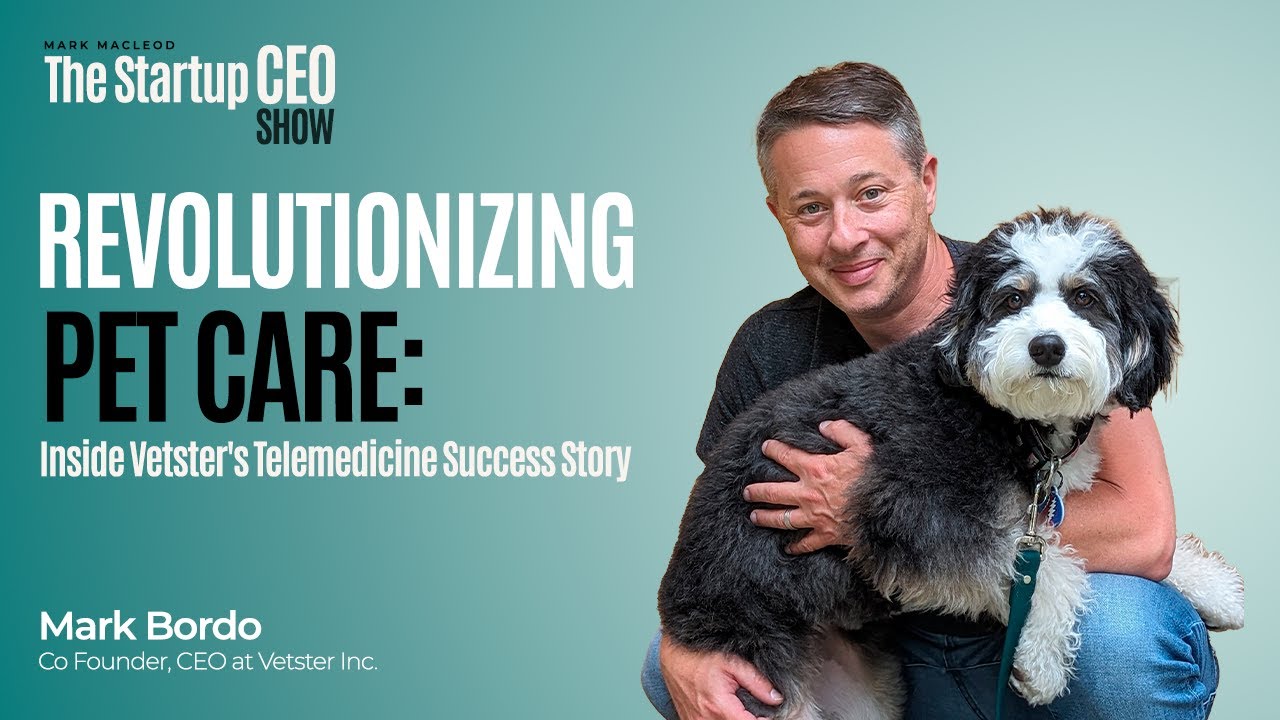
In this episode of the Startup CEO Show, host Mark MacLeod interviews Mark Bourdeaux, co‑founder and CEO of Vetster, the leading North‑American pet telemedicine marketplace. Bourdeaux explains how a personal experience with his aging cockapoo sparked the idea to create a platform that matches pet owners with licensed veterinarians for virtual appointments, addressing veterinary deserts and the inconvenience of traditional clinic visits. He describes the service’s clinical workflow—how pet parents convey symptoms, upload diagnostics, and even live‑stream examinations—resulting in a high‑90s case‑resolution rate. The conversation covers the regulatory landscape, especially the Vet‑Client‑Patient Relationship (VCPR) rules that dictate when vets can prescribe remotely, and how Vetster navigated province‑by‑province and state‑by‑state approvals. Bourdeaux details Vetster’s marketplace growth strategy: initially onboarding thousands of vets (supply) before launching demand‑side marketing, leveraging COVID tailwinds, performance‑driven acquisition, extensive A/B testing, and a data‑centric culture. He discusses the shift from a pay‑as‑you‑go model to a subscription offering, the importance of tracking full‑funnel KPIs (CAC, LTV, conversion, retention), and the role of AI and analytics in marketing. The interview also explores Bourdeaux’s personal entrepreneurial journey—lessons from previous startups, mentorship from VerticalScope founders, the importance of persistence, competitive drive, and balancing work with family. He shares advice for future founders about honor, relationships, and long‑term reputation. The episode paints a comprehensive picture of Vetster’s product, market positioning, operational tactics, and the founder’s mindset behind its rapid growth.
Chapters
I was just hit by the idea of thinking about, well, who's doing telemedicine for pets? It was already starting to grow from the human side, but really was unique on the pet side. And so immediately I knew what I wanted to do, and we basically ran with the idea of building a pet telemedicine marketplace platform. There's veterinary deserts all over the US, and you just can't get into a vet when you need one. So Vetster is a really good supplement to have when you can't get to a vet, when you can't afford a vet, when you don't have a vet, when you just simply want a more efficient appointment. I mean, you know, today we can have a vet appointment on a coffee break or a lunch break or on the way home from work or at night. And so it doesn't have to be between 9 and 5 where you have to take maybe half a day off work or you have to get childcare or things like that to get to the clinic.
Welcome to the Startup CEO Show. I'm your host, Mark MacLeod. In this episode, I sit down with Mark Bourdeaux, co-founder and CEO of Vetster. I love humans, but I love my dog even more. And so I was very excited to sit down with Mark. Vetster is telemedicine for cats, and it's a giant market. I learned on this episode that 72% of households have a pet. And just as humans are going after telemedicine now, increasingly pet owners are doing the same thing. So in this episode, we unpack best practices for building a marketplace business. That's what Vetster is. This is Mark's third consumer startup. And so we talk about all of his learnings over 25 years of being an entrepreneur and what he has done to scale himself to always grow faster than the business. This is really insightful. Lots of lessons here. I hope you enjoy the episode. Mark, welcome to the Startup CEO Show. It's a true pleasure to have you here today. How are you doing?
I'm great. Thanks for having me on, Mark. Excited to be here.
It's my pleasure. So I first came across your company, must've been very shortly after you launched. We had our little 3-pound baby who I just introduced you to, and she had an issue and it was in the middle of COVID and we needed to get her seen to, and I discovered your service and then I subsequently became an investor through BrightSpark. And so I've always, I've I've wanted to have a chat with you for some time 'cause I've been kind of fascinated to learn more about you and more about your company. But for folks who have no clue what I'm talking about, maybe just tell folks what, what Vetster is.
Yeah. Well, thanks for that and thanks for being an investor. Hopefully this podcast goes well for you and I'm joking. No, we are a pet telemedicine platform. We started out as a pet telemedicine platform, I should say. And now We are really the top pet health app on the internet. If you have a dog, a cat, or any other pet, you can get matched with a local licensed veterinarian in your area for an unbelievable pet telemedicine experience and a medical one at that, where in areas where regulation permits, we're able to send medication directly to your door if your animal needs it. So in use cases like the one that you just mentioned, Vetster comes in real handy for pet parents looking for immediate care or just general care for their pets.
Right. I love it. Now you launched this in 2020. So was this a COVID baby?
You know, no, it was not. It was not a reflex to COVID at all or reaction to COVID. I was looking at the pet, excuse me, at the human telemedicine market. And I was really trying to understand that and it was very interesting to me. And the story goes that my, at the time, I guess she was about 15-year-old cockapoo, needed a vet appointment. And I'm somebody who spends an inordinate amount of time at the office, not today because we're having a blackout here in Toronto, but an inordinate amount of time in the office and I couldn't get her to the vet. And she looked at me as her human and really, one thing led to another and I was just hit by the idea of thinking about, well, who's doing telemedicine for pets. It was already starting to grow from the human side, but really was unique on the pet side. And so immediately I knew what I wanted to do, and we basically ran with the idea of building a pet telemedicine marketplace platform.
Wow, that's great. And I, I am a telemedicine customer on the human side, and it, it's very convenient. Um, I find like I'm trying to put myself in a practitioner's shoes. And so like I've used Maple, I've used Felix kind of on the human health side, and it's helpful for them to diagnose 'cause they can talk to me and I can answer. How does it work on the pet side? Like where they can't kind of poke and prod and, you know, there's, they can't actually respond to the, the practitioner's questions.
You know, it's a great question that you ask. And I would say in 2020, I was getting that question all the time, every day. How does this work? My dog can't talk. I don't understand how this can work. And over the years I've got, I get that question less and less, but I still get it frequently. People still are trying to understand how it can work with pets. Um, and how can we possibly diagnose and prescribe when they're not, um, being hands-on. And really what I like to say is the course of care is very similar. Um, as long as the pet parent can communicate, as long as the pet parent can accurately describe some of the symptoms that are going on with the pet, um, the vet is able to really get a good understanding of what is happening. When you couple that with all the data that can be uploaded to Vetster to help the vet out, and that is anything from x-rays to blood work, to diagnostics, to medical records, to videos, to photos. Um, that's another great help for the vet. And then finally, I mean, live viewing, right? So if your dog has an ear infection, I can take my camera and I can hold it up to the dog's ear and the vet is able to take a good look inside the dog's ear. And I think that, um, it's, you know, a lot of those ways combined are, are how they're able to do it. And Um, the resolution rate, uh, would really surprise you. It's in the high 90s of cases that start on Vetster get resolved on Vetster. So in more cases than not, it is, um, not just about triage, but it is about actual providing amazing care and results, um, at Vetster.
I love it. I could see it being better for the pets because I'm not like, when we bring our dog to like the physical vet office, uh, the second we round the corner, she's like freaking out because she's like, oh, I know what's going on there. Like I get poked and prodded or I get a needle. Like she's not into it. And so here she'd be in her home environment, you know? Yeah.
Mark, I walk around the neighborhood and dogs and cats are high-fiving me everywhere I go. Thank you. We no longer have to go to the vet, but you're right. It is like that. Uh, I like to say it's not just the pet. Anxiety, but it's the pet parent anxiety. I'll give you a story about me. Um, that same dog that I was talking about, her name was Riley. She was truly the inspiration of Vetster. I now have a new dog, Bailey, uh, who will be 2 this summer. Um, but Riley, uh, had a lot of issues. She actually died, uh, because of kidney issues that, that she was facing. Um, but there was one day where she was about 15, 14, something like that, and it was a holiday weekend, just like the one we have coming up here in Canada, in Ontario. And my family and I rented a cottage 2.5 hours north of Toronto. And this was probably early in 2021 or 2022. And Sunday morning of that long weekend, the dog wakes up and she's tremoring in pain. My kids are freaking out. My wife is freaking out. I was really calm about it. And I hopped on Vetster. Got to meet a vet, um, right away. The vet was able to read Riley's medical history because it was all uploaded to Vetster and basically said that her symptoms were similar to the symptoms that she was having in the past and she needed some anti-inflammatory medication. And then asked me the best question, Mark, where would you like me to send the medication? I was like, well, there's, there's a pharmacy on Main Street. And she said, okay, great. I'll send it there. So the story goes, I went into town, I grabbed a coffee, I grabbed the med. I came back to the cottage and weekend saved, anxiety saved, dog was fine. And you know, you think about pre-Vetster and I would've literally had to pack up the family, drive back to Toronto, anxious, everybody anxious, pet suffering, pet, and had to wait in an emergency room if I could find one all day on a Sunday of long weekend. Uh, probably pay 10 times the cost of what I paid for the Vetster appointment. And, you know, it was a really different scenario. Just actually just this past weekend with my new dog Bailey, she broke a nail. And even I've had a dog for, I guess, going on almost 50 years now. It was a little, you know, I was a little nervous about it. And that was just this past weekend. It was 7 o'clock at night and again happened to be outside of Toronto. And I pulled up the Vetster app and not an appointment this time, but a Vetster Chat with an RVT, showing them a picture of the nail. There was a little bit of blood on it and getting feedback and basically them comforting me, letting me know everything was just going to be fine and just watch for any infection. But it is, it is such an amazing service when you have an issue, an acute issue like either one of those, and you're able to get in touch with a vet in an economical and efficient and affordable way. It is completely changing the way that you care for your pets. And, you know, I say to everybody who has a pet, download the Vetster app. It is like having a vet on your phone.
That's amazing. Now, so you've sold me on the benefits on the consumer side. When you first approached vets about this, were it like, was it a big friction point? Was it hard to get them on board?
So we had a lot of COVID tailwinds when we first started.
Yeah, of course. That makes sense.
When clinics were closing, you weren't able to get into the clinics, and really telemedicine was just starting to come into the industry. You know, we were really pioneering it, especially on this platform side at scale. And so, um, no, we didn't have a lot of trouble working with the veterinarian side. I would say what's been the hurdle over the last 5 years is more on the regulatory side. And so while vets are very eager to use telemedicine to see more animals, to have a hybrid lifestyle, And we can go on and on about why vets love—
Oh, that's a good point. I never thought about that. Yeah, of course. You're not tied to a physical office. Yeah, that's, that's interesting.
Well, if you want to get into that topic for a second, you know, the being a veterinarian, if you ask kids, um, what do you want to be when you grow up? It's commonly noted that I want to be a veterinarian and I always thought it was such a great career. I had no idea until we started Vetster how many challenges the industry faces. You're only earning when you're on your feet all day. You don't have the opportunity to work from home. It is a never-ending demand on you of animals that are in your office with vulnerable, anxious pets, anxious pet parents. It is a high-stress environment. And then all of a sudden here comes Vetster and wait a second, you can do this from home. You can actually take a minute and have a real great conversation. With a pet parent and not just about the acute nature of the call, but then, hey Mark, what else is going on? What do you feed your dog? When was the last time you changed the kibble or, you know, or moved the nutrition? How, you know, what about some supplements? Like the conversations tend to change, uh, because the vet finally has 5 minutes to take a proper appointment and use their amazingly well-trained, um, you know, experience to, to handle it.
So that's.
But just backing up, vets have loved Vetster, but on the regulatory side, getting the boards to come around has been a province-by-province and state-by-state challenge that we've had for 5 years and has been rapidly moving in the right direction, you know, over North— across North America and even globally.
Do you have to prove efficacy? Is that the thing? Like, you have to prove this works?
No, not necessarily in that respect. I think it's just really to do with— there's a horrible acronym in this industry called VCPR, which is Vet Client Patient Relationship. I didn't know about that acronym before we started, and now I probably say it every day. But basically what it means is that in order for a vet to diagnose and prescribe a specific pet, the vet has to actually seen the animal in person. And the regulations are changing. To say that scene can be established virtually, you know, as opposed to not being established virtually in any state or province where that word scene can be established and the VCPR can be established virtually, then the vets can go ahead and prescribe and, uh, and diagnose and prescribe pets. But if you can't establish that, uh, virtually, then you actually have to bring the pet in. And then once you do, you can move your relationship online. But until you have that in some states, you have to actually see the vet, see the pet in person.
I should have asked, I should know this already, but is there a Vetster equivalent in the US or it's, it's you guys?
Well, so we, we're based here in Toronto, but Vetster for all intents really operates, um, in the US. We're in every state. Uh, we have thousands of vets across the US. Um, we are also available here in Canada in every province. Um, so we're Canadian, but because this is a marketplace and population density is one of our key factors. We started in the US and have expanded all through across North America. There are a couple other groups in the US that practice pet telemedicine, but yeah, I would say, you know, we're in every state and every province across North America.
I'm guessing the TAM is pretty big on this.
Right. It's amazing. We walk into rooms, Mark, and usually the first thing that I say is, you know, raise your hand if you have a pet. And, you know, two-thirds of the room always put up their hands. It's a great way to start. It's like that percentage is around 72% of all families in North America have a pet. It's actually one of the unique things about Vetster that it's not just dogs and cats. It's largely dogs and cats, but we treat guinea pigs and, uh, bunny rabbits and reptiles and fish and horses. So all sorts of pets on our platform, uh, are treated. You can actually go onto the platform and find a vet that specializes in your exact breed or your exact, uh, pet, and then have an appointment with that. So if you have an exotic, um, we have a vet that could, um, help you with your exotic pet.
Do you see, I'm sure you have different personas, um, but is the idea or your hope that I'm simply gonna make Vetster my primary way to get pet care? Like, are you hoping to replace the kind of local relationship or is it more just about those times where you are at the cottage and you don't wanna blow up the, the long weekend?
I love that question. Um, we are completely complimentary to their clinics.
Yeah.
The easiest way to describe it is to say that my veterinarian who has looked after both my dogs for, uh, I guess almost 20 years now, knows exactly what I do for a living and is a very big champion of ours. Uh, I don't bring my dog to the vet when they break a nail, or I don't bring my dog to the vet if they need flea and tick medication and things like that, that I can easily order through Vetster and have that delivered to my my home. But when I need vaccines or if I need blood work, my brick-and-mortar vet is there. So, um, we are completely complementary. I look at it and think that first of all, there's huge vet shortages across North America. It is one of the biggest problems in the entire industry. So most can't get to a vet when they need a vet. We're lucky here in downtown Toronto that we can go and find a vet, you know, in relatively quick period of time. But in most cases across North America, that's not the case. There's veterinary deserts all over the US, and you just can't get into a vet when you need one. So Vetster is a really good supplement to have when you can't get to a vet, when you can't afford a vet, when you don't have a vet, when you just simply want a more efficient appointment. I mean, you know, today we can have a vet appointment on a coffee break or a lunch break or on the way home from work or at night. And so it doesn't have to be between 9 and 5 where you have to take maybe half a day off work, or you have to get childcare or things like that to get to the clinic. So no, absolutely we're not here to replace clinics. The veterinarians in clinics are amazing at what they do, but there's thousands of ailments that we can treat virtually. Um, and it helps take strain off these vets. Um, you know, as we discussed, it is a never-ending huge strain on them and a lot of demand on their time. For a lot of cases that can be solved through telemedicine. And so we are here to complement them. Vetster also really believes in continuity of care. So when you have an appointment on Vetster, we make it very simple for you to send your medical record directly back to the clinics, and we make it very easy for you to upload your medical records to Vetster so that everybody knows what, you know, is the history, the medical history of the animal.
So maybe let's zoom out. Vetster is, I think, your third startup and your third consumer startup. Is that Correct?
Yeah, correct.
Perfect. And if I were to stereotype, I'd say as Canadians are pretty good at B2B and, you know, we don't have a ton of B2C kind of DNA. So I think, and the audience is not limited to Canadians, but I think we could all learn a ton. Like, I don't know, what have you learned over the years? What are the best practices, particularly with respect to go-to-market, right? You know, like how do you. How do you go to market in B2C?
Well, it depends. I think it depends what model we're talking about. I've really worked in marketplace models. So, um, all 3 of my companies have started as marketplaces. And by marketplace, I mean essentially matching supply and demand together in 2 separate cohorts and growing, you know, both sides, uh, at a balance. So that's really where my expertise has been over the last going on 25 years now, but it's, I think it's different in each city.
So let's stay there. Let, let's drill into that then. Like, is it about picking a city and then building supply and demand and creating a certain fill rate before you move on to the next city? Like you have a playbook that you kind of perfect in city 1 and then roll to city 2 or in city 3, et cetera.
That would be a really great strategic way to do it. Yes. That is not the way that I think about it.
Okay.
But no, right? It is, it is that, that's a common way to do it, right? The thing that I found with, I'll use Vetster as the example, and it's a bit different from the other two businesses. With Vetster, we happen to have a major tailwind in COVID. And so one of the first questions you asked is, was this a COVID reflex or reaction? No, it wasn't. But when COVID hit, the service was so needed and was so new all across North America that we couldn't grow fast enough. So instead of taking that approach of going one market at a time, it would've been very easy for us to grow here in Ontario as our first market. But we took the approach of capturing market share. And the way that we did it to start Vetster is first we brought on the supply, which I thought was actually a very strategic decision. We went and talked to thousands of veterinarians and we got them all registered and signed up on the platform, but we coached them through the process and gave them the right expectations that they shouldn't expect any demand until we reached out to them in a couple months and let them know that, okay, get ready for your appointments. And in that time period, we spent a lot of time with them and we were training them and we were doing webinars and we were coaching them on telemedicine because telemedicine was very new. And so we were getting them engaged and getting them, you know, ramped up, but we weren't exactly sending them any appointments whatsoever. And then when the platform was ready, we then started launching our marketing campaigns and we already had supply there. And because of COVID we had a really big tailwind of people looking for it and we were able to quickly ramp up the demand to hit the supply. And then our challenge was always then slowing and onboarding the supply as the demand grew. And when we saw certain spikes in different regions, we would then add more supply. So the balancing act I think started after probably the first year or so once we had our initial push. And still today we're always balancing, but initially with Vetster, we really focused on the supply side before we focused on the, on the demand side.
With your previous marketplace businesses, did you not focus on supply initially or that's always been the case?
No, interestingly, for sure I have. I've launched supply before demand in all 3 cases. In the first two though, it wasn't as much of a buildup of supply and getting supply ready as, and then launching demand as it was almost doing them at the exact same time. Internet was a different animal back then too, especially in the first business, which was around 2001, 2002. Internet was very different and launching marketplaces was very different than it is today, but In all 3 cases, yes, we launched supply and had the supply and then brought in the demand for the suppliers to, or to work with the suppliers.
What does an org chart for a marketplace like that look like? Do you have a team that's just supply? It's cross-functional, but all they think about is supply and then the same thing on the demand side, or is it structured differently?
You could do it in either way, right? I think we have, definitely we have people geared on both sides. So we would have marketers that are looking at our supply side. We would have customer experience that are looking at our supply side and working with, in this case, our veterinarians. And then we would absolutely have marketers on the demand side who are out trying to, excuse me, trying to drive appointments and new pet parents to Vetster. So yeah, we do divide up the tasks. And each department probably has a good split of focus on each side.
Are there, for folks who are running marketplaces but are further behind, are there key metrics that you recommend that they track?
I mean, you know, it's, it's become so different over the last 25 years. Today, this marketplace is an extraordinary data machine. And for the last 5 years, we have built an incredible amount of data into the platform. Uh, we track everything. We have data flowing off all these appointments and all the interactions we have with our pet parents. And I think it's not just one KPI I would be tracking. I would make sure you track every KPI because when you start to grow at scale, one of the most amazing things that I've seen at Vetster is that I didn't necessarily see in the last business. And it's really not that it didn't exist, but the data capabilities didn't exist. Today, our test and learn, or you can call it A/B testing, or, you know, our data programs are so strong that we are able to make very small changes to our platform and test them to see the growth and see the results that it has on customer behavior. And if you don't set up your data properly today and you can't track all that, then you can't follow the data and make good business decisions. And I would say that still, you know, several times a month we are tweaking algorithms. We're, we're moving copy around. We are testing and learning for conversion rates and trying to understand, you know, follow the data to give us the answers that we're looking for, which is essentially, you know, all comes down to probably conversion for most of it, which is you go and try and acquire a customer and you take, you spend money on that customer or have a CAC associated to it. And how do you bring that customer through to a positive LTV? And anything along those lines, that's what we would sit and spend an inordinate amount of time tracking. And I think it's always fluid. You are never at a point where you feel good and it's as good as it's going to get. You can always sort of tweak it a little bit more or learn a little bit more. But to me, that's those KPIs along that line from the acquisition of a customer, watching them right through to renewal and their LTV and all the KPIs along there. That's what we spend a lot of time tracking.
I was going to ask about LTV, right? Because it's not a subscription business, the revenue's variable and perhaps unpredictable. So how do you think about that? And I guess, how do you think about how much to pay to acquire a customer?
So we started out as a pay-as-you-go business and we were looking at that for a couple years. Probably about 2 years ago, we started to really move into a subscription business, which has been very Interesting. Now the bulk of our checkouts are all on the subscription side. So, um, yeah, I mean, so we have like all the subscription KPIs that you would expect associated with the business from, uh, renewal rate and, you know, the retention and conversions around subscriptions and different, uh, price points of different cohorts. Map out that LTV. When it is pay-as-you-go, it becomes much harder to get to an LTV.
Okay. Very cool. I didn't know that. So the purchase psychology there, is it sort of like, I don't know, a benefits plan or insurance? I'm paying this fixed amount because I know when something goes wrong, I have an immediate solution.
It is really in terms of subscription over pay-as-you-go.
Yeah. Like, so I'm the pet owner. I, and now I'm deciding to pay every month for Vetster. Is it, am I in my mind, is it, am I thinking about it like insurance?
This is way different than insurance. Um, insurance, pet insurance is there for major scenarios when you really need it for when your animal goes into surgery. Pet insurance is not really there for your day-to-day coverage of your pet and to provide instant access to, um, healthcare period. When you're on Vetster, really you have the choice still to go pay as you go or subscription. And it's largely a financial decision. Pay as you go, here's your price and it's one-time use and you get your one-time appointment. Or for a similar price, you can have an annual subscription to Vetster, which is filled with all sorts of benefits. And has a much different package and is a way more of a stronger financial decision to take the subscription than it is to take the one pay-as-you-go appointment. We certainly prefer to go the subscription route because it gives us a chance to work with the patient and, you know, provide them with a whole lot of benefits that you wouldn't get from just a one-time use.
Mm-hmm. Do you find people come to you only when they have like an immediate need or, or, or not so much?
It depends. Certainly, um, acute need is a very big percentage of the customers that are searching for an online vet or for pet telemedicine. But, um, we've recently launched a whole bunch of different categories to try and change that. And so the biggest one that we launched probably about 3 or 4 months ago was flea and tick. So flea and tick is something that every dog needs and, um, you don't need to go to your vet for that. You can get that very simply through pet telemedicine and on Vetster. So instead of us waiting for you to have an issue like a broken nail, for instance, like my dog, and needing to call Vetster, we started marketing flea and tick as a category. And we're like, hey Mark, you know, where have you got your flea and tick? Do you need flea and tick now? You can get that on Vetster. So that's more of a pulling customers in and giving them more reasons to use a telemedicine than waiting for something to happen to their pet. And so we've launched a few categories just like flea and tick that are intentionally meant to offer more to pet parents so they can really understand the value of what our veterinarians can do.
Love it. I had meant to double-click when you were talking about the importance of, first of all, the data you're tracking and the A/B testing, et cetera. So given that all of this data and given that you have two sides, do you, you must need, I would assume, kind of quantitative marketers, not brand marketers, but people who can crunch data and go after tiny little optimizations. Is that right?
Yes. Well, I know we're going to get into this at some point, being Canadian and the Canadian ecosystem of fundraising and things like that. It has always been our strategy. To take our budgets that we have and focus it on performance marketing. So Vetster's done very little top-of-funnel marketing, and I didn't do that much in the other two businesses either. It is less about education and awareness and much more about targeting pet parents who have a need for pet telemedicine. And so yes, our data team, our data marketing team, is very savvy following data and using analytics to market. I mean, that is, it is an absolute science for us. And we are, I would say, passionate and totally nerdy about it. I love it.
That's great. I can think of many companies who scaled quite successfully with that kind of DNA in-house. And even though it's not a consumer company, Shopify comes to mind, like Craig, who ran growth for a long time, is very, very data-centric, comes from an engineering background. And yeah, there's always tiny little tweaks to be found.
I think the marketing category and if the way that Vetster markets and the way that any company today online is looking or thinking about marketing, the tools and the amount that you can do through AI is just completely changing the way marketing needs to be thought of and the way it's done. Even our older tactics around SEO and organic search and content and all of those different sort of types of strategies for marketing demand a second look today, I believe.
I believe that. Yeah, I mean, I could imagine a huge long-tail SEO opportunity for this business, 'cause you could localize a page for every single town. But then, I have a client who's seeing some of the traffic that used to be SEO move to answer engine optimization. And like, yeah, so lots of moving pieces for sure.
Yep.
So let's zoom out even further. You're a masochist, meaning you've been an entrepreneur for over 20 years now. Um, and, uh, you maybe have a little bit of gray hair, but you know, clearly, clearly you're enjoying yourself. So I love, yeah. What, what are your lessons from that? You know, what? What has been your key learnings? How have you remained kind of persistent and still had the energy and passion for so many years?
Yeah, Mark, you know, this is, I like to say, I don't know anything different. This is, you know, when I, in between companies, I've not taken a break. I really have started, the second one was started right after the first one. And you know, I had every reason during COVID to just do puzzles and drink wine and relax and instead have this, I guess I have this problem as you discussed, which I can't sit still for more than 5 minutes and really wanted to continue to build. So I definitely get energy from building these companies. I love watching them grow. I'm a hypercompetitive person who wants to see these businesses succeed and wants to see the people around me also succeed and grow in their careers. And I get a lot of energy from that. So I think that's why I've stuck with this for half my life.
Where does the competitiveness come from? Were you an athlete before?
Still is.
Nice. What's your sport?
I play hockey and I play squash.
Oh, nice. Nice.
Yeah. I'm definitely an athlete. Still today playing sports a few times a week and grew up playing a lot of sports. But I think it's more than that. I think it's just the way I'm wired. I think that, you know, it is part of what drives me., is the desire to see the company and the people around me succeed is why I show up to work every day. And, you know, all the people that are part of Vetster, from our board to our investors, to our team, wanting to see them win and showing up every day with the same consistency to make that happen.
You worked for VerticalScope before founding your own companies. And I live in Caledon and Jesse Rash lives in Caledon. It's useless trivia for you. And obviously he built, had a lot of success with that. And my understanding is he built it, sold it, bought it back, built it again. I'm just curious what lessons you learned from Jesse, because he's one of our Canada's more successful entrepreneurs. Right.
I'm so happy that you bring up Jesse. So Jesse is one of the most successful entrepreneurs, as you mentioned, in Canada. Maybe people don't know his name, but he, uh, he is, um, and, um, he and Rob Laidlaw, uh, that's at, uh, VerticalScope. I met them very early on at, uh, VerticalScope. I was probably one of the first 10 employees at VerticalScope, and I learned a ton from those two guys. Um, I'm proud to say that both of them today are investors at Vetster. So my relationship with Rob and Jesse Uh, they've both turned into friends and, uh, still today, 20-some-odd years later, we're very much in touch. Um, remarkable entrepreneurs, both of them. Um, and it's not just in VerticalScope, it's in other businesses that they've run. I think that through Rob and VerticalScope specifically, I learned a lot about marketplace. Um, he was building some marketplaces in the early 2000s that I was a part of. And he definitely took a lot of experience about the way he ran businesses back then. And yeah, I mean, that, that's a lot of where my history comes from, from Jesse specifically. I've spent a lot of time with him over the years and he is, yeah, he's for sure been one of my, you know, biggest supporters and mentors and just been really lucky to have met him at the same time as Rob and through all 3 of my companies, I think Jesse's been a big part of them and still to this day he is. So yeah, I just think those are 2 amazing Canadian entrepreneurs who've had unbelievable successes and yeah, and also 2 awesome guys. And I just say, yeah, I can't say enough good things about VerticalScope and Rob and Jesse. You can see it brings a smile just to talk about it.
Yeah, no, I love it.
Came up in this podcast.
Well, maybe it's a great segue into our final topic, which is you as CEO, right? There's a clear pattern back when you first got into startups. This was not the case, like back in the '90s, early 2000s. The idea was a founder would start a company and then investors would come in and like, let's bring in professional management and the founder would step aside. And then at some point that narrative changed and there was a realization like, Hey, actually founder CEOs, they're behind almost all the biggest outcomes, right? And you've led your companies start to finish each time, which means if you're like, you have to grow faster than your business, right? Otherwise you fall behind. So I'm curious what tools, tactics, systems you've used to make sure you're always growing faster than your businesses.
Yeah, that's a great Great question. And it's, it's, some of it's like obvious to me, I think at this point where there's a few things that have happened along the way. And I think, you know, definitely in the early 2000s in the first business, the highs and lows that you get on a day-to-day, you know, you're like, you're up and you're down and you're up and you're down and you're scrambling and you're stressed and you're, feeling that, you know, you're unstoppable and then you are stoppable. And it's like, you know, it was, it was, those emotions were really like, you know, a yo-yo back then. And I think, you know, today I'm much more calm and even keel about both the highs and the lows, and it helps me manage better. And I think that that skill has come with experience over time. And I think that's one of the things that I work on a lot is, um, is understanding different scenarios and like processing them very different than I used to. And that can be a positive or that can be a negative. You may have a great win with a partner and you could get excited about that, but you know, you may be dealing with some, um, you know, negative customer experience on the other side or a tech problem or something like that. And it's the way that you manage those, I think today that I do way differently than I did 25 years ago. I think, um, you know, recruiting and the way that, you know, the way that I recruit today, um, is another skill that I think is something I'm always working on and how, um, I do that far differently than I did in the past and who you want to actually bring into your company and how are they gonna fit with different relationships in the company? So those are just maybe a couple of like soft skills, but today's a really good example. I mean, AI is coming at us, you know, incredibly quickly. We're already behind during this conversation. It's growing.
Yes, that's true.
But I don't feel that I can sit by and let my team figure it out. So they are, and they're sharp and they're hired for that. But in my own time, I am, you know, ingesting as much information and data and trying these systems as I can and using AI in every aspect of my own personal life so that I can see what's out there. And so it's very easy for me to understand ChatGPT, for instance, and ask our team, hey, have you tried that? Or if I, but if I'm not using it, then I'm going to fall behind in the technology very quickly. So to me, that's like a really good example of something that daily I'm carving out time for to make sure I'm using all these systems. Any opportunity I have to try a new facet of it, I'm trying it. I'm seeing as much as I can and trying to learn it as fast as I can so that I can help and participate in these conversations. That would be a, you know, a conversation for today, like just about something I'm doing right now.
I love it. That first example you gave about kind of processing different problems made me think about boundaries. Like, do you carve out time for thinking, for reflection versus, you know, just jamming your day full of Zoom meetings?
I'm a robot. I would like to— so for 25 years, I probably have a very similar schedule. I am— I don't leave time for that.
I am—
I, outside of work, you know, family is, is really critical to me and I spend a lot of time making sure that I give them my time. And so in the hours that I'm at my desk, I am working and I am I'm spending time on the business. I'm meeting internally. I am at my desk grinding, I would say. And I do that, I do that most days and as efficient as possible during that time period. And I would say that that part of reflection and thinking about the business and thinking about, you know, Giving time for like learning and other things. For me, that's late in the evenings or that's weekends that I'm, I'm doing that. I think the daytime for me is spent making sure I can be as efficient as possible, getting as much done as I possibly can so that I can leave work at a reasonable time and get home and spend some time with the fam.
Yeah, no, I totally get it. I, and listen, your results speak for themselves. So it's obviously working. I would argue that reflection time is perfectly valid work time as well because, yeah, you know, you make decisions every day, but if you look back over the last month, there's probably been a handful of key decisions that were needle movers and having more time, having a fresher brain to kind of bring all of your firepower to those decisions feels strategic. But like, I think your answer is common. I think lots of CEOs feel Yeah, the need to grind hard. Maybe last question on the CEO role is like, do you have a unique superpower and have you designed your CEO role around that?
Yeah, thank you. I think it's, um, it's a really good question. It's probably persistence. After all of these years, you know, persistence competitiveness, leadership, maybe that all falls into the same thing, but persistence and really understanding that if you, it's a stick-to-itiveness, right? And you have every one of us, every one of these CEOs are in startups, have issues every day. And I think that's why what I said before, the processing of those issues is really important. And if you can just be persistent and not give up and just keep going and just keep going and keep going, before you know it, you had 5 issues last week. Well, you took care of them and now you're onto the next, and this is how you grow. And so I think it is a bit of a unique skill to be this persistent and have this kind of stick-to-itiveness to see things through. Properly. That is, you know, part of my makeup, I would say.
I'm curious, when you know, like, do you acknowledge, hey, we solved those 5 things last week? Do you take a moment and celebrate that in your mind, or are you always just focused on the next 5 to fix?
That's funny. I think I said this to somebody at work the other day where I do have, it's ebbs and flows. It's not always hair on fire, but I have moments where I sit at my desk where it's calm and I think, okay, I'm just waiting for it. I know it's coming.
What?
Let's go. I got a minute. So yeah, it's, it's sort of like that.
Nice. Final question, Mark. So you've been an entrepreneur for over 20 years. What advice would you give your 20-year-old self?
I, this was definitely the path for me. Like if you're asking me, would I do it again? Absolutely. I've very much enjoyed the, the last 2 and a half decades. It's wild to say that, but, and learned a lot and met amazing people along the way. There's tons of advice I would give myself. Absolutely tons of advice. Be honorable, you know, which is something that I've always believed in. You know, make sure that you're operating in a fair and with respect, or, you know, are things that I would always I tell every entrepreneur and telling myself and, you know, and yeah, and really stick, stick to it and, and, you know, don't, don't give up. But I mean, I don't know if those are points I would give myself. Those are things that I believed in that I would tell everybody to make sure you make part of, you know, your, your mantra as, as a business owner. I think those are 3 really important things and that's how I've always operated. And you know, what happens is that when you operate that way, 25 years go by and some of the same people are still in your life from 25 years ago because you have treated them fairly. And some of the people are your investors today. And I think maybe what I'm trying to say is like, you know, reputation and relationships are all we have and it's your when you start to develop those as an entrepreneur, you never know when they may come back up in your life in any different kind of way. And I'm really lucky that, you know, it hasn't just been me building these businesses, but the people that are with me today have been with me a really long time, some of them. And it's because we trust each other and because we've done things a certain way always. And so, um, maybe that advice that I would give myself is, you're right. Be good to people and, you know, you will have good results. And I mean, it's, I think it's a really important—
I love it. Well, I really enjoyed this conversation and I'll be cheering you on from the sidelines, not just 'cause I'm a shareholder, but because I love humans, but I love dogs even more. And I realize you don't only serve dogs, but as a dog lover, I can't help but want Vetster to be successful. Thank you so much for coming on the show.
Thank you, Mark. Really nice to be here. Thanks for having me. That was fun.
Hey, thanks for listening to the Startup CEO Show. If you'd like to connect with me, be sure to visit my website at markmacleod.me or follow me on LinkedIn at @TheMarkMacLeod or Twitter @MarkMacLeod_. And if you want to tune in again next week, be sure to subscribe on YouTube, Spotify, Apple, or wherever you get your podcasts. We'll see you next time.
More from Mark





The Burnout Breaking Point - How Strategic Breaks Actually Increase Productivity


Emotional Debt - How Avoiding Hard Conversations Compounds Into Company Killing Resentment


The Death of the Specialist - Why AI Is Creating a New Professional Class Called Scalers