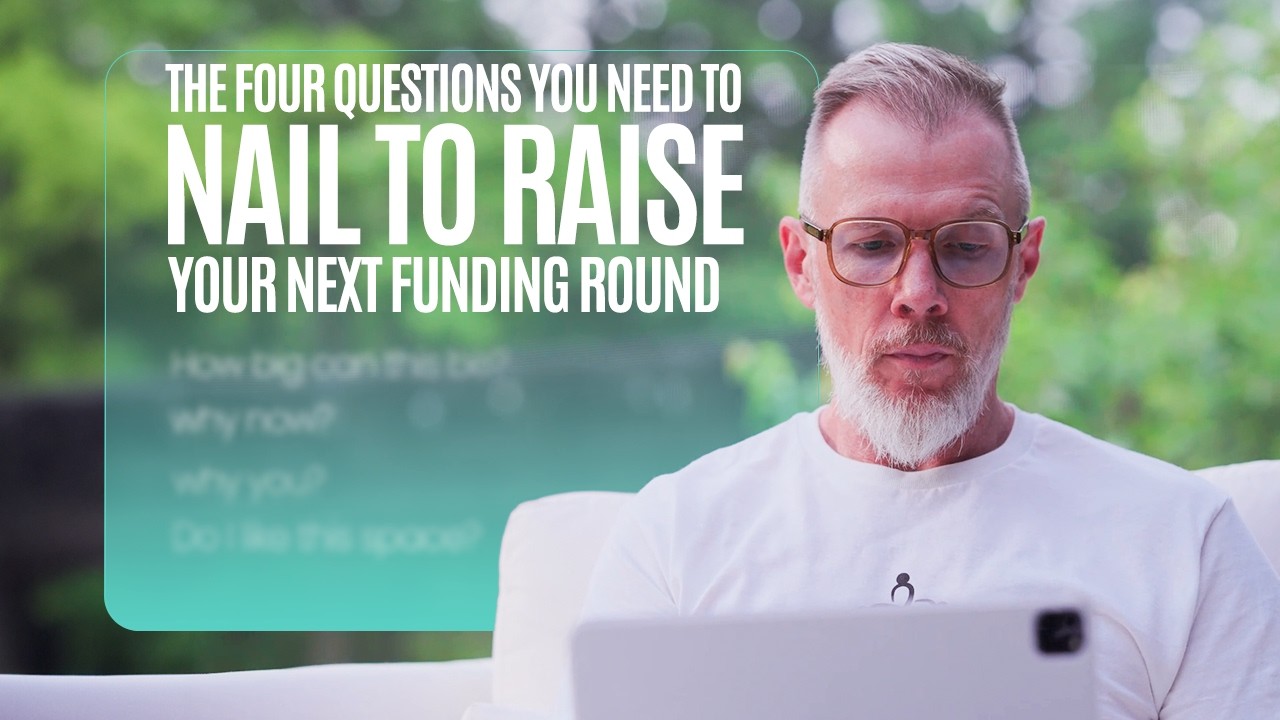
In this solo advisory video, veteran VC and startup CFO Mark MacLeod explains that venture capitalists evaluate every pitch through four core questions. He first outlines the VC power‑law mindset, showing that funds need home‑run exits to succeed, which makes "How big can this be?" the first decisive question. The second question, "Why now?", stresses market timing, illustrated with AI, Zoom, Webvan vs. Instacart examples. The third, "Why you?", focuses on founder obsession, unique insight, and a track record of founder‑led successes such as Meta and Stripe. The final question, "Do I like this space?", reveals the subjective, passion‑driven nature of VC decisions and advises founders to target investors whose personal interests align with the startup. MacLeod also offers a downloadable venture‑capital diligence template to help founders prepare. Throughout, he urges viewers to like and subscribe for more growth‑focused content.
Chapters
VCs pass on almost every deal they see. When I was a VC, I invested in 4% of the companies I looked at. Just 4%. So how do you make it to that 4%? By nailing these 4 questions. The 4th one is the most frustrating because it's completely out of your control. I'm Mark MacLeod. Since 1999, I've sat at the right hand of startup CEOs as a CFO, VC, investment banker, and coach. I've raised over $1 billion in capital and closed over $1 billion in exits. I coach startup CEOs to grow themselves and their companies year after year without limit. Let's get to those 4 questions that you need to crush to raise venture capital. And grab my venture capital diligence template at the link below. It shows you exactly what to prepare before you start fundraising. Question number 1: How big can this be? VCs operate under a power law. Almost all of their returns come from a fraction of their investments. They know most investments will fail and the winners need to pay for all the losers. Here's a simple example. Acme Fund raises $300 million, a small fund by today's standards. To deliver returns to their limited partners, they need to turn that $300 million into $900 million. If they own 15% of their portfolio companies on average, that means their portfolio needs to exit for a combined $6 $6 billion in exits for one relatively small fund. The only way you hit that number is with home runs. VCs are assessing whether your company can be a home run. You might have something great and valuable, but if it can't be a home run, they'll pass. Please like this video and subscribe. I only make content for startup CEOs and I want other CEOs like you to see this. Question number 2: Why now? This is the single most important question. You can get everything else right, but get the timing wrong and it won't matter. Look at AI companies today versus 5 years ago. Same technology, same potential, but now GPUs are cheap enough, cloud infrastructure is there, the models actually work. Companies are ready to adopt. The timing is right. Or look at Zoom. Video conferencing existed for decades, but bandwidth was expensive, quality was poor. It required complicated setup. Then mobile internet got fast, everyone had cameras, and remote work started growing. Zoom launched right when the market was ready. Compare that to Webvan in 1999. Online grocery delivery. Great idea. Terrible timing. Infrastructure costs were massive. Most people didn't shop online. They burned through $800 million and failed. 20 years later, Instacart. Same model, but Perfect timing. You need the market to be ready now. Not in 5 years. Now. Question number 3: Why you? Look at the biggest outcomes. Meta, Shopify, Canva, NVIDIA, Stripe. Founder-led. There's a direct correlation between your performance as CEO and your company's outcome. This is why I only coach CEOs who've raised venture or private equity. You signed up for huge expectations. You signed up to hit that home run. VCs want to know if you have what it takes. Are you obsessed with this problem? Are you uniquely qualified to solve it? Do you have unique insights about a massive market? These outcomes take decades. VCs need to know that this is your mission. It's why you wake up. It's all you think about. Question number 4: Do I like this space? When I was a VC, I passed on great companies, great teams, product and traction. Why? Because I wasn't excited about their space. Totally subjective. The average startup runs 7 to 10 years. I knew I'd own that investment for years. I needed to be excited by what they were working on. It's frustrating for CEOs pitching me, but better to raise from investors who share your vision and passion. The good news is that most VCs are active on social now. It's easy to figure out what excites them. These are the people to pitch. The ones who invest in your stage and love what you're building. These are the 4 big questions. You'll answer dozens more before you close, but nail these 4 and your odds go way up. If you made it this far, thanks. Please like the video and subscribe for more content to help grow yourself and your company without limits.