The CEO as Chief Marketer: Personal Branding in Tech
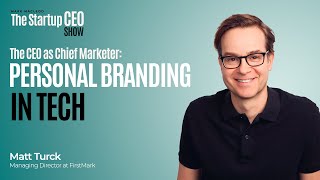
Matt Turk from FirstMark Capital discusses why CEOs should build personal brands through content to attract investors and customers. He breaks down what makes scale-ups succeed: the right team, market timing, and repeatable go-to-market. On AI, he's bullish long-term but warns that data infrastructure and governance are urgent problems startups need to solve now.
Chapters
So a board can be very friendly for a period of time, that get not friendly for a period of time, sometimes become friendly again. So those are truly living organisms that evolve. And therefore you need to know exactly where you are and what situation is. And it's not just the situation of the company. It's the very specific chemistry between the board members and management at any point in time. And based on that, you can allow yourself to relax or not relax. Use humor. Not use humor.
Welcome to the Startup CEO Show. I'm your host, Mark McLeod. In this episode, I sit down with Matt Turk, General Partner from FirstMark Capital. This is my first conversation with a venture capitalist and I went after Matt because I think he's the funniest guy on Twitter or X or whatever you want to call it, and also the most insightful. I knew I would learn a lot from this discussion and he did not disappoint. Matt has been an AI investor for a long time and so we went pretty deep into that and just the market in general. And I don't want to take away the punchline, you're just going to have to listen or watch. But this was a great episode. I hope you love it. Matt, welcome to the Startup CEO show. It's a true pleasure to have you here. How are you doing today?
I'm doing wonderful. Thanks for having me.
It's my pleasure. This is actually a milestone episode. I know you've been a CEO in the past, but this is the first non CEO guest that we have and the first VC guest that we have.
The podcast is officially going to the dark side of the force.
It's going to the dark side, literally. And you know, I've wanted to have you on the show for some time because you are probably like the only reason why I go on X.com and now that I follow you on LinkedIn, I probably have literally no reason to go on X.com. so my first and most serious question is like, you know, I realize you live in New York and there's lots of underemployed comedians and writers in that city. Like, do you have a team? Like, there's so much humor in your content. Like how on earth do you pull that up?
I appreciate it. I will pass on you good words to my extensive team of ghostwriters. Yeah, you know, so I don't have ghostwriters. I do all of this myself. You know, the self aggrandizing version of this is that I always had a little bit of a creative side. I was a little bit of A writer I was as a kid, you know, and so there's a little bit of like sort of pent up desire on my end to do something content related, which is why I write stuff on socials, which is why I run a big community in New York called data driven NYC for the, you know, for the last 12 years. Which is why I started a spin off version of that community into a podcast last year. I just like really enjoy creating content and, you know, it comes very naturally and most importantly, I find it enjoyable, you know, so now I'm going to thank you for the kind words. I would, I would argue that, you know, one, I make more or less the same jokes, the variation thereof, 1 and 2, the bar is incredibly low, right? I mean, being funny on LinkedIn is not exactly a claim to fame, but if there's any learning from this for anyone listening, anybody that thinks in terms of content strategy, which again, in my case I don't do it as a strategy, I do it because it's fun, I enjoy doing it and it turns out people like it. So it turns out that it does have actually pretty tremendous sort of positive consequences in terms of like networking, visibility, content marketing, all of the things, but that's not necessarily the, not necessarily the goal in the first place, but like to reverse engineer it, if that's one learning for folks, it's probably do what comes somewhat naturally. So if you're a startup and you want to create content that's going to resonate, you know, if the CEO, because it often needs to come from the CEO, likes to write, you should do written content. If that's somebody that's much more comfortable speaking. It should be like video podcasts, that kind of stuff, but just like leaning on whatever comes naturally related to that.
Actually, before we go there, I'm curious. You're an early stage investor. You know the deal. Like startups are like whack a mole and you know, there's one issue that gets fixed and another pops up and so shit gets serious sometimes and there can be drama. Like we think everything's fine and now we're being disrupted by the next version of OpenAI. I'm curious, how does humor show up for Matt as a board member? Do you use it to disarm the drama? Does it show up at all? Or is it strictly your online Persona?
I use it more often now, but there was a period of time as I basically learned to be a board member where I wouldn't do that. Like, you know, you joke a little bit at the beginning of a board meeting, but really not during. And I've allowed myself, who is more experienced to do that, so to sort of reconcile those two parts of my personality. And that's, that's, you know, there's tremendous benefits to do that. But the experience part is that it's actually very hard to be a board member because no two companies are alike. No two boards are alike. No two boards are alike across time. So a board can be very friendly for a period of time, that get not friendly for a period of time, sometimes become friendly again. So those are truly living organisms that evolve. And therefore you need to know exactly where you are and what the situation is. And it's not just the situation of the company. It's the very specific chemistry between the board members and management at any point in time. And based on that, you can allow yourself to relax or not relax. Use humor, not use humor. You know, a lot of it has to do with knowing when you're in a bad situation or not. And sometimes things may look like they're a bad situation, but they're not. I think somebody, some smart vc, not me, said somewhere that being a good investor is sort of like, you know, you're like that combat veteran and when you hear the, you know, the cannon somewhere, like all the rookies run around, you know, and hide in the trenches. But the combat veteran knows exactly when something is dangerous, a situation is dangerous or not. So being a board member and, you know, I think one needs to be very careful with war analogies when talking about business because we're talking about emails and people sitting down in conference rooms, but directionally that's a little bit to that. It's knowing what is important, what is not important, and then what is a specific context of the company, the market, and again the chemistry across board members. And when you think about it, it's very much a complex system and it takes years and years and years as it turns out, to become somewhat good at it.
Yeah, I mean, you're in an apprentice driven craft, you just sort of have to put the reps in, right? And then learn from your partners. And there's some osmosis, lots of trial and error. And like I, you know, I know lots of investors and even though they're in a partnership, they actually describe their job as pretty lonely. Like they need for their partner meeting and then they disperse virtually or actually to, you know, the four corners of the country to meet with entrepreneurs. And so you actually have to rely on yourself for a lot of that learning that your Experience as well.
Yeah, 100%. No, no, it's very much an individual sport. So you do it in the context of hopefully a supportive platform that's accretive and helps and all the things, but it's very much an individual sport. Like I'm so lucky that I'm in a very generally supportive partnership and a great firm where people do care about one another and all the things and we small enough that we are not in those bigger firm situations where you have to play politics and have to go before a company presentation pre sell your deal to partners individually with the unspoken quid pro code that if they support your deal at some point in the future you will support their deal. So fortunately we don't have any of that, which again is a privilege of a human sized partnership and we all in one location in New York. So that helps a lot. As we've all learned coming back from the pandemic, spending a lot of time in person really helps. But yeah, so if you're lucky, you're in a situation a little bit like this. But regardless, yes, you have to fight your own deals, you have to close your own deals and then you're on a board representing the partnership in the firm. But.
You'Re the one person going back to content. I'm curious, one super fast question. Has this content manifested in terms of new deal flow? I would imagine your top of funnel's quite large as a result of folks wanting to work with you. Is that true?
Yeah. So look, it's wonderful for top of the funnel, which is sort of what you would imagine, but it's also very good for the bottom of the funnel. So it's great for marketing. It's also great for sales especially look, tech AI today. So I love AI. I've been investing in AI for a very long time. It's a little bit of a weird market in that overnight every VC became an AI specialist.
That's right.
So somehow you need to be able to convince founders and evidence to founders that actually you truly are somebody that spends a tremendous amount of time in the space and has done the reps and all the things. And you know what is better than hey, I got this community that at Urban NYC, 20,000 people, largest meetup in the country. I've been doing this for 12 years. We've had, you know, 400 speakers, 120 events on the one hand or the podcast which is, well, just listen to the conversations. You'll see me every week talking to people at the very forefront of the space. And Then you can judge, you can decide whether you think the conversations are interesting or not. But it's evident. So those are almost like it's going to sound corny or whatever, but sales enabled materials where you're on one on one conversation at the bottom of the funnel. Try to make your case that you're somebody who truly cares about the space, truly understands what the entrepreneur is trying to build and therefore you're going to be a great long term partner for, for them. It helps to have all of this to make your case.
Yeah, I mean it strikes me right firstmark's a tier one firm. You want to back the really special founders and they're going to have the luxury of choice and this might just help pre sell them and have them want to work with you.
They certainly will have the choice. Yes. This industry seems to be getting more competitive every day.
Last question on content. I see lots of CEOs like yourself who are also creators building personal brands. And I'm wondering, what do you think of that is something you Recommend to your CEOs?
Yes, especially in the early days. And I don't know to which extent that's a little bit of a contrarian kind of advice. But we now live in a world of noise. We are bombarded with content. Content marketing used to be a differentiated strategy a few years ago. Now it's become table stake. So content needs to be good, which as per the above, probably means that it needs to be authentic and content needs to be personal as well. And content coming from a person tends to work a lot better than content coming from a company or brand, especially in the early days where nobody knows the brand. Therefore I'm a big believer in the concept of CEO as chief marketer, the person that's going to create a lot of the content, have their own voice and just like make it personal. I think people naturally resonate with something that's authentic. Personal makes sense, human story. And I think directionally the CEO is incredibly well equipped to do that. And there's a whole group of people that do that at all levels of scale. By the way, you can take, I think Arvin at Perplexity is a great example of this. He's relentless on social media and he's very good at it. And for a company like his, which is a consumer company, which you know, revolves around getting more users and more users and more users, building a strong social Persona is really important. He's done a masterful job at it in just a couple of years. You know, when people say it's really hard to grow on Twitter. He went from, you know, 0ish a couple of years ago to whatever he has now now, 250,000 or whatever, last time I checked. So that's a great example. But even in much later stage companies, you see somebody like Ali at databricks, he runs arguably the top enterprise company that everybody raves about, that has all this momentum and all the things. And look, whether that's him or not, I suspect it's him. But he's on LinkedIn all the time. He's like publishing content, interesting content about like, okay, we're very proud of this feature and that model and we're supporting this project and all the things. And he really has a voice and that's really, you know, the databricks voice. So that that works at that, that scale. And you know, you could argue like all the way. Like, you know, think of whatever top company. Like people think of Microsoft, but they really think of Satya.
Right.
People think of Salesforce, but they don't really think of Mark and they have for the last 20 years. So yeah, I'm a big fan of that concept, especially in the early stages. But I guess my point as well is that even in later stages, the Persona of the CEO is incredibly important in terms of building that brand.
That makes a ton of sense. Yeah, I love it. Maybe let's chat about unicorns. So you've had some these fabled spare games with the horn.
Especially in 2021, all my companies were unicorns, which clearly demonstrated that I was a genius.
Absolutely.
We were all geniuses in 2021.
That's right. I mean you only exist for markups. It's not for dpi, it's strictly for markups. So it's all good.
That's right. Those are the rules.
I'm curious if you look back, if you see any common patterns or aspects about the unicorn companies that you've been a part of.
Yeah, look, so this jokes aside, there's a conversation about unicorns versus real companies. So indeed in 202021 there was this crazy inflation around valuation. And as a result, I'm sort of kidding, but not kidding. Like pretty much all my companies, like every single one of my later stage companies became unicorns, which was kind of strange as it turn that was, and still today very much is somewhat disconnected from what the business truly is underneath. And ultimately, especially as you get closer to public markets, what really matters is the actual business. So I guess the question you're asking is those companies that truly have a Business and scale and have real revenue and real financial performance. What do they look like? And look at the risk of standing trite. It's really right people in the right market at the right time.
Yeah, there's a huge element of luck in timing, no question.
And look, that sounds VC cliche kind of thing, but the more you do the job, the more it becomes incredibly obvious. So right finding team and we can decide that, we can discuss what that means. Right. Market absolutely matters for sure. And you know, it can be a small market and it can be a market expansion play or it can be a very large market that's ripe for disruption. And then the right time matters immensely. And that is so tricky. You know, being too early to market is super hard. Being too late to market is super hard. So you want to be roughly in the window and look, sometimes you're too early, but thankfully you're only early by a year and a half. So you have enough cash to go through the desert while the market forms. And then you're like in the right market at the right time. But once the three things happen, which happen pretty rarely, that's the sad truth. When the three things happen, then you see companies getting to product market fit pretty quickly, which is this amazing sentiment, amazing feeling when you feel that the market is starting to want more of your product and more of your product and you know, pull situation rather than in a push situation. And then when that happens, then you see the best team executing with great velocity. They say, okay, this thing is starting to really crank, so all systems go, go, go. Speed is extremely important at that moment. And then things compound. Right? You want to let the compounding happen and you build. Especially if you're in sort of the B2B enterprise side of the world. That's still to this day the Beauty of the SaaS model where things just build and build and build and build. You could argue it's probably true on the consumer side as well, where your brand keeps getting bigger. Maybe you're so lucky to have real network effects and that keeps getting bigger as well. But it's, it's that compounding that leads to, you know, escape velocity. And when that happens, that's very special. So yes, that's what those success stories, whether you call them unicorns or, you know, high revenue companies, that's kind of what they look like.
I love it. That's super helpful. I was the CFO at Shopify when first market the Series A actually did not know that.
Amazing.
I've studied Toby and that company a Lot of it's the single largest portion of my net worth, so I have a vested interest in following it.
I'm sure it worked out.
Yeah.
Amazing. That's fantastic.
Yeah. And Now I coach CEOs, so I'm always looking to kind of reverse engineer success. And there's a few things that Shopify illustrates for me. Right. You know, one like a founder who's completely obsessed with the problem. Like it's not about, like, oh, there's a big market, there's money to be made. It's not about, hey, my product's amazing because that's a closed mindset. Like he's just obsessed with making commerce simpler for everyone so that anyone can launch a product based business. And he's not done right. He doesn't need to work. He works as hard as, as, as he ever has. So complete obsession with the problem. When I have like a pie chart of all the elements of value creation over the life cycle of a company, I would argue the biggest single slice is go to market. To your point around repeatability. Right. Once you figure out that recipe, just like just keep making that recipe over and over again, never compromising on leaders. I think about the number one topic that comes up for me and my coaching, it's leaders who used to be great, who are no longer great and what do I do with them. Yeah. Luck and timing. Nothing you can do about. But I don't know, those are, those are like very small pattern recognition that stands out.
Yes, yes. And then the, you know, I mean, I guess there's so many aspects to that conversation. But to the leaders stuff, companies that can be talent magnets early on, that seems to be a very strong leading indicator of success. And you can sort of tell in the first year the quality of the engineers that join the quality of anyone. Like even the first kind of business operational person and you know, great people tend to attract other great people and that this virtual circle happening.
And Shopify definitely checked the box there. Right. Like Toby was so involved with Ruby. Ruby, thank you. Ruby on Rails. He was super involved with Ruby on Rails and so he had some amazing early developers. And Harley, I don't know if you ever met Harley, the first business hire he made, but guy's a force of nature like wrecking ball. So I think he checked the boxes there. I'm curious, you talked about all those markups you had in 2021. Did you know at the time that you were doing stuff that made no sense?
It's a great question. I think in general the sentiment on my end, but I would say across a number of my VC colleague friends was that, no, it didn't make sense in the grand scheme of things and at some point the music would stop. However, especially for my growth friends, growth stage investors, I think the general feeling was you got to play the game on the field and you can't just completely opt out of investing in two or three cohorts just because you think you can time the market better than anybody else. So now, of course, there's a spectrum. There are people that went truly all in and invested entire funds in 2021, and that's a complicated situation. The more established funds that did that have the benefit of a prior track record that they can lean on and just say, hey, basically, please give me a little bit of a mulligan for that.
That was a drunken orgy. Sorry.
Yes, exactly. Everybody else was doing it, you know, but like the people that had the misfortune of just getting started in this job in 2019 or 20, you know, as a new partner or like a new fund, and they were hyperactive during that period of time. That's, you know, that, that's why we see so many musical chairs and movement in the industry right now. And look, I mean, it's not a good thing, it's not a fun thing. Some people think it's a healthy thing. But I think a lot of people that find themselves in this situation just did what they could do at the time. It's not like they were idiots or it's sort of like that the misfortune of showing up at the wrong time. So, you know, look, some people pushed it a bit for sure, but, you know, many others didn't.
It's easy for me to be an armchair critic, you know, that's for sure. Like, for me, like, at the time I was just like, there's history, right? We have sort of decades now of technology companies and valuation precedents and it's like, man, these SaaS companies normally trade five to eight times revenue and now they're getting 60 times revenue. I don't know how, like, I'm not good with math, but I don't see how this is going to work out.
This last year or two. But even before that, we've been effectively recreating the same situation in AI. Like a lot of people, I imagine I've had this little bit of this split reality experience in my day to day, especially in 2022 and 23, where I would literally spend half of my day undoing the excesses of the past managing tough situation rifts, trying to extend Runway for all those companies that had raised in 2019, 2021, and suddenly were finding themselves in a world that was very different, with very compressed multiples, general slowdown, B2B recession. So that was like half of the day and then the other half of the day. Because I'm an AI investor, data and AI investor first and foremost, I would find myself in conversations where we're effectively just recreating the same situation with a new cohort of companies. And look, it's this kind of, whatever you call it, externality kind of economic situation where you make what feels like a rational investment decision at a micro level. So you see a great company, it turns out to be a very competitive deal, you want to win the deal, you'd rather own less because you're paying a high price than not own anything at all. Therefore, you decide to go all in or all out, and you just push, push, push, and you pay a higher valuation than you normally would. There's a framework where that makes a lot of sense at an individual level. The problem is everybody does the same thing. So the collection of seemingly arguably but seemingly rational decisions, when combined, ends up creating an abnormal situation. And the structure of the industry is such there's so much competition, so many funds, and ultimately a finite number of great companies that unless or until the fundamental structure of the industry changes, you're going to find yourself in those situations again and again.
And so that's happening in AI. And you, to your point, you've been an AI specialist for some time, so let's talk about AI. I'm sure it's easy to imagine what excites you, but maybe what scares you as an investor.
I'm going to make the most unoriginal comment on AI, which is that I'm very bullish on AI. I do think we are now at a moment that has been years, possibly decades in the making, which is very exciting for me. The whole, whether you call it big data or data infrastructure thing, that happened that played out over the last 15 years on the one hand. And then the whole evolution of deep learning, in particular since 2012, we had that moment where, like, those two things are colliding in a really interesting way. And for me, that was always part of the same fundamental mega trend. And it's happening, you know, like for so, you know, in some way, like for people like me. And it's not just me, you know, there's others, but, you know, ultimately not that many others that have been kind of like rooting for this to happen. The fact that it's happening now is very exciting now. You know, look, the things always take longer than one thinks. Typical Amara's Law thing. People overestimate what happens in the short term, underestimate what happens in the long term. So we clearly in that moment as well, but with all the money that's going in the industry and continues to go in the industry, that raises the stakes in terms of we building the supply and building and building and building on the basis that if we build it, they will come. And the concern is on my end is how quickly they will come. So I have no doubt that they will come, meaning that the demand side of this market will materialize at a massive level. But it's going to take time. And you can already see on some earning calls and how the markets react. The markets which are, as we know, very quarter based, they tend to react very in extremes to whatever little smallest news. Meanwhile, demand is going to materialize for me over a decade and we see it. I spend a lot of time in enterprise AI. And the reality in enterprise AI right now is that people last year did a bunch of kind of a low hanging fruits kind of thing. So that's your chatbot, that's your enterprise search, that's your coding AI solution. So people have done all of that, whether that's pilots or deployments, they've done all of this. The other thing that they've done is bring in the consultants, explain to us how we apply AI to our business. And all of this is great and it's a great first stage or first step. But what makes enterprise AI really interesting is for everything else. So I would call that 10%. What's really interesting is the remaining 90%, which is okay. How do we use AI to do things that are specific to our company, specific to our industry? How do we leverage our own data set to do things that our competitors cannot do or will not do as quickly? That's really the opportunity and that is complicated. Right, because that means, well, first of all, where is our data? Is it in a state? Is it clean enough? Is the quality high enough? Do we know how to sort of govern it, manage it? And all the data infrastructure kind of questions which are now becoming super, super urgent. If you want do AI, so that's that. And then do we have the talent? And you know, as it turns out, generative AI is a whole new beast. And knowing how to just manage those models, that's a whole thing. And then, you know, the change Management, all those words like that gives me the shivers, you know, like digital transformation, change management, like all the things which are fundamentally true, which means that you need to convince humans and educate humans on what to do with all those things for which business case and how does that change their daily workflow. And some people will embrace it and some people will hate it, and some people will claim to do it, and some people will actually do it but not talk about it. And this whole human kind of aspect, that's the real mess in the whole situation that will evolve, but that takes many, many years. And any once you really start Talking to Global 2000 companies, federal government, all the things which is where the many, many billions of revenues are, that's sort of where they are right now. So that's a long winded answer to your question. But if the question is what I'm worried about, I'm worried about that time mismatch between an overbuild of supply and an overbuild of expectations on the one hand, and a demand that will materialize, but maybe not quickly enough for the whole industry to stick the lens.
Are you still taking your own meeting notes? Let me tell you about an AI tool that I'm using to take meeting notes. For me, it's called Fellow. It's an AI meeting assistant. It takes human level AI notes, it tracks my action items and decisions and keeps everything in one place built with security and privacy at its core. FELLOW is the only AI meeting assistant that leaders trust to capture meeting notes and recordings while keeping your data safe. Thousands of organizations are consolidating tools and relying on FELLOW to capture their meetings. The team at Fellow is so confident that you'll love it. They're offering an insane deal to startup CEO listeners. 90 days of unlimited AI powered note taking and recording, completely free. Visit Fellow App CEO to sign up today and experience the AI meeting assistant trusted by leaders everywhere. Would you say the like trust like demand being behind? Do you think that's like a trust issue? Like AI scary? I don't trust it yet. Or is it like a readiness issue? Like I know several Canadian big banks like still run systems on Cobalt. So like thinking of like, you know how to like work with the latest AI is just like too big a.
Stretch, you know, all the, all the above. It's a systems issue, architecture issue, where is our data issue? And then human preparedness, human appetite. AI is like this weird thing fundamentally in that as we know it's stochastic, not deterministic, meaning that it's not going to provide a correct result 100% of the time. It's actually not going to produce the same result 100% of the time. So it's a whole new way of thinking about it. I think there's this perception in the enterprise that if you wait long enough, then AI is going to evolve in a way that is going to be 100% correct 100% of the time. In fact, that's never going to happen. It's going to get closer and closer through a combination of improvements of the underlying models and then a lot of rag, but you're not going to get there. So it's like a mind shift as well, which probably means that you can't use AI for all the use cases for something that's in front of the customer and that needs to be right 100% of the time. That's probably not a good idea. But then what is it a good idea for? And you need to think about it again in the context of your business, in your industry, with your data and all the things. So it just takes time. It's a big effort, it's an evolution. Everybody needs to learn, understand how those things work, what they're good at, not good at. And then you need to be able to control it and govern it and not to be the VC that shields for their companies. But I'm a very proud investor in Dataiku, which is exactly that, which is like an enterprise AI platform that enables you to do all the things, integrate all the forms of AI and analytics and metrics, models, agents and govern it. And the reason why I'm very bullish on the company is that that's what the market needs now. It's like control, governance, organization and doing the things in an orderly manner that doesn't create.
That's really helpful. I appreciate that. So I've been mostly a SaaS guy and I wonder if you think SaaS is just going to die and be replaced by AI. Like SaaS is fundamentally a database and like you have to work to get value out of it. And now we're moving to this world where software works for you. Like One of my CEOs feels like UIs will just auto generate in a few years. Like, what are your thoughts? There's a tremendous amount of market value tied up in SaaS. Do you think it's at risk?
I mean some of it is at risk on an individual company basis for sure. As a category, I don't think SaaS is dead. I think SaaS is going to evolve into SAS 2.0, whatever you want to call it, which is going to just incorporate a lot of AI natively to do a bunch of different things. So if you think of SAS fundamentally as a way to buy software, subscription model, to deliver software through the cloud, there's a fundamental need to do the things. So I think you're just going to have a generation of companies that are going to be much more either AI native or where AI will become a huge part of the business and that this transformation that's happening. So clearly you have an extinction risk for certain SaaS companies that just don't move fast enough. Clearly AI native companies right now have tremendous amount of momentum and in some ways it's kind of unfair. But people look at them as AI native, what the future is. And then you have those older companies that just have the bad fortune of having started in 2007 or 2012 and therefore are not considered AI native. And in reality some of them brought it a lot of AI and sort of do the same thing as the AI native companies. But like from a brand and marketing perspective, they considered they perceived as like being on the receiving end of AI versus being part of the disruption. So that's all of that is playing out. And I think the net result is you're going to have a whole generation of companies that are going to be those combination of AI and what we think of SaaS from a functionality perspective. So a combination of databases and agents and all those things.
Things.
I do think that at the margin there's going to be certain companies and certain types of needs that are going to be addressed natively by AI. So if you think of coding capabilities, I think that's actually pretty disruptive. I would argue that it's probably mostly disruptive to customers software. So as we know in the enterprise broadly defined, there's tremendous amounts of homegrown custom things to address needs where the market is too niche for a SaaS company or a SaaS category to have emerged. I think that's going to get replaced by AI because indeed it seems that the world is evolving very quickly towards being enter a prompt, see application come up.
So you've been an investor for a long time through different technology movements. Is it more or less difficult to form lasting conviction about an investment thesis in this world versus previous ones?
It's the same. The more you do the job, the more you go back to the basics. It's a little bit like the speaking of Twitter content and memes, it's a little bit like the noob curve you know what I'm talking about Goss thing where basically you start at a point, then in the middle year three or four, your sentiment evolves and then you sort of go back to where you came from on the other side of it. And VC investing 100% fall in that category from my perspective, where you start your one or two and basically largely because you heard it from other people, you say, well I'll invest in the best founders I possibly can find. And then you get to your 2, 3, 4, 5 of your career as a VC and you're like, oh well what about you know, CAC 2 LTV or NRR or you know, all those things and then you know you're a 5, 6, 7, 8 or maybe faster for like people you know are smarter than me. You go back to I'll invest in the best founder Sakaba possibly can find. And of course you know like the nuances that what you consider to be a great founder at the beginning of the journey versus on the other side of the journey evolves a little bit. And your kind of radar and intuition.
Also your access, the founders you have access to is going to be very.
Different hopefully, hopefully if you did well. So if you look at it from that perspective, sort of whatever happens in the world, ultimately you invest in hopefully great people for very long term journey towards a long term goal. So you have to believe that those people will have the grit and resilience to continue whatever happens. Evolving with the final goal of disrupting whatever industry or disrupting is always a bit of a double edged term. But building the little part of the world that they are super passionate about, a 10 year journey, regardless of whatever happens, month, six or months, 24 matters less obviously as long as you stay alive and all the things. And there's different ways of getting to that goal. But yeah, I mean that's how I view it. So I don't think today is either harder or better. Yes, the world is changing quickly, but we have been for the last 30 years, 40 years in a moment of just profound transformation of the world. So today is not any better or worse. I mean I do think it's compounding and accelerating. Like I don't want to minimize the fact that the world is changing really quick in ways that are unsettling and you know, this whole separate conversation about the actual impact of AI, you know, when that demand materializes and all the things which again I think we're going to take time but when it does happen, I do think that's very disruptive in all sorts of different ways. Ways socially, emotionally, humanly, personally and all the things. So the world is changing, but for purposes of what we do, the fundamentals remain.
I'm actually fascinated by that curve. I start backing the best founders and I come back to backing the best founders. You're a tier one fund competing with other tier ones who all have access to the shiniest founders. And you're an early stage investor, which means those rounds happen relatively quickly. How do you form conviction so rapidly?
So going back to some of the cliches of venture capital, but again there's a reason why they cliches. So prepared mind is something that people may have heard about, which is this idea that you do work up front and that can be industry work, that can be company category work, it can be founder work where you've sort of fine tune your own model. If you think of your mind as an AI based on founder data, but you show up in those conversations with an opinion and when it so happens that the founders match that opinion, then you know pretty quickly and then yes, you have to act fast in a context of maximum ambiguity. You know the world where for the best companies, companies show up in your office, you know, have 2 or 3 million in ARR and are willing to answer all your questions and I'm not talking to any VCs and tell you you have all the time in the world to make your decision. That is long gone. And maybe it existed at some point, I don't know, in the 80s in Silicon Valley, maybe even then it was not the case in our world that's just not the case. But again, you do this job long enough, you build, you sort of know very quickly in a conversation whether that's something that you're going to be excited about. And again, prepare in mind like you've done the work and you know that whatever they're doing is interesting because you've done the reps and that like this specific thing, that's where the world is going. Because it so happens you spoke to a bunch of Fortune 500 CIOs that explain that it's a problem that they have whatever heuristic. But like you've done that and then you meet people that have that clarity of thought where they explain very precise terms why what they're doing is important, why it's almost inevitable that whatever little part of the world is going to evolve the way they describe it and why they're the right people to do it. And when that happens, and you know it doesn't happen that often. And it's very special. As an experienced vc, you sort of know pretty quickly that really resonates.
The reason why I left Shopify actually was to join a venture capital fund. I went to the dark side for a bit.
Yeah, that I'm aware of.
And one of my observations was that the best investments were based on a crisp, simple insight. It was crisp and easy to articulate late. It was just unfortunately not obvious at the time of investment. Hence the venture aspect. But like the entrepreneur's ability to just synthesize everything, have unique knowledge, have alpha, to use an investment term, but then just convey they have such mastery over the topic that they can just tell you crisply. Like you can walk into a partner meeting and you just recite it verbatim like. And so complexity of the entrepreneur struggles to convey what they know. That for me was like a negative investment signal.
That's exactly that. Another mental model for it that I think about pretty often is value capture versus value creation. As an investor and what I found, at least for me, is that whenever I think there is a value creation opportunity, meaning I see something. I see some kernels of interesting things here. And it seems to be a good enough founder in a good enough market. And it seems. But you know, it's going to take a lot of work even to help them sort of refine their vision and all the things. I actually do enjoy that work, but from experience, I'm not a great investor in those scenarios. However, sometimes when you have that crisp insight that you were describing and those founders with deep clarity of thought, it feels like a value capture kind of moment, which I don't know, may sounds terribly cynical as an investor, but it feels like that train is leaving the station. Do you want to hop on it or not? It's that feeling that is very special. And whenever I have it, it's one of those hell yeah moments when you just really, really want to do the deal. And so that's value creation versus value capture.
Maybe as we approach the finish line here a minute, you were just a few more, maybe more practical questions for the audience. So one for any AI CEOs who are listening or watching. There was like an exodus away from San Francisco during COVID and now I feel like people are coming back and especially it's becoming a hotbed for technical talent in AI. And so I'm wondering, do you feel as an investor like, do you valuate AI companies differently depending on whether they're an SF or not?
Yeah. So one of my favorite topics you know, the east coast versus West Coast.
Like a hip hop battle.
Yeah, exactly. Yeah, yeah, exactly. I made a fairly obvious joke at some point, like I must have a tweet if I didn't deal, where I said, like, you know, 1990s was like East coast versus West coast rappers and 20. Oh yeah, rappers. Yes, rappers.
That's awesome.
So look, so to get the, you know, the obvious out of the way, San Francisco is the biggest tech ecosystem in the world. It's an extraordinarily special place. You know, the vast, vast majority of enormous and incredibly successful companies in tech that were ever built were built in San Francisco and Silicon Valley. All of this is obvious, undisputed, and I'm not going to dispute it. And it's true in AI, this tremendous energy, OpenAI and a million other companies, all those things undisputed. At the same time, I would argue that if you stop here, you actually miss one of the biggest successes of Silicon Valley. And the biggest success of Silicon Valley is actually not Facebook, it's not uber, it's not OpenAI. It's the fact that Silicon Valley has very successfully exported its model and its way of thinking to the rest of the country and the rest of the world. And that has been a extraordinary.
Means.
Of creating massive economic value around the world in a way that even in Silicon Valley, I don't think people fully realize if they don't spend a lot of time in other ecosystems. So look, that's certainly true in New York, that's true in Israel, that's true in Europe, that's true, albeit in a very different way in China, a very different way in India, in a very different way in Brazil. But it's like all over the world and variations, local flavors. And you could argue that these ecosystems are not as good, they're nascent. And there's a whole evolution of these ecosystems where effectively you need to have several rinse and repeat cycles where you have companies that become very successful and then create wealth and expertise and redistribute to the system and all the things. And that rinse and repeat cycle has been happening in Silicon Valley for or generations. Generations. You'd argue that in New York it's happened a few times. Like there's maybe four or five generations of this happening as you move east to London, Paris, Berlin, it's maybe happened twice, Stockholm happened twice. And so all these ecosystems are forming really, and accelerating. But so that's, I think, something just really important that people, people don't talk about enough for AI. It's Very true as well. And you see it everywhere. So look, the first big IPO in Generative AI is going to be Core Weave. It so happens that Core Weave is headquartered in beautiful New Jersey. The founders live in New York, in Montana, in different places, but they're not like Silicon Valley insiders. And then just look at Europe. There's just tremendously interesting companies, whether that's Mistral, Synthesia, in which I'm a very proud investor. Eleven Labs, which somewhere between Poland and London, and Brooklyn, Black Forest Labs. There's this long list of great AI companies. There's some in Israel, there's some everywhere. So yes, San Francisco, fantastic. But if you miss the rest of the world, you're missing a huge part of the story. And as an investor, it so happens that it's what I focus on. I do a lot of sort of East Coast, Europe, Europe to New York, Europe to us. I would love to do more. Israel to New York, Israel to the US as well. So to the Peter Thiel question, what do you believe? Whatever that is, what do you believe about the world that most people would disagree with? Especially today when we're in a situation where everybody's very bearish on Europe, on Twitter or in conversations in tech circles. I'm actually very bullish on a type of European entrepreneurial energy, which doesn't mean that Europe doesn't have its own problems. But I think the companies that grow in Europe are very resilient, have a lot to deal with. And you see a lot of people like an entire generation of founders that want to build global companies from day one. They don't want to be the best companies in France or Switzerland or wherever. They want to be the global category leader. They happen to start in Europe. But that whole model, especially for B2B enterprise companies and B2B AI companies of build it in Europe or Israel and sell it in the US I'm a huge fan of. And to my surprise, it's somewhat contrarian these days.
Yeah, I can see that. But yeah, that's clearly some great examples. I mean, a really old school example would be Zendesk.
Yeah. If you look at the in New York for what is worse, like some of the very best companies of the prior generation or current generation. So the companies that clearly have become successes. And whether you think they model in companies today or not, you can argue. But UiPath headquartered in New York, that whole generation of the Collibras you mentioned Content Square, which is still a young company, and then all the Israeli companies like Wiz is Headquartered in New York. Sayera, which is a younger Israeli companies in cyber but doing incredibly well is in New York Data ag, who that I mentioned has been a New York company since I did the series A in 2016. So if you remove the European and Israeli companies from the east coast and there's some in Boston as well, you miss like a big part of the success. And all of those have become American companies, but those are very significant multi billion companies. Some of them are, you know, public and all the things. And then if you include the European founders of American companies, then you start missing like the data dogs of the world. And you know, so yeah, it seems obvious to me but like you know, somehow there was a moment, so there was like a minute and a half where sort of, you know, around the time of Mistral, I would walk around in Paris and would bump into all sorts of, you know, U.S. colleagues. And that lasted about six to nine months. And now it seems like everybody's gone away.
That's really fascinating. Any final question, Matt? What advice are you giving your CEOs these days? And realizing that's a very broad question, maybe like are you telling them to be bullish or bearish? Like what's the sentiment?
Bullish. I'm very bullish on like in general tech and the opportunities and all things. I think it's truly one of those great moments in tech where you have an opportunity to build companies across the board. I think that all AI moment is just a wonderful opportunity and in many ways it's sort of just starting because look, the first sort of two, three years of the generative AI boom that started call it November 30, 2022, the kind of last couple of years that's been very much an influence kind of discussion. It's been GPUs and data centers and then foundation models and then orchestration systems, like all that good stuff, vector databases. It's really been the core focus on building the supply to the earlier point about the supply. And we're sort of at a moment now when that stuff is while evolving fast is kind of in place. You sort of know how to do the things you sort of know how to do. Rag. You sort of know how to route queries across multiple models. People have learned very quickly. So now is a wonderful time to turn all of that into the next generation of Saskatchewan companies, you know, consumer products as well. But you know, the SaaS 2.0 companies like that, now is the moment to think about, okay, what use cases are particularly ripe for AI disruption? So it's a great time to build companies. And you know, last year there was like this whole debate around thin wrappers and there was this perception that if you were kind of a regular software company and all you did was really to add a layer on top of a cloud or GPT, you are not building value and you are just a reseller effectively. And you are just going to die a very quick death, and I think rightly so. The industry has completely changed its mind on that topic. And now the thin wrappers of yesterday have become the thick wrappers of today because people have realized, let's just joke.
There, I'm going to let it go. There's definitely a joke there.
But people have realized that just even at the infrastructure level, this stuff is reasonably complicated and involved. So as much as I was saying, well, now people have understood how to use multiple models and wrap them. If you're going to be a solution, like speaking of Canada, like Ada, in my portfolio, which is an AI customer service company, that very much is a generative AI company. Now, if you're going to be delivering that kind of service to your customer based on generative AI, well, you sort of have to be on top of every little thing that happens in generative AI, which by the way, changes like four times a day, it feels. So you have to be constantly reading papers and then testing models and evaluating models so that, you know. Well, for this query I'm going to route to, you know, Sonnet 3.7, but for this other thing I'm going to route to GPT4.5. And for this other thing I'm actually going to route to my homegrown traditional machine learning classifier. And that all of that is actually, that's not thin wrapper at all. That's actually pretty complicated to do this, you know, day in and day out. And then on top of that you got like all the SaaS stuff, right? So actually authorization and authentication matters, RBAC, like all the things. And actually collaboration matters a lot and so on and so forth and there's a lot of work and all of this needs to be customized for the specific industry or the specific problem that you're trying to solve. And you know, there's a lot of value there and that's a lot of work to be done there. So I'm bullish on all of that, on all those companies, those thick wrapper companies, tech industry, take your industry, pick your industry, pick your problem, pick your geography, pick whatever, and then apply this kind of combination of like AI and SaaS to solve it. There's just tremendous opportunity now. So what I tell my CEOs is to to be bullish, enthusiastic, stay very, very close to what happens in AI and just go for it. It's a very special moment.
I love it. Well, I'm actually very encouraged to hear that. I thought there might be a bit more caution. So that's a nice optimistic note to end on. And I really appreciate you making the time, Matt. I was sure this conversation was going to be insightful and it did not disappoint on any level. So I'm really grateful for you making the time.
Thank you Rudy. Really appreciate it.
Hey, thanks for listening to the Startup CEO show. If you'd like to connect with me, be sure to visit my website at markmcloud me or follow me on LinkedIn at the Mark McLeod or Twitter arkmcleodore. And if you want to tune in again next week, be sure to subscribe on YouTube, Spotify, Apple, or wherever you get your podcasts. We'll see you next time.
More from Mark





The Burnout Breaking Point - How Strategic Breaks Actually Increase Productivity


Emotional Debt - How Avoiding Hard Conversations Compounds Into Company Killing Resentment


The Death of the Specialist - Why AI Is Creating a New Professional Class Called Scalers