The FASTEST Growing Fintech You’ve Never Heard Of yet…
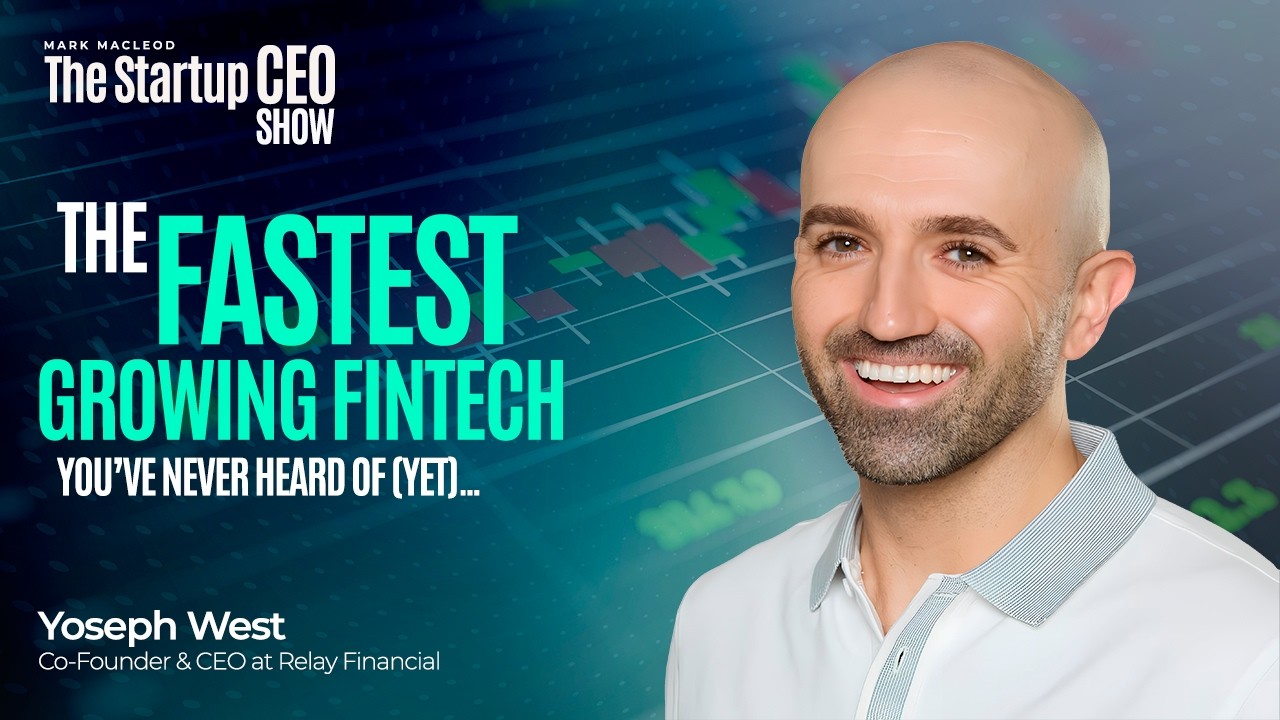
Joseph West, CEO of Relay Financial, says 88% of small businesses regularly face cash-flow crises. His fintech combines banking with invoicing, expense management, and AP software for companies with 2-50 employees, using accountants as a referral channel to build trust.
Chapters
You know, the through line that I had, you know, worked on my whole career and the problems I had seen in that business as we were scaling it, you know, were pretty similar. So if the through line was cash flow visibility or financial visibility is extremely challenging for small business owners, 88% of them hit a cash flow crisis with some level of regularity. And so our view was, what if we attack this from like a first principles perspective and we were the banking platform of choice for small business?
Welcome to the Startup CEO Show. I'm your host, Mark MacLeod. Cloud. In this episode, I sit down with Joseph West, co-founder and CEO of Relay Financial. Relay is an online business banking and money management platform for the small business market, SMB. In this episode, we unpack the SMB market. Both Joseph and I love this space. A lot of VCs don't, so we try and debunk that, but we spend most of the episode talking about the Relay journey. He's 7 years in, there are over 200 employees. He's going through rapid growth. And so we unpack that journey. Lots of actionable insights here. You're really gonna love this discussion. Josef, welcome to the Startup CEO Show. It's a true pleasure to have you here. How you doing today?
I'm great. It's great to be here.
Awesome. So full disclosure right up front, I am an investor in Josef's business. I've also known Josef for a long time. I will say for what it's worth, uh, two things. One that I want to talk about, which is the importance of regular updates to investors from CEOs. I think I get yours before anyone else, and I correlate investment performance very highly with receiving CEO updates. And then also when I look at your revenue graph, I don't know if I've seen a steeper slope. So I don't know, maybe it's just 'cause you're sending out these updates, but like, man, the business is on fire. So congratulations. And as I thought, we could kind of have two parts to our discussion today. One, like, let's just spend a bit of time chatting about the SMB market. Uh, you are an SMB specialist. I spent a bunch of time there and VCs actually kind of love to hate the SMB market. And so I thought maybe for any VCs listening, we could debunk that a little bit, but then let's spend most of the time unpacking the Relay journey. Does that work?
Sounds great.
Awesome. So maybe I'll, I'll kick things off with like some old stats, because I haven't looked at this since I was running SurePath. But what I understood at the time was there was like, if I get this right, 30 million small businesses in North America, 60 million in the English-speaking countries, and like somewhere like north of $200 million globally. The stat, that stat was a little kind of harder to, to kind of confirm. And then, so giant market, you know, in some ways kind of has like the scale of consumer, but with more direct monetization opportunity. And then like a big trend, the last time I was in SMB was Like every day in the US, 10,000 people turn 65 years old. The point of that is like there's a generational transfer and the new entrepreneurs are like your generation or younger who just assume whatever need they have, there's an app for that somewhere and they're going to find it and try it. And so like technology adoption is a thing. So I don't know, what are your thoughts? Like you've done Wave, you've done Hubdoc, now Relay, like you're deep in the space deeper than me. What are your thoughts on the SMB market?
I mean, I obviously love it 'cause I've dedicated my career to it. It wasn't, you know, kind of going back in time to when we first started working together and the Wave kind of transaction came together, that was my first exposure to small business and getting to see, like we were selling accounting software to like micro SMBs at the time, right? And in that context, you know, that doesn't sound super exciting, at least, you know, initially, But I think as you get to meet these people and you get to see the joy and the passion that they get from the work, I think for those of us that love work, right? We wouldn't be doing what we do if we didn't love it. I think there's a kinship in that and there's something really special that has inspired me and it has kind of been the through line of the last 10, I guess 15 years now. You know, I think the overall criticisms of the SMB market are like, A, can you reach small business owners? B, can you do it at scale? And then C, can you do it in a profitable manner?
And churn comes up a lot, right? Like number one objection for VCs and SMB is the rate of churn.
Yeah. And they think of small business sometimes as the solopreneur or freelancer that popped out of a job and is now freelancing and then pops back into a job, and that is churning. I think the misunderstanding or I guess the nuance is how you should think about SMB and how to actually make it economically work. So whether we're talking about a Relay or a Shopify, all of these businesses are driven by fundamentally a power law. Right? Your top 10%, your top 20% of customers are really what pay the bills for everything else. And so when we think about it in a Relay context or even like a Shopify context, which, you know, Shopify's pulled off the most amazing thing, which is convincing everyone they are a software company, not a payments company. You know, we really need to figure out how to do that. Yeah, right. But it's all—
please don't tell the market otherwise because Shopify is the single largest portion of my net worth and I don't want the valuation to plummet. So there's that.
I'll, I'll, I'll do my best to, to keep it on the DL. Um, uh, and so, you know, in this context, the question is not like, is SMB a good market? The question is, can you acquire enough of the actual, like, val— like, not valuable, because that's— I— that feels like the wrong, uh, wrong word, but revenue-driving, uh, segment of the SMB market to be able to make your business work. And so from our view, uh, when we looked at the marketplace, we kind of saw kind of two ends of the spectrum on SMB. So the top end of the market from our perspective on SMB is businesses that have 100+ employees, or you're kind of going after startups. So you think about like the Mercurys of the world, the Ramps, the Brex, Rows, like all of those folks, they're building wonderful businesses. Like I have a lot of respect for all of those folks, but the core assumption that they have made in their business is that there is an in-house finance leader. And they build tools in that context.
So not for the entrepreneur, for the finance leader.
Bingo. And then you have the bottom end of the market on the other end where you have people focused on solopreneurs and freelancers. So the Founders, the Northones, the Lilies, the Novos, and seemingly good businesses. We'll kind of see how that plays out. And they're trying to kind of come up a little bit in terms of number of employees that they're able to serve. You know, candidly, when we started this, we found that that segment felt very challenging to be able to serve, like economically not the most profitable. Um, and then it just felt like every platform would have a version of a business bank account product. Shopify would have what has become Shopify Balance. QuickBooks would have what has become QuickBooks Cash. And it just didn't seem like a place where we could build enduring value. And so for us, like where, where we focus and where we find the most value, the reason that like power law curve really works for, for the Relay business is we focus on Main Street SMBs with 2 to 50 employees. And that's really the place where you can get that kind of revenue lift and make the economics work.
So that's still, yeah, that's a pretty fat portion of the bell curve. Like I was thinking when you were talking to me about Power Law, I was thinking maybe that means you're really serving more of the M rather than the S, but like that's a decent portion of the S, the small business as well, I would say.
Yes. Agreed.
Yeah, that's cool.
This episode is brought to you by Limitless. Limitless is an exclusive community of VC-backed CEOs who want to scale themselves and their companies without limits. The biggest outcomes in the startup world are founder-led. Meta, Amazon, Shopify, Airbnb, Canva, NVIDIA. Behind every one of these companies is a founding CEO who didn't just scale their business, they scaled themselves.
Sales.
They added one zero at a time and today run companies with billions of dollars in revenue each. That's the goal of Limitless— to give you the tools, strategies, mindset, and community to lead at the highest level without sacrificing your health, relationships, or purpose. Through group calls, an elite peer network, a proprietary AI coaching bot, members-only library, and in-person experiences, Limitless gives its members everything they need to keep scaling themselves and their companies for as long as they want. Go to limitless.co to learn more.
What was the, um, what was the inspiration for Relent?
Um, so the backstory is I spent, you know, 4, 4 and a half years, uh, building this company called Hubdoc. Hubdoc was like a central repository for small business financial documents like bank statements, receipts, invoices. And I was the third employee there, and I was almost—
After the two Jamies, it was you?
It was something like that.
Okay, wow.
It was in that kind of ballpark. And what I kind of I was there and I didn't necessarily want to work for someone else at the time. Like, that wasn't my goal. Like, I was, you know, I was kind of like hesitantly an employee in this, in this context. And I got to, you know, I got to learn a ton. I got to grow a ton as a person. Like, it was, it was really an exceptional experience for me. And throughout that time, I kept, you know, it's going to date me a little bit. I kept an Evernote notebook of every problem we faced as a business. Big, small, dumb. I was just like, "I'm just gonna write it all down and one day this is gonna be helpful when I go out and start something again." And so when I came out of that experience, I was like, "Okay, it's kind of time. Either I'm gonna be able to do this and build something or I'm not, and I need to figure out what my career path and what my life path is.", and, you know, the through line that I had, you know, worked on my whole career and the problems I had seen in that business as we were scaling it, you know, were pretty similar. So if the through line was cash flow visibility or financial visibility is extremely challenging for small business owners, and, you know, 88% of them hit a cash flow crisis with some level of regularity, and then the challenges we had as a business was, were like, You know, things like being able to issue corporate cards to our leadership team. I don't know if I'm allowed to say, you know, some of the stories of stuff we tried to get like corporate cards for leadership, like may or may not include, you know, one of the Jamies, we don't know who, you know, using their personal credit to get like, you know, consumer credit cards for each of us. And that was finally the solution. They got canceled like 2 weeks later. Or being able to like capture receipts or being able to collaborate on banking. Like these were challenges that we saw And so, you know, when we thought of kind of the last 10 years of like my set of experiences, it was clear that, you know, we were all trying to solve for like real-time financials and cash flow visibility for these small business owners, but we had done it in a patchwork around the place that small business owners go every single day. And that's the bank account, and that's the nucleus of it all. Like 92% of small business owners make financial decisions based on their bank balance. That is That is the thing. And it's a very static piece of information. It is extremely imperfect. I have bills due this month. I have payroll coming out next week. I have money coming in. And so our view was, what if we attack this from a first principles perspective and we were the banking platform of choice for a small business?
I love it. So that's a huge stat, right? 88% of these businesses struggle with cash flow. This, by the way, obviously completely ties into that churn comment earlier, right? Like most small businesses fail. The reason why businesses fail is because they run out of cash. There are underlying causal reasons, but you can keep screwing up as long as you have cash. And so if I think about, uh, well, especially the S in SMB, like a thing I noticed at FreshBooks. I literally, I remember doing a customer support call because we had to spend our first month in support where I literally was educating the customer so they could tell me whether they were on a Mac or a PC so that I could support them properly. These people are great at their craft, right? Like whatever it is, like we've focused on service-based businesses, so like Like I'm selling my time or expertise for a living. I have this craft, but I don't know anything about back office. Sometimes I think this is increasingly less so, but maybe at the time I don't know a ton about technology. It's intimidating. And so we had to get through those barriers as well. And so the point of all that, I guess, is now tying it into cash flow management is like, I don't know what I don't know. What's an accounts receivable? How do I get paid faster? What's an outstanding check? So are you doing these things? Do you have functionality to accelerate the receivable collection process and yeah, manage timing of payments, et cetera?
Yeah, a lot of our thesis over these last, you know, 7 years was around this idea that the only way to solve for cash flow visibility was through consolidation of financial tooling. Which I think in large part has been correct, right? Like our core thesis is banking plus software equals kind of financial visibility or like the cash flow problem being more manageable. As we've built out kind of that second phase, that consolidated financial tooling where we now offer invoicing, you know, we call AP like bills, we have expense management, soon we'll launch lending. And then you eventually add payroll, accounting, tax, and have it all in one place. What we've come to learn is that fundamentally, or at least we've evolved our perspective on, is that cash flow is a sequencing problem. If you are a business that does $1 million a year in revenue, you clearly have something that's working, and yet 88% of these businesses run into a cash flow crisis of some sort or cash flow crunch. I think the easiest example is thinking of a business that invoices on net 60 and pays their expenses on net 30. You have something that's working, but you got to figure out how to float it and how to manage it. Especially if you're growing, right? Exactly. Yeah. Wow.
Yeah. That's huge. Now, trust comes up for me as a thing in your business. You know, I was, I was around when, uh, FreshBooks launched its payments product and, you know, if there was a bug in the software, customers were, were very tolerant and then you could just fix the software and get on with the rest of your life. But like, I don't know if I lose your customer payment, I'm not remotely tolerant of that. Right? Like, and so getting people to trust us and that was just like, moving money for them, let alone storing money. So I don't know, you're starting out, you're a brand new startup. How do you get these small business owners to trust you as effectively their bank?
So in those early days, like we thought a lot about how do we bootstrap trust? This was like really important. We started by leveraging the trust or social proof from, you know, a channel which was accountants and bookkeepers, right? Accountants and bookkeepers had this significant pain point around their bank, their clients' traditional banks, and they had a lot of trust from their clients. And in that context, our view was, okay, if we could convince the accountant or bookkeeper to recommend Relay as a solution for, you know, their pain points or, you know, banking needs, we would be able to bootstrap trust in that context. And that actually worked like reasonably well to start. If you look at the first version of our website, I don't know that I would have banked at Relay, to be honest. But, you know, people gave us trust and we backed that up with really strong customer service. The number of people that had my personal phone number and could text, call morning, noon, and night, 7 days a week was high. And, you know, to the point where I remember I was talking to our largest customer who to this day, like, I will pick up that phone anytime this person calls. And he actually ran one of the fastest-growing Shopify stores during '21, and it's actually called Metal Bird, metalbird.com. They actually sell literally just metal birds. You whack them into the back of a fence post in your garden. It's so wacky. It's wacky, but it's very cool. We've bought a bunch obviously over the years, they're great gifts. And I asked him, he was coming back from some skiing boondoggle driving through Utah, and I was like, "Jason, I was like, what is the single greatest benefit of Relay? Because I was trying to figure it out, right? Like we were early, I was trying to understand the value. And he literally said to me, it's the fact that I can call the CEO anytime I have a problem. And in my head in the moment, I was kind of like, shit. Like this, you know, this isn't going to work. Like how are we supposed to scale this? That's not scalable. No. But I, you know, I think the, The learning that came from that as I sat with it was that fundamentally what small business owners want is they want to feel supported. They want to feel like someone's on the journey with them and that they are not alone because it is a lonely job. And so, you know, we've taken that thread of like, how do we be this financial partner for these small business owners? Yes, even in the beginning it was like, how do we get them to trust us and feel good about the service even when things go wrong? But it's transformed into a larger vision of being the financial partner in their pocket. And so that's the way we think about it. It's the best thing in the world when those early customers text me, email me, reach out. It gives me nothing but joy that they're still with us all these years later. And yeah, that's how we thought about bootstrapping trust.
I love it. So huge. Well, I'm pretty sure JP Morgan CEO's not handing out his personal phone number, so you, you've got a competitive advantage there. I'm curious, like for your customers, so you're, you're their bank and like, do they also have like a Chase account and you, or it's, they're moving from Chase to you?
Like how does that work? Yeah, I, I think, you know, this is, this is the part where I do the regulatory disclosure. Relay is a financial technology company, not a bank. We are a partner of ThreadBank and we offer a banking, a banking service for small business owners that is FDIC insured through Thread. You know, when we think of the customers that are coming to us, I think there's kind of like two journeys. There is the net new business. They just incorporated, they need a bank account and they don't want to lose an afternoon in a Chase branch and the wonderful small talk that you experience through that appointment, you know, that and all the fees that come with it. So you get a digital account, you sign up inside of 10 minutes, all really easy. And then you have the folks who have an existing bank account and there's kind of a wide gamut of maturity in those customers. I think fundamentally what they're looking for and what they're trying to solve for is financial visibility, and they want to do it through a platform that makes it really easy to understand what's happening inside of their money, that allows them to consolidate all of their financial tooling, and that has great customer support to back it up. And so even in the context where someone has moved, made Relay their exclusive bank, they might keep a third-party bank account, right? And I think that kind of makes sense. Even when we've done surveys with customers and asked them like, hey, if we were to offer you like crazy high interest rates on savings, would you move everything to Relay? And there's some portion of small business owners that are like, absolutely not. You know, I love you, but no. Yeah, yeah. Like you could be Chase and I'm not going to keep all my money with you. Right. And there's kind of this distrust of the system. But yeah, that's, that's kind of how we, how we approach it overall.
Got it. That makes sense. Maybe this is a today question. Maybe it's a, you know, in the future question, but like, is, are Intuit and Xero friends or foes?
Hmm. Um, I mean, Intuit and Xero, I, I think have been foes for, for some time. Oh, oh, to me, Relay, to Relay. Sorry. I was, sorry.
I was like, yeah, I guess I could comment on this.
You know, like I've been in the industry longer.
Like, because there's some overlap, right? And financial services and technology software are merging, you know, have been for some time. So yeah.
Um, you know, I think for, for someone like Xero, uh, you know, they are, they're certainly a friend, like they're a partner of ours. Uh, we work together, we go to market together, we go to XeroCon. Um, and you know, QuickBooks, I've talked to their team there. They obviously have their QuickBooks Cash product. Um, but you know, they are, you know, a good, uh, a good actor in the ecosystem. And so, you know, we go to QuickBooks Connect as an example, um, and they're, uh, generally encouraging. Um, uh, I think ultimately what our opportunity is, is to build, um, you know, part of that stack into Relay. Um, and, uh, you know, I think there's, there's some moment where friend or foe, I think it becomes more existential. But I think there's a gap in scale today that for Intuit maybe really doesn't matter. But yeah. Interesting.
I assume you're long past accountants as a channel. Is that true?
Or that's still a thing? No, accountants drive about 30% of our revenue. Wow. Through the small business owners that they refer.
I ask only because again, in the FreshBooks experience, now we were selling accounting software, not, not kind of really going beyond that. They, and, and you, you focus on the US market. The US accountants viewed accounting software as QuickBooks. And that's why Xero had such a tough time when it came into the US. Uh, and so we really struggled, I would say, to build a channel, but it sounds like maybe you are more complimentary than overlapping, uh, from the point of view of the account.
Yeah. Like, like very complimentary. Um, that's cool. It's, it, it, I would liken it more to a Gusto in that ecosystem. Yep. Yep. Yeah. Where there's QuickBooks payroll, but Gusto still like drives a lot of, of value from, from that world. Yeah, makes sense.
So I, I feel like maybe your role at Wave was growth. Could be wrong. Your Wave, your role at Hubdoc was growth. Uh, and now you're CEO, but I'm guessing you grew through a growth function. So like, what does growth mean kind of as separate from sales and marketing in the SMB context?
Um, yeah, I think at Wave I was product growth and then Hubdoc I was like more B2B kind of marketing. I would never have described myself as a dyed-in-the-wool marketer. There are people that you just meet and you're like, "Oh, yeah, it's just like, it's coming out of your skin with how much of a marketer and promoter you are." I think the things that I've been able to learn that have complemented the Relay journey really well are really around how do you build distribution at scale, both from a PLG motion as well as a channel motion, and how do you build a brand that people can stand behind? Because that was something we did exceptionally well at Hubdoc. One of the descriptions I got from a partner after the Hubdoc journey was over, was effectively, yeah, Hubdoc customers would walk on hot coal while wearing a Hubdoc t-shirt. That was the level of love for that product and that team and our place in the community. And we were able to plug into kind of brand in a way that was really special. And I think the learnings that I had helping scale that business from a marketing perspective have allowed me to be able to find distribution, I think, in a way that is much more economically profitable than some of the competitive set and be able to do that at scale for small business and be able to attract people who are candidly much better marketers and growth people than me. And they've been able to have a huge impact.
So you did that even though you were CEO, you were personally doing that for some period of time and then you handed off a machine that was working.
Exactly. And a huge credit to those people because I took it til beginning of '21, and now we're in end of '25. And they really, really led the way and I supported where I could.
So you were still, for the first 3 years or so, you were personally driving growth then? Yes, with the team. Along with wearing every other hat. Yeah. Which explains why last time I saw you in person was at a mutual friend's wedding in Paris. And I feel like I remember you saying like you worked on the flight over and like you were still very clearly in work mode. Like, is it still like that? Is it 24/7 for you or are you able to back off a little bit now?
It goes in waves, definitely. I think, you know, one of, I got this as a gift, which is kind of like this like leather notebook. And you can get words written on the lip of this thing. And the words I chose, I only had a 15-character limit, which is really tight, and you don't want to be too corny. So really quite a challenging thing to try to figure out. And so I managed to convince them to do 16 characters, but the words I chose were "lead by example." And so, you know, If we're 220 people today and my expectation is that everyone shows up with intensity and care and passion for the work, if I'm not doing the same, that's unfair, right? If there's anyone that should be doing this, it should be me. And so, you know, over the years I've certainly learned how to bifurcate, and I think you build muscle memory around intense moments and how to manage through them.. But certainly we're here to win and do what's required. I love it.
So how has your role changed over time? Like, it sounds like you were, okay, yes, technically the CEO, but really you were working in the business, probably very involved with products, directly involved with distribution. But like, yeah, tell me about what are the chapters, I guess, or the evolution of your role over time and Are there any milestones behind that? I don't want you to give up revenue numbers or anything, but you know, anything actionable for folks around how, uh, the role changes over time?
Um, trying to think of where to start, right? You, you know, you, you compare, uh, you know, 4 people in a, you know, metaphorical garage, uh, to where we are today. Uh, they feel like 2 different worlds and It feels like a lot of time and no time at all. I think the biggest things that— we were just talking about the last year where we've gone from 100 people or so to 200 people and the changes that come with that, where you go from being able to know every single person and having a relationship and being able to show that level of care. And I think that's really important to me as a leader. And feeling like at least for the most part, people kind of like you, right? Like mostly, as much as anyone can like.
Are you solving for that or it's just you hope it happens but you're not solving for it?
No, I don't solve for it. I hope it does happen. I hope that I find the right balance is kind of my hope. A friend who's a people leader, put it to me really well. We were 110 people and I was reflecting on a 360 I received. And she's like, "How many people are you?" I'm like, "110." She's like, "Okay, so there's at least 10 people that just don't like you." And I was like— That's fair. Yeah. I know there's a notion of as a leader, you should never solve for people like you, and I I can guarantee you I subscribe to that. I think it's more like if you are trying your best and you're doing what's right, the hope is that people see that and they see you. And so, as we transition from 100 people to 200+, I think the big thing that you have to accept is that you are a little bit of a figurehead or almost like a caricature in a lot of people's minds. There's a narrative of who you are and what you care about. And at first that can be a bit jarring because, you know, when you're in an earlier stage company, you can have the conversation and clear things up in a very clear way. But at 200 people and you're adding, you know, 5 people a week or whatever it is, that is, it's just, it won't scale. And so then the question is like, okay, if that, if that's the reality that you live in, then how do you create that clarity for everyone? And how do you make this a superpower? Because now you're in this position that's kind of like vaulted, right? Or I don't know if that's the right word, but you're in this position of power where, you know, you can have a high impact on people with very small gestures. Yes. And you can inject energy into the organization. You can inject clarity into the organization. You can really celebrate people's work just by going up and having a 30-second conversation. Um, and you know, th— this is the transition that I've kind of gone through of accepting that like, hey, this is my role now. I am here to cheerlead the business. I'm here to figure out what the problems are. I'm here to make sure the strategy is extremely clear. I'm here to hire great people and make sure we have enough money in the bank. And that's, that's my job. And, um, it's hard. Communication, team, money. That's it. Bingo. Yeah. And so, you know, now in some ways, uh, it's the most fun I'm having. Um, because I get to, you know, we have like a real leadership team. Uh, they're very impactful. Um, we're adding new people. They're like, I get to talk to people that Mark, you know, in the early days, they were just like, there's no way they would ever take Relay seriously. And they're like, oh my God, this business is amazing. I would love to join this. And I'm like, Great. This is awesome. And we'd love to like figure out how to do that. Uh, but it's, it's, yeah, so that's kind of the stage that we're at and it's, it's really exciting and energizing. Um, and that's, that's kind of the transition that we've gone through over the last kind of year, year and a half.
I love it. You know, the biggest thing that transforms a CEO like yourself is going through that growth, right? It's just unlocking growth and hanging on for dear life. But like you said, you know, the 200+ person company bears no resemblance to the 4 people. So you've had to transform over and over again. Are you doing things explicitly to do that? Are you doing other things outside of just operating to grow yourself?
And if so, could you share them? Yeah, I can go a little bit in depth here. So Initially, we hired a leadership coach that worked across our entire leadership team. And this was really great context. I would say we worked with her for I think 2 years, 2 and a half years. And for me as a leader, picking up those skills was extremely impactful. I learned a lot, I got a lot better, and I kind of developed the foundational skillset that I felt like I needed as a CEO in that leadership role. And then I kind of hit a wall. I kind of felt like, "Okay, I'm having these same conversations. I'm not breaking through, and it feels like a different version of me is what's required to be able to grow the business." And I didn't feel like it was a skill gap. My feeling wasn't about the skills. And so I had this inkling that it was actually— I have a belief that fundamentally your success in life is a function of your social intelligence. I think that is a function of your upbringing and the DNA that's coded into your social fabric. And so I was like, "Hey, I think it's the emotional stuff. I gotta figure out the work blockers from an emotional perspective." I ended up getting connected to this coaching group that are all ex-Marines, ex-operators that go into kind of the woo-woo world, find stuff that works, and they pull it back into this world, I guess. I don't know how else to say that. And I tried Internal Family Systems and the idea of no bad parts, if you're familiar with Dr. Schwartz's book. And I remember the first time I tried it, I felt like I was on psychedelics of some sort. And it was very surreal, completely sober. But working through that stuff actually unlocked a bunch of anxiety that I had around performance and how to be excellent. And actually being good enough for the role is kind of the thing that I perceived. And that was really great. I did that for like 6 months, and then I've transitioned to finding someone who's run larger organizations than me and getting coaching specifically around working with our leadership team as we've gone through transition moments and all of that stuff. And it's a constant journey of growth, and I don't say that to be trite, it is just the nature of the work. So yeah, constantly iterating.
Yeah, I've often said building a company is, it's actually a personal development journey disguised as a business. Hopefully it's both. Yeah, hopefully it's both. Hopefully you actually have a business as well. Back to your leadership team, like, that's a huge milestone, right? As a founder, right? When you start putting yourself out of different jobs and replacing yourself with, you know, people who are better than you. Could you talk about how you've done that? Is this like V1 of your leadership team? Have you had to go through different versions and how do you find people who fit into your context and can operate with in your company?
Yeah, I think this is V3 that we're on today. I would say going through the last 6 years and you think about what the economic environments were, so you can almost think about the different contexts in which you would hire people and how much you can have really honest conversations in say 2020 or 2021, around performance and driving that forward compared to today where high-quality companies that are high growth are fewer and far between. Maybe they were fewer and far between back then, but we didn't really know it. And so I think a couple things are true. One, we're able to access higher quality talent than we were previously because of our scale. And I've grown a ton My co-founders have grown a ton. I think we're a better business and a better team. And I have this kind of perspective over the years that you have these moments where the business is at this precipice and you just hire the right person and it's like you have a new company. And I've been fortunate enough over the years to have a couple of these moments. I think back to our first marketing leader, Eleni. Eleni Deacon, she's amazing. She joined us in January 2021 for God knows what reason, but she did and changed the trajectory of our business. Lorena Scott joined us as our people leader and leader of of customer experience. And it was this precipice moment, we were really on the knife's edge. I was spending weekends doing customer support tickets because everything was broken. And that was a shift. And then recently we had this guy Dave Vitale as our CFO, and again, it felt like another level up. And this special thing, and I would also mention our VP of Eng, Patrick Smith, who's amazing as well. He joined us in September of last year. It feels like it was yesterday. But all of these people have their own special moments where they've significantly stepped up the quality of execution of our company and it's started to compound and it's very exciting. And I would say each of these people have this special ability to be able to operate at a 30,000-foot level, and like a 300-foot level. And they have that intellectual flexibility where they can talk about where we need to be for their function in 2 years and what they need to do in the next 2 weeks. And this is a very consistent kind of attribute I see with the best leaders where they can zoom in and zoom out. And you combine that with all the other skills you would want to see like obviously proficiency in their function, fast learners, low ego, long-term orientation. Like, these are not people that job hop. These are people that have been in roles for 4 years, whatever, whatever it's been. They do their tours of duty and they have impact. They learn, they grow. And I think all of that comes together to build a really great team that I'm very proud of.
Wow, that's great. I, when I think about hiring execs, I think the biggest mistake is maybe overhiring, hiring for someone who can take you, you know, all the way, all the way to exit versus someone who's maybe 2 years ahead of you and therefore can still operate this business today, but has been where you're going, but not too far ahead. Was that your approach for hiring? Like, how did you solve for someone who could go to that 300-foot level today?
Yeah, I think I saw your newsletter today.
Yeah, it was a LinkedIn post today. That was today's topic.
Yeah. I was kind of thinking about it as a result of that. I don't think there's an easy answer, right? I think what you're kind of looking for is someone that has operated a company that is somewhat analogous to yours. And yes, they can be a bit further ahead, but yeah, definitely not too much. I guess there's two streams. There's the stream where you're taking someone who has led the function, owned it, and scaled to your level and scale and just wants to go and do it again and take it further, and they can take some of those lessons. And really in that context, you're testing for intellectual capability. And like horsepower, uh, to be able to flex into a new environment. Because I think that's like part of the challenge with some execs is they are like, oh, I have my playbook and I'm just going to take my playbook and apply it to your business.
Here's what we did at Acme Company, which is a closed mindset, right? You're just coming in with a playbook.
Yeah. And it, it doesn't work. Um, and you know, there's all kinds of politics and stuff that kind of can come with that, um, as well. Uh, so I think that's like one stream. And then the other The other stream is you find people that have been on the journey at companies that have scaled and had success, but maybe they haven't owned it at the highest level, and you're making a bet that they're going to be able to figure that out. And those also can be really great. And it can take a bit of adjustment because you're owning that front seat is a little bit different. But yeah, these are some of the things we kind of think about when we're hiring.
Such an imperfect science, that's for sure.
Yeah, it really is. Yeah.
Yeah. So when I think about fintech, it's from a venture investor perspective, it's like go big or go home. So much pressure to build real scale. And yet at the same time, you're a regulated business and so you can't go balls out. And, you know, we saw this with Zenefits, which was also a regulated business and kind of, it just blew apart 'cause it grew too fast. So I'm wondering how you balance those two perhaps opposing forces.
Early in our journey, I got introduced to a person that turned out to be the best banking lawyer in the US. Uh, it was totally, totally dumb luck. I don't know why he got on the call. I'm pretty sure he charged, you know, charges $3,000 an hour. Um, and the advice he gave me was, uh, we actually still work with him to this day. Uh, so maybe that's why he was willing to chat with me. Um, uh, you know, his, his advice to me was make compliance a core part of your DNA from day one. And so everything we do, we look at it from the lens of what is the right long-term answer, and then work back to the experience for the customer, how it interrelates with regulatory requirements or what our partner bank needs from us in this context. And I think when you take a long-term orientation, you tend to avoid some of the short-term hacks that tend to get you in trouble. We're here to build an enduring business and that's how we operate. One of the things we took part in in the last couple years is being a founding member of the Coalition for Financial Ecosystem Standards. So this is effectively a group of private fintechs, Stripe, Marqeta, Square, Relay, Mercury, Block, or sorry, ROE, And our kind of fundamental view is that we all want to be regulatorily compliant. We want to play a role in actually influencing a private market solution that will ensure that we're able to deliver a lot of value to the market, but also help regulators as they try to understand a new landscape. So these are some of the initiatives we're really part of. That's really cool.
I love it. You know, some of those names that you just brought up there makes me think about competition. And as I think about your space, like that there seems like a decent number of players, but also like a giant TAM. And so I'm wondering, yeah, what, what role, like how much real estate does competition take up in your mind? Is it, is it a big thing or a little thing? Yeah.
Building this business in the last 7 years, that's kind of the piece of feedback I hear most consistently where it's like, "Oh, it feels like such a busy space or a crowded space." But building this business, you're like, "I don't feel it." And over the years, you kind of build relationships with folks that are adjacent to you, whether it's directly competitive CEOs or people that are kind of indirect. And we all have the same conversation, which is like, how often do we see each other in the market? Place. And that number is like sub-10%. All of the TAM is in you going up against Chase, Wells Fargo, a local regional. I think coming from, I'm personally based in Toronto and a lot of our team is as well, and growing up in the Canadian banking system, the big difference is that we have probably like what, 40 banks in Canada? And in the US, there are 5,400.
The 1,800th Yeah, I knew there were a lot, but I didn't know it was that many.
Yeah, and that's a reduced number. Well, I think when we started it was like 6,500 because there's been compression on the bottom end, on the long tail. And a part of the reason why a relay can exist is because a lot of these smaller banks are trying to figure out technology and trying to figure out how to scale themselves. And credit to them, they're like, hey, this isn't necessarily core to our DNA. We are a bank, we are good at risk management and doing the jobs of a bank, but maybe we could partner with software entrepreneurs who can build software at scale and build financial services at scale. And that would be a win-win where they can acquire deposits much more economically profitably than they would be able to AOS. And so that was the big change that was kind of unlocked in the US market.
Yep. Cool. I love it. Hey, two final questions for you, Joseph. One is like, one of the reasons why I wanted to have you on the show. Well, A, you've achieved scale that few have, and so I think there's some lessons there, but B, you actually keep a really low profile. So I thought I'd get you outta your comfort zone and force you to be public. And you know, you see lots of CEOs like who are like me, like posting on LinkedIn every day and like, I don't know, like you're, you're not doing any of that. So tell me about that. You know, like have you felt any pressure to do that? You know, I don't know, is your marketing person be like, dude, you gotta share more.
Yeah, what's going on there? Yeah, I know you sent this one over and I think this was the hardest one to perhaps answer. I asked it. Yeah, I respect that.
This is hard journalism right here.
Yeah, getting the real answers. For me, I think a couple things are true. I think first, I want to talk about things when they're real and when they're done. And I I probably want to do that to a fault. I think of the people that I really respect, they have long careers that they might actually keep a low profile and then 20 years later, everyone's like, "Oh my god, this person's great," right? And I respect the people that keep their nose to the grindstone and continue to do that work and care about that above all else. And I don't think that's mutually exclusive from actually promoting yourself, so I think that's the second part of this, which is I would actually I would like to do this more and I'm trying to get better. I think the challenge that I have is like, doing so authentically. Like, that really matters to me a ton. And finding things that I think matter, because I think it's one thing for your marketing team to be like, "Hey, Youssef, we want to use you as a channel," right? Which I've heard ad nauseam. And I would love to do that. I would also love for it to be authentic and impactful and fit my voice. And I think that's the thing I'm trying to create room to be able to do. And I think I'm slowly getting there, I hope. I hope if I ever watch this, which hopefully I don't. I'm sending you the YouTube video like, every week until you watch it. Yeah, exactly. You have a recurring email that goes out to you. And you know, I hope I go and do that because I actually think it's a really important function. As we scale.
The beautiful thing about serving small business is there's all these rich stories that everyone can relate to 'cause so many people are entrepreneurs. And Harley from Shopify now considers himself to be like their chief storyteller. And you've got other things to occupy your time, but you're sitting on an unmined asset there. In all those stories, right? And just showcasing the businesses and the impact that you're having on them. So I'm not a marketer, but you can file that under free advice. Love it. Uh, last question. I often write about, um, the importance of fitness and health in general, because this is a long game. You're 7 years in and, and often it's the first thing that founders sacrifice so that they can get more time to work. And so I would love it if you could talk about what role fitness plays in your life and the practices that you have to make sure that you keep going and don't burn out.
Yeah. Fitness is really important to me. I'm in the gym like 3 times a week and then I go for a run 1 to 2 times. It is my time to disconnect from the world. And just sweat it out. I think some of my best ideas come in those moments. I think making sure you have that time and figuring out when that is for you. I can't do it early evening. I can't do 6:00 PM, I can't do 7:00 PM. I'll be up late, doesn't work for me. And so I get up early. This morning I was up at 5:00 and get to the gym for 6:00, and that's the time. Yeah, I don't know that I have any miracle cures for it except for just showing up and doing it. I think on the subject of burnout and how do you build over the long term, I am a big subscriber to the idea that burnout is fundamentally a feeling of lack of agency. Vacations can help, sure, but fundamentally it's like, can you change your environment? And I think if you have a business that's working and you are a founder, I think you're in the highest agency position you could possibly be. And so in those moments where you feel like some level of burnout, at least for myself, I write down all the things I don't like about what I do and what I want to change and what I want to see, and then I start to figure it out and start to do the work. Amazing. Yeah.
Yeah, I love that so much. I call those tolerations, and I ask my clients every quarter, Let's write a list of everything you're tolerating. And like, A, it's cathartic just to get out of your head onto a virtual sheet of paper, but then, okay, then we rank it by impact and then like, okay, let's just like start knocking them off. And then suddenly you feel lighter and freer and the business moves faster and you've got more energy. So yeah, tolerations are a thing. Bonus question related to health. Uh, how do you manage like your sleep? Because I think sleep is the number one productivity hack. Yeah.
I bodinate sleep. Uh-huh. I take magnesium L-threonate or whatever it is, some magnesium complex, and I take L-theanine and I'm in bed by 10.
And, but are you working till 9:59 or do you have like a wind-down routine?
I get to like 9:00 and then I close the laptop as best I can, but I can switch it off a bit enough to be able to pass out. Yeah, I have friends who have the full-on, they wear the blue glasses, they do the whole thing. Yeah, I got rid of my Oura Ring because it just kept telling me I was terrible at sleeping. So that's where I fall on the spectrum. Okay.
So I'd say I'm gonna give you a B- for that. Right? Like I like the supplements, the consistent bedtime, super important. It's a good bedtime that getting to bed before 10, our deepest sleep is in that 10:00 PM to 2:00 AM window for most people. Some people have a different circadian rhythm. I think maybe a little more of a wind-down routine. And if you are consistently getting up at 5, that means you're in bed for 7 hours, which means you're asleep for less than 7 hours, which sounds like maybe not enough. Yeah. Well, Iosef, this has been amazing. I'm cheering you on, not just because I own a tiny piece of the company, but because you're doing, you know, really important work. And certainly in the Canadian context, we just, we need more folks who just keep scaling the way you are versus selling. So, uh, I hope you keep going and, and thank you so much for making the time to be on the show.
Thank you for having me. This was really fun.
Hey, thanks for listening to the Startup CEO Show. If you'd like to connect with me, be sure to visit my website at markmacleod.me or follow me on LinkedIn at The Mark MacLeod or Twitter @MarkMacLeod_. And if you want to tune in again next week, be sure to subscribe on YouTube, Spotify, Apple, or wherever you get your podcasts. We'll see you next time.
More from Mark





The Burnout Breaking Point - How Strategic Breaks Actually Increase Productivity


Emotional Debt - How Avoiding Hard Conversations Compounds Into Company Killing Resentment


The Death of the Specialist - Why AI Is Creating a New Professional Class Called Scalers