The random episode: US election, Sovereign AI, and more with Amar Varma
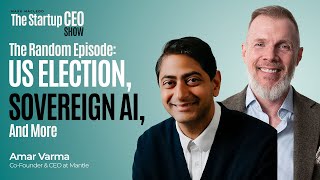
A conversational episode of the Startup CEO Show (released on US Election Day, Nov 5, 2024) featuring host Mark MacLeod and guest Amar Varma. They discuss the uncertainty and polarization around the 2024 US election and urge civic participation, then shift to tech topics: the rise of sovereign AI, national competition for compute/energy infrastructure (large CapEx requirements), implications for startups vs. big tech, and venture fundraising dynamics. The episode includes anecdotes about immigration, nuclear energy, quantum computing, biotech, and concludes with reflections on risks and opportunities ahead.
Chapters
Not only for the year but the quarter. When you see like a 11 figure budget for Capex next quarter from big tech, that's a big number. If you don't have that money, you're just not playing in this infrastructure potential. And there's only a few places on earth that have this capability to go do this. And once this is done and the spending is gone and the cycle is there and you can't catch up. Missed, miss, really missed. And I'm watching bubble countries that have the resources but are kind of waiting and stuff like don't wait too long.
Hi folks, welcome to the Startup CEO Show. I'm your host Mark McLeod. We've got a different episode for you. This one's sort of inspired by Tim Ferriss Kevin Rose random episode that they had recently. Now they did it with a bartender making them cocktails. We don't have that, but I get together with my good friend Amar Varma pretty regularly. Amar is here on the show with me and we often talk about what's happening in the startup world and then we thought maybe we should just do that on some kind of cadence here on this show. And so that's what we're going to do today. And it's an experiment, we'll see how it goes and please let us know how you think it went. Amar, welcome back. How are you doing man?
Oh, I'm great. Thanks for having me. I'm excited for this episode.
Yes, it'll either be amazing or horrible and nothing in between, that's for sure. So this episode's actually going to drop on US Election day and since I'm the guy who gets to ask the questions, even though I'm going to do more than that here, let's just jump right in. What are your thoughts? What are your predictions? What's going to happen on Tuesday?
Yeah, we're heading into the weekend before the election and it's become even clearer than mud. Who's going to win next week according to your favorite poll piece, whether it's journalism in the newspaper, social media or folks that you follow influencing your your opinions, it's one of those darn it if you do, darned if you don't type of feelings, everybody's going to be excited if their side wins and extremely, not just upset, but action oriented if their side loses. So, you know, not having a vote myself, it'll be interesting to see what happens. I think we've seen what happened after 2016's election and the reaction we saw what happened after the 2020 election. And the reaction. So I would expect people not to be standing still after the election between now and, you know, January, early January.
I mean, big lesson for me. I think back to 2016. I actually was on a flight from Canada to London, England, the day of the election. I arrived at 9pm London time, which was still middle of the day in the US And I was like, oh, I'm sure Trump's going to lose. Hillary's going to win it, whatever. I'm going to go to bed. And then I woke up the next day in complete stunned disbelief and just sort of stumbled my way like a zombie around London, wondering what on earth happened. And so if there's a lesson there for me, it's don't take Trump for granted. I totally dismissed his candidacy the first time around, and it was real.
Yeah, I don't think you can take anything for granted this election. We've had attempted shootings, we've had candidates sitting president fall out. So it's just interesting to see all of this in 2024. I'm reminded I'm a huge appreciator of the series Narcos on Netflix, season two of the Mexico version. You'll see the 1988 election was taken, according to the show, by the Cartel. They had a piece of software which was to predict the election results, and the key piece was early in the day, they were showing who was winning, and it would basically mimic the rest of the day. They were able to influence those early poll results, and it kind of changed the outcome of the election. So look at that as a long time ago and a different lifetime ago, and I'm looking at what's ahead of for us, and hopefully everything plays out smooth and there's no. There's no complications, but we'll see.
And you and I were chatting about the candidates this week. Obviously, we know what Trump stands for. He's pretty vocal about it. And of course, we've seen one. One round of this already. And the thing with Kamala is, like, we don't really know what she stands for. We just know that she's not Trump. Like, if I was an American, I'd be voting because she's not Trump. And so that's probably not sufficient.
I feel like we've taken for granted our privilege and right to vote for a long period of time in our life. And voter turnout is not 100%. And, you know, you see the outcomes of that, and you see countries where people can't vote and the ensuing crazy chaos and disruption, violence that sometimes occurs Right. So it's like if you are watching and you can vote, get out there and vote, make your opinion count. What diligence you do and what, you know, do you resonate with the person, the party, the policies, your neighbor, you know, whoever you're like that is your right and privilege. Exercise it. And you know, I think the outcome of which if one side wins, what'll happen in the market and kind of to society and if the other side wins, what'll happen in society, in the market? Like we're going to find out. There's going to be a very, very, very, very interesting dynamic either way for the next, at least, I don't know, two, three years.
Yeah. You know, listen, without trying to come up with the canonical, I don't know, ripping apart of the US political system, which is way beyond my pay grade, I just think this whole two party system is just deeply polarizing. Right. It's just like, it's like party over country.
I think you're right. I think it's become this divisive tool in modern day versus it being a forum where you can kind of resonate and express your, where you sit in the spectrum of policies in society and people in society. And now it's become you're either with me or against me, or you're against me or you're with me. Right. You can't darn if you do, darned if you don't back into that again. And it's like, you know, if I'm going to one person's house on Friday, is my tune changing versus, you know, who I was interacting with in the office earlier in the day? Like it's, it's getting people to have to be chameleons and not being able to let them really be themselves. I commend those who've been open of their opinion, their, their, their reasoning, their stance, whatever it is. Right. I really commend those people because that's really hard to do and it's hard to really stick out and you're going to cra. Face critique and you're also going to face the things you don't hear behind your back. And that's the one that I really think is interesting. I'll give you an example. I did a call for an LP who's an investor and one of my, one of my investors invested in my current company mantle and at the end of the call they had like this five, five minute conversation with me asking about the political views of the gp and I was like, where did that come from, wow. First of all, it's none of my business. Right. But second of all, why don't you ask them? And really, the crux of the questioning was, did I feel like their political opinion was helping or hurting me as a portfolio company in their fund? And I was like, oh, very interesting. I had to pause for a minute going, well, they've been incredibly helpful, and I can't, you know, So I said, it's probably helping. Right? Like, that was my initial response. Right. I've had some time to ruminate and kind of let it marinate, but I don't have something on the downside. But the problem is, the downside is probably something that I'm not being told, I'm not seeing, I'm not seeing feedback on, or there's a closed room. I just don't know.
That's fascinating. I've never heard that ever come up in diligence before. That's a sign of the times, if anything. Maybe the last thing I'll say on this topic, but then happy for anything else you care to bring up about it is I try not to watch the news because I find the news is polarizing, divisive, it's focused on the negative, and there's so much goodness in the world that isn't newsworthy. But I did happen to just catch Elon Musk endorsing Trump at a rally last week, and it really pissed me off. You know, here's a guy who I don't think he is anymore, but for some period of time was the world's richest person. Like, does he need more freedom? Does he need lower taxes? Like, where does human decency rank in his, like, algorithm for picking a candidate? And, like, a lot of folks have come out in defense of Trump because presumably Republicans and Trump are for more freedom for entrepreneurs. But, like, where does decency show up?
You know, I'll. I'll. I'll say this. I've had at a cursory level, many friends, colleagues, talk about, you know, they've loved their Teslas for a decade, and they're contemplating what else to get. Of course, they tell them a Ford electric Mustang is the number one, as you should love it, my fleet.
For anyone listening and watching, by the way, Amar sold a company to Ford, hence that allegiance. So I just wanted to give that background.
Thank you. The concept is the Tesla is a computer with wheels for me, and my Mach E is the car with a computer. Right. So it's like a different dynamic. Human decency is all we can exemplify. As individuals every day. So I think it's very important. I'll give you a quick aside. One of my previous companies, the Acquirer, was run by this gentleman Palmeritz. Palmertz was the number three guy at Microsoft when Balmer got the job. So Ballmer got the job. He left eventually. He ran VMware through its Epic run and Pivotal, which we did public and got bought by vmware.com long journey. Anyways, moral of the story is he said, look, we're going to win this race when we were contemplating joining. And he goes, that's a for sure thing. He goes, but how we win will be what we'll be measured by. Were these good, decent people conducting things in a manner that was representative of the image we wanted out there. And that was the takeaway for me for life where I was like the privilege of the journey is in conducting yourself day to day with how you feel is exemplary of yourself and how you want others to perceive you and how you want to treat others and vice versa and how you want to be treated. And I just don't think there's anything more core or critical to that in the day to day. I'm by no means a politician or understand much about politics clearly. So it's like I don't know how that translates, but that's my fundamental core fabric of people I interact with and things that I'm involved with.
Yeah, listen, I won't pretend to know what the reality is for a politician. I think many enter for the right reasons and then just get caught up in the system. But that's another topic. But let's stay on America for a second. Right. For certainly the entire time that I've been alive, America's been the leader of the free world. So much of global trade is US dollar based. It's kind of like the currency of reference was. I don't know if it still is, maybe China is, but you know, I think it was the world's largest economy for some reasonable amount of time. But you know, do we still bet on America? Right. You know the, the brick countries just had this big conference recently and you know, Putin's bringing in all of his so called friends and you know, there's just troubled waters wondering what you think.
You know, I always resonate with some things I see and maybe part of it was just marketing and just frequency of seeing something, you know, betting on, on the index, on the stock market is, is the proverbial betting on America that's proven up to be a great bet at least in our, our living lifetime, if not before that as well. I see that still continuing when I go back in history and of prior to some of these revolutions of industry, you know, there were other powerhouses and the GDP was distributed based on percentage of population of the world. For you, I think back to India before colonial times, right? It was like, I think it was 27% of GDP because they were about 25% of the world's population. You know, some.
No way. I didn't know that.
It's a statistic. Yeah, it's in one of Shashi Tharoor's books. One of the existing politicians, he goes through this. But I think about it and I go, okay, what do you need to drive change in things now? You need something that's the equivalent of the fabric that connects us as a society. At least for my lifetime, it feels like it's been some kind of energy, you know, oil and things that has been global distribution and that, that's got a very tight ecosystem amongst, you know, producers, suppliers, markers and all the contracts that go back and forth on it. I'm watching this next wave now of countries that are starting to merge where they have large populations, they're able to have domestic markets on things that otherwise previously required support in America first. That's interesting. So, you know, I started investing in India maybe a decade ago. I started going to China for a number of years prior to Covid and just watching, watching that whole, whole place move at a pace that, you know, I'm like, okay, they're living partly in the future, right? Like they're just able to do some of these things, you know. And I'm just like, huh? And I'm watching this phenomenon now of sovereign AI labeled as a sovereign AI. It's something critical to your national identity, critical to your national security, and something that will define whether you're a player in the next chapter of global power or not. And it's super interesting for me to watch the technology from an outsider perspective. Looking in is now something that should be relatively accessible to everybody. There's now trained open source models at scale. Like Android was an open source operating system for mobile Facebook. I guess Meta now has gone and created these open source models at scale for people that are pretty powerful. But we all know that that's what the front of what they're showing is. And the war is being, is being fought on the back of things you're not seeing. You know, access to compute capability is a big deal. Access to energy, like if you look at the Energy requirements for these things. Like Microsoft went and is firing up a nuclear power plant to power their AI. Are you serious? Yeah. Wow. And if you, if you, you know, I think we were talking about this the other day. You start looking at the CAPEX numbers.
Yeah, we're going to talk about that for sure. We can get into it, right?
Yeah. Like the capex numbers not only for the year but the quarter. When you see like a, you know, 11 figure budget for CapEx next quarter from big tech, that's a big number. You multiply by four. It ends up being a huge number across a one year period. And I'm like, if you don't have that money, you're just not playing in this infrastructure potential. And there's only a few places on earth that have this capability to go do this. And once this is done and the spending is gone and the cycle is there and you can't catch up. Missed. You've really missed. And I'm watching bubble countries that have the resources but are kind of waiting and stuff like don't wait too long. Canada's one of those places. Don't wait too long. This is the birthplace of a lot of the AI and it's now the best export we've had that we've got zero return on. This is one of those types of things. It's frustrating, but not the story of Canada.
I remember we've got a good number of Canadian listeners here and I remember hearing a stat once that there were 400,000 Canadians living in Silicon Valley in high tech. You were one of them for years. I don't know if it's still true, but at one point every publicly traded technology company in the US had a Canadian and the executive team like just giant amount of brain drain. And you're right, there was so much AI kind of research intelligence in Canada. You were telling me a pretty frustrating story about someone trying to immigrate to Canada. Maybe let's tell folks about that.
Yeah. So anybody listening who has a line to the leaders of immigration, you need to get this person immediate immigration, immediate citizenship. There's an individual that I've known for some period of time, runs a very prominent company in AI, was a very prominent researcher, worked at the largest ride sharing company around and is now revolutionizing driverless capabilities now and for some reason isn't yet a citizen of this country. And I met this person recently and they're like, I recently was told my application was rejected. I don't want to swear on your show, but who the heck else is getting you.
Can I do it all the time?
Who the hell else is getting this immigration if it's not a person who's highly educated, highly skilled, prominent job creator and just an all around great person. I'm just shocked that this is somebody. I had to hear that story. It was like, yet again, I was let down by the government and I'm just like, I'm not here to complain. If I don't like it, I gotta go fix it. And this is one of the ones we need to go fix. So anybody listening, anybody's aligning, reach out directly. We need to get this person citizenship and get past this incomplete, whatever the status is of this thing.
Yeah, it's super frustrating. Do you think AI? Let's back to this concept of sovereign AI. Is this the thing, like establishing some foothold in AI? Is this the thing that's going to set countries up for the next generation?
Short answer is yes for me. The long answer is I take a lot of cues from Hollywood, so it's a guilty pleasure. I look back to Bond villains, I look back to Terminator, I look back to some of the, some of the things we're seeing. And I even think last year in Mission Impossible series there was this whole thing like if you think the Cold War is, was something that just set the world stage for the, you know, how the world should end up. The next version of some kind of war is this, you know, cyber security war that starts as a cyber security war and then evolves into something larger where if you can win the technology game, you can, you can leverage it into a bunch of other pieces in the political chessboard. You know, we've already seen wars being fought from computer terminals halfway around the world, right? Like that's the thing today. Imagine those aren't powered by people anymore, they're powered by bots because they, they understand they're, you know, humanoid robots or some, some version of robots that are powered by these open source models, like not trying to pay deadly kind of doomsday. But this is the war that's being fought. And when I look at sovereign, sovereign levels of investment for these things, obviously they want to be at the forefront of tech. Like that's important. We've seen that play out. I think if I look back like 20 plus years ago, South Korea was a great example. They went and invested immense amounts of money for broadband and look at, you know, kind of a generation later, how prominent that's become and how important that country's become in terms of the knowledge based economy. And a lot of manufacturing. So I think, I think we're seeing those, those groundworks being set now. But if you look at the scale of investment and the power requirements, et cetera, et cetera, et cetera, like not everybody can do this. Everybody's going to have access to this. It's not putting fiber in the ground anymore. It's like, you know, getting access to the compute, having, having sustainable power that allows you to power this compute and then being able to use it and harness it in usages that are important to your country.
This episode is brought to you by fellow. Tell me if this sounds familiar. You wake up, you take a look at your calendar and you see it's filled with meetings, stand ups, weekly check ins, one on ones, town halls. And those are just your internal meetings. Some are productive, but some are definitely slowing you down. Be honest with yourself. How many times have you thought this meeting could totally have been an email? Now consider that in the US alone, there are 55 million meetings each day and 85 to 90% of those don't have an agenda. Velo is on a mission to solve the meeting problem by offering the only AI meeting management solution that covers every part of your organization's meeting workflow. And As a startup CEO show listener, you get 300 free minutes of AI recordings. If you sign up today, go to fellow app CEO to start your free trial and start having better meetings.
So on the energy front, that feels like a strength for Canada. My dad back in the day used to install Canadian made Candu nuclear reactors in different places around the world. And he spent a whole bunch of time actually in South Korea doing that. So this is a resource that we have.
I went in high school, grade 12 physics, we went to the nuclear power plant. I grew up maybe an hour from one and it was cool. You had the Geiger counter, you had studied the unit in advance. And when you're young, sometimes you don't realize how amazing it is that you're physically close to something like this and you can actually go see it. So for me I was like, wow, this is really interesting, really cool. You know, then you watch, you know, disasters happen across the globe in this and then you also notice locally there's actually a bunch of reactors that are still running and still operating and still out there. So there's like operator error, technology error, like there's no room for error in this game. So you've got to be very precise. And you know, this is what it's going to take to power the next generation. Like I just saw Microsoft turn on, turn on or announce that they're going to turn back on a nuclear reactor. Like this is, this is, this is the start, this is the trend coming back. Total random question. Your dad now having been involved with Candu reactor installations like, you know he's fine, right? He's fine, yeah, yeah.
It was a weird period of time where his hair was green but I think it was just the process of turning white. I think it was a coincidence. But my sister and her husband, so my brother in law both work at Ontario Power Generation now. So it's a nuclear family. And so far they still have 10 fingers and 10 toes. So yeah, I think they're good. And to your point about the Geiger count, like they, they get checked, right? They measure that stuff on some recurring frequency. So you brought up Microsoft and so let's go back to that, right? Capex and what you called it. You and I were playing tennis this week and riffing about this stuff and we call it that kind of the haves versus the have nots, right? And so Alphabet, right. They spent 24 billion on capex last year but they announced they're going to spend 3, 13 billion just in this quarter alone. Meta spent 37 billion on capex last year. Microsoft spent 24 billion. Like how on earth does a startup compete with this?
So I think it warrants mentioned kind of why the power requirements are so high because I think this is sometimes lost. I'm going to try and simplify it and I'm going to oversimplify it so there's going to be some mistakes. So in the comments please adjust if you feel like I've missed something. But I happen to be a chip designer to start my career in Silicon Valley. So I understand a thing or two about compute cycles and things like that. I worked on graphics cards which are confused. So one of the things that's very interesting, if you look at the order of magnitude of increase in compute, it's just gone up order of magnitude. It's logarithmic now. Moore's Law was a doubling every 18 months. We're far surpassing that based on the measurements. The challenge with that is the power requirements to train these models has been so great. So if you think about a physical space of a data center, the compute capability that was capable in there was big. But until the cycles and operations went way up and the power consumption leveraging technology went down, you couldn't get enough of the compute cycles to go train these models. The second you, the second they were Able to do that, the ability to do, you know, I think Jensen put it in his 2024 keynotes. I think it's something like the compute capability went up 300x, the power requirements went down basically in order of magnitude. And basically by leveraging that and tricking, tricking, shrinking, they're able to now train these models. And when they started to be able to train these models it was like years, months, weeks, days and it just starts coming down, coming down and coming down. This is why the power requirements at a very, very abstracted level are, are there. And when you think of like, hey, we want to create models, train models, use models for inference, like these are expensive operations from a power envelope and you need a lot of it. So you're starting to see like data centers that previously came with like a small power generation capability are like we need backing of nuclear plants. So this is just escape scale and order of magnitude thinking that are required to understand this, this CapEx. So the CapEx on, you know, buying H1 hundreds from Nvidia is immense. You're seeing it in Nvidia's quarterly call, the backlogs there, the demand is there. The ability to train models now is, you know, mind blowing versus even, I don't know, three, three, four, five years ago. The fact that they're open sourced out, you can get them at scale, I think that's something that's unbelievable. Now the race is to make that resource available to people to leverage and doing that is an arms race now and there's only a handful of people with the balance sheet to go do it. Which is why you're seeing the immense investment and the winners of that by proxy will be the folks Nvidia, its suppliers, you know, likely even AMD and some of its suppliers as it goes through it. I'm sure there's a bunch of people I'm going to miss in that shout out, but you'll see it. But like in cloud and some of these other super scalers where there's just a Microsoft, an Amazon and a Google and you just can never spend to leverage against these people, you're going to see that in this AI infrastructure and you're seeing, you're seeing the investments that were like quick to happen in a lot of the infrastructure companies. The scale is now just so large that you know, raising $500 million is an immense amount of money. But when you hear an announcement like we're spending 13 billion next quarter or 24 billion next quarter, you're just like this going to Be like it's orders of magnitude off know and it's just like how, how can you win in that situation? Right? So that's, that's really the interesting part. And the way to win is not to go after the core investment piece, but to go after the, the next, next piece of the roadmaps that they have that they may not be able to fulfill internally and stuff like that. And you get big, big wins that way and you're seeing it, but it's, it's just at a such a scale now where you know, if you think of infrastructure of construction of roads, airports, these things, like we're now putting that in the AI infrastructure. It's just unbelievable.
I was not the chip designer buzzword compliant at best. And so I'm curious like do you take from this that anything foundational, anything horizontal at this point is really just the exclusive purview of the big players and you have to kind of go vertical. Like I'm, I'm dumbing it down but like is it as simple as that?
Yeah, it's a good question. So I think the question is really is that like the opportunity to go invest in this infrastructure still available? For a select few it is, right? I think for a select few it is the folks who know some of the tricks of how to get the 10x gains or the 100x gains, you're still seeing companies being formed, you're still seeing investment going into those folks. But for the average person to go in now and say hey, I'm going to go try and company making a model, well, there's going to only be the super scaled folks and maybe a handful of others, maybe even less. Like I put it three, the next wave now becomes okay train models. The next to me is now the inference. Can you go win the inference layer? And that's where you're seeing a lot of investment and a lot of really, really, really, really smart people who are spending their time on it. The luxury and benefit of all of those people putting their effort into it is you're seeing a lot of productivity capable applications that are starting to come out fully integrated is obviously a chatgpt. But the consumer side of winning in this is amazing resources at hand. Seeing it now in an enterprise capability where we're working on one of them for ourselves, seeing a vertical model where it's integrated, helping people do their job better, not just like multiples better, but like orders of magnitude faster better, smarter is just like, okay, we're seeing that and we're just at the Start of it. And every vertical has some play of like, hey, we use AI to fix your workflow or ingest documents and give you this output. It's like it's coming, it's here and it's in trial or you're already using it, you don't realize it, so it's coming. Those will be a lot of the productivity gains we'll see over the next, you know, call it to two to five years. So if I were to start over today or start again today, I would really be looking in that area and I'd really be looking for a, a knowledge surface area where I'm an expert. I have really good relationships with a, you know, design partners or somebody in industry who really knows what they're doing. You know, I'll pick Health, Health, Tech Healthcare, right? Everybody's like, hey, doctors should have transcription or use AI models to help with billing codes and these things. And it's fun. Yeah, of course they should. But do you know enough people practicing that could help you form and kind of figure out how to, how to optimize all those things? Do you understand how the clinic works? Do you understand at scale like, you know, what a regional thing, like a New York Presbyterian, how does it operate? How does it do all this stuff? Is it outsourced to a third party? Do you need to work with a third party farm like this? There's a lot in here that's super exciting to, to go through. Other areas I think are super interesting as you're seeing in maybe biased because I'm an enterprise focused person, but you know, you go into these large organizations and you know, there's like $100 billion being spent in general IT budget and, and nobody knows what some of the programs or some of the software repositories are doing. There's really an amazing opportunity to go in there and be like, okay, let us use these capabilities to tell you what the code bases are doing, which applications are powering, which stuff is like sliced off code that has no functionality that you can stop maintaining. There's just a bunch of these obvious things that are out there. And then the other one I talk about, if I were to ever do a service business again is like there are so many applications people need, but if you could start from some base layer of a platform that's built for half of the stuff we know we need to do and the other half is a service engagement to get it right with the customer, I think you could have infinite business. Right now I'm just seeing it in some of my investments, my friends doing this stuff.
Fascinating. I'm curious. We've been talking about a whole bunch of macro. We got two questions that are maybe more specific to you and your company. One is like, how much do you feel you needed to be aware of kind of these moving pieces in the broader environment in order to formulate your strategy for your company?
I think you need to go down the rabbit hole and whether that's. You started reading stuff, you started using the models, you started talking to friends, you started contributing. There's just. There is depths and layers to this. You know, my co founder, Dwayne Ford, is the CTO here. He put out a piece on our site on how to think about models. You know, at this point, unless you're super skilled, it's this tame, not train, you know, understand the parameters, understand the, you know, what you're doing with the different parameters. And he's not the only one. Lots of people have published good things on this. So, like, you can go read pieces like that, understand the state of the.
Art.
But really getting deep has given me one other piece that I think is really important. It's like, these models were great at consuming information and having a lot of readily accessible stuff. I say like in their, in their, in their cache memory equivalent, but their reasoning capability is kind of. Was very, very, very small to start. And I have four kids, so I'm watching these kids every day, every week, every month, every year, kind of gain motor function, intellectual function, speech, all these things. And I'm watching the inference of these models grow in leaps and bounds. So what would have been a newborn to a toddler is like newborn toddler, high school student.
Wow.
Master's student, you know, professional at the top of their game to like emeritus type stuff. And then, you know, like, once you can get past that, you end up with like an expert out of the box at some point. And, you know, that's. That's kind of the bit of the holy grail of all these people working on it. But, like, I'm seeing it, I'm seeing it in the early, early innings, but I think we're a long, long, long date myself. But I think we're not one or two models away from every, you know, worker that sits in front of a computer being obsolete. Right. I don't think that's happening. I'm watching. We have another series on our, on our website around leveraging AI and code. And there's a bunch of great resources out there. You know, if you've never, you Know, I think, I think for myself what was really eye opening is there's, this is a cohort of people who've written code, understand code and they're using these tools and they're getting way more efficient. You know, whether it started out writing test infrastructure or you know, writing out simple things that would have been tedious tasks. Okay, great. But then there's this category of people who've never written code and never will write code.
That'd be me.
And now you have these like you had these no code tools for a period of time. Now you have these tools that are like writing code and if you know how to really prompt and understand things, you can get it to write things in production things with test. It's really quite intriguing to watch because we're, we're, you know, we're trying to leverage some of these tools every minute of every day because every time we do something I go, can we automate it? Can we take our knowledge and go to a higher order bit in our business and our understanding? And, and I think as if you evaluate everything in that automation capability, you'll really start to see efficiencies and gains in these things. So I, I, I'm, I'm, if I had to, the follow up question for me always is like so what's the quantify the, the, the gain? Right. I think for us as a skilled group that's worked together over five companies, like I'm, I'm seeing probably productivity gains in at least call it a third, 33, 35% on a few things or most things on average. And then there's some places where we're getting like 100x100 times or 100% right. We're just getting automation of tasks or things that are just happening. So it's very interesting if I had to compare maybe to a decade ago for what we're outputting, what would that have been in number of people? It's probably 3x right? There's so it doesn't correspond with the third productivity gain but just we're able to get the tools got more efficient as well and all those things. So there's a bunch of things I'm.
Curious, you know, you've raised money recently, to what extent did you have to like there's a pie chart of the mantle story. How much of that story was AI.
Centric in terms of fundraising? None, because we'd raised in the fall of 20, 22 years or so. It wasn't really a driver. The wave we caught was obviously the Models coming through and providing us a really good opportunity for a lot of automation. Now, when we talk about our products and all of our interactions with customers, partners, prospects, we are very upfront with like, we're trying to automate everything, right? And we're very clear we're not using your data to train anything. Your data is not going into the models and being trained in any capacities. And it's very important that people understand that data piece for obviously understanding peace of mind and a bunch of things. But they really are encouraging us to be like, okay, you can do that. And they're seeing it reflected in speed, time, time to market, and then cost and quality. Right? They're just seeing a lot of those things getting tightened and tightened and tightened.
Maybe a random aside, but again, I'm completely unencumbered by any technical knowledge whatsoever. What role does like D wave and quantum computing have, have to play here at all?
I'm probably likewise.
Does that lower the burden? Like, I feel like right where we're brute forcing our way through things now, like, does this change that at all?
It's like, well, you know, star asterisk. I'll likewise say I'm not fully qualified to comment here. I will say quantum computing has always been an interest of mine and just in terms of reading and curiosity, I never felt skilled that I could go work at it because it felt like a ready or company to build or something like that. If you, if you plot the gains and you plot the charts, you know, it's kind of the holy grail. You know, there's some folks that are out there now with commercial opportunities that seemingly are starting to crack the nut. It's exciting. I would love to, I would love for it to be here today because.
This, this, it kind of scares me to be honest. But yeah, it does sound also cool.
It does. But you know, if, you know, I haven't gone and checked, checked out the interviews with like Jetson and, and others on it. So I, they probably have a much better take on, you know, where they think quantum computing is versus today's state of art and where they see an intersection of this stuff. I, I will just comment on a few things. Like we did a research chair in AI and bioinformatics as a family to the hospital, sick children. And this was six plus years ago now, maybe closer to seven. And I was like, hey, if you guys could leverage, you know, AI to, you know, uncover things quicker, et cetera, like, you know, molecules for, you know, exclude molecules for, you know, that shouldn't be tried as candidates. Like that's going to be revolutionary in terms of speed to market of things. Right. And you're just watching like.
How many.
Days did the COVID vaccine take? 3. It was like they just were able to do stuff like that. And I was like, that's the kind of stuff where you can see generational changes in outcomes in terms of knowledge of information and leveraging it. We're seeing now combination of CRISPR CAR T cells. There's a couple other alpha folding problems now have been solved. Not just the first, but second, third one solved now. Right. Like you could start seeing these types of things that are, that are jumping and I think in terms of isolating reasons and root causes for defects or aging or longevity, like you're starting to see a bunch of people spend a lot of time and money in this area. Like that's super exciting to me. Right? Like if, if that, if that can be unlocked by quantum computing. Like we should all be working on that.
That would be all certainly into learning how to slow down aging. I have a vested interest in that.
Maybe. Last big topic.
You and I were marveling at the set of funds that General Catalyst announced last week. $8 billion in new funds. These guys have been around since 2000 and for anyone tracking this is like a 40% increase in their assets under management. Like giant expansion. What, what's your take on that?
Yeah. So Mark, you and I have been around the VC game for a long time. Like I, I, I joined my first firm. That was, it was a, it was 2000, early 2 mid 2000s, it was a billion plus dollars. It was giant. Now today that is not a giant firm. And I'm watching, you know, I think, I think Lightspeed's gone and done it and recent has gone and done it. Sequoia has gone and all the big firms have gone and done it and raised billions and billions and billions of dollars. And when I saw General Catalyst Do 8 billion, I was just like, what are they investing in? And to me there has to be some thesis of like we're going to go invest in some kind of public market equivalence. Just watching, investing in Nvidia stock maybe, right? Like Nvidia has just outperformed everybody. Right. It's just like if you just had the index versus some venture portfolio, I think the returns were ahead over the 10 year time period. Right.
And you just like, correct.
You know, how does that, how does that feel for paying 2 and 20 or 3 and 20 or 3 and.
30 or whatever deals, having your money be Tied up for at least 10 years.
We're liquidity premium for that too. Right. So it's just like, I'm really amazed at the scale of money going into this. Really impressive to see. I'm just watching to see, like, when you have to manufacture opportunities to put money to work, it feels a little less authentic.
Yeah, I feel like Softbank did that.
Softbank did. I watch a lot of PE people over the last decades with large amounts of capital. They weren't, they're probably manufacturing outcomes, but they, they were able to go find mispriced assets at scale and, and, and put a formulaic like, here's how we're going to buy it, here's how we're going to tighten all the screws and, and we're going to make, you know, we're going to create this rosy picture at the end and somebody else is going to buy it. Right. Like, I've watched them do that at scale. That is not the craft or the experience of most people in startups and venture. Like, that is just not the DNA of the person. That is not the apprenticeship. So I'm interested to see the openings of which partners start joining, which partners start leaving. Because, you know, if you've worked at a firm and you've been at a $300 million fund for 10, 12 years, having three or six or $10 billion is a much different game. Is that why you got into this business? Was that your passion? Is that where you really see your, your best superpower being flexed? Like, I, I just don't think that's true. But then there's some who've really adapted with the times. They've become, they've become the great investors across decades at scale. And I, you know, there's, those are, those are very few. I'm like, how old's veno coastline?
He's still at it, still at it. Still a baller.
I remember Cisco buying Surrender for, I don't know, $6.7 billion. And I lived in Silicon Valley. I was like, oh my God, this is amazing. Like, that was him. That was like decades ago. He's still doing it, right? It's like. But, you know, if you, if you put a $6.7 billion exit and the $8 billion, you know, fund plus growth vehicle, I don't think you get all the money back.
You know, I had a $50 million fund back in the day, which I would need to turn into 150 million for the math to work and to deliver on the promise that that LPs expect. And I was stressing out, figuring out how to do that. Right. You know, you, let's say you own 10% of the companies, you got to generate one and a half billion of outcomes, right. In order to get the 150 million for the venture fund math to work, I was saying I would literally just have a coronary if I was responsible for generating a return on $8 billion.
What's happening now, and I'm watching this is when you watch these portfolios, a lot of the times the best companies out of the gate get picked up early. And when they get picked up early, the fund's like, shoot, you were supposed to be the fund maker. Let me give you another round. Let me preempt this deal. Let me give you more money at whatever valuation they can, they can wrangle that's, you know, proportionate with the amount of money and go for that next rung. And when you see that, you're like, okay, there's, there's a defined probability weighted outcome. The entrepreneurs and investors have to get in, in on together. And it's like, okay, I'm not, I'm not exiting here. I've got a, I got a take the money at this point and 10x it from here so that I can make your fund, you can fundraise on this. And I'm taking all the risk. Which is why you're seeing a flurry of these secondaries that have happened over the last number of years.
I was just going to say that, that, that to me is just giant secondary territory.
And they're like, hey, you don't get your head around an entrepreneur. Here's a huge secondary, it's fine, you know, carry on and, and, and keep doing you. And it's just like, okay, that's fine, it's the game. But it doesn't feel like the acquiring capability is out there to go consume things at scale right now, Especially with big tech in a purgatory zone, right. With doj. But it's just like with that wheel not turning, all this money's going in and it's kind of creating this cascading effect. If there's no returns, there's no recycling of that money. And if you look at dpi, I'm in dozens of funds, like, I wish there was just more dpi. They're not bad funds. They're just, they're in a vintage where there's not enough exits.
So true. Yeah, so true. I do you connect the dots. I think you kind of said it here with kind of the doubling down on the ones that are winning. But connecting the dots here between this $8 billion funds and what we were talking about earlier and this is dynamic of haves versus have nots and just the magnitude of the dollars that it takes to play now, now, one thesis.
I mean we were referring on this the other day. One thesis might be that you're. Your startup is now more of an infrastructure type deal than it, than a, than a whiz bang software or system that you could put in network or something like that. Right. And it's like, okay, the venture investment here is something of infrastructure scale that requires dollars that are commensurate with having not a $80,000,800,000,000 fund, but an $8,000,000 series of. And we're just picking on eight because that's what, that's what they announced. But the commensurate with that kind of scale, you know, if it's working and you're putting money and you have like a clear ROI for each dollar spent. Okay, got it. But there are a lot cheaper costs of capital when you start getting at that scale that like don't have venture people behind them. It's just like, you know, it's interesting to see I, I have a purview through my investments on a lot of this, but a lot of the backers are really important in institutions around the world and if they're directionally wrong and they're wrong at scale, watch out.
I worry about that, to be honest. And it's probably out of scope and out of time to unpack it fully, but we just came through a drunken orgy of investing in 2021 and now I feel like this notion of deploying 8 billion forces, artificial behavior and is sort of just like soft bank all over again. I have to like artificially and prematurely anoint kings and I worry that it just doesn't turn out well.
Yeah, let me flip one thing for us here. Like, I don't want to make it feel like we're just, you know, we're of a different generation. It was harder in our kind of.
Those old guys, they don't get it.
Well, it's very much, There's a lot of promise, a lot of opportunity. I want to be very clear that that is a thing. I just feel like as the landscape is shifting and the game is changing and the order of magnitude of the scale is, is going up by another order of magnitude, it's like, let's not forget what makes these ventures successful and it's the people who run them and work through them that they are putting their entire life and time into it. So there's a lot of optimism. I think really now we'll see some outcomes over the hill here. But let's just be mindful of the scale of those outcomes. Like I don't, you know, is it, is it, is there, is there a world in which you start seeing, you know, multi hundred billion dollar exits?
This is fascinating stuff. As I expected, I knew we would run out of time before we could get through all of these topics. So I guess we're just going to have to do it another time. And we're about to enter the never ending Canadian winter, so maybe the next time has to be in person with a single malt and like a smoking jacket or some kind of dipshit thing like that. But Amar, fascinating stuff and I really enjoy the conversation.
Thanks for having me. Always a pleasure and see you soon.
See you soon. Hey, thanks for listening to the Startup CEO show.
If you'd like to connect with me.
Because sure to visit my website at Mark McLeod me or follow me on LinkedIn at the Mark McLeod or Twitter arkmcleodore. And if you want to tune in again next week, be sure to subscribe on YouTube, Spotify, Apple, or wherever you get your podcasts. We'll see you next time.
More from Mark





The Burnout Breaking Point - How Strategic Breaks Actually Increase Productivity


Emotional Debt - How Avoiding Hard Conversations Compounds Into Company Killing Resentment


The Death of the Specialist - Why AI Is Creating a New Professional Class Called Scalers