Values-Driven Leadership: Gusto’s Core Philosophy with Josh Reeves
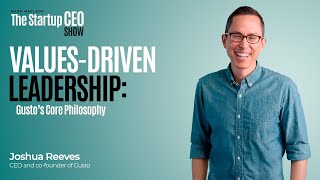
Josh Reeves, Gusto's co-founder and CEO, talks about building a values-driven company from YC 2012 onward. He hired for value alignment from the start, grew through accountants (15,000 firms now use Gusto Pro), and shifted to paid acquisition a year after launch. He emphasizes codifying values early, hiking for reflection, and the phrase 'debate, then commit' for making decisions together.
Chapters
People don't have personal and professional values. You just have your values. I think my advice to founders is your values should show up primarily in your hiring process so that you're screening for folks that are aligned with your company's values. You can codify your values when you're just a founding crew. We codified ours when we were three people hiring our first employee. And really importantly, if someone's not aligned with your values, they're not a bad person. Just means they'll be more successful in a different company.
Welcome to the Startup CEO Show. I'm your host, Mark McLeod. In this episode, I sit down with Josh Reeves, co founder and CEO of Gusto, one of the leading payroll software companies for the SMB market. Josh is building a really special values driven company for the long run. In this episode we talk about many things. What he got out of going through yc, fundraising for SMB, how to grow an SMB hiring, the importance of values, how he's built culture. Josh is building a company that he hopes outlives him. And there's so many actionable insights in this episode. I hope you enjoy it and I hope you subscribe for future episodes. Josh, welcome to the Startup CEO Show. How are you doing today?
Mark, it's good to see you. Glad to be here. Hopeful we can share some advice and wisdom.
I sure hope so. I was really looking forward to this episode and thinking back to many, many moons ago when I first met you and you were running not Gusto, but the predecessor, Zen Payroll. Same company, just different name. And I remember laughing to myself because I thought for the longest time that you just didn't have an office and you were just randomly strolling around south park waiting to meet with whoever the next person was. And you were just presumably massively over caffeinated because all you did was meet for people in the park for coffee. But I subsequently learned that you did have an office. And so anyway, it's a true pleasure to see you again spin a very, very long time.
I feel like we have to unpack that story. Mark, should I elaborate a little bit more?
Yeah, sure.
It's one of my favorite favorite early memories actually. So we started the company in Palo Alto, which is about an hour south of San Francisco. But we moved out to the city when we were hiring our first teammate and we were near a small park that Mark mentioned called south park. But our office was really more of like a loft. No one lived there, but it was where we worked, where we ate, we all went home to sleep and so There just wasn't conference rooms. And so we were less than 10 people. When I met you, Mark and I would do all my meetings, interviews, partner meetings, candidate interviews, all of it in basically the park. We would meet at Cafe Centro, I'd get like a chai latte and then we just go sit in the park. And it was you who I remember said at one point, after maybe two or three meetings, I think it was tongue in cheek, I hope, but it.
Was like it was, do you have an office?
Are you like a legit company or not? Because I keep meeting you in the park. And I was like, I swear, I promise you're a legit company. We are building real product. We have real customer. Trust me.
Yeah. Do you ever. Is it ever a real company? I mean, I got it handed to you and I hope we can unpack this a little bit in our chat. But like, the hardest thing to do, the hardest thing to do in any company is scale. You look at all these elements of value creation over the life cycle, by far the biggest single slice of the pie is distribution. And distribution is tough in SMB and in particular, retention is tough in SMB. And I was at FreshBooks when we first met and we were a much bigger company. And all credit to you and your team Gusto is now a far larger company than FreshBooks. And so you've clearly done a lot of things right. But I want to start with, you know, and you know, you talked about doing all your meetings and if it's cool with you, I'm just going to jump around. We don't need to go chronologically, but maybe this stems from all of your meetings outside. But I remember you telling me that you made many of your biggest decisions around kind of executive hires, investors by going for a hike with people. And I don't know if you still do that, but tell folks about that and why that was your methodology and the benefits of that. Because I love it.
Yeah, no, happy to unpack. And maybe I'll also note, just grateful to be on the podcast. Big part of the tech community. When it's working the way I admire and respect it, working is about folks who don't view it as a zero sum game, want to pass on advice, learnings, advice. A ton of folks have been helpful to me over the years, and I still go to a lot of folks for advice and help. And if I can pay some of that forward and make it useful to folks, that's really why I'm excited to be here. Plus, there's also Many ways to build a company, which I'm sure we're gonna unpack. So my advice is always to a listener, determine what resonates, what aligns with your philosophy, and then make it your own and make it authentic. And if it doesn't, then so be it. There's again, many ways to build a company. But yeah, at the heart of your question, for me, that's kind of a deeper question. I just grew up in the outdoors. My family, my parents are both teachers. We had summer break. We would go to Yosemite every summer for two weeks, just camp out in the valley. My mom was a nature docent with the Sierra Club. My brother and I are both Eagle Scouts. We did a lot of camping and hiking growing up. I have four kids now, Mark five. And under their names are River, Sky, Canyon and Ember to map to water, Air, Fire and Water. So anyways, nature is in my blood. And so, yeah, to the heart of your question, I think really just changing environment is really the heart of it. Whether it's a walk in south park, whether it's a walk along the Embarcadero. Yeah. In some cases, driving to a nearby area to go hiking in the San Bruno Mountains. Or now that I live in Marin, there's a lot of hiking around here. It's not a requirement. I don't meet all people hiking. I obviously do meetings in the office as well. But if folks are game for it and want to go, have a chance to do a more extended conversation. It's something I learned actually from some of my professors at Stanford. When you're on a walk, you can actually have silence much more peacefully, much more easily. You can just be strolling, you can have a puff pause in conversation. It's not awkward or uncomfortable. And then you can delve deeper into something. You can also have eye contact, but also not have eye contact at times. And so you can actually just get into, I think, more interesting, deeper topics more quickly than sitting across from each other in a conference room.
I no longer live in the city. I now live out in nature myself and go hiking pretty regularly. And just our property alone has three acres and a pond with trout in it. And we have trails and I'll often go and walk the trails. And I'm running a super simple business now. You're looking at it. It's a one person business, so it's a different reality. But I don't know if you find the same thing. But I encourage my CEOs to get out and get out in nature. Obviously a It's healthy for you, but maybe more, I guess, short term. Practically. I find that change of context, that breath of fresh air, that exposure to nature just activates way more of their brains, right? That rational brain, that voice that's going on all the time, is just a tiny fraction of actually our potential. And our subconscious brain, intuitive brain, is way more powerful. And we're just slamming and going from meeting to meeting and zoom to zoom to zoom. We're leaving no space for that subconscious to do its magic. That's why we have these aha moments, right? In the shower or on a hike. So do you use it for yourself in decision making, or you use it really just for kind of meeting key people?
I mean, I'll add to it. I use it by all means for reflection and introspection as well, which is much more of a solo activity. It could be on a run or like you said, just literally sitting in nature. I think a couple more things. One, you just have more senses at play because now you're smelling, you're obviously seeing, you're hearing. If you really kind of get quiet for a moment, there's much more sounds in nature than most people expect or think of. And then the second thing I love is whatever challenge, obstacle puzzle I might be facing, maybe I'm getting into it too much. When you're in nature, especially with where I'm at, where there's a lot of redwood trees, but I'm sure for everyone, there's trees nearby that are pretty old. I just do a really quick thought exercise which is imagine when this tree was initially growing and it was small and what was happening around it. And often that's 100 or 200 years ago. So it's kind of a fun thought exercise. Or. And what will happen 100, 200 years from now? And with that time horizon, whatever challenge or obstacle I'm facing in the moment kind of quickly pales in comparison. And then it's a little bit less of the, hey, this is a stressful situation and more great, let's break it down. Let's look at what's working, not working. Let's assess different solutions. Path A, B, C. Let's get more inputs or not. But it's an action orientation that comes out of it for me. And it's a very healthy way to kind of release some of the pressure.
I love it. I'm curious, do you meditate at all?
I've had various times in life where I've done more structured formal meditation. For me, honestly, just being in nature Quietly is kind of my present form of meditation.
I gathered that that's what I need to ask. I had that sense as you were speaking, if I go way back to the beginning. So Gusto, or I guess Zen Payroll went through Y Combinator and I'm curious what you took out of that program that set you on your path.
Yeah. So we were part of YC winner 2012. Company was started 2011 and a little bit of backstory. Gusto was started by three co founders who are all actively engaged and committed and full time at Gusto today, which we hopefully will come back to and talk about that founder relationship and how it evolves. But we had all had prior startups and so we'll get to how we came across the idea, I'm sure later. But we were going to tackle this pain point and start a business no matter what. We really wanted to kind of make this problem better. But we met with a number of folks and one of my co founders had been through YC actually earlier, I think it was in 2008. And we just really liked the idea of going through this program with folks all at the same stage, kind of at that same early seed, kind of build out, first product prototype phase of development. And so what we got from it was number one, community. Just that shared experience with laser focus on talking to potential customers, building software and then just seeing each other every Tuesday. That was pretty much our existence. We'd go to the gym every day, we would make meals together, the three of us live together. And that was our four month plus kind of existence there early on in the company's history. But we also got a couple tactical things from yc. Number one, we got our early customers because we were focused on new employers paying their first employee. It was just a unique audience to start using the product from day one and two. It really was an accelerant for when we did demo day and raised our seed round of fundraising. That process worked out really well for us, which I'm sure we'll unpack as well.
Yeah, yeah, actually I'd love to go there because I'm no longer focused exclusively on SMB. When I first met you, I was and my experience is not all VCs love venture. I mean love SMB even though it's a giant market. But it's. They just struggle for like to get their head around how you're going to reach real scale. How are you going to get distribution to work without CAC approaching ltv, they struggle with Churn. And so I'm Just wondering, I guess at a certain point your success spoke for itself. But maybe in the early days, how did you get folks to get on board? Especially because I want to talk about that next, but you've got, you got a lot of tier one investors on your cap table and if I were to look at their portfolios, they're probably much more skewed to enterprise and consumer and much less on SMB. So maybe just for all the aspiring SMB SaaS founders out there, how did you get folks over the hump?
I mean, it's an amazing segment. As you and I both know. It's a real large, meaningful part of society. It's folks that historically haven't had access to great technology and tools. So from a mission lens, it's been really motivating and inspiring for us and the team of 2,500 plus gusties to all of us now interact, either have family, friends working in SMB and when we can see concretely how we make their life better. It's an amazing feedback loop. But yeah, the heart of your question, I think early on I'm going to try to go back to seed stage, early stage, where maybe more of your audience is at, rather than where gusto is today. There was two big things we had to prove. One was could we build a meaningfully differentiated product? And again, three co founders all of us had studied electrical engineering, had no background in payroll HR benefits. So first off, the first four months plus was just literally building out a backend system to do tax filings, tax payments, direct deposit. Just the ability to run payroll we knew was something we had to get done prior to raising money because we were going to face that question of can you even build something that works? And we wanted to make sure that we had de risk that piece of it. So when we got to demo day and we're then engaging with seed investors, we could say proudly, we had run payroll. It was for a couple of pay periods, but it was money moving through the system, it was taxes being filed, forms, documents, it was money moving, et cetera. And it was done accurately, compliantly. And so that was a really important thing for us to initially check the checkbox on, but on product more broadly. And what we spent the next year plus doing before we raised our Series A is we had to prove that we could build a product that was incredibly easy to use too. So it took us a while to build out all of the front end, build out the employee onboarding, build out the ability to run payroll through software, et cetera. But we had a hypothesis, and that's maybe my advice to folks is if you haven't done it yet, doesn't mean your answer is I don't know what you want to have, hopefully is a hypothesis of what has changed in the market, in the technology landscape that makes it possible to finally solve this pain point. Because small businesses doing payroll by hand had been the norm, businesses getting fined and penalized by the government was the norm. Close to 40% of companies in the US every year got fined for incorrectly doing payroll. So the pain point was really obvious and that wasn't sufficient, right? It was like, hey, can you build something that people are going to be able to use, set up and adopt and then love so much they want to tell others about? So we had to prove that that was kind of a big bucket. And then the second to maybe the heart of your question too was we had to prove out that we could go acquire folks in a cost effective way. And for that also early on was a set of hypotheses. We had hypotheses that with really high customer love, we could leverage organic, right? So SEO people searching and finding Gusto organically, but also through referral, through social. So two big ingredients were necessary, like Google and Facebook, not products or companies we created but didn't exist 20 years prior to Gusto. Actually, we started Gusto 2011, didn't even exist close to, you know, 10 years prior to Gusto. But we felt those were ingredients that enabled finally this audience to be accessible in a more cost effective way. And then the other big technology trends we were bringing to bear were paperless, mobile and cloud, which also were obviously things we didn't create or invent, but made it possible to create a product that anyone could use, set up in a browser, enter some information, go run payroll and go, wow, it's that easy, right? It's that simple. But until we built it and showed it, those were all hypotheses, right?
Makes sense. I remember studying the SMB payroll market when I was running my investment bank and realizing that there was probably a venture fundable TAM just in the churn that ADP had each year. I don't know if that's still the case, but did you know at the time that there was a big dinosaur you could go after or you just knew it was a pain point and therefore we're just going to go and try and solve it?
I think there's a pitfall for earlier stage companies, founders to get too caught up at times in competitors and incumbents because if you really think about it, three people back to the early founding who had never done anything in this space, you have a $75 billion company, now they're $100 billion company. What chance do we have to go do anything against them? And the reality is we didn't even think about them too much. And that was actually a good thing because I think if we had thought about it too much, we would have found all these rational reasons that this a real opportunity. But one thing that really helped for our segment and maybe is the same for a lot of other entrepreneur segments, is that it's actually a really fragmented market. So if the incumbent has 90% market share, I do think probably it's a different ballgame, but in our case, just looking at payroll because we now do many products helping small businesses. But payroll, you add up the three biggest incumbents, ADP, paychecks, intuit, and they had 50% or less of the market. And so you had a huge long tail of folks doing it on pen and paper, working with their accounting firms, doing it manually. Those were a lot of the folks we met with and talked to early on when it came to user research and interviews. And we were just shocked because we were like, of course everyone uses some type of system and it turns out no like 40% of folks were doing it by hand still in 2011. And that's when we got really excited because then it became, hey, let's go build something that is dramatically better than pen and paper. Let's go prove out that it can be a scalable go to market driven by organic and word of mouth. And then even to this day, a big, big part of our growth is from that greenfield. It's from folks starting out and or shifting off pen and paper onto gusto. We also do get a lot of switchers from some of the incumbents as well. But it wasn't that day one we had to be obsessed with poaching from an edp. It was let's go build a great product and have folks finally move off of that pen and paper pattern.
Yep, so many similarities with FreshBooks. We were also competing with pen and paper into it. It did eventually, you know, look down and think about how they could serve our segment. But for many years it was really competing against the status quo. I'm curious, when you talk about serving brand new businesses, I'm curious about how you identify them. Like I think about mind body, kind of an old example really kind of went deep in the yoga space, but they literally were sending direct Mail, they would figure out, oh, you just registered a new yoga business. Like they would go to wherever it is that you find that that has happened and literally send a physical mail to that studio owner. So I'm curious, how did you identify brand new businesses that could be clients?
So once we launched in December 2012 and up to that point it was more of just helping friends companies prove out the system, make sure that it was something that we felt could be if you gave it a fire hose of traffic, could actually have self serve, easy setup, easy run payroll, obviously be accurate, compliant, but also customers would love it. So we launched December 2012 and in that first month we added 100 customers. And the vast majority we had never met, knew and were not near physically us at all. They were all over California. And so that's when we really knew we were onto something interesting. So there was really two things we did to drive go to market early on and they're still really, really big parts of our go to market today. First was really try to almost programmatize that organic flywheel. So word of mouth referrals, great customer experience, easy to share, tracking leads coming in through word of mouth. We would see pockets where all of a sudden five churches in a small town in Southern California would sign up. And we're like, I think someone probably talked to a conference and said, I use gusto, you should use gusto. Because we definitely didn't do anything targeting churches in that town. And so there was PR as one piece of that, There was amplifying word of mouth as one piece of that. And then it was really optimizing that onboarding conversion setup process to be as easy and smooth as possible. And we didn't actually start doing paid acquisition to drive direct up a funnel till about a year after going live because we really wanted to prove out the organic piece and then augment it with the paid piece, which I think sometimes founders get off. If you jump too quickly to paid, you don't know really what your unit economics are, or they're just bad. And then you have to really have high confidence. Otherwise it's just gambling to think about how do you scale a system when your unit economics aren't great. So direct became a big focus. You could kind of call it inbound, if you want to use a jargon term. But it was all about that inbound, high volume, low touch, more self serve, dynamic and lead volume mostly coming again through organic and then some about a year in paid acquisition through SEM, et cetera. But the second big program we also launched early on was working with the accounting firms. We had met with a bunch of these accountants and bookkeepers and for them payroll had actually been one of the products they were doing, often by hand and not as a joyous thing, more as a necessary kind of thing that their customer was making them do and they didn't like it. It wasn't a really great margin business or product for them. And so when we came in and said, hey, we can actually be that product for you. You'll get all the credit. You can be the hero here. That brings a modern smart solution to your client. That actually resonated really quickly. I would go to accounting conferences, then we built out a sales team. It was still, I would say, mostly inbound, but we were higher touch in that relationship because as we added accounting firms then we would have 12 of their clients on Gusto. But over time it could be 10, 20, 30 clients on Gusto. And today we call that our Gusto Pro kind of platform. It's an indirect channel and we have over 15,000 accounting firms that are a part of that. That's amazing effort. It.
I remember seeing you at some of those conferences in Vegas and I was at least a cpa, so the content was interesting to me. But kudos to you for toughing that out. You, I remember you and Jelly there. But when I look at my experience trying to navigate that same channel, I'd say we encountered a lot of resistance. When I think about, it's probably a different name now, but it was like the Pro Advisor program or something in the time intuit, like QuickBooks was synonymous with the category. Like they couldn't imagine. I think it's the same reason why Xero struggled in the US A Intuit is a phenomenally well run, highly competitive company, but when accountants thought about accounting software, they just thought about QuickBooks. Now I'm wondering because Intuit had a payroll product, it's nowhere near their emphasis. But did you have to overcome similar resistance things?
I think it was a different ball game on the accounting side, mostly because of how dominant QuickBooks market share was with small business. And even with some missteps as they transitioned from desktop to cloud, they did make all the right decisions more than not. And ultimately that kind of closed the window for some of the startups to kind of capture that opportunity. And there's a whole other set of opportunities in that space. But that's not our focus at Gusto. I think what we had is a little bit of luck, frankly. The reality was payroll was More of a side project and add on for QuickBooks Intuit. And so that gave us a chance as our entire focus, as our entire wedge, as our primary product until we added more things like benefits and time and retirement savings, et cetera. But also I think frankly ADP and Paychex were less, I would say present and locked into that community than they could have been. And so even today we have more of a partnership and competition with Intuit. We export from payroll into the GL for QuickBooks or Xero or whoever someone is using. And obviously from a QuickBooks payroll loads we're fairly competitive. But yeah, I would say it clicked pretty early on and then it became more choices on how do you structure the program and how do you scale it. We gave folks rev splits so they could well not rev split. We gave them a discount, basically a volume discount. So as you added more clients you could actually lower your pricing. Think of that more like wholesale pricing or you could just literally pass on that discount to the small business owner. But there was really strong product market fit I would say with accountants early on. And you know there's other examples like that. I think Bill.com had a pretty good similar story when it came to fit with more the apar pain point.
Yep. So I bet I've had my company for nine years now and I've been a payroll customer with the same vendor for nine years but it's sort of like set it and forget it. I'll maybe update the salary once a year or I'll add a new employee back when I had employees but otherwise I'm not in it. And so I'm wondering how important user interface is that the reality for your customers and if so, how important was user interface for gusto, given that I'm not in it all the time.
Yeah, I mean I'm going to guess too. You probably have one of the easier use cases.
I sure do.
Salaried not having lots of employee turnover. We found actually the US especially is more like 50 countries, not 50 states. So you have lots of complexity. The local, state, federal. So a company that has three employees but multi state faces a lot of challenges there. If they have benefits and they have a dependent, there's obviously the updates and enrollment processes there. So ease of use mattered a lot because we have a pillar we call peace of mind. All of the complexity we want to abstract behind the scenes. Business owners don't start a company because they want to be really good at how to submit a form to the government. If they don't do it, they might get fined or penalized or shut down. So that whole umbrella of work for us is about taking several hats off the head of a business owner. And I love it when we send an email to our clients on a quarterly basis and that says, hey, here's all the quarterly filings you need to do. We did them all for you. Have a wonderful day. And you can imagine that customers love that email as well. So there's a whole basket of stuff there. That's that as we've done more around HR compliance and 401k compliance and workers comp compliance. Compliance is a gigantic category of headache for business owners. And our goal is actually to abstract all of that compliance and keep broadening and expanding what we do there. And so if all that's behind the scenes, what's left in the product for the customer to use? I would argue it's actually also very important things. It's adding an employee to your company, right? It's choosing what pay to set for them, it's choosing how much you can spend on benefits, it's they have a child and that's adding a dependent to the system. So we think of these as more life moments. One of our biggest early hypotheses, which I think has been proven fairly positive thus far, is like this system to the customer should not cannot come across as this kind of cold, sterile transactional system because you're actually doing very human things ins the product. If all of the complex stuff is being abstracted, the product is about people, right? And so having there be that warmth, that humanity be present, not just in the software and the design, but also if you interact with us and our teammates, whether it's through chat, email or phone. That's also something that we really felt would be a way to stand out, frankly, because some of the incumbents had taken more of that transactional approach and I would say today that's been a big part of our success is really viewing gusto as a partner. Like if you're going to be a subscription based business model, this is my advice to any company that's in the SaaS space. If your customer is going to be paying you for the value you provide, potentially indefinitely that can mean 5, 10, 20 years. I can't think of a better term than partnership. It's not a tool, it's not just a transactional system. Like you deliver value, they pay you for it. If you don't deliver value, they leave return. That's a wonderful feedback loop to hold a company accountable to actually Creating something useful and valuable over. Over the long term. That's been just a big part of our ethos on how we approach product development, customer interaction, company building, et cetera.
So funny. So you now run a company with 2,500 people. You now are a father of four children. But as you were speaking there, I'm having flashbacks because even when you were 10 people and I thought you were some homeless vagrant in south park, you spoke with the same values and the same sense of mission and the same sense of privilege. How privileged you are to serve these customers. I'm curious, where do those values come from?
Values is a whole topic unto itself. I really love this broader category. Some things I'll just put on the table, and then I'll get to where my values come from. I think values people don't have personal and professional values. You just have your values. I think my advice to founders is your values should show up primarily in your hiring process so that you're screening for folks that are aligned with your company's values. You can codify your values when you're just a founding crew. We codified ours when we were three people hiring our first employee. And really importantly, if someone's not aligned with your values, they're not a bad person. It just means they'll be more successful in a different company. And so we have values at gusto, like service mindset or a lot of this customer centricity that I'm sure is coming through for me. I'll go to the heart of your question. I was raised by teachers, and a big part of that profession is not pursuing a career for fame or fortune. It's about the desire to help others. And so that was just an example I had from day one that really became ingrained in me, this idea of a big part of what gives me joy. And it was an idea, and then it became reality. Is helping others sounds simple, but truly, that's what gives me a lot of satisfaction and pride. And if I finish a day and feel like I did something that helped either a teammate or helped a customer, that's a good day for me. And if I haven't, that's a harder day for me. And so I think that comes a lot from upbringing, family, et cetera. How it showed up early in Gusto and why it did was a little bit of, I guess, unique to our journey. We had all had prior startups, and I'll be the first to say this isn't me from birth having values as a core philosophy for how I Do company building. I didn't know anything about company building. I didn't know anything about startups. I didn't even know a lot about science and technology. My dad was a humanities teacher, high school English, history, social studies. My mom was a Spanish and French teacher. And so the journey into math and science and engineering, engineering was much more personal and self directed. At Stanford I got a lot more exposure to tech and startups and the ability to use technology to solve big problems at scale. But it was actually my prior startup where I experienced a different way of company building where we didn't have purpose, we didn't have a core value system. We were just building product from day one and making some money and going where does this go? Where does this go? And it was actually reflecting on that introspection, you know, bunch of hikes, walks in nature. For several months after my last startup, before we started Gusto, where I was able to reflect and conclude that when I had been most happy, most fulfilled, it had been when I really had purpose around a mission, something I wanted to solve, make better. And it was actually a nonprofit in college that I used as a reference point that kind of gave me at least a example when I had been in my best state of output and productivity in my own opinion. And so, so when we started Gusto, we did go in with this headspace. Maybe it's somewhat the benefit of just being second time founders, but we wanted to tackle something where the problem was really, really clear. We had to prove that we could build something useful, we had to prove that it could scale and that it was a real business. But we really wanted to tackle something we could spend decades, the rest of our working life trying to make better. And that was a due north from day one that this is going to be a multi decade journey. And when you have that headspace, caring about the what and the how is kind of logical, right? Caring values and how you hire is logical because it's going to set the foundation. Five people set the foundation for 10, 10, set it for 50, 50, set it for 100. It's much harder to go back and have to transform or fix a lot of stuff. And we've had plenty of things where we have to go back and make changes. But if you're more intentional with things like values early on, it saves you a ton of time later.
This episode is brought to you by Fellow Fellow is the only AI meeting management solution that covers covers every part of your organization's meeting workflow. Go to fellow app CEO to get 300 free minutes of AI recordings and start having better meetings. I think values are super important. You know, I think they are not fully lived in most companies, but I actually think the root of any disagreement, any miscommunication, is ultimately a value that is either not being lived or just not articulated. We haven't codified it yet, so I think they're that important. I get the sense that you are a very kind and caring person. And so I'm wondering how disagreement shows up in the company, maybe particularly at the leadership level level, maybe. Talk to me about that.
Well, I am who I am. I think I'm trying to be an example of one can be kind and competitive. I was a competitive rower in high school. I love winning. I have a younger brother. There's a lot of fairness and justice, parts of my upbringing that manifest in how I approach leadership and company building. But yeah, I think there's a couple lessons here that might be useful to folks. So first, at least at Gusto, we have deconstructed. There is a difference between being nice and kind. In my opinion, kind is about seeing the bigger picture, wanting to win, not at the cost of someone else per se. But being kind means giving direct feedback. If someone's not doing well, they need to know that. If they don't know that, then they're not going to have a chance to grow, learn and develop. And if there's a disagreement on strategy or path A, path B, the kind thing to do is to debate it. One of our values is debate, then commit. And so I think there is a pitfall. Nice sometimes can seem like avoid conflict or avoid debate or avoid disagreement. I think that's a pretty quick path to actually not being kind because then topics get swept under the rug or important things might fester. And so at Gusta, we try to manifest really raw, direct, as objective as possible, break down a problem, share the pros and cons, highlight an issue, let's deconstruct, let's problem solve, let's see what's working and what's not working. We try to kind of run the whole company through that lens in terms of how we use okrs today. But yeah, kindness shows up as we want each other to be successful, we want the company to be successful. We see how pieces come together to help all of us better benefit. And I think a lot of times if you hire again, we have a low ego kind of component to how we hire. We hire people that really, really want to advance the mission, really want to help others. And so we get as an outcome, I think a population that is kind and competitive can be ambitious but also have humility. I don't think these concepts are oppositional. I think sometimes they're debated these days in an overly simplified way is choose one or the other. All I can say is Gusto is full of people that are incredibly ambitious, really competitive, want to provide the best possible product, but again focus on the things in our control. Right. Like I get asked sometimes about and I'm sure we'll talk about landscape, ecosystem, competition. It's good to know what's out there, how it's changing. But I want our attention, our time to be focused obsessively on how we make our product the best possible product for our customer. And if we're off, how we learn from that and close that at. And that's again to me where we spend most of our time.
I love it. Your results speak for themselves. So I kind of know this question, but I'm going to or know the answer to this question, but I'm going to ask it anyway. Does that approach do you find, does it result in, I don't know, more time talking and making decisions. Do you find it creates any slowness or do you find actually because you're being direct, because you're being fully authentic? Authentic? It's actually the opposite.
I think any approach out there and on many topics in company building you have lots of just different approaches, right? Like there's companies to go to org structure that are more functional, more GM structure. There's companies that are much more tops down or decentralized. The reality is these are all spectrum topics. No company is only one or the other. And every one of these things have pros and cons. We call them shadow signs. So I would say at Gusto, one thing I really like is that we on any issue, debate topic, I would say almost never are wondering what's someone's real motivation. We know across the board at Gusto, the motivations are very pure. We really all care deeply about advancing the mission. We want to make it easier for entrepreneurs to start companies. We want to make healthcare more accessible. We want to improve the employer employee relationship. These are the pain points that bring us together as a team. Now on the flip side, we do have to navigate all the corresponding trade offs around how does the company get organized, how do we design different swim lanes, who has decision authority over what, how do we resolve conflict? One of the shadow sides I think can be that nice dynamic which again we've worked through quite a bit. Where Is the goal to make everyone happy? I would say very strongly no. Everyone being happy just means consensus, just means average mediocrity. So even when we look at scorecards for candidates, I much prefer to see yeses and nos versus just a bunch of yeses. I want to see a few strong yeses. I wanna see a debrief where there was discussion around what this candidate would bring, how their spikes map to the needs we have in the organization. But values, we do have a binary filter there. If someone's not aligned with our core values, they're just not going to be a good fit for Gusto. They're going to be more effective and successful elsewhere. So we're always trying to hone and iterate on this. We would hope to be an example of speed. And I think some of the things we navigate at 2500 are just harder because of scale. But I still think we're early in the journey. I still think of us as a startup. You look at market share, you look at what's possible. We're definitively still just early. We could grow 10, 20, 50x from where we are now. But we have a lot of work to do to get get there.
I love that. I'm curious, do you look for people who are similar to the people you have? Like, if I stereotype, let's say you had a candidate who crushed it at Uber under Travis, would you be like, oh, that person's not going to be a fit because our culture is just so different? Or are you curious and you'll go through the process?
I mean, we have some great folks at Gusto who came from Uber.
Okay, there you go.
I'd say even a company, like, whether you want to talk about Uber, there's many people there that either map to that culture or don't map to that culture. And that culture has, by the way, changed a lot, obviously, on your dairy. It has for sure. And so we really try to take a person by person approach to it. We screen for values, we screen for motivation, but along every other dimension. Company background, experience, geographic exposure, length of time in the workforce. Frankly, I think diversity is a great thing. It gives us perspective, it gives us new ways of thinking about stuff. Our customers are incredibly diverse. And so if we don't have a team that maps to that, we're not going to build a great product for mainstream small business. And again, maybe the audience is already aware of this, but we are tackling mainstream small business. There are more dental offices in the United States than there are tech startups. And so everything, zip code, every town, it's the true distribution of small business that Gusto is focused on. And it's just an incredibly diverse customer set.
Absolutely. We've touched on a lot of elements that I would throw under the heading of culture. And for many CEOs, culture is at least partly synonymous with being in an office. Office, it's not the same. Culture is not a foosball table. But, you know, there's something about the space you can create when you get people under one roof. And I remember coming to visit your office and being told I had to take my shoes off and being handed a pair of Gusto socks that were very colorful, argyle. They were awesome. And, you know, now the world's kind of different and very less office centric. And so I'm curious how you've morphed and your practices and be able to kind of keep these unique elements. Right. It was very unique to walk into your office versus other offices that I would go see. And I'm wondering, have you tried to replicate that in a virtual way?
Yeah. I'll try to share some learnings here, and we can talk about that tradition, which is a fun one. It's changed a lot, obviously, post pandemic, but I really think of this category as traditions, and they should form organically in a company. I don't really aren't done. Tops down, it's something that just resonates with the team and then kind of catches like wildfire and then becomes a part of the culture, like you said. And they're also, you know, it's not speaking about office. It's not. The goal is not to be unique. The goal is to be authentic. And like, for us, we started in a house. We were all raised by our parents to take our shoes off in our houses. So we were clearly taking our shoes off in the place we lived. We had our first Gusty join. That was a tradition in his family as well. We moved to that loft I mentioned near South Park. We were there from four people to about 20. Every person joining was like, I want to keep doing this. This is comfortable and what I prefer. And so to be clear, we scaled it with slippers and socks and giving people flexibility. But the whole idea was there's outdoor and there's indoor, and they're just separate. And that became just a part of the culture. We opened our Denver office. We have cubbies. We passed out socks and slippers to folks as they came came in. And it just, again, was something that resonated. It was Authentic. And I would say it was something that became a tradition with the pandemic, everyone being at home. Obviously, people can do whatever they want in their own home. Everyone's in socks, whether it's in socks or shoes. I mean, I'm sure a lot of people obviously do wear shoes inside. That's their choice on their own home. But when we started coming more into those that are near an office, back into the office, I'd say some people tend to today still do the shoes and our socks and slippers, and some wear shoes. So the tradition, I would say, has tempered a bit, and that, to me, is okay. Traditions, again, should form organically and also evolve organically. There are teams within gusta. This is now my mental model. Like, should a tradition affect 2,500 people in many locations, many offices? That's kind of hard. But should the Time team have a tradition for how they do their standout meetings? I hope so, and I hope it performs organically, and I probably am not even involved in it. Should the team that in New York loves coming into the office. That's where we have kind of the highest in office attendance. There are some unique New York traditions for that space that I think are fantastic and wouldn't make sense in San Francisco, for example. So to me, values we talked about, traditions we just talked about are two big ingredients to culture. And again, they're company specific. But. But ideally, when you're looking at your company entrepreneurs that are listening, if you have no answer to what are your values, what are your traditions, then there is a pitfall here to just be the average of all other companies. And that's probably not an ideal place to be.
Agreed. No, for sure. And the best people can choose to work anywhere. So it's not about paying. Right. It's like I have the luxury of choice. I want meaning. I want purpose. I want a place where I belong. Right. So you can't just be. I have to know that I belong. Right. I can't just be this bland copy of everything else, because I'll just get bland copies of everyone else working with me.
I mean, with. With the, you know, some of the changes to the future of work. You know, there's a dystopian view, that's my own editorial, that work is all just going to become transactional. It's purely about compensation matters. But the dystopian view is it's the only thing that matters. And every company is interchangeable, every team is interchangeable, and it's just whoever is the highest bidder and that's a dystopian view for me because I just see concretely, through both Gusto, but also through our customers, how work can be much, much more than a paycheck. Paycheck matters and it should be aligned with impact and. And absolutely, in a tech startup, the bulk of the benefit of our progress and the reward goes back to employees in terms of things like equity, ownership, et cetera. But more than anything, there's also purpose around. You spend a lot of time at work. What are you doing with that time? Who are you helping and is it meaning something to you? And then also there's this community component which we've been alluding to. You meet people through work, whether it's virtually or in person. Obviously, our small business customers are mostly doing it in person. And these are either your neighbors, these are people you get to know, you might know their family. And so there's already not just the paycheck piece, but there's the purpose piece, the impact, the helping others, the community piece. And it's also just a huge part of your hours in your day, hours in your week. So I'm heavily in the camp and it's a big part of our product philosophy. How do we help companies navigate this topic around surfacing the human side of running a business, not just the pm, P and L matters. We can talk about financial and transactions and cash flow, but like, the human part of running a business is always going to be something we gravitate to at gusto, both because of our product and because of our core values.
Right. Well, I certainly hope that dystopian view doesn't come to pass, that's for sure. When I look at the quote, unquote successful companies in the tech world world, and when you read about them in the press, there's this cult of personality, like, you know, Shopify's got 10,000 people, but the press write about Toby, not the 10,000 people you read about. Meta. And it's Mark Zuckerberg did this, Mark Zuckerberg did that. And I feel like you deliberately keep a low profile and you don't even refer to yourself as circumstances CEO, looking you up on LinkedIn, you're head of Gusto, and if I were to describe your leadership style from my sense of it, I would. The term I would use is servant leadership. And I'm just wondering, so a lot of that, I guess, runs counter to how many of these other companies do it. And so I'm just wondering, first of all, does that resonate? Is that an accurate Description from the outside looking in. And maybe if you do describe your leadership style as servant leadership, maybe talk about that, because I think, like, maybe people would be curious about it.
Yes. I mean, first off, I would say, you know, to me, it comes down to motivation. My goal is to be of help to my team, be of help to our customers, and I couldn't care less when I'm 90 if my name is associated with Gusto. You know, frankly, you know, to me, life is the journey. And, like, how we live each day, each moment is where I want to more than not. I'm not perfect by any stretch. You know, feel like I'm giving and contributing and getting energy from what I'm doing. And for me, that comes down to helping others. I would like to say that maybe somewhat challenge the premise. Like, I think there's a silent majority of a lot of tech founders, CEOs, who have the same mentality. I don't think it's that unique. You know, it's a focus on the customer, build good product. You know, try not to get too caught up in the echo chamber, you know? You know, do it for reasons that, you know, again, put the customer on the pedestal. Right. Like, that kind of feels logical to say, because that's why a company exists. Gusto doesn't exist for our benefit. We exist to go help our customers. And I actually think a lot of folks generally take that approach. Maybe the folks.
Can I say something there? So, first of all, I agree with you. I think many founders have that. That root motivation. I think the difference is. And to be clear, I have some spent zero days working inside Gusto, so this is just me filling in the void. But I see so many CEOs who are omnipresent, and they're in the critical path of every major decision and in some ways become the bottlenecks of their companies as a result. And the company can actually only scale to the extent that they can keep doing this. And it's often what brings them into coaching because they burnt out through their own. Through their own efforts. And, you know, you've got 2500 people, you've got four kids, and I'm trying to look around. You don't have a lot of white hair yet, so I feel like maybe you're not putting yourself in the critical path of everything. And so I think maybe that's the distinction. You're enabling people, but I think you're probably empowering people to make a lot of decisions that actually.
Yeah, no, I can unpack. I think these Are also spectrum topics to be more specific. Like, I've had to grow, evolve my role dramatically. You know, when we first met, I was wearing many hats. I was, I think just shifting or had just shifted off of like writing code still to like being our main salesperson, our main marketer, you know, being really focused on like all parts of, you know, running the business, while my two other co founders were focused more on the engineering product side. And so, you know, many, many chapters in scaling and growing. I've worked with the coach, which I think is fantastic practice. My reminder to anyone out there, if you haven't explored that concept, is like, LeBron James has a coach, Steph Curry has a coach. If you like basketball, name any sport. People at the best of their field still have a chance to grow, learn, improve. And so there's nothing weak about having a coach. It's actually quite the opposite to me. It's an amazing enabler to add another tool to the toolbox. Self reflection. Introspection is great. I leverage my board for growth, I leverage my executive team for growth. And I think working with a coach is a great way to complement all the above. So some things I navigated pretty quickly was how am I going to scale in a way where I'm living a meaningful, fulfilling, happy life. And that's all personal to define, but happy for me means spending sufficient time with my kids, getting enough exercise, obviously helping Gusto reach its potential and advance on its mission. And so some of the tools I guess that I developed, maybe that's where the shift sharing number one is. You gotta just mental model has to be. And it sounds simple, but a big part of the job is bringing in incredible talent and giving them the chance to go run key initiatives, projects, activities. Now I play a key role in what we call gusto, the operating mechanics. What are those swim lanes and what is the role and accountability and who has decision authority? And I definitely can't and I don't want to shirk my duty to play a very strong role in setting up that part of the process. And when we reach impasses on things and something gets blocked, there is an escalation path to me. But how often is that happening is a good feedback loop. And if it's happening too often, then there's something off in terms of how we've set up our structure or the leadership team we have. Or am I really living into my ideal, which is am I getting involved because I'm needed, or am I getting involved because I want to get involved in some Micro optimization that might not be worth it in the grand scheme of things. And so these are all topics I've had to navigate. I continue to navigate. How do I compress mentalize better is another big bucket when I'm doing one thing, do that one thing at a time. Otherwise, multitasking is a pretty quick path to doing a lot of things pretty poorly. And then, yeah, being present, which is kind of what I just alluded to. So serving leadership for me is just all about putting the customer at the forefront and then realizing that any product company developing is based on the people they're delivering. Like every single customer care rep picking up a phone call, talking to a customer, every engineer writing code, that is the building of gusto. And my job is to kind of try to set up the potential for folks to reach their potential in that process and get out of the way.
Otherwise, I love it. As we start to wind down, I want to ask you two more questions. First of all, I want to go back to. We talked about your co founders at the beginning of the conversation. You're now over 12 years in. And I recently had Toby from Shopify on the podcast. And Shopify is a great example of a company where all three active co founders were crushing it in C level roles at the time by Peel. Two of them have stepped back, so now it's just Toby. But that was their choice. It wasn't like they were booted out. They didn't become BP of special projects because they couldn't keep up. And anyway, that's the case in your company as well. Right. Your two co founders continue to crush it and in senior roles. And so I'd be curious for your thoughts on, I guess first of all, how you have, I guess collectively grown as founders and how you manage the founder relationship perhaps separate from just actually how you lead the company with the rest of your leaders.
Yeah, I think there's kind of parts of this that are intentional, parts of it that are just, just like luck. And then there's definitely some watch outs that I have on advice here for how to navigate kind of the evolving founder relationship. So a couple of things I'll put on the table. Number one, founder relationship, if anyone wants to use an analogy, is like marriage. And like marriage, you hope you grow together, but there's also the potential to grow apart. And so what I would say that's the luck piece is 12 years in the mission, the motivation, why we care, and also the need to keep growing, learning and up leveling our own skill set. You know, that's the thing, right. It's not favors to have a founder in a role in a company. We have to keep, me included, growing and becoming the best we possibly can be, fill our knowledge gaps to be able to then be the right leader for this next chapter in the organization. But those have been things that myself and my founders have been able to navigate. And that's part of why we're 12 years in, still very involved, engaged and closely connected at the hip in building gusto. I think one tactical watch out is when you start shifting from just founders as the leaders to having a broader leadership team. Definitely make sure you don't create a shadow leadership team dynamic. We were pretty intentional. We started adding other leaders. We would have a leadership team meeting or Augustine staff meeting. And I didn't want to have that be a meeting. And then on Sundays, me Tom Etty chat. And that's actually when real decisions get made because that would just undermine the folks joining. Right. Like this is a leadership team. Tomoretti are part of it. But let's have those discussions as debates as much as possible with these other folks in the room. And so I really think that was a very important approach we took. But also don't forget there is a unique dynamic at play in scaling where as founders, you are going through this unique journey that only each other can relate to, where this is not a job, it's kind of more of a purpose. It's something you might do for decades. And so when we interact, we still do that on a very structured, regular basis. It's much more as a support network, more as a sounding board on life topics and sharing than trying to replicate our executive team staff meetings. And that's, I think one of the most beautiful parts of the relationship today is being there to support each other. And if you can get the ingredients to line up this way. And we're not the only company that's done it. Like having a founder who has credibility, has trust, is super, super connected to the business, might be responsible for one thing now, something else later is really a superpower of a company. And I actually look up to Intuit. Scott Cook is a great example of this. Who's someone who really was able to for decades have meaningful impact on the company because that founder DNA actually gives you a chance to kind of really make meaningful changes in a company without questioning as much the motivation of the person. Because with the founder, you know that they're really just obsessed with how to help the company achieve a its mission.
Yeah, I love it. That's so great. I'm curious. You clearly don't have a lot of free time, but like, do you, do you guys hang out socially? Do you get together not to have a, you know, a business discussion?
Yeah, that's kind of what I was alluding to.
Yeah.
Business discussions are in the work context. So when we get together it's usually just to like go on a walk, a run, you know, go work out, exercise, which has been a routine for us for a long time. Or it could be retreat where we go away for a few days and that's just more shared experience as friends, often with family. We even have some unique stuff that was totally a surprise and I would be shocked if it's happened elsewhere, but I think it'd be amazing if it did where our parents got to know each other really well. Our parents do trips together, the mothers will go do adventures. And again, that's all just to me, icing on the cake of people that have this underlying shared value system creates the potential for those types of relationships to form.
I love it. Final question. It's funny, in some ways you're a lot like Shopify on this. Toby for almost forever has Talked about building 100 year company, like building for the long run. You also have talked about building for the long run. And so I'm curious how you have navigated that with the idea that, well, VC are not in it for the long run per se. Right. They have to get in and get out. And has that created tension along the way? And I presume this means you're going to be a masochist and ring the bell and go public someday. I don't know, maybe just talk to me about what it means to build for the long run versus building just towards an exit.
Maybe just to be really tactical on the VC piece. VCs generally have these 10 year fund structures. We fortunately have some investors who've evolved to also hold public equities. But more so than not, there is going to be turnover in the cap table for any company that raises money from a vc. And the tactical advice I have, which we acted upon really starting in 2018, 2019 is when you're at that later stage of the journey. We shifted towards public equity shareholders. So Fidelity T Rowe, these are mutual funds. Their investments and private companies are really about starting to build position but with the goal of building much bigger positions in the future. And these are funds and structures that can hold if you perform. There's no favors here, but if you live into your potential and can compound For a long time. Many of these funds would love to have a 20, 30 year position and it's kind of one of the things they'd be most proud of is what that meant in terms of their funds, portfolio return. And so I think that's a tactical thing just to know when do you shift from seed investor to a VC kind of series A investor? When do you shift from a series A investor to a late stage? And when do you shift to more of a public equities crossover investor? And you can be pretty intentional about that process as a founder versus just wait and see what happens in terms of the long term question. To me it really just starts from not what I want. It starts from this is such a big pain point. There are so many adjacent product lines. So we talked about a bit about benefits or alluded to it. That's a huge, huge set of pain points that we want to really move the needle on in terms of making healthcare more accessible, affordable. There's a bunch of stuff around time tracking. International hiring is a newer product from Gusto. You can hire international contractors in over 120 countries. And so there's just a lot of additional things for us to build pain points for us to solve, customer market share for us to go win and businesses to go serve. That to me backs into why this is going to be a multi decade journey and then are we ever done? And the reality is we happen to be in one of the just biggest markets out there. So I aspire Gusto, to absolutely be a company that lives long beyond me. But as long as we're providing value, as long as we're solving more pain points, not just for the sake of it. And yes, to be clear, that means we're going to be a public company at some point. No timeline to share in a public forum here, but that to me is just a milestone in the journey. I'll quote a CEO that told me when they went public it was was like, you know, high school graduation, you got the rest of your life afterwards. It's a milestone, it means something. There's obviously a component that matters a lot from a, you know, liquidity of the stock for either M and A or for, you know, employee liquidity. But on the flip side, like we're building Gusto to go help businesses and I'm sure there will be, you know, just as much market share for us to pursue after that milestone than frankly before.
I love it. Well, Josh, it's been so great to see you albeit remotely again after so many years and I couldn't be happier for all the success that you've generated. And I'll definitely be cheering you on when you ring that bell, that's for sure. Thank you so much for making time to be on the show.
No, my pleasure. And I hope the advice was helpful. Cheer us on when we pass, you know, a million small businesses. That'd be the milestone that I would say. Saver.
Amazing. Seriously, I love it. Hey, thanks for listening to the Startup CEO Show. If you'd like to connect with me, be sure to visit my website at Mark McLeod me or follow me on LinkedIn at the Mark McLeod or Twitter ARMCloud. And if you want to tune in again next week, be sure to subscribe on YouTube, Spotify, Apple, or wherever you get your podcasts. We'll see you next time.
It.
More from Mark





The Burnout Breaking Point - How Strategic Breaks Actually Increase Productivity


Emotional Debt - How Avoiding Hard Conversations Compounds Into Company Killing Resentment


The Death of the Specialist - Why AI Is Creating a New Professional Class Called Scalers