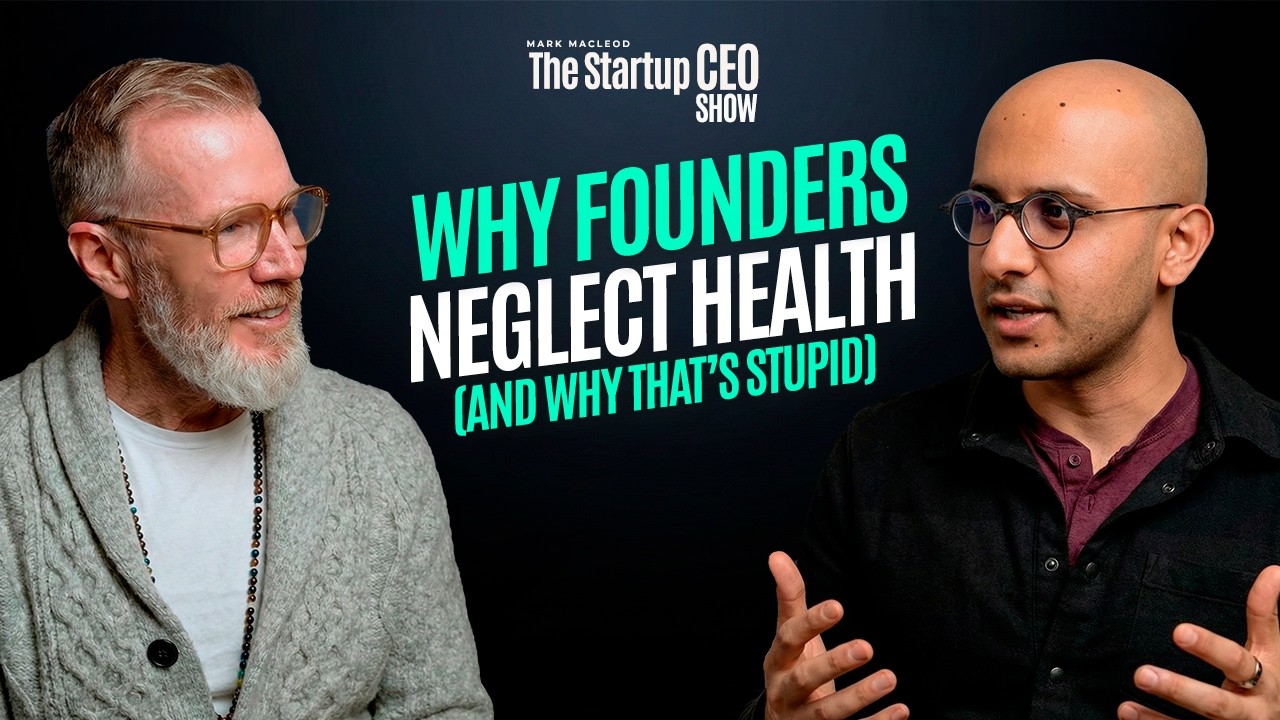
In this episode of the Startup CEO Show, host Mark MacLeod interviews Samir, co‑founder and CEO of Nia Health, about the chronic neglect of health among startup founders and executives. The conversation opens with the observation that a healthy person can juggle many priorities, while a sick person’s sole focus becomes health, yet many founders sacrifice wellbeing to chase growth. Samir explains how stress, sleep loss, and other lifestyle factors manifest in measurable biomarkers that raise risks for metabolic and cardiovascular disease. He argues that leaders must treat their bodies like a business—tracking health metrics and making incremental improvements—rather than relying on vague advice to “exercise more.” The dialogue highlights the emerging market for accessible, data‑driven health services tailored to the entrepreneurial class, noting that while a minority already follow longevity playbooks, most need education and a simple, consumer‑friendly feedback loop to motivate change. Both hosts stress that a founder’s personal health not only affects individual performance but also sets a cultural tone for teams, potentially boosting overall company outcomes. The episode concludes with a call to action for listeners to prioritize health without demanding perfect balance, and provides contact information for further engagement.
Chapters
The healthy person has 100 priorities. The sick person has one: to be healthy. When we're sick, we realize that nothing matters more than our health. And yet most founders are sacrificing their health and happiness in order to build their companies. And then they wonder why they burn out. In this clip, Samir, who's co-founder and CEO of Nia Health, talks about why that is a short-sighted approach.
So yeah, I would say that there's a nuance because even at the starting, start of the race here, we aren't just offering the thing that, you know, frankly, the affluent and the wealthy can access and no one else. We have already created and we're intent upon continuing that journey of creating a more and more accessible solution. So yeah, that's why I struggle a little bit with just the, that kind of model S as the starting point.
So it's probably fair to say that 100% of the people watching or listening to this are within your 20% kind of entrepreneur executive class. So I'd love to take a few moments and just talk about the need for this kind of service for these people, right? So I'll speak I'll kick it off. You know, like I only coach CEOs and I watch these founder CEOs almost kill themselves trying to turn a vision into reality and, you know, create something out of nothing, you know, zero work-life balance. And I'm okay with that. Like no one who masters anything is a balanced human. Michael Jordan wasn't a balanced human, you know, like any rock stars, they're not balanced. So I'm okay with that. But you need to also have some kind of practices to sustain yourself. Right. And like I tell people all the time, like a healthy person has 100 priorities and a sick person has one priority, which is to be healthy. So I'm probably preaching to the converted, but maybe, you know, from your vantage point, like talk about the need for this, for kind of, yeah, the entrepreneurs who are listening.
Yeah. Well, I think, you know, one takeaway from what we know and what we, we see in our existing customer base is that, you know, stress, lack of sleep, like these things show up in your body, right? Like we, we see it from a biomarker level, right? Your rates of metabolic disease, cardiovascular disease risk, like these things, these things are real. And, and, and I think that for, it's kind of cliché at this point, 'cause we've been talked a lot about, but from our vantage point, it is, it rings true. Is that if you want to be the most effective CEO or C-suite or leader in a startup context, you gotta show up as your best self. And so at least being aware of what these, you know, what it is you might be doing by neglecting such a critical aspect of your engine, I think that it's important to be aware of it. And then if you decide that you want to You know, you want, you want to continue to persist down that path. I mean, that's up to you, but I think that it would be, it's kind of this crazy thing in my mind because people ask us sometimes they're like, oh, well, you know, you guys are just going to tell me to exercise more and diet. I know I need to do that. I'm not what, like, what's the point of this? And then I asked the same kind of leaders back. I say, that's kind of a silly comment. Why? Because, yeah, that's the equivalent in business is like saying, hey, well, you all, you just got to increase your revenues and decrease your expenses. And that's, that's, that's That's all that you need to build a successful business. Like you don't need to track any operating metrics or anything like that. So why are we, you know, with the one body, the one vessel that you got, you got to kind of, you know, run your race in life. Why is that something that you're just willing to boil down to the two metrics and say that, yeah, there's nothing, there's nothing else to be done there. You don't tell me anything I don't already know. I think there's a different playbook for managing our lives. As founders, as startup executives, or just, you know, executives in general, where we can lead in a different way and we can lead ourselves first and understand and own our health. And I think, by the way, that also will have secondary effects on your teams, 'cause if they see the kind of leader codifying that and embodying that spirit of wanting to, be healthy, be a, be their whole self. I'm not necessarily saying even be balanced, by the way. That's, I don't think that's necessarily—
No, no, it's separate from balance.
It's separate. Yeah. Yeah. To me it's a really important thing even for teams.
You know, there's an interesting trend here and you look at some of the most successful entrepreneurs like Jeff Bezos has somehow gotten jacked over the last few years. Same with like Mark Zuckerberg. To a lesser extent. There are counterexamples. Elon Musk is, you know, dad bod. Toby from Shopify is a lean, mean machine who's literally in his spare time become a professional racing car driver. So there's clearly like an— these are just a few examples. I could keep going on and on, but like there's an emphasis, like a recognition that physical health leads to a better life, but also just far better company performance. Are you seeing that? Like the people who are coming to you, do you like, are you, are you seeing that or are you having to educate them and evangelize this?
I think it's a bit of both, to be honest. There are the folks who, you know, who are following the longevity space, for example, and are, you know, type A, following the playbook, listening to Outlive or reading it, and they're just following the playbook and trying to execute. But I would say that's still probably the minority. I think the majority, and I feel this myself too, right? Building the company that's trying to change this, ironically enough, it's hard, right? The majority, it's hard because it's like, yeah, I know I need to be better about it, but how am I going to do that when I'm working X number of hours per week, right? And I wake up every morning and I'm just focused solely on the mission at hand. Like it's really hard it's a hard, it's a hard thing to wrap your, your mind around. And I think one takeaway I've had when I've observed, um, the progress of some of these types of executive types that we have as part of our customer base is that when they are empowered with consumer-friendly information that they've never had before, it serves as this catalyst. That is, it sounds so simple, but it serves as a catalyst to see your See you and, and you know what's going on inside of you, simply portrayed not in crazy medical speak, but just here's how I'm actually doing inside. Like it, it serves as this wake-up call that doesn't necessarily require, you know, them to go zero, 100 and, you know, stop drinking, for example, if they, if they enjoy alcohol. But taking incremental steps that actually day over day when you start making some of those shifts, or if you end up going and getting that follow-up through primary care, maybe having to take the, pharmacotherapy or whatever it needs to be, it makes a massive difference. That makes a massive difference over time. And it, and it's less scary than when you're kind of confronting the mountain of like, oh my God, and you changed my whole life because I'm a disaster right now. And not having kind of a compass or any kind of indicator of, of, of, of where you're sitting and how you can, how you can actually get to the next step.
Hey, thanks for listening to the Startup CEO Show. If you'd like to connect with me, be sure to visit my website at Mark markmacleod.me, or follow me on LinkedIn at The Mark MacLeod or Twitter @MarkMacLeod_. And if you want to tune in again next week, be sure to subscribe on YouTube, Spotify, Apple, or wherever you get your podcasts. We'll see you next time.