Y Combinator: The Ultimate Startup Launchpad with Michael Litt
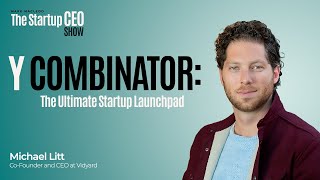
Michael Litt, CEO of Vidyard, explains why Y Combinator's network and credibility matter for startups, and why he built his company in Kitchener-Waterloo instead of Silicon Valley. He's now focused on AI avatars and autonomous sales agents, and runs a venture fund that shapes how he operates.
Questions this video answers
Target $850,000; oversubscribed to $1.65 million (seed round through YC).
Giving up 7% of the company for $20,000 (YC terms mentioned).
May 2024 (recording referenced as May 2024).
About 20 leads per day (automated outreach).
A cited customer had 7,000 users and laid off 5,000 users (example of churn risk).
Chapters
And that's the big difference between a founder CEO and a professional CEO. Right? A professional CEO may have come into an organization, you know, largely through go to market leadership. I think is is the most standard path. And I'm preaching to the choir here. A founder CEO does everything in a business. They've written code, they've run hr, they've been a bdr, they've been an sdr, they've been a customer success manager, they've been a product manager, they've been a product marketing manager, they've been a demand gen foreign.
Welcome to the Startup CEO Show. I'm your host, Mark McLeod. In this episode, I sit down with Michael Litt, co founder and CEO of Vidyard. Vidyard helps B2B companies create engaging video content to grow their business. In this episode we talk about the magic of Y Combinator and why there's no other accelerator like it, why he chose to build his company in the Kitchener Waterloo area, the difference between founder versus exec CEOs and how he has scaled himself as CEO over time, how he's driving innovation in his company through AI and other means, and how running a venture fund has made him a better CEO. I hope you enjoy the discussion and I hope you subscribe for future episodes. Michael, welcome to the Startup CEO show. How are you doing today?
I'm very well, Mark. Thanks for having me. Big fan.
No, no, thank you. Likewise. True pleasure. You and I first met, I want to say maybe it was like 2011, 2012, whenever you had just graduated from YC and you were raising your seed round and I was at Real Ventures at the time and I couldn't get over those pre monies that YC has. And anyway, now you're very firmly in the anti portfolio, so that's a lesson learned on my end. But it brings up maybe, you know, my first question. Let's just dive into, you know, you were an early grad of yc. You know, what are your thoughts on the program today? Do you think that founders should just by default try and get into it just because of the visibility and I guess the team osmosis. Right. We all learn from each other and there's just like this fairy dust of people who graduate from the program. Yeah. What are your thoughts?
Yeah. Thank you. And you know, it's funny, that story of passing on valuation is still very much true for YC today and probably makes up some component of why I would highly recommend being a part of the program. You know, in the end of the day when you start A company out of undergrad. You know, you are. You're definitely a byproduct of the ecosystem that you exist in. And I think the problem with a lot of tech ecosystems around the world is they're trying to emulate components of Silicon Valley. And the reality is, you know, Silicon Valley is unemulatable because of its scale and the sheer volume of people that have built interesting companies that are floating around that ecosystem. And why Combinator is like a black hole for that ecosystem. It's a center of gravity which attracts a lot of really amazing founders, both founders that have graduated from the program and founders that had nothing to do with it, but are willing to go and speak to YC founders specifically for the benefit of being able to invest in them. And I have it on fairly good authority as a new LP of YC's latest funds, that there are some of the highest performing venture funds by far and away in the world, and I mean orders of magnitude in some capacity. So it's an incredible program. What makes it really incredible? Well, you think about an ecosystem like Waterloo or Toronto, it's a good ecosystem there, it's gotten a lot better. And I'm sure we're going to talk about that. But in the end of the day, it's a relatively short ladder as compared to what happens in Silicon Valley. And, and there's rungs at every single level of that ladder. When you go to a program like Y Combinator, when you go to Silicon Valley, there's a lot of people doing a lot of things. It's an infinitely tall ladder, and there's really no rungs at the bottom. Right. There's a lot of. There's a lot of, like, grift. There's a lot of noise. And why Combinator automatically puts you up to a place on that ladder that is far higher than you could get to in an ecosystem like Waterloo or Toronto. Or even if you just showed up to Silicon Valley on your own, because all of a sudden you are going to a dinner and you're hearing Mark Zuckerberg come and tell you about, you know, the founding stories of Facebook, Marc Benioff coming and talking about, you know, the founding stories of Salesforce and the things that, because they have Chatham House rules, you may never read in the books. And so you get exposure to the inner workings of how these companies are made. And then, of course, you get exposure to some of the brightest minds in the world that want to go to yc. I mean, the acceptance rate is less than hbs, and so As a finishing school for like an engineering undergrad from the University of Waterloo, there's absolutely nothing better. And so when we went to yc, we had two paths in front of us. There was stay in Waterloo, found the company, raise some money from existing programs, known, known pricing, known valuation, very attractive terms or yc, which at the time was a black box. And all we knew was we were giving up 7% of the company for $20,000. Every YC founder I talked to said it is going to be a life changing experience. And to this day I highly recommend people go to it. And if you ever get a chance to Talk to Mike McCauley, highly recommend you interview him for the show. Founder of Bufferbox My partner at Garage Capital will tell you that he and I almost got into a fist fight because I was so forceful about him applying to yc.
Oh my God, he went to the.
Program and he was going to go to some lesser accelerator program in Canada. We'll just call it that, that no longer exists. Got to YC, had an amazing time and 6 weeks later he was flying around with Mike Moritz, the founder of Sequoia Capital. His private jet sold his company to Google. You know, the rest is history. So that's amazing, incredible program. Gives you a big leg up. The exposure you get to the network, the exposure you get to Silicon Valley is, is bar none. And once you have that, once you have that network, once you have that exposure, you keep that for the rest of your career and that network remains for the rest of your career. And I think that's just such a, such a powerful entity.
Wow, that's a huge endorsement. I completely agree what you're saying about the Valley being unemulatable, which really brings up my next question.
Right.
You know, it would have been so obvious for you to graduate, raise capital and just stay there. Right. And just be in that network 24 7. But you chose to come back to Kichler Waterloo, which is in its own special place. But I'm certain you gave up something. Maybe talk us through that decision to come back and build. Build up in Canada.
Yeah, for sure. So first of all, you know, there was, there was three co founders of Vidyard. One of them lived in the Valley. And when it came time, when we got towards the end of the program and we started raising money, we started talking about where we were going to start to build and hire engineers. That's what we needed to do. That's what we were raising the money for. We set out to raise $850,000. We oversubscribed. We ended up raising $1.65 million in our seed round through YC. And you were obviously a part of that process.
Made the wrong decision.
Yeah. You know, what sort of investing is akin to gambling? I think in a lot of ways it's. And anyway, we'll get into that. But we found, we started to do an analysis of every single ecosystem that we could build and hire in. And we talked about Boston, we talked about Austin, we talked about Boulder, we talked about the Valley. The value was becoming a very competitive talent marketplace. You know, costs were, were pretty high. San Francisco had yet to truly become like the place. The Bay Area was still where most organizations were building. And we kind of came to the fundamental realization that the money we raised, that USD we raised, would go a lot farther if we spent it in Canada. And we took advantage of a lot of the programs that existed to help fund R and D. Add to that, my dad was terminally ill. I just found out. Terminally ill. A lot of people don't know the story, but you know, I'm from Kitchener Waterloo. I, I was born at St. Mary's Hospital, lived there my entire life. Was fortunate to, to do an undergrad at the University of Waterloo. Systems design engineering. So we knew the ecosystem, we knew how to hire in the ecosystem. We needed some strong video delivery developers. And Google had a small YouTube office there that we knew we could probably at least get one or two engineers from to get us started. And so it started to look pretty attractive. Now when I told Paul Graham that we were going to do this, he told me that going back to Waterloo would be like climbing Mount Everest with a 10 pound weight on my back. And this is a PG ism. Like PG has a way of saying things that are metaphorical. And you kind of walk away from that conversation and think like, what did he truly mean there? And of course, when you climb Everest, it gets harder with altitude. And you know, his positioning was the bigger the organization gets, the harder it's going to be for you. With this 10 pound weight, no oxygen, like you might die. And so what I decided to do was not tell any of our investors we were going back to Waterloo and spend a week or two every single month for the first many years couch surfing with other YC founders in Silicon Valley. And I was at every single event. I was basically in the Valley. That was just the way we built the business. Acquiring customers, talking to users, talking to investors. Everybody kind of assumed we were. Meanwhile we were building the business back in Waterloo. And I felt like I could go to the Valley and take in a lot of those inputs and then come back and go heads down and build and innovate and then go back to the Valley and do that in a cycle. And that was very, very productive. When we ended up raising the Series A with a Canadian lead, Omers Ventures stepped in and kind of knew who we were and missed the YC round or our seed round and decided to invest. I talked to Paul Graham and told him the story about my dad and what we were doing and how I was able to be close to my mom and support her, but also spend time in the Valley. And he said moving back to Waterloo might have been one of the best possible things you could have done. And we proved that it could be done. And so that meant that a lot of other YC businesses then went to Y Combinator and came back to Waterloo to build their companies. The, the, the. The second company that did so and got to reasonable scale was Thalamic Labs, which later became north, which sold it to. Built the. Built the AR AR glasses. And I think since then there's been about 60 to 70 yc founders that have come back to the Waterloo region to go and build their businesses. So we were the first. We broke the seal, so to speak. And that's an incredibly important part of building an ecosystem which ultimately led to the garage story. So yeah, we really did feel like we could capture the best of both worlds, still spend a lot of time in the Valley, still have a strong network there. I think Y Combinator again is just a really great starting point. And to the comment you made at the beginning of this, on, on, on exit valuations for organizations just to close that loop. Like we still see companies coming out of YC raising at 1.5 to 2x, you know, the post money caps of businesses and founders in any other ecosystem. And so the dilution you give on the front end, you definitely get later on in the raise if you do it successfully. And then of course, now you're a YSU founder, you have pixie dust. The more successful you are, the more people are willing to pay for your business because you have those really strong foundations.
Yeah, I love it. There really is, like I said, something special about the Valley. When I was at Real Ventures, geography mattered a lot more then than it does now. And I would encourage my founders to go down at least quarterly, if not monthly. Just plug in. Every time I went down there, I came back and I was like, I'm not moving fast enough. I just need to go. It was just lit a fire under me. And when I was running the investment bank, we had an office there. I was there every month. And it's just a special place, that's for sure.
You know, that's one of the raw ingredients of YC is every week you sit down, you have dinner with all of your fellow YC ers that eventually become alumni. And everybody seems like they're like way farther ahead than you are.
Yes, yes.
And there's this like, if you're a competitive person, and I think most founders are, there's this disassociation which occurs where like you want to go, go home, work hard so that the next week you have a really good story to tell about a new customer or a new feature that you shipped to make them all feel like shit for product.
There's the spirit and it's this vicious.
It'S this vicious cycle. And you know, the other thing is like, the Silicon Valley is very much for profit. And a lot of the versions that of, of YC that tried to exist elsewhere in North America were part of not for profit programming where there was no vested interest from the partners or people operating that business for you to be successful. And like I heard, you know, PG told a company in our batch that was working on a music startup, in our, in our era there's a ton of music startups which would be turntable. There's all these like, amazing. I remember that building cool stuff. And PG was like anti music start because everybody was doing it. And I heard him tell a group of founders, if you want to drive your company off a cliff, go ahead and be my guest. This is why I funded 50 other businesses and got up and walked away. And like, you just don't see that behavior in a lot of other ecosystems. There isn't that level of confidence in the feedback that people are getting in that tight ecosystem. Everybody's competitive. So yes, you've captured it very well. It seems like Silicon Valley is alive and well, especially in this AI movement. It's really come back post pandemic. But I think that's also true for the Canadian ecosystem, thanks to all this, you know, capital gains, inclusion rate nonsense. I feel like you've really brought everyone together. Yeah, I think that's one of the best.
Best.
That's, that's the silver lining in this whole thing. But yeah, we have a long ways to go.
Yeah, so you mentioned like Kitchener Waterloo is pretty small area geographically. I don't know what the population is, but it's small and yet it's had a huge impact on startup ecosystem at large. Like I don't know about this. I know there's 400,000 Canadians in Silicon Valley and I know that most of the public companies have a Canadian in the leadership team. But I'm certain that there are University of Waterloo engineering grads all over Silicon Valley. And so what is it about Kitchener Waterloo that makes it this spawning ground for startups? Is it just because BlackBerry got started? Is just. University of Waterloo has just got the most relevant like curriculum what's going on there?
I'm really good friends with a Prof. From the University of Waterloo named Larry Smith and a lot of people, I think he taught hundreds of thousands of students during his tenure. So a lot of people know who he is. We recently had an event, there's a UWaterloo mafia WhatsApp group and a lot of them were talking about Larry. So we ended up having a like a salon seminar at our office where Larry came in and did a lecture. And I've had Larry come and talk to LPs in the fund before about what's in the water in Waterloo. And he actually takes it back before the university existed to like the origins of the settlement and the Mennonite community that came to to Waterloo essentially to farm and start their lives. And you know, there was like an independent grocery store in Waterloo that nobody could buy called Zaires for like the longest time that got to, you know, very significant scale. There's been incredible innovations that have ultimately come out of the region in, you know, military technologies, you know, from the blue bin recycling and like a lot of this stuff predates the University of Waterloo. And in fact the founding of the University Waterloo is almost a byproduct of that region's barn raising independent mentality. I think the reality is Waterloo was far enough away from Toronto to be its own economy. And because of that these trade systems got developed and it was relatively close to the borders. And so there was all sorts of interesting things that happened there during the prohibition era, etc. That didn't help happen elsewhere. It's also like smack dab in the center of the Great Lakes and was accessible via, you know, the busiest highway in North America. So these ingredients I think are actually a core component of what started the University of Waterloo, which was like, you know, when it started considered a trade school. Right. The idea of bringing work ethic and professional work experience, a professional degree program like engineering was scoffed by so many. But what it's created is grads that have work experience, which is highly applicable and therefore very sought after. It also creates grads that see from that work experience how inefficient businesses are run and they've got the skills to go and solve problems and build companies. And that's exactly what happened to my founder, Devin and I. We were working at BlackBerry, he was working at cgi, I worked at Cypress Semiconductor. And we consistently saw that video was a very difficult medium to produce and use in the professional context. And so we saw an opportunity to start the business. We had the skills to do so. We didn't have a ton of student debt because when you work every four months and go to school every four months, your costs of, of tuition are offset. Most people graduate from the co op programs with money in the bank versus heaps of student debt. Like there's so many contributing factors here which make it a critical component of the ecosystem and that has just kind of accelerated its trajectory. Is Canada the best place to start a company? Well, that is the big, the big debate, right? I fundamentally don't believe that any founder thinks about capital gains when they go start a business. But does it limit the ecosystem long term? Probably. And we need to not limit the ecosystem long term to encourage innovation, to encourage individuals like yourselves, yourself to reinvest into the ecosystem, to stay in the ecosystem, to help up level the ecosystem with your experience and knowledge. That's why I'm a huge fan of this podcast because it's one of the key ingredients to people that have been there and done that giving back, which is what makes Silicon Valley so special. So yeah, Waterloo is a great place. There's a lot of that going on. There's a lot of interesting people there. All the BlackBerry executives, obviously a lot of them are still there. Mike and Jim have put so much money into that ecosystem in surrounding area, they love to give back. Profs like Larry Smith, like there's, there's some, there's some amazingly powerful ingredients there, but I think it could be a lot better. And that's kind of what I'm on a mission to help deliver over time. I love it.
Yeah, I mean it's hard to think of KW without you. It feels like you're an integral part of that, especially with garage, which we will talk about. But no, I love that I have to say the co op program, I did that for my undergrad and I came from a poor family. I was the first to go to university and I couldn't afford it and I wouldn't have been able to do it without co op.
Yeah.
I will say sadly it was between Waterloo and Brock University and I decided to go to Brock because University of Waterloo was very male and I didn't date one woman in the undergrad at Brock. So whatever. My, my rationale turned out to be redundant.
But yes, Waterloo is not a party school by any stretch of the imagination. The undergrad is unbelievably difficult. The failure rate is like very high in a graduating class. I think only about a third actually finished from the starting point, self included. So like they kind of say when you start system design engineering, look to your left, look to your right and like it's likely neither of those people are going to be here when you finish. And that's the reality of the grit determination. But I had a similar story to you. My parents, we did not have see through on our tuition. Fortunately my brother and I both applied to every scholarship under the sun and turns out not that many kids apply to scholarships. So if you just put in the effort, I'm sure it's changed now with ChatGPT. So we were able to get a few scholarships to kick us off and then the co op program carried us through and that made university possible for us. Otherwise it wouldn't have been an option. And that's a powerful thing too, right? Especially you know, as Canada looks to bring new immigrants into the country that are starting from scratch. Like I think these institutions have a very powerful role to play in the future of innovation, in the future of how companies and families get brought up in Canada.
Yep. Yeah. I have to say that I didn't know until this podcast that you had an engineering background because I always found you to be so good at go to market from the outside in. And so I'm just curious. There's obviously lots of technical folks who start a company. How did you, other than just putting the reps in and making mistakes, how did you turn yourself into this full CEO who can do all the things? What was your journey?
Yeah, yeah, I'm glad it looks like I can do all the things from the because it certainly doesn't feel like that from the inside. So when we went to Y Combinator, I mean the story of founding Vidyard is I think maybe important here. I drove the idea of starting a business with my co founder Devin, and Devin is one of the smartest people I've ever met academically, financially. He was an engineer in my class systems on engineering, raised by accountants and so he had kind of a broader understanding of the world than I did. But I grew up with an older brother. We both did the same undergrad program. We were highly competitive, and I wanted to see if I could punch above my weight and do something interesting. And so I took my last co op term off to start a company called Redwoods Media, which is a video production business that eventually became Vidyard. And I applied to a program called Summer Company with the city of Kitchener. They paid me like 3, $500 through a grant program to go and build this thing. And that was my, that was my salary. And so there's a bit of a do or die element to it. And we were selling video production services, so I had to like, put myself out there and like, I was talking to local real estate agents and, and car dealerships, anybody that would let me make a video for them, an explainer video about some part of their product lineup to fund this thing. Because we fundamentally believed if we could, we could fund the development of the software Vidyard with the production services for Redwoods Media. We were really a solution to a problem. We weren't a solution in search of a problem in that way. And so Go to Market was kind of embedded in who we were because I had to put myself out there so much, so frequently. And we had a goal, which was to sell $50,000 worth of video production by Christmas of 2010. We called it Project Christmas. We gave ourselves six months to do that and we didn't get there. But we were close enough to say, like, you know what, we don't need to go look for jobs right now. We were in our fourth year. We should pursue this full time and see how far we can take it. When we got to Y Combinator, Paul Graham took us on a walk around Pioneer Way, where the old YC office used to be, and kind of just said, hey, Mike, you're going to be the CEO because you're the one that's answering all my questions. Like, you're the talkative one and you're the one that's going to drive go to market. You know, Devin and the team needs to go and build the product. And because you've got product to market, I want to see you grow MRR by 10% per week. And every week. Had you grown MRR by 10% per week? If not, why not? And so that just became my job, and it was pure survival. And, you know, I think the role of, like, when you start a company, the role of CEO is you're not actually a CEO. You know, this, like, you're kind of.
The do you're a product manager until your product market fit, anything else is a complete distraction.
Yeah. Yes. And what that means is you're talking to, I mean you're a product manager, you're the first pdr, you're the first sales rep, you're running HR like you're doing absolutely everything. And that's the big difference between a founder CEO and a professional CEO. Right. A professional CEO may have come into an organization, you know, largely through go to market leadership. I think is, is the most standard path and I'm preaching to the choir here. A founder CEO does everything in a business. They've written code, they've run hr, they've been a bdr, they've been an sdr, they've been a customer success manager, they've been a product manager, they've been a product marketing manager, they've demand gen leader, they've kind of done everything. And so you, you end up having empathy and compassion for every single role. And then you generally hire the people under you to do the stuff that you figured out how to do and you scale and eventually you hire leaders to manage those people. And then at some point you realize, holy, now I'm actually a CEO. So to answer your question, I think succinctly coming from an engineering background, especially systems on engineering is all about pulling systems together to get to a result. Software, you have an input, it goes into the software, creates an output. A business is really the same thing, right? You have an input, you get to an output, the input is money and people and then that output is product and customers. And having a systems way of thinking about building a business is, I think how I've applied my learning, my undergrad, my ability to learn quickly in a high pressure environment like system design, engineering into becoming a CEO. I think the other part of it though is like the constant learning of knowing what I don't know and for lack of a better term, you know, having my ass handed to me and experiencing ego death time and time again over being proven wrong and which has, you know, driven me to seek help and to seek coaching and seek support and you know, higher experienced individuals. And that's why I love what you're doing again because you know, you are providing the, the skill set and the thought process and the hard questions that a lot of these founders need to ask themselves in their process of becoming CEOs.
Yeah, I appreciate that. Yeah. The right question can change your life, to be honest. Just open up a whole new perspective. Can be really powerful. Maybe let's switch gears and just, you know, I had Chris Savage, founder and CEO of Wistia on here pretty early on and he was like, you know, 17 years in, I think you're almost 14 years in. What drew you to video? Because you were doing video production before Vidyard. Like, did you just know that this was going to become the dominant medium? Did you think, hey, attention spans are going to go away and so we need something more visual. What, what brought you to this space?
It's a great question. I like Chris. I mean, we've been, we've been like competitors for a long period of time. Less so now. But yeah, he's an incredible entrepreneur. I grew up with a video camera in my hand. So every family event I was the kid with, you know, VHS camcorder like on my shoulder. And through high school I got into freestyle skiing and I wasn't the most talented. And so I loved being behind the camera and filming and editing my friends and then, you know, sending those videos to sponsors. Each sponsor got an individual link and when the view counter went from 0 to 1, we knew they'd watched it and so we'd follow up. And then when I got into undergrad, often we would be doing, in systems, you have a kind of like a capstone design project every single year. And I would always produce a video to describe what we were doing and that would be like a little bit extra for the TAs and our profs to understand what we were doing outside of just the core presentation, Little, little razzle dazzle. And so video was like always a part of the way I communicated. I felt like you could communicate things more emotionally and powerfully with video than you could with other forms of media. And I just fundamentally wanted to help businesses understand how to do that better. And so when I, when I got into the co op program and I went and worked at BlackBerry and Cypress Semiconductor and Roadtrek, I found that they were using video or trying to use video to do things like report, reduce customer service costs. So send someone to a video to show them how to do the thing versus tell them how to do it from marketing perspective. Get customers to tell the story of how the product innovated and changed their lives versus the company doing that. And something that I saw was a companies weren't really great storytellers and a lot of people didn't have the technical knowledge of these products to really produce high quality converting videos. And two, businesses didn't know how to put those videos online. And the best example I use early on was, you probably remember the BlackBerry playbook, you know, was a ill fitting competitor to the iPad. Even BlackBerry.com early on was using YouTube. And when you clicked that video on the Playbook website, it took you to YouTube where the first recommended video was an iPad versus Playbook comparison video. Right. And so like that was just, they were just bleeding their funnel to the competition. And so, you know, we saw like I could take this passion and transform it into a for profit entity in the B2B space. And video was still relatively early. Like up until that point, Flash was the dominant method of streaming content online. And of course Flash, and I believe it was Active X from Microsoft or the competing Adobe vs Microsoft protocols that you had to, you had to pay for if you wanted to stream media on the web. And then HTML5 created this new open standard. And when we emerged as a video hosting provider, premium video hosting provider, even YouTube hadn't moved on to the HTML5 streaming standard. In fact, the only organizations that had, I believe at the time were like the porn streaming services, which in video, like, you know, I'll tell you like that that's the industry that always really leads innovation. Yeah, so, so there was like a ton of green space and you know, we built the business on that green space. Helping businesses tell stories of video and then focusing on the technology to help them do that better and then focusing on who was watching and for how long and helping marketers use that data to more successfully communicate with their customers, so on and so forth. That eventually became how do we help sellers do this? And then we saw the boom of, you know, video in our consumer lives. The way we communicate, the way the next generation communicates, the synchronous video consumerization of enterprise, how do we bring that to the enterprise? So it's been a very interesting journey and you know, I think it's well capsulated in something Byron Dieter said when he invested in our series beat. Byron's an incredible investor, you know, one of the tier 1B 2B SaaS, probably most prolific in terms of, you know, go publics. And he, he said to my wife Donna one time over dinner, he said, you know, I don't really know about this video space but like I really do believe that Mike and crew are going to be the ones that figure it out. And like, I will tell you this and I'm sure a lot of CEOs do, I don't think we've cracked the code yet. I think there is clearly a massive opportunity, but we're innovating inside of it consistently to find, you know, the true billion dollar error opportunity that we fundamentally haven't found yet. And that's a big part of my job. And that's what's so exciting about running Vidyard in this moment, because we've got thousands of customers across, millions of users that we get to iterate with and develop new technologies for. Especially now with the emergence of AI to reduce the friction of creating videos and telling stories of videos and putting those things online to improve the experience that their buyers have with their brands. And our vision is, you know, the power of the future of relationships between buyers and sellers. You know, B2B commerce is this massive category and video is this really powerful medium that I think is still underutilized. And it's only underutilized because it's still a very high friction asset. And this AI moment is potentially the moment where video truly becomes the powerful asset we all know and want it to be. So yeah, 14 years learned a lot about building a business, operating, building in video, building in technology, but I think there's still so much to learn.
How do you maintain your passion for so long and your energy to keep driving, keep innovating, keep putting one foot in front of the other?
Yeah, it's a great question and I will say I ask myself that as regularly as I can to just check in with myself to make sure that I'm not, you know, driven by like insanity, you know, like trying to do this same thing over and over to.
Have some level of insanity to start a company in the first place.
Yeah. And to stick with it through the highs and lows. Right. And you know, I would say right now for, you know, we are recording this in May of 2024. So you know, at some point in the future, you know, people will wonder what life was like. Like we are, we are stuck in a 24 plus, 24 plus month period of like macroeconomic instability where building video technologies for go to market teams has been, been, been tough, it's been bumpy. Right. And, and the reality is companies aren't spending nearly as much in go to market as they were, especially during the pandemic or pre pandemic. And you know, we sell a product on a perceived basis to sales teams and you know, one of our largest customers had 7,000 users. They laid off 5,000 of those users. Right. And that, that is churn that you experience as a business. So what I would say is right now is marked with a difficult moment in the context of go to market tech that is offset by, by this exciting moment which feels like an industrial revolution is happening. And when we build Vidyard. The Internet, you know, was a highly anchored thing and it was really about streaming video for the lowest possible cost to transfer value to our users in the context of who was watching it and for how long. Powering their sales teams to use a different medium to get attention, their process, so on and so forth. Very straightforward. Now there's this like, there's this entirely changing landscape where software, software has always had the promise of doing the work, but it's actually made people busier. We're at this inflection point where point and click interfaces are going away, where you can do huge amounts of work with artificial intelligence. You know, the most basic level of what LLMs can provide today that you ultimately couldn't do prior. So this is like an entirely invigorating moment to be building in tech because it's difficult, but there's also this massive change and it's like a reshuffling of the deck. And when this deck gets reshuffled, businesses that are small can become very, very big. And businesses that are big can become very, very small. And I'm a risk taker. And so it feels like I'm needed more in this world with the context and experience I've had over the past 10 years of building this business, than I might have been even two or three years ago. Adding to that, I've recently gone through the process of rebuilding my entire executive leadership team. So something I'm sure you talk to a lot of CEOs about is how do you know when to build and hire around you? It started with finding a gentleman named Jonathan Lister who was the general manager of the LinkedIn Sales Solutions business. I mean, he ran Google Canada, then he went to LinkedIn, he ran the marketing solutions business, then he went to Sales Solutions when Sales navigator was a $0 ARR product, he left when it was a billion $ARR product. So now I get to work with this guy who has way more experience than me, is absolutely brilliant, and is looking at the business with a fresh perspective. And that led me to bring in a new head of talent, a new cfo, Chris Wolf, who ran biz ops for Jeff Weiner at LinkedIn. And this crew has totally reinvigorated me and operationalized the business to let me go focus on building with AI. So this is a moment where because of a lot of things outside of my control, I feel way more energized than maybe I did in the past. And So I wake up every day with like, you know, what's happened in technology? What's the latest with OpenAI? What's changing from a regulatory perspective? How can we use these products to make it easier for our users to communicate with video? That's my dream. We have distribution, we have these, you know, millions of users, we have these thousands of paying customers. Let's go build stuff for them and blow their minds and be at the bleeding edge of this change and see where we are in five years. And the last thing I'll say is, like, I don't know what the world's going to look like in five years.
I don't know what the world's going.
To look like in a year and a half. Right. Based on the pace of innovation in AI, I think we're starting to see some kind of asymptoting of the capabilities of LLMs, which is nice because it means we can start to make some more accurate predictions about where the world is going and where we should be innovating. But at the same time, that uncertainty is incredibly exciting.
Wow. So it's still. You're driving the roadmap personally then?
Yeah. So I see my role in three things. Three buckets. Right. One is the strategy and the vision, which is all about product. It's all about what we're building for users. And so we've got this vision right now for what we call the autonomous sales agent. And I'm happy to speak about that in detail.
This is the new AI avatars that you launched.
It's part of. Okay, so we've been building and launching technologies that are core ingredients of this broader vision to try to get an understanding of how people are using AI or comfortable with AI. Are they comfortable giving it full control over, say, their calendar and their email? Do they want to be in the loop? Are they comfortable with videos being produced in their likeness when they didn't even sit down and click record? That's the AI Avatars product. Like, we're experimenting with human psychology here in software products with non deterministic outputs. So, like, you tell your avatar to go say something and all of a sudden it shows up with a British accent that's like. And nobody can tell you why. Like, that's like a different paradigm of working with software, which is cleverly exciting. So vision and strategy I spend a lot of time on. And where's the puck going? How can we create software that's capable of doing all this amazing work? The second thing is, do we have the best talent possible to go and achieve that vision and execute the strategy. Execution. Eat strategy for breakfast. Talent's going to do that. I just talked about this awesome ELT I've put together and then finally, do we have enough money to go and do those things? And that means, you know, are we looking at profitability? Are we flowing cash? How much are we burning? Do we need to go raise more money to do some stuff? Do we need to acquire a business to go after the vision? Do we have enough money to do that? And that's kind of how I ultimately break down my role in that order. And so I spend as much time as possible with product and helping think through ultimately what we go build. But of course I have an awesome product team. Devin runs R and D and he's obviously very close to it as well. And because I wear this dual hat as an investor and an operator builder, I get to see what startups are building at the various earliest stages of tech. And they're kind of taking this 5, 10 year look and seeing the capabilities they're building and how fast they're building it. We get to apply that energy to our business in the context of our vision and strategy as well as. I love that.
Yeah. Your description of your role reminded me of an old definition by Fred Wilson where he talked about the role as being communication, like communicating strategy, vision, values over and over again through your secret hearing yourself speaking, build the strongest team that you can, which I distill further down to building the strongest leadership team that you can. Because if you get that right, they're magnets, they're going to attract talent and so on and so on, and then never running out of money. Really simple, right? Easy job. I'm curious, do you find now, especially with this new elt, that you're able to take time for reflection, just like big open blocks and just think through stuff? Or do you. Are you still grinding?
I try to do that, I try to, but you know, it's funny, like I'm, I am, I'm using this shit.
Out of our products.
So we have this product called Prospector. Prospector does fully automated outreach on my behalf. 20 leads per day. I tell it our ICP, I give it a prompt, I give it a type, like a style of email that analyzes it and then it uses GPT4O to go and build emails that are personalized for these users, sends them a video of me, sends them my calendar link, and I have probably five to six customer calls per week from Prospector. So like, I love that, right Because I'm showing them. I'm like, hey, by the way, did you know that you responded to an AI generated email? Like, wow, no, I didn't. That's crazy. And I'm like, hopefully that doesn't devalue the experience because here I am and here I am irl. I wouldn't have had time to do that. What do you think about it? So I'm learning and I'm using the product. So I love, you know, we just finished our fiscal year and so we're kind of kicking off. Our fiscal year starts in May. So I have a lot of conversations, I do a lot of skip levels with people across the business, try to understand how they're feeling, do they understand the strategy, vision, et cetera. So I'm a pretty like in the weeds CEO right now. But I'm hopefully getting into an era where I can spend more time doing stuff like this out in the ecosystem, spending time with other founders, investors, and really getting a feel for what's coming, what people are thinking about, which is going to be exciting. And I think in that, in that process and in starting to travel again, I will have some more time for reflection. I find when I do reflect and, you know, not to turn this into a coaching session, I start feeling like I haven't accomplished enough or like I'm not, I should be spending time doing something else, like talking to customers, talking to users, like, you know, playing with our technologies, understanding how they can better benefit those groups. And so that's probably something I need to work on because I feel like a recommendation is coming.
Yeah, listen, both are important, right? You need that input, especially from talking to customers, especially from dog fooding your stuff. I just think one thing I'm really amazed by is like 14 years in the level of kind of innovation and risk taking. That's an uncertainty that's still going on because the last company I operated was FreshBooks and it was a little older, but anyway, whatever, in its second decade and we were just making sausages. We knew exactly what we were building and who we were going after that. The marketing mix was nailed. We were just making the recipe over and over again. Maybe that's good, maybe that's bad, but I love that there's still a ton of innovation and risk here. And if I think about that, that what you're doing is creating and we cannot be optimally creative when we're stressed. Right. That's why when we go for a hike or we're in the shower, that those insights just pop up because we've given space for our subconscious mind, which is ultimately far more powerful than our rational mind, to go to work. And that's when it just hits you, those insights. So you need the inputs.
You need.
To put the reps in. Right. Mastery takes a long time. The 10,000 hours. I think you put in the 10,000 hours at this point. But then I think the missing piece is just space for the magic to pop up.
Yeah, it's a good point. You know, I think that space probably exists more than I give it credit for. I'm actually at. We've got a small little hobby farm here and we grow peaches. And you know, last year we had four peaches. It's so like grow peaches is kind of noticeable, but at full scale, in a few years we'll have 5,000. And, you know, I spend time here doing farmy type things. You know, I'm operating a chainsaw, I'm clearing a path, you know, you name it, we're moving, moving mulch and earth around and, you know, blah, blah, blah, blah, blah. And that Jeff, Jeff Shiner, CEO of 1Password, talks about how every CEO needs a tractor. And it's kind of his. And he loves tractors, he loves farming. But I think that's what I've been able to identify is these things I like to do that are physical in nature, that aren't necessarily knowledge work, that are problem solving, that are activating a portion of my brain that allows me to create in the moment and then subconsciously process things that are ultimately happening with Vidyard and in the ecosystem and in the fund. Because my wife would say like that processing never stops. And I'll often like wake her up in the middle of the night with some idea that I'm like, communicating through my sleep. She'll write these things down and report back to me in the morning. But I find if I didn't have that, I probably would. I mean, she always says if I didn't have Vidyard, I would find something else to torture myself with. And so it's just, it's, it's part of who I am. And she's definitely true. And I'm sure that's, that's part of the mix of a lot of the entrepreneur CEOs you talk to.
Absolutely, yeah. You know, anyone who's trying to achieve greatness cannot truly be balanced. Right. No sports star, actor or musician that we admire is balanced. And I think the expectations on the shoulders of CEOs who raise meaningful amounts of capital are the same as those athletes and others stars that we admire. Right. So yeah, you have to be a bit obsessed, that's for sure.
And I feel a huge sense of responsibility to our stakeholders. Right. Like I think about our stakeholders in the context of customers, employees, the community in which we exist and can benefit, and then our shareholders. And I think of them in that order. And so I know if I deliver an insane amount of product value to our users, they'll give us that value in exchange. That allows us to create better programs to promote our people, it gives them more growth opportunities, so on and so forth. That creates impact in our community, which is the Canadian ecosystem, in my mind. And then our shareholders ultimately benefit, but the shareholders provided the ingredients for us to go and service, you know, those for first three stakeholders. And that's kind of how I think about, you know, what five years looks like in the context of our customer and our and our team. That's the stuff that I process most consistently because I feel, you know, extreme levels of ownership over those outcomes.
Yep, totally makes sense maybe as we start to wind down. Mike, you know, you referenced earlier how you were both an investor and a CEO and I'm a happy LP in Garage Capital. And maybe just tell us about that. Like, first of all, I certainly say, if I was your VC and you told me, hey, I was going to start a fund, I'd be like, oh, that sounds like a big distraction. So wondering like, how did that come to be and how has been on the other side made you better at your actual job running this company?
Yeah. I'll start by saying I work a lot. Like, there's no. There's no question. But the parallels in the work, especially recently, have become far more extreme and useful. The way Garage started was founders were coming to us wanting to go to YC, Canadian founders and Mike McCauley was one of those. Mike McCauley gave me an opportunity to invest in his company. I couldn't get liquidity. Six weeks later, he would say, 12 weeks later, but six weeks later he sold it to Google. And that would have been an outcome. And so I said, I knew Mike. I was Mike. I knew what drove him. He gave me an opportunity to invest. I provided help and assistance by recommending him, pushing him to get into yc. He got it and I got no personal upside. And I was like, would I have done that work regardless? Yes, of course I am going to spend time with founders because I can learn from them as much as they can learn from me. And the next generation of founders is thinking about the world far more differently and far more creatively than a business that's making sausages. So if I want to stay on the competitive edge of what's happening in tech and innovation, I'd better be spending time with startups. So if I'm going to be doing that, I might as well invest. And so Mike made some money. So I asked Mike if I could invest some of his money. My brother and I had bought a house in 2008, subprime zero down that we rented to our friends at the University of Waterloo on a promissory note from BlackBerry that they would hire me when I graduated. That was what helped get us approved for the mortgage. Back then the bank would approve any, like anybody that had any.
Oh, you have a pulse. Here you go, here's your money.
Yeah, or like you're, you know, you work at BlackBerry. Amazing. Oh, you got this note. Amazing. Like we can underwrite that. It was, it was, blew us away anyway, sold that place and started investing the proceeds of that into startups. And one of our investors said, hey, like we like what you guys are doing, we like your portfolio. Can we invest in you? And then you invest on our behalf. And that became fund two. So fund two was relatively small, $8 million pool of capital. Fund three became a $35 million pool of capital. Fund four became a 50. And then we raised a couple opportunity funds that sit, sat on top of three and sat on top of four so we could maintain pro rata and maintain the structure. My job with Garage is, is not to manage fund dynamics. There are, there's a lot of fun dynamics, there's a lot of LP relationship stuff, there's tax stuff, there's, there's like, there's things that, that, that happen when you're invested in companies. There's liquidity events that you have to manage. I try to stay as far away from that stuff as possible, with the exception of providing my opinion based on the company and the founders. I spend time with entrepreneurs and I decide if this is a deal or a company or a group of entrepreneurs that we want to pursue and invest in. The benefit that gives me is I am seeing we're building at the bleeding edge of technology using artificial intelligence. We are finding the limits of LLMs. We're finding the limits of these open source models that can generate human forms digitally and use those human forms to communicate with customers. Super cool, super powerful stuff. We know the limitations of these systems and so when we look at startups, we're able to tell if this is like a chatgpt in disguise or if this is like a real innovation that is is happening in a space where this individual is uniquely suited to innovate in this space. And that's again, because we're ultimately building with the technology. We're also seeing what founders are doing and understanding where our own capabilities, what we believe to be the limitations of this technology could be stretched or pushed a little bit. And so the two are working harmoniously together in the context of this vision. And it turns out we're pretty good at it. Charles Plant just did an analysis and suggested that we are one of the most, we are the best fund in Canada at picking eventual scale ups based on the way he manages his data. And when we look at the benchmarks across, you know, US based funds, we're kind of like a top decile performer. So, you know, really comes down to like having empathy and compassion for what it is to build and found a business and what's required and looking for, you know, versions of ourselves that come from in different backgrounds and different locations that have unique advantages, building in certain categories, doing so in Canada and supporting those founders to go succeed. And I think the two work incredibly well together. Initially we had feedback of like, how are you going to do both? But the way we structured time and the way we structured the way we, we, we go to market with the fund and the way I've structured, you know, the way I'm building Vidyard, it makes it very possible. And the vast majority of our investors in vidyard are also LPs and Garage Capital, which I think speaks volumes.
Amazing. Well, I got to say that it sounds like there's an awful lot of benefits there, a lot of work and maybe might be awkward if a Vidyard competitor showed up looking for funding. But yeah, just going back to again how much risk and innovation you're still taking today, getting that stimulation and seeing what the next generation are doing sounds actually really, really valuable.
Yeah, I think you got to keep the knife sharp. And when I get lazy or tired or stop pushing that innovation envelope, nobody's going to do it. It's clear that that is my job and my responsibility. So, you know, garage is one of the ways I feed that engine.
Well, Michael, given that you have at least two jobs, possibly more, I really appreciate you taking the time and so much more we could have talked about, but I really enjoyed it. Thank you very much.
Yes, thanks for having me, Mark. Cheers.
Hey, thanks for listening to the Startup CEO show. If you'd like to connect with me, be sure to visit my website at Mark McLeod me or follow me on LinkedIn at the Mark Mc McLeod or Twitter @Mark McLeod underscore. And if you want to tune in again next week, be sure to subscribe on YouTube, Spotify, Apple, or wherever you get your podcasts. We'll see you next time.
More from Mark





The Burnout Breaking Point - How Strategic Breaks Actually Increase Productivity


Emotional Debt - How Avoiding Hard Conversations Compounds Into Company Killing Resentment


The Death of the Specialist - Why AI Is Creating a New Professional Class Called Scalers