Busy Entrepreneurs Are Wasting Their Most Valuable Asset
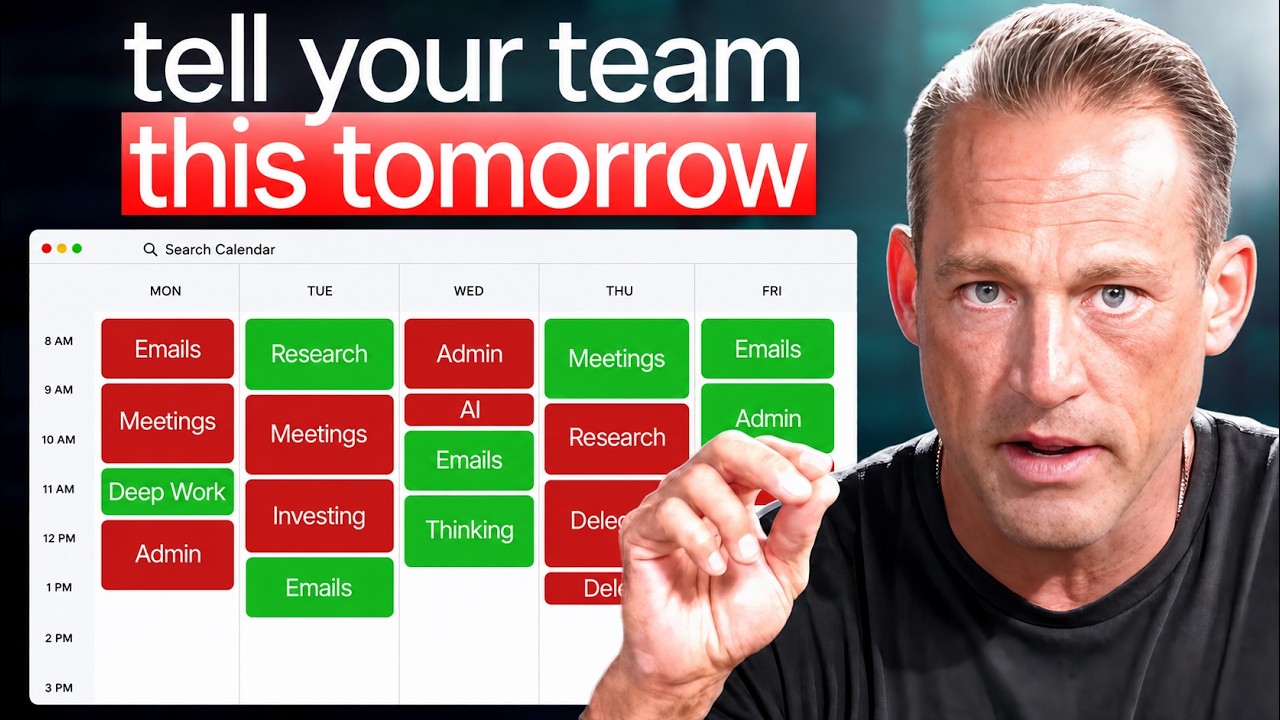
In this presentation Mark Moss argues that an entrepreneur’s attention is their most valuable asset and that most busy founders waste it on low‑return activities such as endless email, meetings, and ad‑hoc tasks. He introduces a practical framework for treating attention like capital: first define an "investing thesis" (goal, timeframe, asset view), then use AI tools to curate only information that confirms or disproves that thesis. He shows how to conduct a time audit (30‑minute interval tracking, low‑tech sheets or AI‑enabled wearables) to surface where time is actually spent, and then categorises tasks into three buckets – eliminate, delegate/outsource, or automate via SOPs. He adds decision rules based on the entrepreneur’s hourly value and energy drain, emphasizing that anything that does not move the goal should be deleted before delegation. Moss ties the attention‑management system to a broader "wealth operating system" that aligns business, investments, taxes, liquidity and debt, and cites Buffett/Munger wisdom that success comes from a few high‑leverage moves rather than constant activity. The video ends with a QR‑code call‑to‑action for a wealth‑operating‑system service and a teaser for the next video on the three engines of wealth.
Chapters
If I offered you a guaranteed 20% return on your money, you'd probably stop and calculate it. But every week you see successful entrepreneurs that spend 10, maybe 20 hours on work that produces almost no return at all. Email, scheduling, fixing small mistakes, sitting in meetings where there's no decision that actually requires them. Then they say that they don't have enough time to build the next product or make the important calls, study the investment, or spend a day thinking. Now, your attention is an asset. Maybe the most valuable asset. And most people have never even calculated what it's earning them. So today I wanna show you how to measure return on attention and identify the work that's quietly making your life smaller. You ready? Let's go. So before I explain to you how to calculate this, let's just think about what it even means. Like return on attention, you never even heard of that? Well, this is an investment channel, right? I thought it was supposed to be return on investment. Well, yes, everything is investment and it starts with that mindset shift. So what do I mean by that? The words that we use influence the way that we think about things and the way that we think about things influences the actions that we take and the actions that we take obviously create the life that we live. And so we have to think about the words that we use. So think about what words you're even using. Do you use investment words or do you use consumption words? Let me think about this. So do you say that I'm spending time? I don't have a few hours to spend doing that. I spent an hour or 2 watching Netflix last night. Am I spending time? Or am I investing my time? The difference of spending is things are going out with no expected return. Investing is where I put something out expecting more back in return. So if I invest my time, do I get more back than the time I put in? So we have to think about the words even more. So now that we understand that, if we think about my attention, am I investing my attention or am I spending my attention? Is there a return on my attention? Because we only have so much attention. At the end of the day, there's only so many hours that you can focus. There's only There's only so much attention that you can give and there's only so many decisions that you can make. Decision fatigue is real. Focus is real and attention is real, which is why the number one thing that people are going for, the thing I'm getting from you right now is your attention. So if we're giving attention to things, will it give me more back in return? What is the value that I will get back from this? Now, hopefully you're giving me your attention for this and I hope that this makes a mental shift for you so you can now start building Investments. So the question should then be, what should we put attention to? What should we not put attention to? How do we determine what things we should put our attention to? Now, of course, there's a wide range of things in your life, but we're talking about investing here. So the first thing we have to do is we have to clearly identify what are the things that are worth our attention, and then we can think about what is not. So what's worth my attention? The first thing I need to do is I have to understand what is my investing thesis? And what is it that I'm trying to accomplish with my investing activity? Those are the 2 main things. So what is my thesis? A lot of people, they love the doomer stuff online and they're watching every video about how the Fed's wrong move is gonna crash the market and the dollar's gonna die. And so they believe there's a big market crash coming and they're gonna have this chance to buy assets really cheap. And if that is your thesis, then you need to clearly lay that out. What is the mechanism that will cause this? What type of timeframe? What am I expecting? And then you're looking for information that relates To that thesis? Does it confirm it? Does it delay it? Or does it remove that thesis? Okay, number one. So I have to understand what is it that I'm even looking for? You see, most people are looking for information, but because they don't have anything to compare that information to or apply that information to, it's actually just a waste of time. You're watching videos on YouTube of how to do things, how to get better at whatever task, but because that's not actually solving a problem you're actually trying to do, you don't actually do the work, and then it just became a waste of time. You feel a dopamine rush because you've got some information and you think that maybe my life could be better, but you don't actually do it. It doesn't matter. So what is my investing thesis? And I'm only looking for information that either confirms or denies that. Then I have to think about what am I actually trying to achieve? And how will understanding that thesis or the movement or the timing of that thesis contribute to that? Let me give you an example. My goal is to continue to build my asset base forever for my heirs, but more specifically, in a shorter timeframe, let's say probably in the next 5 years, sort of 2030 is this finish line I've been looking at, that it might be time for me to really scale down on things that I'm doing and maybe get an RV and drive around the country with my wife or go travel a lot more. And let's just say overall work less and have my assets pay for my life. And so I am trying to get my asset base up to a certain level so that by then I can take some of that asset base and start turning it into liquidity to pay for my life. So what I'm looking for are things that confirm my thesis up until that timeframe. My thesis is that I believe that death and taxes are inevitable. And so is money printing. I don't see a big crash coming. I think we continue going up higher and longer. Not every asset. I think there's certain assets that will work better in that environment. Debasement assets, gold and Bitcoin being 2 of those. And I like Bitcoin specifically, but the problem with Bitcoin is that it's highly volatile. So I have to understand the cycles. So that's my thesis. That's my timeframe. And that's an asset. And so I'm looking for information specifically That fits within that. What's the Fed doing? What's the bond market doing? What's the global liquidity markets doing? What's Bitcoin cycle like? What are the indicators? So that will give me what I want. Anything else, I don't need to be paying attention to it because it doesn't apply to my thesis and it doesn't apply to my assets and it doesn't apply to what I'm trying to do. So now that I've given you that part, let me tell you how to make this actually really, really easy to do that will take almost no of your time at all. But before I give you that, I want to say that this is why building wealth isn't only an investment problem. If your business, your assets, your taxes, liquidity, and decisions all depend on you remembering what to do next, then you don't have a system. You have a very demanding job. So I want to put a QR code on the screen right here, and you can just scan that real quick, and my team can help you map the financial decisions that still depend on you and begin turning them into a wealth operating system with rules, roles, and repeatable processes. So scan that code, because now we need to reclaim the attention that is currently being trapped. So let me give you a tip. So hopefully you're using AI. If you're not, like, what are you even doing here? You're not going to catch up to people like me who are using it every day. But it doesn't really matter which AI you're using, but I would recommend using a tool like Perplexity, but you could also use Claude or ChatGPT. And what I've done is I've taken the time to write out what I think my thesis is. If you're not clear, you can use AI to help you brainstorm the thesis. And I've written out what my thesis is. I've written out the things that I think could make it either true or false. And I've written out my assets and my goals. And then I have it running chronological jobs, or let's just call them automations, that are constantly looking into the market on a daily basis and looking for news that's coming out that either confirms or denies my thesis. Again, I don't want just a yes man. If my thesis is wrong, I want to know. But what it's doing is it's bringing me a curated feed of news and then it's interpreting that news to me based off of the thesis that I have. And this saves me hours and hours every single day. Now, just that alone is going to eliminate most of what you feel is actually really productive and it's a big waste of time. Because you could spend hours and hours and hours scrolling on the internet, reading everything, thinking that you're being productive. But the reality is you're sort of just wasting your time. So how do we determine what is productive and what's a waste of time? Well, the first thing you have to do, it sounds really simple, but it's not that easy. But the first thing you have to do is no different than you would do with your investments. It was no different than you would do with your business, but you have to do an audit. Where is your time even going? More specifically, where should your time be going? So I need to understand that just like a budget. Here's how much money we have coming in. Where should that money go? You ever heard time is money, money is time? Because they're very similar. They're almost the same thing. So you can either at the end of the month go, man, where did all my money go? Or you can make a budget at the beginning of the month and plan where to spend the money. Time is no different. At the end of the month, you can say, shoot, where'd all my time go? Or you can plan in advance where the time goes. But it starts with being aware of where it should go and then doing a time study, just like you would look at your books, right? So a time study is something I do on a regular basis. I do them probably a couple of times a year, anytime my life starts feeling like it's out of order. And what I'm doing is I'm taking a study of my time. So specifically, I'll put a timer on my phone and it's going to go off about every 30 minutes. And I'm also usually, I just keep a low-tech, I print out paper like an Excel sheet. And every 30 minutes when it goes off, I literally write down what I'm working on. And I'm going to do that for 2 weeks. I do it for 2 weeks because one week could be just out of the normal. So I do it for 2 weeks to get a good capture. And at the end of 2 weeks, I break that down and look at what did I actually spend my time on. Now I've gotten a little bit more high-tech. I use an AI wearable device. And now when my timer goes off, I just say a trigger word like time tracking, and I say what I do, say what I'm doing, and then AI sorts it all out for me. But then I can see what I spent all my time on. And only when I'm able to see all my time and I'm able to break it down into categories can I then look at and say, Huh, well, this is something I could probably not do. This is something I should probably have somebody else do for me. This is something I could probably have AI automate for me and I shouldn't do anymore. And then I can start taking action on it, but only once I've tracked it and I've determined where it should go. Now, once I see it all, what order should I use? Well, I typically think about it like this. What our job as a business owner, as an entrepreneur, but just as a human in general, should be to constantly trying to be moving to the creative side of things and less away from the technical side of things. Now, I typically would call technical anything anything that you're doing more than one time. If you do it more than one time, you should write down a system of how it's done and create what's called an SOP, a standard operating procedure. And you can have someone else do it, or you could have AI do it for you. Those would be technical things that I'm doing more than once. For example, if I spend 30 or 40 minutes going through my email box every morning, sorting through there, deleting the spam, the newsletters I don't need to read, trying to find the little bit of signal that's in there, I can just have AI do that for me and it can just bring me the most important things, for example. But when I look at that, I want to look at it from 2 different ways. The first way I want to look at it is if I were to hire someone else to do this for me, how much would it cost me? Low-cost tasks I should get rid of. Anything under $15 an hour, hire out. Anything under $25 an hour, anything under $100 an hour, whatever that number is for you. Typically, think about the annual income that you had divided by the hours you work gives your hourly rate. Anything less than that, hire it out. But I also think about it in one more dimension. And that is my energy that I spend on it. Because some things are very important and very expensive, but they just suck the life out of me. I just absolutely hate doing them. And some things are very low level, but I get energy from doing them. So I want to understand what I can hire out. But also, does it drain my energy or give me energy? And I also want to be thinking about those as well. Now, one last thing I'd say about this that I think is very, very important is that You should never outsource, delegate, or automate something that should be deleted first. So the first thing we want to do is when we're looking at this time study and looking at the things that we're doing, we want to look at all the things first that we could potentially eliminate. Is this making me money? Is this getting me closer to my goal? If the answer is no, then you should just automatically get rid of it. Not delegate it, not track it, not even automate it. Just get rid of it. And then we start working from there. Then what we're trying to do is we're trying to look at the things that we have that are important, and we're trying to think about how do we turn them into systems? So how do we automate them? And the reason why I want to do that is because it's a lot of energy to think. I think it was Henry Ford said that thinking is such hard work. That's why so few people do it. Now, the reality is, is that it consumes an enormous amount of energy to think. And so what our body does is try to preserve our energy and it tries to turn everything into habits. That's why you notice, like, if you're like brushing your teeth in the morning, you're not even thinking about it. Your brain is just literally on autopilot. And so what we want to do is we want to think once and then put it into habits and autopilot after that. So we take the important things that we should be focusing on, like building wealth systems, for example. It's a lot of work to build wealth, and I got to look at my taxes, and I got to look at my investments, and I got to figure out how we're deploying them and getting loans and all these things. But I don't want to have to think about it every single time. I want to think about it one time and turn it into a system that can automatically run. Let me put it into something else. So for example, I spent a lot of time thinking about my diet. What should I be eating? What food gives me energy? What food makes me feel slow in the middle of the day? How much protein do I need? How much fat can I consume? And I've basically decided that there's like, I just mostly eat meat. And I just want to have basically hamburger meat every day. There's a few different ways of like hamburger You know, ground hamburger bowls that I like. And I just have those made for me before the week starts. And I never have to stop and think every day, like, what should I have for lunch today? How much time have you put in every single day thinking about what you should have for lunch when that time could be spent on some real decisions? And so the wealth is no different. Once I've determined what my goal is, what assets I have, and I can build out a system to do that, then it can start to run. almost on autopilot for me. I can work obviously to maintain it and to make sure it's working properly, but it doesn't require me to rethink the situation. It doesn't require all of my attention from scratch. Now, I know this is supposed to be about investing, so let's just bring it back. How does this all make us a better investor? Well, it makes us a better investor from a couple of ways. First of all, I think often about what Warren Buffett said, and he talked about how if a brand new investor that first came in to Wall Street or whatever. If he was told that he was only going to have 20 moves his entire career, he'd be able to outperform everybody. That's because you would just sit back and you'd wait for the right 20 moves. The problem is when you're doing too much. Typically, we want to do less but higher value things. Charlie Munger, his partner, said that the big money's not made in the buying and selling. The big money is made in the waiting. And so we want high value, high leverage things, but not high activity. And so when we can focus our time, energy, and attention, we're talking about attention into the couple of moves that I should be doing, we're going to outperform everybody. That's the key. I know that everybody wants to be a gambler. Well, no, you don't. You want to be a day trader, right? Gambler, whatever, same thing. Everybody thinks that I should learn this new options trading strategy, or I should learn how to trade crypto, or whatever it is. I need activity. Every single time you watch a video or a piece of news comes out, you think, what am I supposed to do? What do I buy? What do I sell? As this— as is every piece This is a tradable event. But the reality is I know the goal that I'm trying to get to. I know the returns I have to achieve to get there. I know the assets I want to use, and I have a thesis for how the market will play out. So now I'm getting the news filtered for me, bringing it into me every day, and it's confirming or denying my thesis. And only if my thesis changes do I even need to do anything. And that's how I'm investing my time, not spending it, investing the time that I have to get to my ultimate goal in less and less input time. So hopefully that makes sense, right? Like you can see now that freeing your attention gives you the capacity to make better decisions, but those decisions still need a system. You still need a system that connects everything together— your business, your assets, your taxes, liquidity, debt, long-term goals. So in the next video, I want to show you why having more assets is not necessarily making you wealthy. I want to break down the 3 engines behind the wealth operating system. I'll put that video on the screen right here, and I'll see you over there.










