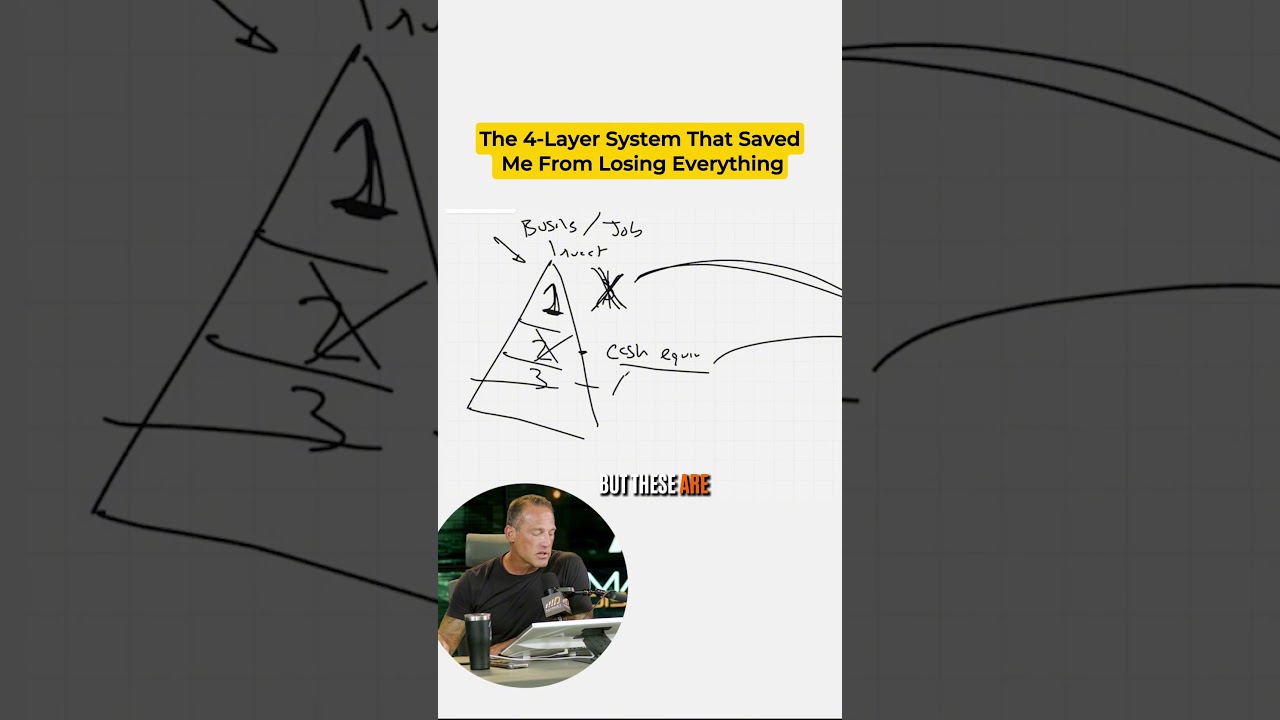
In this monologue, Mark Moss outlines a four‑layer liquidity protection framework designed to prevent a forced liquidation of assets during severe financial stress. He begins by emphasizing the need for sufficient free cash flow from a business, job, or investments to meet payment obligations. If cash flow dries up, the second layer consists of cash‑equivalent investments—low‑volatility, yield‑generating assets such as Treasury bills or high‑cash‑flow stocks. Should those be exhausted, the third layer taps into assets that can be used as collateral to obtain liquidity, allowing borrowing without having to sell at depressed prices. The final, fourth layer comprises non‑collateral assets that can be sold as a last resort, acknowledging that this may involve selling at the worst market timing. Throughout, Moss stresses that volatility itself is less problematic than being forced to sell under duress, and he references past crises (2008, 2020) to illustrate the severity of scenarios where each successive layer might be needed.
Chapters
So if I have investments, if I have money that's being owed for these investments, I want to make sure, number one, do I have enough free cash flow to make those payments? In my case, I didn't. Why? Because I had sold my businesses and I had sold my cash flow income. So I didn't have that. So number one, I want to make sure, do I have enough money coming in to cover those payments? Now, where does the money come in from? Well, it can come in from your business, right? It come in from your job. It can come in from investments, wherever that money comes in from. But I want to make sure I have enough free cash flow to cover that. Then number 2, let's say that I run out of this money. Let's say that, uh, I, I don't have enough to cover that. I didn't cover it for as long as I thought I needed to cover it for, or my business or my job takes a hit and I don't have that. Well, then I fall back to layer number 2. Liquidity number 2 is what I call cash equivalents. Okay? So those are cash-like equivalents, meaning that they're not volatile. They're not going up and down. They're earning me yield. They're investments that earn me yield, but they're not subject to volatility in the market. That could be treasury bills. It could be certain stocks that I use that have high cash flow, things like that. And so I'm earning money here. It's not cash. I'm earning yield. It's an investment, but it's cash equivalent. So if I run out here, then I need to make sure this layer is enough to cover all of this. Well, let's say that, man, this is worse than 2008. This is even deeper. Not only did I lose my job, lose my income, run out of number 1, now I burned all the way through layer number 2 as well. Shoot. Okay, well then I have layer number 3. What's layer number 3? Well, these are my assets, but these are assets that are collateral assets, meaning that I can get liquidity against these assets if I need to. Remember, volatility is not the problem. It's being a forced seller at the worst time. So my goal is just to get myself back up to the top. So I've gone through 1, I've gone through number 2. Now number 3, I tap into my assets that are used as collateral. And let's just say that, man, this is worse than 2008, worse than 2020. It's the worst we've ever seen. And now I've burned through layer 3. Well, now I have layer number 4. And these are just my assets, not collateral assets. These are other types of assets. And maybe I have to— unfortunately, I have to sell some of them in order to cover that. But I have 4 layers that protect me until I implode, until I'm forced to liquidate everything at the worst possible time.