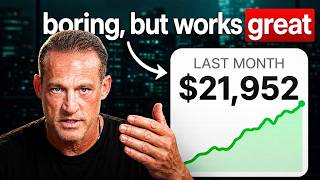
Mark Moss shows how to turn $250,000 into $7,000 monthly tax-free income in 15 years. He assumes a 20% blended annual return, which grows the pool to $1.5 million, then withdraws 10-15% yearly. The mix: 10% real estate, 14% stocks, and 30% Bitcoin with leverage.
Chapters
So I'm planning to use $250,000 for 3 jobs to get me to my goal in 15 years. Is the $250,000 the correct amount to enter for the engineer base amount, or am I only using the amount needed for the primary job? Okay. So I'll, uh, if you're here, you can kind of comment on that, but yeah, here, here's kind of, here's kind of what I'm, I'm, I'm reading between the lines here. So if I'm planning to use the $250,000 to do 3 jobs and get to the goal in 15 years, right, is that the right number to enter is what I'm hearing.
Okay.
So the question is really a question about how the WealthOS thinks about engineering the capital, right? So the whole point of that module, module 3, is that you're not modeling 3 separate piles of money. You're modeling one, one base amount, your entire pool. And how I can utilize that or engineer that to get to my goal. Now maybe it needs to do 1 job, 2 jobs, 5, or maybe just do 37 jobs. I don't really know, uh, but, but that's sort of where we're trying to get to.
Yeah, yeah, answer the question. Yep. So I basically, I was using the $250,000, which is the pool, the base, the base pool amount that I'm using to get me to my 15-year goal. Um, I just wasn't sure. I mean, the numbers came out, came out the way I thought it should. But I just wasn't sure if I was specifically— like, I kind of started backtracking, maybe overthinking. Well, maybe I should have just used the amount I'm using just to get to my first job to see what that looks like, because it was the primary. But if it's the pool that I, that I chose that I think will work to be able to get me to my overall goal, ultimately using the 3 jobs, then yeah, you answered the question, so.
Yeah, I mean, the way that you're repeating it back to me gets me confused.
Okay.
So it's like, I need to get to this location, right, on the GPS, I need to get to this location. And then where am I at? Well, I'm at this location. So now I know the 2 areas. Then it can say, you know, can you walk? Can I ride a bike? Can I take a train? Can I drive a car? Um, or try to complain, right? Ride a ferry, subway, whatever. Right. So it gives me all my available options and then knowing where I need to go and where I'm at, I can take all my available options to engineer a way to get me there on time. So what I'm saying is when you decide, I need, I need $7,000 a month of income to support the lifestyle in 15 years from now. That's my goal. In 15 years, I want $7,000 of tax-free income coming in. Great. Where am I at now? I have all the assets I own, everything I have, the pool I think you're calling it, is $250,000. Cool. All right. So that's where I have. What do I need to do now to get to that goal? And you, you're throwing out like, count the number of jobs, 3 jobs, 3 jobs to get to my goal. I don't know. Like we need to kind of think through like how many jobs and what return level do I need? So you have 15 years. So if you can get a 20% return, your wealth will compound every 3.5 years. So that's 5 times over the 15 years you've allotted. So now you have the $250,000. If you engineer a 20% return would be, what is that? $1.5 million, not assuming. Uh, so about $1.5 million, right? Correct my math if I'm wrong on that. Right. So Uh, that'd be 5 doubles at 20%. So if I engineer a 20% return at 5 doubles, that $250,000 becomes $1.5 million. Now, depending on where those assets are at $1.5 million, I could pull, let's say, 10 to 15% against that in perpetuity. So now at $1.5 million, I could pull $150,000 to $200,000 for the rest of my life.
Yeah.
Yes. Okay. Then what I need is I need to engineer a 20% return. How do I do that? Well, I think that real estate will do a 10% return, but I could use the tax leverage to get more income in. And then if I borrow against that and I buy the S&P or I buy NASDAQ at a 14% return, and now I layer that, okay, now I've blended a 20% return. Or maybe I'll put it into Bitcoin. I think Bitcoin's going to do at least a 30% return over that same 15-year timeframe., but I'm not 100% sure. So I'll also leverage that and I'll put that into some, in the NASDAQ. So how do we engineer the 20, right? Because the 3 levers we have is time, the return, and the capital I have. How much capital do I have? How long can I wait? And what's the return I need?
That's the 3 variables. So, so yeah, that's, that's what I did. Um, I, I just overthought that last piece as far as if I was I actually following the correct train of thought as far as using all of the pool of capital? It wasn't going to be just for one job, it's going to be essentially for 3 jobs. And using those 3 jobs with that pool of money essentially gets me to where I'm looking to go in 15 years. So sounds like I was following the right train of thought. So yeah, thanks, Mark Moss.
Yeah, sounds like it.
Sounds like it.
Yep. This may open up a ton of other questions. Anybody else have any questions about that as they've been thinking through a very similar thing?