If You Have $3M in a House, Rentals, Bitcoin and Cash… Watch This
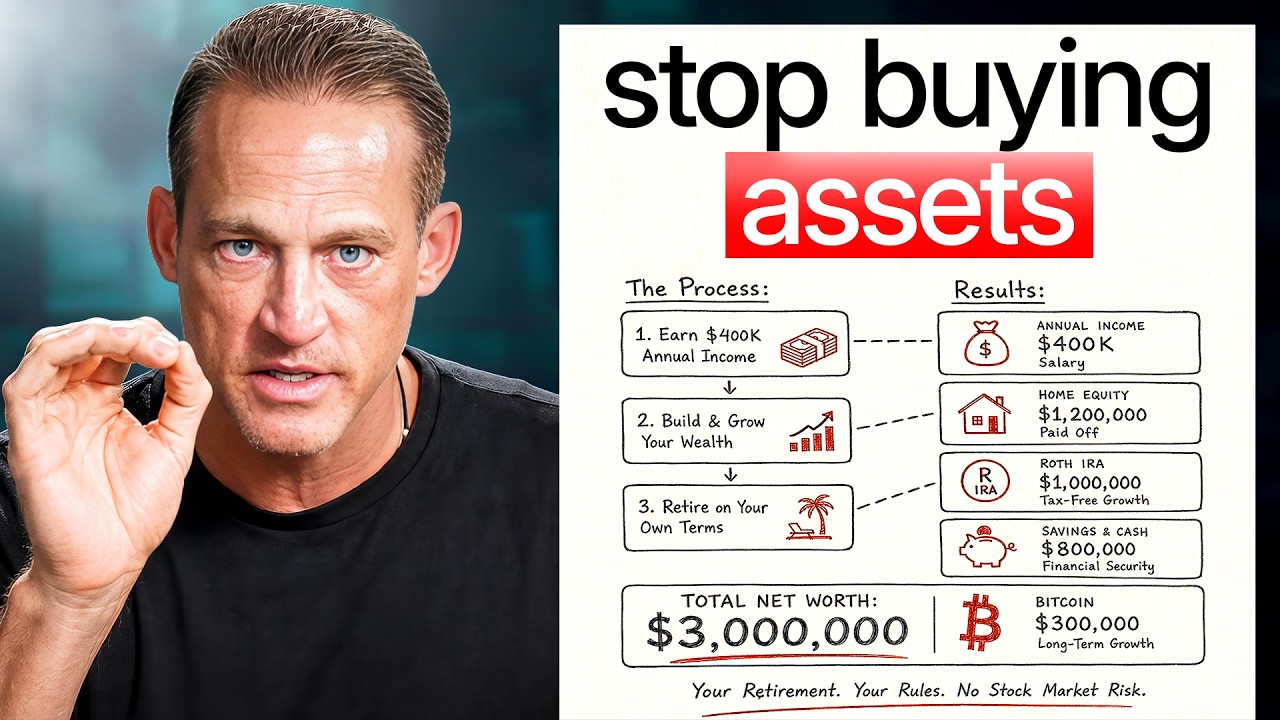
Mark Moss restructures finances for a $400k earner with $3M in assets who feels cash-strapped. By moving idle cash to Treasuries, refinancing 14% debt to 6.5%, and using real-estate depreciation, he frees $37,000 in annual cash flow without buying anything new.
Chapters
He made $400,000 last year, but he still felt broke every month. And it wasn't because he was bad with his money. In fact, he was good with his money. His balance sheet looked great. It was getting bigger and bigger and bigger— home equity and IRAs and rental Bitcoin, even cash in the bank. But the problem was how it was all structured. So we ran one exercise on his finances, and we found over $37,000 that he didn't even know that he had. I want to show you exactly where it was hiding in his balance sheet so you can find yours. You ready? Let's go. All right, let's jump in. So does that sound familiar, first of all? Like, you make some good money, good revenue, but you still feel broke every month? Like, on paper, you see a lot of money. I know there's a lot of people that are nearing retirement age that maybe have a lot of money in their house, for example, but they're broke. Like, I don't want to sell my house, I have nowhere to live, but like, I'm rich on paper, but I'm broke on income. Well, on this, on this particular person, they were making good money, making about $400K a year, and they were doing the prudent thing. Of course, uh, they were having this huge Huge tax hit right here, taking a big chunk of their money out. But then they were putting the money into their house, into their rental properties. They had an IRA. They were buying a little bit of Bitcoin, not enough. And of course, they were holding cash. And so on paper, every month their balance sheet looks solid. As a matter of fact, every month their balance sheet was going up and up and up and up as it's supposed to. But the problem is, after the tax hit, after the lifestyles, after investing, they just felt tight every month. And it's frustrating, right? It's like, man, I see that balance, but Like, what good does it do me? So let me show you a way that we were able to free up over $37,000 of cash flow. Okay. So the first thing we did is we asked a couple of questions. If you've been watching my videos for a while, you know, we need to go through what we call a balance sheet X-ray. Assets are like tools in a toolbox. Every asset is supposed to do a very specific job. They're not all the same. So we asked a couple of different questions about the assets. So number one, is this dollar sending income back to me? Now, my mentor, Robert Kiyosaki, would say that an asset puts money into your pocket every month, and a liability takes money out of your pocket. So for most people, they think their home is an asset for them. And Robert Kiyosaki would say no, because your home costs you money every single month. And so even if you see that home and it's $500,000, $1 million, $2 million on your balance sheet, it's still costing you money every month. So the question is, is this dollar sending income back to me? Is it an asset? And so yes, it pays me money every month. So maybe that comes from a rental property. Maybe it's dividend-paying stock, maybe it's something like credit fund that I'm in, treasuries, whatever. Okay, so good. So I have assets that are paying me, I can leave those alone. But then we have assets that don't pay us anything. And so like Warren Buffett, for example, would not buy gold because gold doesn't do anything. Warren Buffett only would buy a productive business, a capital-efficient business, as he would call them, because he wanted things that produce something. Gold would not do that. My retirement strategy, my wealth strategy is a little bit differently. I don't typically like to invest for cash flow or productive assets because the return profile on those are too low. I like to go for assets that have high return profiles and I access liquidity against those assets instead of making them pay me through some sort of a dividend or a cash flow play. So then the question that I would ask is, could my asset do it? Not does it currently, but could it? How could it? Well, if the asset could be used as collateral, like a central bank takes assets in, they issue credits against the assets. So could the asset You'd be used as collateral. Is it borrowable? Could I issue credit against it? Would a bank give me more liquidity using that as collateral? That could be unused home equity. It could be Bitcoin. It could be business credit lines. It could be all types of things. And if so, then we could turn that on. We could start using that to produce income, putting income in our pocket. And then maybe no. So for example, you have a large amount of money sitting in a checking account or something like that in your business accounts. A lot of people are holding a lot of cash right now. They're still waiting for this 2008 financial crash that's going to come that I don't think it is. And it continues to buy less and less work. And so So with that, we would want to put it to work. All right. So let me give you an example of what we did with some actual numbers and how we got this to move. Okay. So for example, here's what we found. Here's what was sitting there. He had about over $150,000 sitting in checking account. Now, cash makes me sleep good at night. Not everything has to be for the highest, highest return that we can get. We buy, we invest in things, we do things that just make us feel good. So he had $150,000 in checking. That made him feel good. His operating expenses were high, but we could Move some of that. He didn't want to lose the money. This was as risk mitigation for him. This was limiting the downside. He thought that there'd be a market crash coming. He'd have a chance to buy back in lower. We wanted to hold this cash position. But with those, we can move that into something that's cash-like, a cash-like equivalent that could earn a yield. So for that, we moved them into treasuries paying about 4.8%, which brought him almost $7,500 a month. All right, then we looked across his assets. We found assets that could be used as collateral, things that could have credit lines against them. So we had over $300,000 of liquidity sitting there. that wasn't currently being used. Now we were able to tap into that liquidity for anywhere from 5% up to 6-7%. Let's call it a blended rate of 6.5%. And we bought rental-paying property paying 11%, which means that he has a 4.5% spread, or we call that arbitrage. Okay, that now brings in another $13,000 per year. Then there was a lot of debt. Now, I'm a fan of debt, but I'm not a fan of expensive debt. And this debt was about 14%. That's too high. I only want to keep the debt if it's less than what I'm earning in the market. And so we were able to move some of that debt onto his other liquidity lines down to about a 6.5% line, which saves us 7.5% or brings in another $13,000 per year. And then finally, the new rental building. With the new rental building, we already talked about the dividend, the money we're making from that. But what we also get from real estate is something called depreciation. The depreciation means that I don't have to give all the money to the IRS that I was gonna have to give them before. I get to keep More of my hard-earned income. So we keep it off of the tax bill. That was about another $3,400. So when you add all that up, it was about $37,000 a year back in his pocket, money that they could spend. $37,000 a year. It's considerable. It's almost 10% of his total gross income that could be used for a new business or new investments or family vacations, or just not feeling so tight every single month. What he's doing is currently working. The assets are growing. And so maybe you just want a little bit more breathing room in your life, whatever that may be for you. But this was $37,842 that was found from his existing assets without having to buy anything else, but just by changing the structure. All right, now real quick, uh, there's a link down in the description down below. I'll put a QR code on the screen right here. Hopefully you can see that. And if you want to see how these types of strategies apply to your own specific situation, if you'd like my team to like walk through your numbers like I just showed here and help you build a personalized wealth operating system, just go ahead and scan that QR code on the screen right here or the link in the description, put it in your application, then come right back because I've still got more important parts of this video to get through. Okay, now while that probably sounds pretty Cool. Like, hopefully that's amazing. Like, wow, I'd love to get 10% of my gross income back. That'd be amazing if I could do that. We're barely even getting started because what we want to do is build a system that turns this into a flywheel. And a flywheel is something that gets faster and faster and faster, gets bigger and bigger and bigger with every single turn. And so now we want this to flow into a loop like this that keeps going and going and going, feeds on itself. So we take our income and we feed the income into the right layers, right? So we want to build up our liquidity layers. That's our protection. That protection allows us to grow, push even harder. We of course want to do that tax advantage. So I'm going to put a cross through that. So I want to keep as much of my income as I can, so I can invest almost my full income into the right layers. Then once I have that, I want to get the assets that pay. But again, pay isn't just assets that will pay a dividend or some sort of return, doesn't have to be rental income. I like to buy assets that have high appreciation. And then I can harvest a little bit of that appreciation from that by issuing credit against it. But I want assets that pay. We walked you through that. And then I get the cash flow out, which pays for my living expenses, my lifestyle, and it goes back into buying more assets. So now my income buys assets, my assets are collateral, the collateral creates liquidity, which is then income. So a little bit goes out to my life, and the rest goes back into more assets. And every time this loops, my asset base gets bigger and bigger And bigger. I can pull more and more out for my life, gets bigger and bigger and bigger. And this gets bigger every single turn and goes faster. All right. Now, you may be watching this and go, great, this sounds amazing. Like, I'd love to build this out. Like, what do we do? Okay, well, let's walk through what you could do. All right. So, this is not how to make money. It's how do I grow my money even faster? So, let's say that I'm making, you know, probably a minimum of, say, $150,000 a year up. Maybe I'm making $10 million a year. The first thing I'd want to do, realizing that, shoot, I did $150,000, At $400,000, whatever, I might be like the person who just explained that I'm pretty tight. The first thing I'd want to do is figure out how much are you leaking to taxes every year? What is your tax bill? Just look at it. How much did you send to the government last year? That is the first place I would start attacking. Now, what I'd want to do is I want money back into my pocket. The IRS will allow me to invest money into assets that will allow me to keep more of my tax money back. But again, I don't want to spend the money to save the money. That's, uh, my wife would call that girl math. What I want to do is I want to issue credit. So even at $150K, definitely at $400K, I have access to credit. I can go get a bank credit line, a business credit line, I can get credit cards, 0% credit cards. And I would use the credit to buy assets that give me tax depreciation. All right. Now these assets give me tax depreciation, which means I get to take some of my tax money, and I invest it into more assets. Plus, I have these assets that continue to compound. So I would start there. How much am I paying to taxes? How do I get the tax depreciated assets to keep more of my income so I can invest that into assets? You do that for a couple of years. Now your collateral base has grown to where you can really get your flywheel going. All right. Now, what I just showed you, it's a framework, right? It's not, it's not exactly what to do. It's the framework of what to do. But of course, knowing the parts, it's not the same thing as having the entire system and the system installed for you with help. Now, in the next video, I want to show you the entire wealth operating system and how it all fits together across Your cash, your assets, your debt, your taxes, and your cash flow. And every single dollar has a job and a decision, always follows a rule. So if you want to see all that, click on the video on the screen right here and I'll walk you through the entire full system step by step. And I'll see you over there.










