The Money Principle That Saved My Business
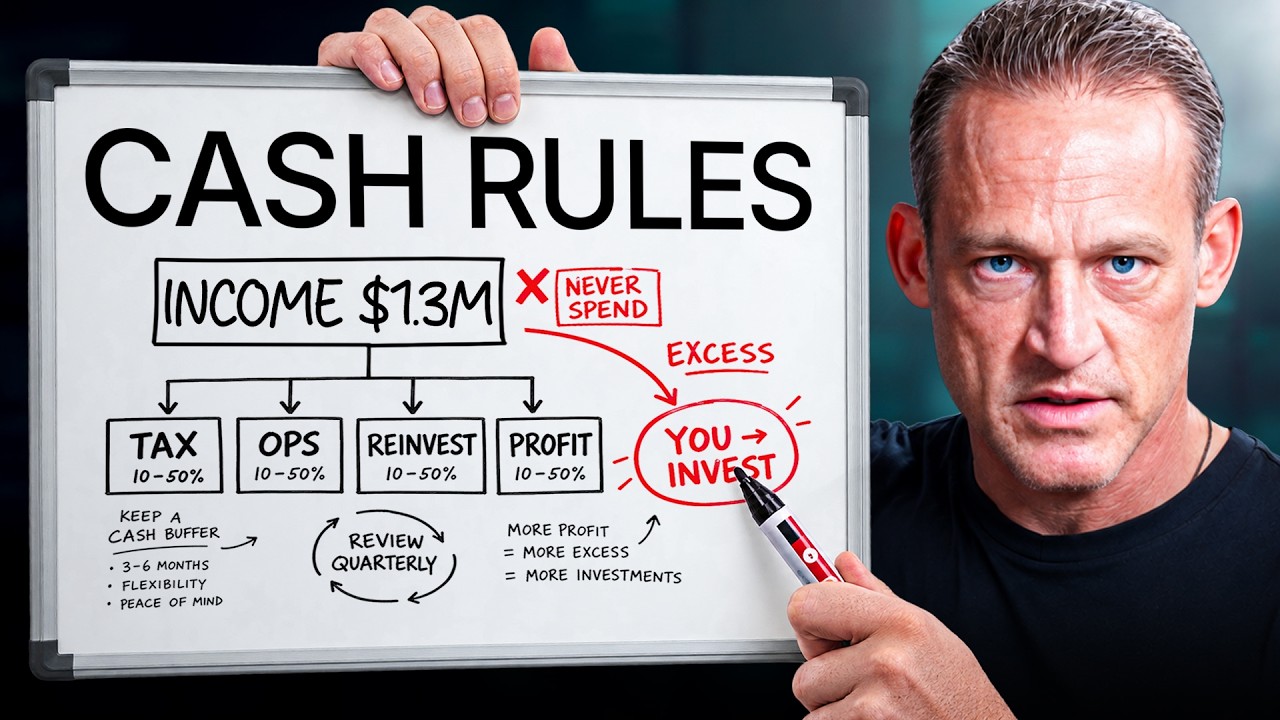
Mark Moss explains why entrepreneurs drain their business accounts and how to fix it: set up separate bank buckets for taxes, operating costs, reinvestment, and profit, then automatically split incoming revenue by percentage. He uses a 13-week cash forecast to determine how much each bucket needs, and parks excess cash in Treasury bills or money-market accounts earning 3-13 percent.
Chapters
Imagine your company has $1.3 million sitting in the bank, and that sounds like a lot of cash. So, I don't know, you take $500,000 out and you decide to invest that personally. But then payroll hits, and then taxes are due, and then a major customer pays late, and the equipment upgrade that you already committed to still has to be funded. So suddenly, the company that looked cash-rich is borrowing money just to operate. Now, the mistake wasn't taking the profit. The mistake was never calculating which dollars were actually profit in in the first place. So today I want to show you the cash flow I protect inside a business before I move a single dollar onto my personal balance sheet. So let's go. All right. So if you own a business, then you know exactly what we're talking about here. So many times have I been guilty, and of the people that I've coached through this, I find them guilty as well, of treating your business sort of like a personal piggy bank where it's like, oh, there's money in the bank. Let's go ahead and just transfer some of that out and spend it. And then you get yourself into trouble. And so we have to think about how much should we keep in the business? Why should we keep it in the business and when should we think about taking some of it out or leaving it there? Now, I do want to say, obviously this is not a one-size-fits-all. So I want to give you the thinking model through it so you can figure it out for yourself. And the reason why this really matters to me specifically is one, I don't want to get my business into a situation where it gets in trouble, where we owe vendors or we owe taxes. We don't have the money, number one. But number two, it's a mental model for me, right? Maybe you've been here before. Where I've put money, taken money out of the business, and then all of a sudden the business doesn't have the money. And so maybe an opportunity comes up. Maybe I could launch this new business line, do this new marketing promo. Maybe I could acquire a business, but I don't— the business doesn't have the money to do that. And so now I have to think about, do I want to take money out of my personal investments and put it back into my business? And for me, that's proven to be very difficult. There's like this mental block for me where once the money comes out of my business, I don't want to put it back in. And so first of all, it kind of really starts with like, what are you doing with your business? If it's like a personal business, like maybe a lifestyle business, maybe you're like a service-based business, then maybe it's just a high cash flow business where the goal is to make as much cash as I can, take it out and go build assets outside of that business that can start paying for my life. And I can get off of the work required to work hamster wheel, if you will. But maybe I'm really trying to grow a business that may be really capital intensive. So maybe I'm building out IP, I'm building factories, I'm building out moulds, things like that, or maybe I have a plan to acquire other businesses, things like that, well then I'm definitely gonna wanna keep more cash flow in. So number one, it's like understanding what am I even trying to do with the business? Where are we even going? What are the long-term goals? And so if it's a long-term goal where I'm really trying to scale the business and I'm thinking about potentially getting a big equity valuation and selling the business at the end, then I'm just gonna probably pay myself a small salary, whatever salary I need, and keep almost all the rest of the money in the business so I can show good EBITDA, I can build that business up. Again, if it's a lifestyle business, service-based business, I might pull more of that cash out. Okay, so that's number one, understanding what type of business I'm in and what is my ultimate goal. But now let's get back to this question. So the first thing, hopefully you're doing this, is a business should always be forward-looking, like what is coming up. And typically we want to think about 13 weeks forward-looking cash flow statements. So we want to try to understand what is the amount of money that we're going to need forward-looking for about the next 13 weeks. And so this is like a projection of my Income that I will— I expect to have coming in and the expenses that I expect to have coming out. So I always want to be looking at that. Now, in order to understand that, I have to understand like, what does my lead flow look like? What is my time from lead to customer? What is the time from sell to acquire the cash? And you have to understand that I can't get into all that with you right now. I will say cheat code here, I have started using what I call an AI second brain. And the second brain has all of my business information coming into it in one place. So All of our social media, all of our lead flow, all of our CRM analytics, all of our accounting and all of that. And once you have that brain going, it starts helping you figure out this, this really easy because it sees all that marketing, all that lead flow. Anyway, that's a whole nother topic. But once I understand what are my demands for both my spending, my expenses, and my income over the next 13 weeks, I can start to think about this. I don't want to leave more than I need to in there. And so I need to understand this first. Now I also want to prepare for these expenses that I'm going to have to pay, but I don't to pay right now. So I want to leave that in there. But if you watch my videos, you understand that my thesis is that there's more money printing coming in the future, which means more monetary debasement, which means money becomes worth less and less, which means I don't really want to sit on a bunch of cash because it is worth less, but I'm stuck because I am going to have to pay my taxes. I am going to have to keep operating cash on hand. And so I want to think about it like this. So here's how we do it. When money comes in, I want to automatically distribute it into the buckets that it's going to need to be spent from. So we have one account where all the income comes into, but that account is never spent from. That account receives the money and then distributes the money to the appropriate accounts. So for example, I have one account for taxes. Now, whatever your tax rate is or your expected tax rate is, you can calculate, well, based off of income, 10%, 20%, 50% of that income should start going into the tax account. Now what I'd say is that for most people, you think about your taxes as something that happened in the past. Your CPA is like a historian. So at the end of the year you sort of bring all your books to your CPA and he looks through it and then he helps you figure out the tax that you're going to owe. But hopefully what you're doing is you're working with a tax strategist and you're actually thinking about your taxes a year or 2 in advance. And so you're doing things in advance to bring this number down. So instead of paying 50% tax, maybe it's only 10% tax, but whatever your number is, you should be putting about that percentage into this tax account. The same thing is every month I want to make sure I'm putting money into my op account, my working capital account. And then if I want to, if I need to be reinvesting in my business. So for example, the life cycle of this equipment that I've purchased is 3 years or 5 years or this vehicles. And so I might want to amortize those and put something into a reinvestment account. But the thing is, is that now I have all of this cash sitting in here, $900,000, and what are we doing with that? Because again, that money is losing value and I don't like losing value. I want all my money working harder than I am. So now that I have these individual accounts, I don't want to spend it. I don't want to put it in something like Bitcoin that's highly volatile because as much as I love Bitcoin, if I need to spend the money and Bitcoin happens to be down, that could be detrimental. So what I want to do is I want to put all of this money into something that I would call A cash equivalent. So this might be anything from treasury bills that might be paying anywhere from 3 to 5%. It could be like money market accounts all the way up to maybe something a little bit more exotic that I like to use, like a stretch or like a SADA that could be paying 12 or 13%. Now the purpose of those are to stay like cash. There's no capital appreciation. They don't go up, they don't go down. Maybe they go down a little bit. That's a whole nother video. But now these buckets of cash are making money for me while they're waiting. So we've established that. Now that I understand what my cash floor is, we want to think about what do we do with the potential excess that we have over here? Okay, so now we've established that we need to keep this $990,000 in those buckets. And again, I keep them in the buckets, I want to make my tax account separate from my operating account. So I see them differently. But again, all of these could be earning anywhere from 5% to 13% on them, but they're staying cash-like. Okay, which means I can get the cash, I can get the liquidity instantly, you know, within 24 hours, and I'm not having to worry about volatile prices. Okay, but then it leaves me this potential excess right here. So what are we doing with that? I might want to leave a buffer. So typically, I like to think about a conservative buffer. When I used to build houses, we'd have a contingency, like a 10% contingency. So you probably want to leave a little bit of a contingency right here. And then I have this transferable wealth right here. And this is what can come out of the business for my own investments right here. The key piece that we're trying to get through here is that I want to think through what I'm going to be doing with my income, with my profits in advance. You see, humans are very emotional and we want to remove emotions out of how we manage our money. It's sort of like, you ever been to the grocery store when you're starving and everything in the grocery store looks really good for you? And so what you want to do is you want to have a shopping list or go to the grocery store after you've had a big meal, but you want to have a shopping list so you just buy the things that you need. And so it's sort of the same way. We need to predetermine what we're going to do with our money in order to achieve the end result that we're looking for in 5, 10, 20 years from now and make sure that we're putting this into advance to get us that goal. And we would have rules on these. And then of course, these rules can be revisited and changed. They're not like locked into stone for all of eternity, but maybe quarterly you're looking at this and then rebalancing it. Now, this is where most entrepreneurs realize that they don't actually have a rule for moving money between the company and their personal balance sheet. And so they wait until their bank balance feels high and then they make a decision based on that emotion. Like I said, it's a terrible thing to do. Now there's a QR code on the screen right now that you can scan, and then my team can help you map out what your business needs to protect, what's genuinely excess, and how that money should enter the rest of your wealth operating system. So scan that code right here because now we need to decide what happens after the cash floor is fully funded. Another question we need to dig in though is like this money that's transferable out for me for my personal investments, when do I get that? Do I get it daily, monthly, yearly? How do we think about that? So As you notice, we have all these different buckets, but the way that I want to do this is I want these buckets again to go on autopilot. Everything in my life is thought through intentionally. I build a system for it and I try to let them run on autopilot. So what I like to do is I like to think in terms of percentages of buckets. So remember, all the money comes into one single account right here at the top, and then that money gets distributed into these buckets here Based off of percentage rules. So for example, the tax bucket, as I said, could be anywhere from say 10 to 50%. Hopefully you're not that high. And that money, every time money comes in, I'm going to peel off whatever I think is going to be due in taxes, 10 to 50%, and it's going to come in here and that money is going to sit here. I should understand that my operating expenses should stay a percentage of my revenue. And so whatever that percentage is in comes here. Now, your operating expenses, you probably have fixed expenses. So like Fixed payroll, and there's variable expenses or cost of goods sold. And so you could also say for the fixed expense, maybe it's not a percentage, maybe it's a fixed expense where, you know, until we get X amount, until I get $100K in this account, then it goes to percentage. So you can set a rule like that. Now, real quickly, I have no affiliation with this at all, but there's an app I use, it's called GetSequence. I should have an affiliation with them. GetSequence, and you can map all this out and set all these rules automatically. Or you can just do the math yourself. Okay. And then I have over here is this profit account. So this is the amount of money that I'm going to be able to pull out for myself. And so I have a profit account filling up. This is based off of the book Profit First, which is I want to make sure that I'm paying myself first, just like the government gets paid first. I want to get paid first. And so I'm also putting aside this profit account here, and this could be whatever you think you can pull 10 to 50% of profit out of your business. And that money starts collecting here. The way that I do this is I have myself my payroll. You need to have payroll of your own business. of course, for tax reasons. And then I have profit that comes out, that's distribution. And the reason why we do that is because what I pay myself gets taxed at a different rate than what my distributions are. And typically for me, I allow this to build up and I pull this out quarterly. So about once a quarter, every 3 months, this money is then coming out to my investments over here. And why every 3 months? Well, because I don't know exactly what's going to happen during that time. You know, obviously business goes up and down, especially my business. This profit bucket, might vary throughout those 3 months. So I kind of wait about every 3 months and then I'll pull out what I need. The point that we're making here is that all of this comes down to having rules because my life and my kids' life and my wife and my legacy is way too important to leave up to chance. So everything starts with the end in mind. Where am I starting at and what is the plan that's going to require me to go from here to there. And I set those rules in advance. And then this just plays out on autopilot. If you care about the future of your life, then you should also set rules. That's how important this is. Now knowing how much money you can safely leave in your business is of course just one part of building a personal wealth operating system because you still need a system that tells the capital where to go, how to remain liquid, how every asset should be working together. Now in the next video, I want to show you why having more assets is not necessarily making you more wealthy. I want to break down the 3 engines behind the wealth operating system, and the video is on the screen right here, right now, and I'll see you over there.










