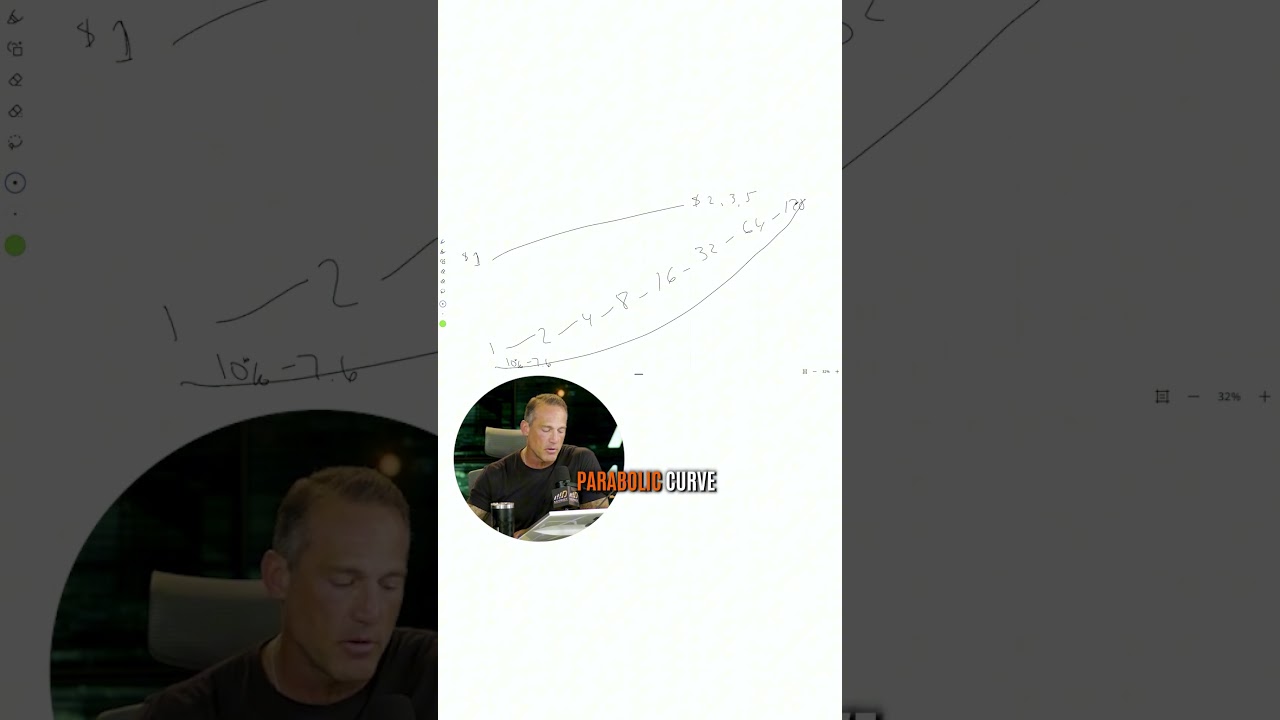
Mark Moss explains why wealthy people hold assets long-term instead of selling. Compound interest doubles money every 7 to 7.5 years at 10% returns, or every 3.5 years at 20%. Selling interrupts that exponential growth.
Chapters
Most people don't understand this piece. So let me draw it out for you so you can understand this. Most people think that if I buy an asset for $1, eventually it grows to $2, $3, $5, something like that. But that's not how this works. What happens is that money compounds if I leave it in place. And so that means I get growth on top of growth on top of growth. So what really happens is I have $1 and if I have, let's say, a 10% return on my money, It takes 7 years, about 7.5 years for it to become 2, and then it becomes 4, and then it becomes 8, and then it becomes 16, and then it becomes 32, and then it becomes 64, and then it becomes 128. And so what we really have is this parabolic curve. Now, the interesting thing about this is the time it takes to go from 1 to 2, 7 years, is the same time it takes to go from 64 to 128, meaning I'm making $64 million. In only 7 years. Now, if I double this to say 20%, now I cut this in half and now it's about 3.5 years, 3.5 years to make $64 million, right? Or $64, depends on how much money you start with, but you understand the point. And so what happens is when you buy low and you sell high, you break this piece.