A conversational video between Martin Varsavsky and Fabrice Grinda about global entrepreneurship. Varsavsky outlines how global GDP and entrepreneurial activity cluster in a few time-zone regions (East Asia cluster, Europe, United States) while noting surprising startup successes emerging from unexpected places (e.g., Buenos Aires’ Mercado Libre, Alibaba from China, Israel/Tel Aviv, Stockholm, Helsinki). Grinda emphasizes the democratization of startup creation—much lower costs and widespread seed investing—while arguing that ecosystems still matter because access to later-stage capital (Series A/B/C and growth funding) remains concentrated in major hubs like Silicon Valley, New York, London, Berlin, Beijing.
Tell us a little bit about the world. Tell us about New York as an entrepreneurial hub, but tell us about what you see globally.
No, I. Well, thank you for all the kind words and the introductions and thank you, all of you for being here and I hope we can make it productive for you and that you leave this meeting feeling more excited about whatever project you're working on. Now, in terms of the world, it's interesting. The first generalization I could make is that the world has 24 time zones, but there's basically three that have over 80% of the GDP and activity of the world. It will be the time zone of Korea, Japan, and when I say time zone, it may be one, two or three time zones, but it's a cluster of time zones. So Japan, Korea, China, the east of China, Hong Kong, Taiwan, Singapore, that area, that part of the world. Then there's kind of like a dead zone with some activity beginning to happen, but with billions of people who are doing things, but certainly not at the level of East Asia. Then you have the European time zone where you have a GDP that is actually larger than that of the United States, slightly larger, but larger than the United States. And then you have the United States and these are the centers of the world's gdp, let's say. But when you look at entrepreneurial activity, entrepreneurial activity is becoming quite random. And that is something that I am fascinated by because when I started it was Silicon Valley. Silicon Valley. Silicon Valley. And now there is more and more these random places where, I mean, we were talking about Buenos Aires with a five billion dollar company, Mercado Libre, that you would say, why? Why come out of there? Why should it come out of Buenos Aires? You're talking about Helsinki, where people are building companies. Also in the billion. Stockholm for sure. While you're talking about Alibaba, that came out of nowhere, nowhere. And Jack Ma has rocketed into the top position. People didn't expect it. Of course, some people expected it. Jerry Young, Masayoshi's son, who had invested with him, but the general public was not aware of this coming. I think China will come up with more and more of these surprises for all of us. We already heard that China is the country where they have all these cities that are much bigger than Paris that you never heard of and they have many of those. I think the shift of reputation and activity will come a lot from there. Then there is a lot of extremely unusual, like Israel countries, tiny country with almost no people, who seems to be in perennial conflict and yet incredible in innovation. And startups and activity. And you're like, why Israel? I mean, hard to understand, but there is an incredible center of activity in Tel Aviv. So I think the world of GDP and the world of startups is diverging and that there's an incredible opportunity to almost do your business wherever you are in the world, provided that you have link to the financial clusters which are Silicon Valley, London and New York mostly.
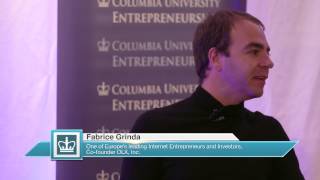
Actually, I think I have a slightly different perspective. I mean, there's clearly been an extraordinary democratization of the ability to create startups and the creation of startups. I mean, when Martina and I built our first startups, we needed Oracle databases. You need to build your own servers and have your own data centers. And so the cost of building startups was in the millions. And today, for basically no money, you can build anything. You can even build it on top of other people's software. If you're building an E commerce company, you can use Magento. And so we're seeing that the cost of building a startup has gone down lower than it's frankly ever been in the history of the Internet. But at the same time, so you're seeing startups pop up everywhere and you're seeing more and more angel investors investing everywhere. So seed capital is available globally, intrapreneur is available globally. But I still think that ecosystems matter. And it used to be only one ecosystem, which was Silicon Valley, and now you're seeing a few other ecosystems. I mean, New York, for instance, has become a very robust ecosystem in the sense that you have a lot of startups that are being built around the strength of the city. So a lot of the fashion companies are here, a lot of the advertising companies are here, a lot of 3D printing and maker movement type companies like Etsy or Kickstarter are here, and a lot of fintech companies are here. But what I'm seeing is you need access to capital and access to capital is not available to. It's not all things being equal, right? It's not seres paribus. So you get seed money and intravenous everywhere. And if your company reaches 100 million in value or 100 million in revenues or more, you get late stage capital that comes to you. So the tiger globals of the world will come and find you and then you can go public and can exit. But if you're in that middle zone where you've already had your seed money and you're not yet worth 100 million, or you're not doing 100 million revenues, if you're not in Silicon Valley or Berlin or Beijing or New York, it's a heck of a lot harder to get. Capital Series A, Capital Series B, Capital Series C. Capital has not yet been democratized for a whole bunch of reasons that we can reach. And so for the most part, I still think it makes a lot of sense to be in one of the main clusters and ecosystems.
Let's make some actionable sort of suggestions for folks. So you're in New York. That's the good news. Congratulations. You probably are reminded of how good that news is every day of your life. It's a wonderful place to be, and it's a great place for building startups. Clearly.