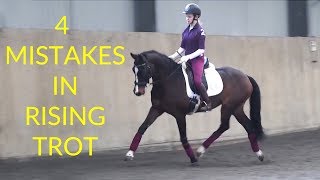
Mary Wanless breaks down four common rising trot mistakes: pushing heels down swings your lower leg forward; keeping your leg too far ahead leaves you behind the motion; changing stirrup pressure creates a bouncy pelvis instead of forward movement; and weak muscles pitch you forward or leave you behind when the horse speeds up.
Let's talk about some of the biggest mistakes that people make in rising trot. The first mistake is, I think, a mistake that a lot of people make, which is heels down and the focus on heels down and the focus of pushing the heel into the stirrup. The problem of doing heels down too much or pushing too much into the stirrup and rising trot is, is it will start making the leg do this and swing forwards and leave you behind the movement. The other mistake is having the leg too far forwards. If your lower leg is too far forwards, you'll always be somewhat behind the movement in rising trot, and you'll find it very difficult to lever yourself up out of the saddle, effectively being too upright in the sit phase of the rising trot. And I see this quite a lot. A lot of people really trying to be upright all the time. And as they come back down in rising trot, they end up landing quite heavily, being quite behind the movement. You know, good rising trot has you upright at the top of the rise and then a slight incline forward at the bottom so that, you know, you don't end up just sort of falling backwards and landing in a heap. Another mistake that people make in rising trot is they end up pushing down into their stirrups to be able to go up. So in other words, the pressure in the. The stirrup changes from when they go up to when they come back down again. This will cause the lower leg to move, but, you know, it will also straighten your joints. So you're essentially rising up and down like this, which causes the other problem of the other mistake, which is the pelvis goes up and down in what I call frog hopping, rather than traveling forward over the front of the saddle and back down again. Another common issue in rising trot is that of lack of tone. So the riders kind of wobbled around and moved around far too much by the horse. For instance, if the horse slows down, they get pitched forwards. If the horse speeds up, they get left behind, and they don't have enough tone through the entire system to actually maintain the tempo that they need.