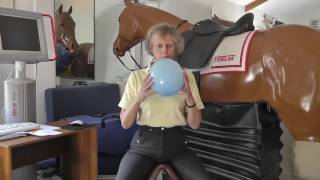
Instructional segment teaching a balloon-assisted breathing exercise to help riders access core strength and organize the torso like elite dressage riders. The speaker guides listeners to notice rib and abdominal movement while inflating a balloon (without pinching it off), and emphasizes keeping ribs expanded and abdominal wall engaged during inhalation and exhalation to maintain stability.
So now I'm going to show you how to access core strength and breathe, organizing your torso in the way that basically elite riders do without even know they're doing it. And the best way to learn this is with a balloon. So I'm hoping you can come up with a balloon and give this a go along with me. Maybe next time you watch this video. So normally when people blow up a balloon, when they breathe in, they pinch it off either with their fingers here or with their lips. In this version, you're not allowed to pinch off the balloon. And what that means is you have to arrange your tongue in your mouth to breathe in through your nose, get air down into your lungs, get it out into the balloon, and all of that has to happen without the balloon emptying itself into you. Okay. As you do this, I think you'll instinctively know how to organize that. The bit I want you to pay most attention to is, is what happens in your rib cage when you're blowing up a balloon, and particularly what happens in your ribs in the front and the back of the sides around here. So, first of all, you need to notice how you're breathing now. If you can get yourself in a good neutral where your seat bones are pointing down, your front and your back are the same length. And within that neutral, take a few breaths, noticing how much is the movement in your upper chest here? Is this the bit of you that predominantly moves when you breathe? And if so, how much does that lift? It may be that the movement is predominantly here or predominantly lower down. If the movement is here, how much is it that your ribs expand widthways like that, or how much is it that as you breathe in, your ribs lift, as in like that? Is the expansion just in your front? Is it in your sides? Does it go into your back? And once we've blown out the balloon, you're going to be noticing how that might have changed. So here we go with the balloon. You get to take a breath, blow it up. Remember, you're not allowed to pinch it off. So here goes it. So now I've blown out the balloon. I'm going to pinch it off and hold it at the moment and keep breathing in the same way. And my question to you as you do this is, what happens in your ribs and what happens in your abdominals? So if you notice your abdominals, I think you might notice that you have pulled your stomach in to make a wall and pushed your guts against the wall, as we did in our little bit of video about bearing down. So that's Access to your core. Just as clearing your throat makes you pull your tummy in to make the wall push your guts against the wall. When I ask groups of people what happens, in this case with their ribs, sometimes people tell me their ribs have really dropped down and in together. They're the people whose ribs would lift and flare with the in breath. If you're still breathing like this, which I hope you are, notice what happens to your ribs on the out breath. Do they collapse? Do you deflate or do you stay inflated? Our aim is that you stay inflated, so on a normal out breath, you'd actually go as you let the pressure in your insides decrease. And if you were a singer, that would give you trouble, because we're learning diaphragmatic breathing here, which is the same kind of breathing used if you use single player wind instrument. And by the time you go ugh, you lose the note, you can't keep singing. So it's the ability to keep your ribs expanded here, with your intercostal muscles helping you on the out breath that enable a singer to really hold the note and a rider to really keep that stability. So I wonder, are you still doing it? So maybe that you've lost it by now, You. In which case you need to deflate your balloon, blow it up again, it'll be a little easier second time round, and see if you can keep breathing when you've blown up the balloon. And notice how your ribs stay expanded, how your ribs stay so they don't lift, they just expand, and how you keep having in your abdominal muscles a wall to push against. So good riders are breathing like this, keeping their ribs like this, keeping the expansion and the firmness like this, and they're doing it the whole time. This is how riders access core strength and breathe.