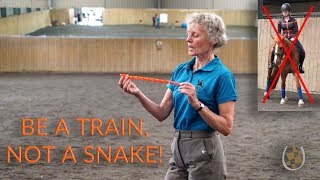
This content was created by Mary Wanless. This content was uploaded by Mary Wanless. This is a YouTube video titled "Be a Train, Not a Snake! - Better Riding in 2 Minutes or Less" containing a monologue by Mary Wanless recorded in May 2019. In this instructional content, Mary Wanless explains the biomechanics of a horse's spine and movement, using analogies like a snake and a train to illustrate how riders should think about horse movement and stability for better riding technique.
So this snake has however many pieces it does, and we're thinking of this a bit like your horse's spine. So Your horse has 33 vertebrae, which means 32 joints. And it may be that those joints only allow 1 degree of movement, but if every joint only allowed 1 degree of movement, that would add up to 33 degrees, which is a heck of a lot of displacement within his body. So we talk about the waltz being pushed along from his back legs, but if he's pushed along from his back legs and he's got goodness knows how many degrees of movement possible within all these joints, it's a bit like we're trying to push a snake. As we ended up saying years ago, before we found this rather lovely little model. You could push on the end of a broom handle and make it go somewhere, but you couldn't push on a rope and make it go somewhere because the rope would just squiggle. And squiggliness is one of the biggest deals for us as riders. But it's also interesting because all the kind of idea that your horse has got to be forward and straight, and when he pushes equally off his hind legs, he'll be straight really gets questioned there, because if you can't stabilize the front end at all, we're in danger that the force from the back end just gets derailed and derouted. And it's kind of like if this snake, if your horse's spine was like a train on rails, you could put the engine at the back and all would be well. But this snake and your horse do not go along on rails. And we have to get the effect of as if your horse was a train on rails, then we could put the engine at the back. But given that he's not a train on rails, it's really easy to understand why he would rather pull himself along from the front and have all the carriages, as it were, in his train, follow his front end. That's way more sensible to him than push him along from the back. And what happens is some goodness knows what. So we as riders have to get the effect of as if the train was on rails. And we talked last time about the wither and the rib cage and how the wither is like a teardrop shape. It gets pulled up between the shoulder blades. You're aiming to steer that wither along an imaginary line, like the horse's gymnast on a balance feed. He's not falling off on this shoulder or falling off on this shoulder, and you're endeavoring to just cut down the wiggle room. And essentially, you could think of it like if you thought of the kind of trains that have two rails for the wheels and an electric rail in the middle, it would be like the wither needs to be on the electric rail and the two front legs need to be on the wheel rails, and the back legs, too, need to be on the wheel rails, and then everything can go along. Sam.