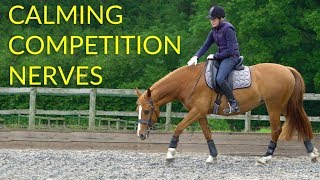
Mary Wanless (speaker) gives practical mental strategies for managing dressage competition nerves by setting realistic, achievable goals (e.g., getting the horse calm, unloading from the lorry, walking in the arena) and by being ready to reassign goals on the spot if the horse becomes tense. She emphasizes that competition percentages largely reflect prior training and that the primary value of an outing is what can be learned from the result rather than the score itself.
Set appropriate goals for yourself for the competition. What are the expectations? What do you want to achieve from going out? What would be a win for you? This could be just the horse's behavior. You know, this could be, we're going to a competition and I want to see that we can get him out of the lorry, get him calm, get him walking around the arena with other horses is, get them used to the atmosphere. And if that is your goal, then whatever happens in the actual competition in the dressage arena shouldn't really matter if you've achieved your goal. Perhaps you want to get better marks out of a certain part of the test. You know, maybe you want to just get your personal best, maybe you want to have a better experience in the warm up arena. But it's really important that you choose your goal along those kind of lines. Really say to yourself that you'll be happy with that no matter what else happens. If you get to a competition and everything falls apart and the horse starts acting up and being tense and being difficult, you've got to be able to at any point do a goal reassignment. So let's say you get to the competition and suddenly your horse is messing around and being excitable and so on. Well, forget the goal of competing in the dressage test. Maybe your goal then immediately should be, well, let's see if we can just get him being calm. And in the outdoor arena you don't even have to compete. And I think that's really important that you can get to a competition, reassign the goal immediately and not get stressed about it. When you get your result, results tell you what you need to work on more. The results tend to be based on what's gone on in your training and so on. So, you know, one of the things I often say to Millie when she gets to a competition is not to worry about what might happen, not to worry about what percentage you might get or anything like that. Because taking away bad luck, what happens in the competition is based on what you've done already before. Results are about what can you learn from your outing, what is it that is learnable from your outing? And the learning you get from your result is the perfect outcome of going to a competition.