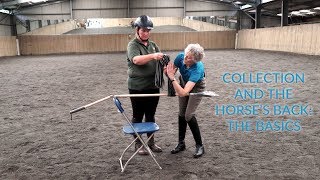
Mary Wanless breaks down collection as a biomechanical shift driven by the horse's hind legs stepping under its body and flexion at the croup, not by forcing the nose vertical. True collection engages the thoracic sling muscles, elevates the withers, and requires flexibility through the neck and spine.
This is kind of a horse. Here's its head, here's its croup, and here at its croup, we have a hinge, because this is one of the places of the horse's spine where there's a lot of possibility for what would be flexion and extension. And I've overdone it there, because about the most you can get in this joint is 20 degrees. And the FEI definition of collection talks about the hind legs coming under the croup, lowering, and is predominantly happening in this joint. And it's what a lot of people talk of as the loin coil. Interestingly, though, the FEI definition doesn't talk at all about the withers and the horse's shoulders. So what we have here is his spine has come along, and at this point, we're in between his shoulder blades, where we have muscles that are generally known as the thoracic sling. And these muscles here would be fixed at the top onto the insides of the shoulder blades on each side. And serratus anterior is one of the big ones here, fixed on the top of the shoulder blade. The other end is low down on the ribcage here. So if we actually lift here, the horse comes up through the wither. And I think most people, practically in their learning, learn about how to bring the horse up through the wither probably before they really learn about the loin coil. Of course, what often happens is people do none of these. So here we are, we've just got our horse here, and they know they want their horse on the bit, or they know they want the horse collected. And what they know about it is its nose should be vertical. So we have a horse without a loin coil with its withers and its spine probably really dropped here and its nose vertical. Actually, it might even be like that, mightn't it? And often these riders are really proud of themselves because the vertical nose is the thing everybody knows about. And the joint between the skull and the first vertebra can actually make 80 degrees of flexion here. That's nearly a right angle. And the other, between the other vertebra and the neck, you've got about 20 degrees between each one. And, you know, the horse has to be able to put his head way in the air, and he has to be able to scratch his front legs and all the rest of it. So he needs a lot of flexibility here and in the neck vertebra. But really, when things work right with the horse, we've got, as well as this major change here, just little changes in more vertebrae all along the way, rather than the horse has gone with its nose. And I think this is what happens a lot when people have the idea that if you kick the back end and you hold the front end, you're going to bring your horse onto the bit, and at the very best, you're going to get a horse who goes, okay, I'll agree to have my nose vertical, and it'll look like it's got a very big head on a very short neck with a very tight V shape under here, and it won't look beautiful and it won't ride beautiful. And we're wanting to involve much more of the body in an overall change of shape carriage posture, which will end up with a nose just around or a little bit ahead of vertical here, but predominantly involves the loin coil and the muscle split.