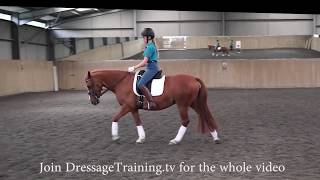
Peter Dove and Millie explain why riders need core strength and tone to stay independent from their horse's movement. They use a steering wheel analogy to show how bearing down creates stability through walk, trot, canter, and transitions. Elite riders at Grand Prix and Olympics maintain firm core control, not just relaxation.
Hi, everybody. My name is Peter Dove, author of Master Dressage and co author of Master Dressage the Basics. Thank you for joining me. This is covering core strength and the seat. So it's very basic stuff. You really do have an awful lot of tone and that will help stabilize your body. It will stop the horse, you know.
If it decides to pull, pulling you.
Forwards, it will keep you up with the horse. And I'll tell you what we'll do. You can do a little experiment when you, when you go away, if you drive, find somewhere very quiet to do it. And be careful. If you try, it's your own responsibility for whatever happens. But if you sit up in a car and you take the back of.
Your body off the seat and hold the steering wheel and you're driving along, just gently start to increase the accelerator pedal and feel what happens to your body. And if you're not careful, if you do what most people do, you will be hanging onto the steering wheel to stop your back of your body touching the seat. Because that's the game. We're trying to sort of make sure that our body doesn't fall backwards and touch the back of the seat. So you'll likely find yourself hanging onto the steering wheel to stop that happen. And this is why I suggest doing it carefully. You don't necessarily put your foot down and go, wah and then be zooming off at 100 miles an hour.
So try it. But if you decide to try it, it's your own responsibility to what happens.
Hopefully the thought experiment is enough. Now imagine what you would have to do to stop your, your upper body touching the back of the, the car seat whilst holding the steering wheel. Without pulling on the steering wheel, you'd.
Have to really engage your core, bear down and feel as though you had.
A push from the back of your body up against the front to stop yourself having to hang on the steering wheel.
And this is what happens. Every single beat beat in trot, every single beat in canter. This happens even in walk. This happens in transitions from walk to trot to trot to canter. This happens in transitions from, you know, trot to walk. You know, if you did the reverse.
And press on the accelerator and your body tipped forward like this, what would you have to do without holding or pushing onto the steering wheel to keep your body stable? While that happened, you'd have to use.
Quite a lot of tone. So this is why I don't believe in the whole idea of telling somebody to relax. The vast majority of people. And I would kind of say, 90 plus percent of people have way too little tone when they ride, certainly not enough to match the forces of the horse, certainly not enough to stop them getting left behind every single stride or having to hang onto the reins to support their body. An independent seat needs tone, you know.
And quite a lot of it generally.
You know, you might be watching Millie riding around and thinking that she looks relatively relaxed, you know, that it all looks fairly easy up there.
But she is bearing down.
She is creating tone, which helps stabilize her body. You should watch some of the Grand Prix tests and the Olympics. Some of those riders, some of those really top riders are, you know, really.
Firm and still there's no wobbling around.
Going on at all in the middle. So this is Millie in walk, and Millie's really still her lower leg is underneath her. The thighs on the saddle.