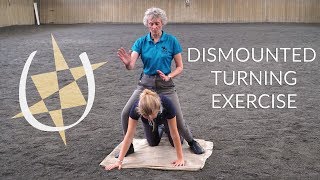
Mary Wanless teaches Millie a dismounted exercise that breaks down the mechanics of turning and body movement for dressage. By working off the horse, riders learn how their weight and position actually work before getting back in the saddle.
So can we get Millie in here? Because I want to do a little exercise that I would really recommend you to do. And if you have a friend here who's willing to do it with you, that would be perfect. Otherwise, I hope you will find a time to do this exercise. And I'm just going to get myself here, something that I can kneel on. Okay. So I'm going to play the role of the horse here and invite Millie to come and sit on my back. Now, when you do this at home, hoping that you will, you want to try and do this with somebody about your size and weight. And the person sitting on your back obviously needs to support some of their own weight. This is interesting. It's a very bony. Ah. It's not your seat bone, it's mine. It's not you. No. Hang on a minute. Stand up again. We have to do microphone adjustment. Okay. There we go. Not quite a technical hitch. All right, so Millie gets to sit on me here and support some of her weight on her thighs, which is going to be somewhat hard work, but. Oh, well. And I don't want you to think about it too much. I want you to just turn me right. There you go. So what she's done has essentially. Let's do it again. Faced her body to the right and had me twizzle about my axis. Do it again. So notice how my bum's gone that way. My shoulders have gone this way. Okay. Let's do a left turn. So that does the opposite. My shoulders go to the left, my bum goes to the right. So what she's done here, essentially, is to twizzle me about my axis. Yeah. So let's do a right turn. Okay. And let's do a left turn. And virtually everybody who's ever done this exercise, if they've been a naive person, as it were, has done that. Yeah. It's so instinctive to us because we turn our bodies where we go on our feet to turn our bodies when we go to turn a horse. Okay, so let's reverse rolls here so I get two. Sit on your back at this point. Okay. And again, I'm going to support my body weight as best I can. So what Millie did when she was on me was face your body one way, face your body the other way. Okay. And again, just like me, what she got to do was twizzle about her axis. And if you do this with somebody, what you might find is that as they face one way, they do that. So what did I do different? Millie? Yeah, I dug my right seat bone down into her back. And she went, ah, digging my left seat bone into her back. So she hollowed, come back up with your back. That's it. And that got even nastier for her. So the way to make this work is not quite that. It's this. So what I've done here now is I haven't turned my body still facing forward, but I've made a movement that we talk of as fencing lunge. So it's kind of like within me, as if somebody pushed on there and pulled on this knee. We're going that way. And I haven't twizzled her, but I have got her to move her little paw in whichever direction I want us to go in. And that is essentially what makes a turn. So reverse roll. Okay. So you get to decide which way you're going here. And you will need to have the foot slightly further back on the side you're going away from. Okay, so you do your turn. That's it. So it's as if somebody almost pushed on her here and pulled on this knee. Go again. That takes that that way. Let's go the opposite way. And then we go this way. And again. That's it. So you can see that that's very different to Twizzling me. Twizzle me. So that does that. And now do. That's exactly right. Totally different movement. Okay. All right, let's have you jump up a minute. And I think probably you need to go jump on your horse, actually, and we'll take that away.