
Dressage Training - Getting your horse on the bit
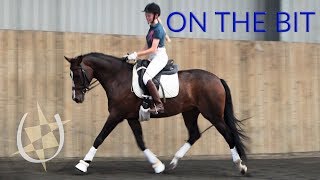
A practical lecture by Mary Wanless explaining that 'on the bit' is principally about the horse’s posture, core strength and biomechanics rather than simply head position. Wanless argues riders must learn to engage their own core and change the horse’s back and abdominal engagement so the hindlegs step under and the neck reaches out; she illustrates common bad habits and the learning process and points to further resources.
One of the things virtually everybody knows about riding is that the horse should be on the bit, even though, of course, there's a number of varying definitions of what that really means. And getting the horse on the bit becomes a big stumbling block for most riders at some stage in the learning process back through time. It certainly was for me. And I think it's fair to say that a lot of riders think that they either succeed or fail according to whether the horse is on the bit or, in its more common interpretation, whether their horse's nose is vertical. And the more desperate riders get, the more they fiddle and kick and pull and shove with their bum and try and make it happen. And certainly I can remember being shouted at so loudly that you desperately wanted it to happen. For me, as a young rider, certainly when I was struggling to work for the British Horse Society exams, it became a huge, big deal by which I defined myself. And I think I was willing to do almost anything to be a rider who could pass that hurdle and be seen to have her nose vertical. And I think that caused a lot of bad habits and a lot of unlearning that took me a long time and takes very many riders a long time. In fact, one of my young colleagues in America, we had a joke that she had been on an equine management and degree that involved riding and that she had a BSC in fiddling horses heads down. It took her three years to get that bsc and more than three years to unlearn all the fiddling. So why is it that I'm so big on trying to convince people that on the bit is about the horse's posture, movement, carriage, how his back is organised, not just about how his nose is organised. I think this is maybe one of my missions, partly because it makes it more learnable, it makes it more ethical. So I am Mary Wandlis. I am founder of the Rider Biomechanics movement, author of the Ride with your Mind books. I teach riders to ride their horses with more awareness, feel and skill in a way that makes them feel safer, have more fun, ride and train their horses more effectively in a way that makes their everyday work more ethical. And I want Reed to really understand something about how this works. So let's suppose the horse's back is hollow. Horse's spines, in this sense work rather like human spines. So in my back, if I hollow here, I'm going to hollow at the same time behind my neck. That's just how bodies work. And I'm going to lift my chin and if I fill out into My back more and my abdominal muscles shorten, my neck is going to elongate more at the back, shorten more front, my chin is going to drop. So you could say at this point that I am above the bit and at this point I'm certainly closer to on the bit. And if my back was hollow here and I was a horse and then somebody tried to bring my head down, I kind of end up in a bit of a contortion, which is not how my body is supposed to be or the horse's body is supposed to be. So if his back is down, his head is supposed to be up. And in one of the books I wrote about really just acknowledging that sometimes this happens and saying, well, it's 11:15 on Thursday morning and my horse is going along with his nose in the air. So what if I get desperate about getting it down, I fall into the trap of kicking and pulling and fiddling and I'm trying to put a down nose on top of a hollow back and making the horse have a contortion. The other thing is, if as a rider, what I really know about is my hands and what my hands are doing, the chances are that what my horse is going to know about is his mouth and the bit and the head and what his head is doing. And this may become a bigger deal still. If the horse has been ridden a lot in drawings we had on the Naked Truth of Riding DVD set that's newly come onto the market. One of the horses on that DVD set had been ridden a lot in drawings. And he was an event horse. He'd actually been jumped in drawings, which makes it one stage worse. And we worked with the normal rider on the horse. And then Heather Blitz, my colleague, who's a U.S. grand Prix international dressage rider, she rode the horse and we made the comment that all this horse knew about was his head. He virtually didn't know he had a body. But when on the bit works well. It's about core strength, it's about core strength in the rider and it's about core strength in the horse. And both rider and horse need to learn about their body. They need to learn about their midsection, they need to learn about how it works. Just knowing about the hand and knowing about the head, that isn't it. For many trainers, getting the horse on the bit is what I call a bite sized chunk. It's something they just think about and it just happens. And when they say get the horse on the bit to you, as if it's a bite sized chunk of Course it isn't. And if you're not careful, your desperation could lead you to doing the wrong things. So many years ago, there was a time in my late 20s when I gave up riding in despair and frustration. When I came back to it again, I really wanted to break down what is on the bit. How can we teach a rider these skills? And ultimately it becomes getting each person to make the shift from being a rider who wants to get the horse's head down to being a rider who understands how to bring the horses back up. Because if you could change the back and just bring that up, the head and neck would take care of themselves. Try, try to organize the head and neck when you haven't organized the back and you're in trouble. So the reason why other trainers don't talk about this in the way I do is because for them it's so easy. And I can remember years ago, at the place I used to be based at, there was a cafe that had windows looking out over the arena. And I was sitting in this cafe watching one of our elite riders riding on horse during a lesson he was teaching somebody. And in fact the horse was halted just outside the window. And I could see from about the level of his knee to the level of his waist. And he just climbed on this horse in halt and the horse hadn't moved yet. And framed through the window like this, from his waist to his head, I watched the horse go and the horse hadn't even moved. He had drawn the back up in the most phenomenal way. And if I'd have been the person in that lesson, I would have been all, whoa, stop, tell me how did you do that? That's what I need to be able to do. So understanding about your core, the horse's core, how to change his abdominal muscles so they shorten his back so it falls out is the name of the game. And a hollow backed rider like this will almost always be reflected in a hollow backed horse and a rider who topples backwards. So the majority of riders have their weight behind the ideal balance point, toppling down what I call the horse's man trap. Having their weight predominantly here on the top of their thigh and their butt and essentially squashing the horse's back down. So if this is the horse's back and this is the rider's thigh, we set rider's thighs at about 45 degrees between halfway between horizontal and vertical. Here's the rider's upper body here, and we want the weight at her knee to counterbalance the weight of her Upper body stacked up here. And just that change compared to her weight being focused here because her knee is up and her foot is forward, or her weight being focused here because her thigh is too vertical. Both of those put the weight down the mantrap. But the weight here at the knee, counterbalancing the weight of the upper body here changes everything. Skilled riders on the whole really do not know that how they do what they do. Just like the rider in that story I told you, I'm quite sure he couldn't have explained to the rider in front of them how he just drew that horse's back up as I watched it encased in the frame of that window. And it's well researched in the literature of social psychology that experts in any skill have what is often called expertise induced amnesia. He does it so well, so easily. He doesn't know how he does it. There is no need for him to break the skill of on the bit down into bite sized chunks. But making bite sized chunks is what all of us need to learn how to do it well, to do it ethically, to do it in a way that we can draw the back up, we can get the head and neck to reach away, we can get the hind leg to step under just as the water's way of going changes. Obviously, the pictures we're showing you just capture a moment in time. They are all absolutely genuine. Most of them were changes made within one lesson, some of them were changes made within three lessons. All of these horses were really hollow at the beginning. And the riders got much more able to draw the back up, reach the head and neck away. You could pick holes in any pictures, I'm sure you could pick holes in these. But for these riders at these times, it was a phenomenal success. I'm not suggesting that the horse went into carriage and continued like that forevermore. Everybody's learning process goes, got it, lost it, got it, lost it, got it, lost it, got it, lost it. As you hone in on your goal and of course that will be the reality for these riders as it is for all of us, let me show you a little bit more about how bodies work. So if I hollow my back and then attempt to hug my knee, this is where it comes to. If I take the hollow out of my back, my knee then comes to here. So it's the same with the horses. We want his hind legs to come underneath his body more. But if his back is hollow, the amount to which they can do that is restricted. Okay. It doesn't matter how hard you kick, you can't make a difference to that. Once his tummy has shortened and his back is filled out, his hind leg can move underneath him, much closer to his tummy, and then you're getting much more the response you want. So by lifting the back, you made it possible for the hind legs to come under. If you were to go kick, kick, kick to the back and hold, hold, hold to the front, all you're doing is attempting to scrunch the two ends towards each other. But the hind legs can't come under that much, and the front will tend to just scrunch in a short neck or a break at the third vertebra or something like that, rather than the real genuine reach of a head and neck out of the wither. So, in essence, getting the horse on the bit is about learning to draw his back up underneath you. It's about your core and how it operates, his core and how it operates, how your center of gravity is placed in relation to his center of gravity, how you support your own body weight and spread it over his ribcage. It's about biomechanics more than anything else. If you want more information on this, there's loads of short video snippets on my YouTube channel. My website, mary1list.com has information about my books and the longer DVDs.










