
Dressage Training - How to avoid tipping forwards
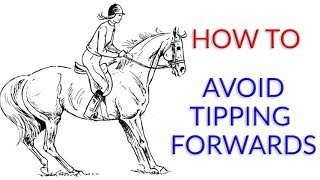
Webinar (presented by Peter Dove, assisted by Millie) teaching how riders tip forwards and how to prevent it. Identifies several distinct biomechanical causes (pivoting about the thigh, folding at the waist, collapsing in the middle), plus behavioural causes (fear/fetal crouch, poor rein handling). Offers practical, repeatable solutions: adjust stirrup length; use the "slingshot" thigh-tone exercise to keep thighs out in front; monitor and keep the front-thigh-to-body angle open; "bearing down" (diaphragmatic breathing and front-wall engagement) to stabilize the core; keep hands forward and reins short; avoid pushing into the stirrups in downward transitions. Contains live demos, chair-based exercises, Q&A, and pointers to further courses (How of Riding — 10 lessons; Dressage Yoga). Also mentions a limited-time shop offer (DOVE25 for 25% off purchases over £20).
Questions this video answers
10 lessons
DOVE25 for 25% off purchases over £20
So welcome everybody. Welcome to the webinar on tipping forwards. We could have done this on, on a horse but it's freezing cold and really dark out there. So we decided to do it from our studio and actually it's a lot easier to, to demonstrate some of these techniques whilst not on a horse. And also to get you to do some exercises too.
I've got my little saddle chair which.
We can work with. My name is Peter Dove. I'm the author of the book Master Dressage and just actually just to get us all going, I'm going to give a copy of one of these way right at the start. I'm also a certified writer you mind coach. And if you want to find out more about route of the mind, go to www.mary-oneless.com and I think I'll get Claire to type that up for you in the chat so you can know where to go. And if you're looking for one to one instruction, then you can find a list of coaches on there and find somebody in your area worldwide. So my big promise to you today is that I will talk about the different ways that a person can end up tipping forwards and I shall give you some really good solutions to those problems as well. It won't be comprehensive because we could be here for quite a while, even though it is only about one subject, but you'll go away with some really good techniques and a really good idea of what causes people to tip forward and how to solve it. One of the things we've had in the past when people are looking at dressage Training TV is the idea that dressage is perhaps too difficult or too complicated or too high a level of skill. But, you know, dressage is based on a French word meaning to train. And at Dressage Train tv, we train everybody right from the beginning all the way through to competition. So, you know, we offer everything from how to avoid tipping forwards to, you know, how to get better marks in your score. And we do groundwork as well. And you know, we work with quite a range of riders. So dressage shouldn't really put you off. Dressage riders isn't just something dressage riders do, it's it's really what everyone does when they're training their horse or even training themselves. So hopefully some of you will have got the email from us which we gave you a PDF which you can print out and that PDF has some room for you to make some notes and, you know, so you can follow along as we're doing this. So what is one of the biggest ways that prevents progress in riding, you know, why can't we make rapid progress? And I think one of the biggest problems is, especially, you know, when I see a rider come to me, is they imagine that they might have to change by, let's say, this much. You know, they're expecting to have some small incremental improvements. They're expecting to have their position tweaked or what they do tweaked. And, you know, they can kind of accept that they might have to change perhaps this much, that, you know, they might feel a little bit pushed about how they're having to change their body and change their techniques and so on. But often what really is the case is the rider needs to change this much. And what happens when a rider has to change so much more than they're expecting is a lot of objections happen. Like, this is too weird. This can't be right. I can't possibly be upright. I feel like I'm tipped forwards or I'm leaning back, or I feel like a hunchback or I feel really hollow in my back. And, you know, a lot of those things are simply your body telling you that this does not feel normal to you at all. And, you know, often the body's really good at telling you where it is relative to where it's used to be. So, you know, if you were.
If you're a rider, like, perhaps the reason why you came to this webinar is that you tip forwards. When I finally get the rider upright and ask them how they feel, they will say that they're leaning back by quite a bit. And, you know, you have to kind of sell them on that leaning back.
And, you know, I use things like cameras and photographs and video and get them in front of the mirrors that we have to really convince them that even though this feels the weirdest thing ever, that this is correct. And, you know, I think as.
Riders.
We do often under. Do the corrections that need to be made. You know, I think kind of the best pupils that, you know, I make a correction to somebody and they come back two weeks later and they've overdone it. And I'd much rather have someone overdo it than underdo it, because underdoing it often ends up being never quite getting there and then also losing heart because you don't see or feel the results that you really want. We're going to move on to one of the ways that a person can tip forward.
And this is what I call rotating about the thigh.
So if we.
If we Imagine myself sideways on and where my thigh is here.
If you imagine there was a bolt.
Going through my thigh, the rider can keep these angles the same. So in other words, I'm not going to tip forward from my waist. But, but actually what happens is the thigh does this and the rider ends up with the thigh too vertical, the lower leg too far back underneath. And sometimes the lower leg isn't too far back underneath, but the thigh ends up too vertical and the upper body is too far in front. And that's one of the ways a rider can tip forwards. They can be thigh too straight, body.
Over the front, and of course, if.
I come back up, the knee comes up and we've pivoted about the. This particular point here, even though I haven't collapsed or leaned forward or anything like that, One of the ways in which a rider can end up pivoting around here is that they have their stirrups too long. You know, if your stirrups end up.
Too long and your leg is too.
Straight, often you'll find yourself immediately, oh, crikey, the chair did something strange.
There we are.
You'll find yourself immediately in front of the thigh.
So one of the things that we.
Recommend is that the rider initially has the stirrup set, so the thigh is at about a 45 degree angle. And as soon as you start getting that stirrup too long, it's going to be really easy for you to end up in front of your thigh. So that's the kind of first thing.
By the way, I'm kind of going.
Through the ways in which riders can tip forward. And then we're actually going to move on to the solutions.
So the other way a person can tip forward is by closing the angle that the front of the thigh makes.
With the upper body. So that's just plain folding forwards like this. Okay, so we've got, we've got that one and we've got the thigh doesn't move, but the rider closes the angle that way.
And then the other way that a.
Rider can tip forwards and Millie, could you be over here to flip the charts please? Is to collapse here in the middle. So this is usually the tummy gets pulled in. The rider sort of rounds their back really and tips forwards.
So those are the three basic ways that a rider can tip forwards. And it's really important for you, if you're looking at yourself or even looking at other people and coaching, that you.
Try and figure out where this person is tipping forward. Is it the problem with the stirrup length? Is it a Problem that they rotate around the thigh and the thigh changes its angle. So if you watch them tip forwards, you can kind of watch where the knee is and the thigh angle and so on and see what happens there.
There are two other ways that a rider can end up tipping forwards that I'm going to talk about today. One way is simply through fear.
So as soon as the rider becomes fearful or scared, they go into fetal crouch, everything kind of comes up and.
They tip forward, forwards.
The other problem is to do with.
The way you're holding the reins. So if you, if your reins are too long, if you're kind of holding your hands like this or, you know.
You'Re pointing your hands down, you know, you'll end up often with your hands too far back and your upper body too far forward. And also in a really sort of difficult, unbalanced position where the horse can pull and push you around. And, you know, it's just not a very good place to be.
So it's really important that, you know.
Your hands are out in front of you and your elbows are slightly ahead of the midline here, and your reins are short enough. You know, too long a reins and you could almost end up tipped forward by default.
Interesting story. Last week I taught a lady called Gail Anne on a fairly exuberant horse. And she was nervous. You know, she was a little bit nervous. She was doing a really good job of attempting not to show it, but she was pretty nervous up there. And, you know, one of the things that we got her to do was.
To get the hands out in front, taught it how to do more neutral spine, taught her how to engage her core. And we'll talk about that in this session as well. Taught her about having the thighs out in front. And again, that's what we'll cover as well.
And, you know, once she learned to.
Do all of those things, she had an incident where the horse went and tried to kind of plunge forwards. And quite surprising for her and surprising for him, he essentially hit the end of the rein and Galen just didn't get moved.
And she told me afterwards that that was a really big confidence building moment from her because she would just be there in place. Whether the horse is going correctly or.
He'S trying to move her around, she didn't get moved by him. And often part of not tipping forwards is learning how to correctly hold the reins, hold the contact and where to hold it from in your body. And, you know, we will talk about that.
The other thing that is really important in being able to avoid Being tipped.
Forwards backwards is having a neutral spine.
Now in lesson one and the how of riding course that we've got for members, I cover alignment and neutral spine in there. But I'm just going to show you how important it is to have neutral spine by getting Millie over here to do a demonstration. She's just giving me a funny look like, really? What? Yeah, you can turn it over.
So one of the problems about not.
Having neutral spine, for instance, and will actually start. Go really hollow for me, Milli. That's it. Oh, not. Not as hollow as that. Okay, so one of the exercises we can do is if I was to stand behind Millie and to push down.
While she was not a neutral spine.
And in this case hollow, what happens.
Is as I push down, she'll go extremely hollow.
I haven't broke, you know, she's got such a flexible back. Looks like we've broke her in the middle. But the spine just doesn't have the.
Strength and you end up being even.
More hollow because of it. Now go round back. And we have the same problem with round back is, you know, the spine.
Has no rigidity in it, no firmness, so that, you know, the horse can.
Easily pull you around and pull you forwards. And if I go around to the front and we get Millie to do hollow back and put her hands out and if I'm the horse and I pull, she'll easily get pulled forward like this. And if she goes round backed, her upper body gets pulled forwards to what? Let's pin that in place. Gets pulled towards me like this as well. Okay, thank you very much, Milli, you can go now. Yes. Okay. So, you know, neutral spine is really important. And for those of you that are members, that whole first lesson covers neutral spine. So, you know, when.
When we're talking about core strength, we're talking about core strength when you have a neutral spine where your front is the same length as your back and you know, you don't have an excessive curve and you're not collapsed here. But the. But neutral spine has a big impact on whether you're going to get tipped forwards or not.
Okay, so hopefully that made sense to everyone. We're now going to go on to the solutions for this.
One of the things that we teach people who have the problem of the thigh doing this and who have the problem of folding that way is something.
Called, we call slingshot. And it's the idea that the thigh is at 45 degrees and you're trying.
To keep the thigh out in front of your upper body.
Now Anyone who's been and watched any of our videos or been to any of our webinars before knows that we do talk about muscle tone, we do talk about core. And it's no good to kind of.
Have your thighs out in front of you passive flaccids, because they won't do anything. You know, you're upward, you'll still go bleh out in front of them.
So.
So hopefully, if you can sit yourselves on the edges of your chair. So we'll do a little exercise. So sit on the edge of the chair so that your kind of thigh hangs, you know, down from the chair.
My saddle keeps slipping and keep feeling as though the thigh is down out.
In front of you. And we're going to try a little exercise. I'm in.
Hoping that you can feel your seat bones.
What I want you to do is to start pulling your seat bones back along your flesh as if, you know, you end up. You're going to end up sort of poking your seat out behind you, so you'll end up quite hollow and you'll find your kind of knee comes backwards and your bum goes backwards like this, and you'll end up actually probably tipped over the front of your thigh. Okay. Oh, got a bit of cramp. Now you're going to do the opposite. What I want you to do is to reach the thigh away from you.
Much as you can, and you'll probably.
Feel your seat bones getting pulled forwards and the thigh reaching away like that. Now bring yourself back to neutral. And we're going to try something, what we call it slingshot. So that. That's a sort of ride of your mind. Terminology. We call this slingshot.
So if you were to imagine that you're.
If you imagine a catapult, or in.
The U.S. i think they call it a slingshot. Imagine that the two points at the top are your knees, the elastic is.
Your thigh, and the little pouch which.
Holds the stones is your seat bones. And you want to get the idea that you reach the knee away from.
You, but pull back off the seat bones as well. So you're trying to almost lengthen the thigh in both directions. Now, when you get this right, there will be quite a lot of tone in the thigh. You will feel the thigh really tone up.
And when you go for slingshot and keep the feeling as though the thighs.
Act like a buffer and stay out in front of you, you will automatically feel that it is actually quite hard to tip forwards, having the thigh out in front acting like a buffer. In slingshot, where you feel the tone of your thigh will act as a very good buffer. If you let go and, you know, the horse throws you forwards and the thigh is too flaccid and too loose, you will just end up thrown in front of it. So it's important to keep feeling thigh out in front and get this idea of slingshot by knees reaching away, but seat bones kind of pulling back.
It puts you in a really solid place.
So that really helps solve the knee kind of doing this and the thigh going too vertical.
And, you know, often when you've got.
Horses which pull or try and lean on the end of the reinforcement, try and pull you forward. This idea of slingshot is really important to keep you back and not getting in front of the horse.
So the other problem we mentioned was.
The tipping forward from the waist. And I hope you can feel from the little experiment that you did with slingshot of pulling back off the seat bones, but reaching the thigh away, as if somehow you could lengthen that. That would make closing this angle more difficult. Now, what you need to do as.
A rider is monitor this angle really.
Closely when you ride. I think one of the biggest mistakes.
People make is to try and forget their mistakes as quickly as possible. What you might want to start thinking about is, how did I make that mistake?
How did I tip forward, forwards?
Where did the tipping forward start?
And when you do tip forwards, if you're the kind of person that folds this way, you want to, let's say it happens at a downward transition. At a typical place, people tip forwards, monitor that angle and see what happens. Does the angle close? When does it close? Where does the closing start from? Do you start by starting to hollow your spine and then close forwards like that? So try and figure out what is happening to you. Now, once you can kind of realize that perhaps that angle starts closing, you can start thinking about doing more slingshot.
Keeping this angle open so you actually want it as you come into the transition, you want to really make sure.
That the angle doesn't close and you.
Keep it really open.
And we'll teach you about core strength, which will help that, too.
Another way that you can end up.
Tipping forwards, especially in downward transitions, is.
Pushing into the stirrups.
The moment you push down into your stirrups, you're going to push your seat out behind you and this angle will close. I haven't quite finished with that, Millie. This angle will close really quite clearly. Yeah, you can. You can. You can open it now. So it's important, especially in downward transitions, that you do not push into your stirrups. And quite a lot of people do. The moment you push into the stirrups, the. The stirrup is going to be like a pendulum will swing forwards and your upper body will close. So foot stays light and transitions. You stay focused with thigh out in front of you, monitoring the angle that the front of the thigh makes with the body.
The final thing, really, you know, even if you.
If you're doing slingshot, okay, and you're monitoring the angle, if you're very loose and flaccid in your front and you don't have any tone or core strength, you will easily end up collapsing this way and that. The tummy ends up being pulled in. So you can be doing shoulders like crazy and everything else, but the horse will still end up pulling you forwards.
So we call this bearing down. This is taught in lesson two of the how of riding. And this is essentially how you engage your core and stabilize your front. Now, I'll will go through the exercise with you, but I will warn you, it will feel like really, really hard work. You know, I can bear down like I'm doing now, and quite a strong bear down. And I can still breathe, I can still talk to you. I can still ride a horse, but, you know, the.
The horse isn't able to pull or push me around. In fact, that's one of the things that gave Gaylan her kind of epiphany.
Is that she is there ready.
She isn't affected by the worry of the horse about to do something. She just focuses on being there in place and stable. And when the horse tests her, she's.
Already in place and doesn't get moved around. And, you know, I think one of the things that we try to do as riders is not be reactive, but causal. So, you know, the horse pulls and then.
And then we don't suddenly go, oh, God, got. Got to put that right. Must fix that. You know, we're already there and the horse pulls and it's kind of like. And they can't move us or they suddenly speed up and we just suddenly don't go wah. Or they slow down and we don't suddenly go wah. You know, as a rider, you need to be there, already in place with a good core and not get so easily moved around.
So here we go. Just put the heel of your hand just underneath your sternum, press it in and just go. Now, hopefully as you clear your throat, you'll find these muscles push out against your hand. Now see if you can keep those muscles pushing out all the time and what you'll find is this is diaphragmatic breathing. Now we go into this a little in a little bit more detail. So we teach you how to activate all the way up the front wall.
And by engaging your core and doing.
Diaphragmatic breathing, when the horse suddenly slows.
Down, he pulls against your body or the horse suddenly decelerates. You don't get pitched forwards because you're doing slingshot.
You're monitoring the angle here, you're bearing down so that you've engaged your core.
And you don't get pulled around by the horse.
And this isn't just, you know, I.
Say pulled around by the horse because it's the easiest thing to imagine. But even surviving forces like downward transitions.
That really needs for you to be.
Firm in your core. One way you can easily test this is when you're driving in your car.
If you just bring your back away.
From the back of the seat, feel what it's like when you try to accelerate, what muscular force do you need in your core to stop yourself falling backwards into the back of the seat?
And that's kind of gives you an idea of the kind of tone that you will need on your horse. One thing I would say about tone and bearing down and having your core engaged is if you haven't done it before, it will feel like a huge amount of effort. And it will be one of those things where you go, surely it can't be that, surely it can't require that much firmness. Surely this is too much effort. Well, you know, for a fit rider that's skilled and, you know, rides several horses a day and so on, you know, their level of core engagement to them will feel fairly negligible, you know, like almost. There isn't much going on, but for us to kind of match the tone that skillful riders produce without a second thought, it will feel like a lot of effort. And the other thing too is you don't have the core switched on at a hundred percent all the time. It really depends on the horse you're riding, the amount of movement that the horse has. I mean, Millie, you may have seen some of the lessons on dressage training TV of Millie riding Ella. Ella is a 16 hand Dutch Warmblood that moves beautifully with huge amounts of power. And Millie really does have to create a lot of tone in herself to stabilize herself on that horse, to stop it from throwing her around all over the place. I do remember the very first lesson that we did when Millie got her horse home and we were laughing A lot about how much Millie got wobbled.
Around on top of the horse.
But now, you know, the kind of bonuses she, she gets on her 14 hand pony and now is able to produce incredible power from that pony because she's had to learn to stabilize herself more on the bigger horse. So actually I will cover that in the Q and A. So someone asked about how to prevent going fetal when you're anxious or worried. So I'll talk about that in the Q and A, actually. So if you can write that person's name down, the question, that'd be great. So, you know, that was a small amount of information about one aspect of riding. You know, sit up just doesn't cut it. You know, if you're, if you're paying for a lesson and you know you've got all this problem of tipping forwards and someone just says sit up, it isn't, it doesn't help, you know, riding, despite what some people say, riding is a complicated deal with lots of detail to it. You know, that there, it just isn't stretch your leg down and sit up tall. There's a huge amount to it than that. If it was simple, we, we'd all be riding an awful lot better than we are. So if you like that level of information, think about what solutions there would be to leaning back, to asymmetry, issues of leaning one way or the other, to transitions, to turning, to how to sit, to the canter, how to get good canter transitions, how to do rising trot or sitting trot, how to sit still, how to control tempo. There are so many questions. And really, you know, there is only one biomechanically optimal way of riding, in the same way that the elite riders do so on dressage train TV membership. We've got a course currently running called the how of Riding. That course is 10 lessons, and each lesson is a breakdown in a lot of detail. So, for instance, the first lesson teaches.
You about alignment, about neutral spine, about how to solve those kind of problems.
It talks about stirrup length, how to.
Get the right stirrup length, where your.
Thigh should be, and so on. And lesson two talks about the seat, how to control tempo with your seat, and so on. And in fact, the next lesson is on Saturday, and that's about rising trot mechanics and how to get really good tempo control when you're doing trot as well. Because, you know, in fact, one of our lessons is on impulsion, but you know, you can't get impulsion if you can't control tempo. So that's kind of One of the things that we sort of build into teaching Rise and Trot is, you know, how can you control the speed of the horse's legs.
We have lots of other courses on.
Dressage training TV2, and we have a new one starting as well, which is, I think it's gonna be called Green to Great, which is how to take a young or inexperienced horse through to their first competition. So, you know, there's lots of video on there. I think Claire's put up a link and if you'd like to find out more about joining Dressage Training TV and getting access to all these great courses, then you can just follow that link and have a look. And there's lots of information there. I will say one thing, we've been working on a piece of code for our site which limits subscribers to only seeing content for the month that they've paid for. So kind of that prevents people, you know, not subscribing for a whole year and then paying one month and having access to an entire year's worth of courses. When you first join, you get about 20, 20 something hours worth of existing content. And of course you get access to the current courses that are running now. Fortunately, I haven't put that code up yet. It's taken a while for me to figure out. I am a programmer, so I do all that sort of thing as well as the lectures and so on. But I shall have that code applied in the next couple of days. So if you join up now, you'll still get access to lessons one and lessons two of the how of riding, which, you know, go into neutral spine and stirrup length and how to fix typical problems and the seat, and how to control your seat bones and walk. And you'll be in time for the lesson on Rising Trot, which is this weekend and the following weekend transitions both upwards and downwards. So if you go to the, to the page that we set up which describes, you know, how to join Dressage Training tv, if you scroll right down to the bottom of the page, okay, so, you know, you'll scroll down the bit where it says monthly subscription or six monthly subscription, past the instructors and keep going down past the pictures which, you know, we've taken from some of the different courses that there are, right at the bottom, you'll see the Harry hall logo. And what Harry hall have said is they will give you 25% off from their shop on any purchases over £20 if you use the coupon code DOVE25. So I've put all that right on that page. So we'll leave it up for a while. We'll leave it up during the Q and A. So you should be able to click on it and, you know, scroll to the bottom, and all the information's there. And you can save yourself 25% on Harry hall clothing from their shop. Don't go and buy it from my shop, because the code won't work. But the link to their shop is also there, too. So Charlotte and Rachel have asked, how do you kind of stop yourself, go into the fetal position? Well, I think, and this is, you know, what happened to Gail Anne as well, is you need to be already prepared. You already need to be thinking about.
Engaging your core, having your thigh out in front of you, monitoring the angle.
Here, making sure you're breathing correctly, your.
Shoulders are back in place, and you are kind of in a state of.
Red alert, I guess, if you like.
You know, you're already prepared and in a firm place, and, you know, when something worrying happens, just keep checking in with yourself. Are you still bearing down? Are you still breathing? Do your thighs stay out in front of you? Do you have this angle open?
And, you know, kind of what happened to Gaylan is, you know, the horse went to plunge and literally he went.
Dunk and kind of hit the end of the rein. And, you know, that was because Gaylan was already practicing doing these things.
If you sit up there unprepared, waiting for something to happen, then it will catch you unawares, you know, as in, you know, if you're. If you're too loose in your position, if you're too easily moved around, then you're kind of at the mercy of whatever the horse throws at you. You know, this is one of the reasons why I don't really understand the idea of people saying, relax. You know, I'd be kind of like, which bits should I relax? When should I relax? How should I relax it?
Do. Am I relaxed through the entirety of my body?
And, you know, as far as I'm concerned, you know, when I watch elite riders, the answer is no, they are not relaxed. They are highly toned athletes, and they are stable under all kinds of situations. So, you know, as a nervous rider, the best thing is to breathe, improve your skill, improve your stability, because that.
Will give you a lot of confidence in and of itself.
And I've seen that happen over and over again with people that I've taught who are nervous that they improve their skill, they learn how to engage their.
Core, they learn how to become more.
Stable, and it makes them so much more confident. Especially when, you know, things like that happen to Gaylan, they suddenly go, wow, I wasn't budged, I wasn't moved. You know, the horse didn't get. Get me, as it were. Not that horses are out to get us, but I think you understand. We got any more questions? So Mary and Dawn and quite a few people are asking, you know, are there any off horse exercises you can do? So one of the courses that we've got running at the moment, which is on dressage training tv. And again, if you, if you're getting in before, like the next couple of days, you'll have access to that. There is a dressage yoga course, and that is really, really good for building up your core. I mean, some of the exercise, all of the yoga exercise you're doing there are engaging your core. And Demelle's a horse who's running the course. She's a PSG rider. And, you know, she, she's, she looks great up on the horse. You know, she's really stable and dynamic. So, you know, that, that really works. Pilates works. You know, some Pilates instructors, I think.
For riding, you know, emphasize pulling the too much in towards the spine, whereas actually bearing down and engaging your core for riding requires that little bit more of you pull your guts in to.
Make a wall, but you push your.
Guts against the wall.
Okay.
Because if you're kind of just pulling inwards, you could end up back in the same situation where you tip forwards.
So dressage yoga, the dressage yoga is great. Pilates good. And, you know, I actually go to, I use another site called beachbody.co.uk they have tons of programs for improving your core. You can do things like just. So if you watch lesson one. Sorry, if you watch lesson two, it.
Teaches you about bearing down.
Well, I bear down all the time, you know, like, if I'm walking around, I'll bear down. If I'm. If I'm brushing the yard, I have to bear down. Because you, as you push the broom, you have to bear down. So, you know, when I drive, I think about bearing down and that in of itself builds up tone and actually kind of gets you used to engaging your core because some of it is getting used to doing that and then learning how to breathe. And, you know, I've been rabbiting onto you all this time and I've been, you know, bearing down and engaging my core the entire time. So it just takes a little bit of practice. And, you know, when you're on the horse and you're in a dynamic situation, it doesn't feel as for forced as you know, when you just sat here generating all this energy because, you know, I can tell you as soon as I start bearing down, engaging my core, I start to heat up. And it's actually, it's great way to.
Burn extra calories as you're doing your.
Jobs or walking about, you know, if you've got an office job and you get up and you walk somewhere, bear down all the way, you know, engage your core all the way. Other questions? You know, I think, I think one of the things. So the question was, you know, if you've got an upward transition from trot to canter and you tend to, to pitch forward in that upward transition, which is easily done, you know, if you're using aids where you bring your outside leg back, well, you're kind of doing.
The whole rotate about the thigh and end up throwing yourself, throwing yourself forward.
And you know, I, I teach outside leg back to, to ask the horse to canter. And you know, when you see talented riders riding and they're doing flying changes, you know, the legs go back. So the thing is, and I do this little exercise when I'm teaching people good transitions from trot to canter. And what I'll say to them is, go sitting, trot, get yourself in place.
Monitor your angles, and then on top of that, apply the aids to canter. And what you're trying to do is run a little experiment in your head. Can you keep thinking about your angles and your thigh being out in front of you and engaging your core as you give the aids to canter, what.
Tends to happen is people go seeing and canter and they kind of threw everything to asking the horse to canter it. It's like it's a big deal. They've made it a big deal inside of their minds. And this idea of treating it like an experiment, regardless of the outcome, it's almost like, you know, you're going to.
Do this experiment whether the horse canters.
Or not from your aids, and the result is not getting the strike off.
But the result is, can I keep thighs in slingshot, keep bearing down, keep these angles the same, keep my hands up in front of me and at the same time give the aids for canter. And be aware, if the outside leg comes back, you know, you may be opening this angle more as you give the aid with the leg.
So treat it a bit more like an experiment. Don't be so kind of focused on the result, which is the canter strike off, but much more on the process of how you do it. So just disassociating the result can often help. Most riders that throw themselves around in canter are doing it because they are trying too hard and focusing on making the canter happen rather than getting their body in the right place. Look at it this way, we don't influence the horse through magic. You know, we apply the horse responds to our body. So the question really is, what are you going to focus on? Well, you don't want to focus on what it is that you want the horse to do. You focus on what is it that you have to do to make that happen. So a lot of riders, their focus is on the horse and on the result, rather than what is it I'm doing with my body, what is happening to me when I canter. And again, you know, if you do throw yourself forward, figure out how you throw yourself forward. Does the thigh get vertical? Do you close the angle here? You know, do you crumple in the front? What is happening now? Because until you know what's happening now, you won't be able to change it. You know, you have to know what's going on and then you can make the changes.
How are we doing for questions?
Whoo. More questions. That's an interesting question. Nothing to do with tipping forwards, but.
What was her name? Dawn.
Yeah. So dawn was saying, how do you use the side of your calf rather than your heel to kick? Okay. Alrighty. So although there isn't anything to do with tipping forwards, we will answer that one and that. I think we talked about that in lesson two in the how of riding.
So basically, when you use your leg, the typical problem people have is they kick backwards or they use their heel or they start to, you know, wiggle and move the whole leg around. When you see a good rider, give a leg aid.
If you see a good rider, give a leg aid.
And actually, I'll try and stand up as I do this. What you should see happen is if.
I can do it like this, this.
Is a big aid.
So the leg would do this and it literally comes out and in.
And then on a more advanced horse that is much more sensitive, the leg, and you probably hardly see the leg move there, there's a contraction inwards of the lower leg.
And, you know, the. Let me just get myself sat down here. The important thing is, is to.
What will help you is to imagine the whole leg is like a wooden boot, okay?
There's no flexibility.
There's nothing going to happen with the heels or anything like that.
You're to think of the whole leg.
Being there and as if you want to slap the stirrup iron underneath the horse's belly like this. The leg comes inwards, there's no coming back, there's no wiggle, there's nothing like that. Just literally inwards with the leg.
Forwards. Oh, that's a good idea. Okay, so, so, and actually, hey, try it on your chair. So, so sit yourselves further forward on your chair. Get your seat bones on the edge of your chair and, and try and get yourself in. In a kind of almost on horse position. And if you feel like your heel is like on one of the chair legs or, or your ankle there, just think of kind of banging inwards like that. It is literally just in. The toe doesn't turn out and, and you know, if you, if you are using your heel to ask the horse to go on, just imagine if you were to have to wear a spur and you'd be basically applying spur without meaning to. So the only time the heel should ever rotate in is if you were going to use a spur. But generally toes stay pointing forwards and it's kind of like an inward slap of the stirrup iron. And you need to feel as though you allow the leg to rebound off a little bit. You know, don't kind of go and.
Get stuck as if you're trying to.
Squeeze the horse's innards out. It literally is a short, clear aid that the horse will then respond to. Okay, question. So Jelaine is talking about.
She feels like her lower back is fairly straight, but she's rounded at the top and, you know, and that can happen. And she says when she gets it right, it feels really strange and stiff.
So, you know, I think my answer.
To that is it might do. It might feel strange and stiff because all your body's telling you is this is very different. And I'm stretching all my muscles and it's really hard. And that's pretty much what your body's going to be telling you. And you may have to feel really strange if you best thing to do, as I think I forgot to say.
It at the beginning, but the best.
Thing to do is get a photo.
Get a video, get in front of.
A mirror, ask a friend, and, you.
Know, get a picture taken so you.
Can see if you're like this, you know, you're going to have to bring the shoulder blades back and close together. You're probably going to have to think of lifting your sternum up a bit like this.
Your shoulder blades come back together, you're.
Going to have to feel probably like, by the way, I have this problem of rounding.
You actually probably have to feel like.
You'Re shortening the entire muscle chain down the back. Not like this, you're not trying to.
Hollow, but it just feels as though.
Everything'S pulling down and back to connect your shoulders with the back of the seat almost and that the elbows must be out here. So this is pretty tricky.
But yeah, it could end up feeling really strange. And again, that's often one of the reasons why people don't make the kind of progress that they could is because their body's saying to them, this can't be right or this feels really weird. Now, I'm not saying your correction that you make is the right one, but best thing is get a picture taken of it. And it's not always wise to trust your body. Best to trust a mirror or a photograph. Yeah, I have, by the way, I have this as well. I know about things being weird. You know, I know that when you change something in your body that it's going to feel weird. And yet, you know, I've been on a course with Mary and Mary's saying push the inside elbow forwards. You know, like my left hand wants to be a little bit further behind. Push the left side forward. And she's saying more. And I'm in my mind going, you've got to be kidding me. And I know she's not kidding. And Mary doesn't exaggerate things, you know, she sort of gets you into the right place. She doesn't make you ever exaggerate. I totally trust it and you can see it on the video. But even I kind of sometimes go, you're kidding me. As you could just can't trust your.
Body, you know, it's just saying this is really weird.
This is really different.
Another question.
Okay, so a lot of people are asking for me to repeat the slingshot explanation. And what I might do is can you zoom the camera out a little.
Bit so I can stand up rather than sit down?
It might be a little bit easier.
If I put myself on a non horse position. So you can do this sat on your chair. But imagine you were to try and get your knees closer down towards the floor, really stretching the knee down and away from you. And I don't mean vertically down, but.
You'Re kind of as if you were trying to push them down towards the horse's front feet. If you were to do that, it's.
Quite possible you could end up with your seat like this and your thigh too far out in front of you. Now go the opposite way and feel as though you're trying to pull your seat bones back along your flesh. And you're kind of almost making yourself duck butt, I suppose, seat stuck out behind you. So that's the opposite. You know, one way we're pushing the knee down like this and out in front of us, and another way we're bringing the knee back and the seat bones back. Now, rather like this idea of a.
Slingshot where your thighs are kind of like the elastic on a.
On a catapult and your knees are the. The two kind of the V shape that kind of comes up and the pouch is your seat bones.
Try and get a sense that you.
Reach away with the thigh at the same time as pulling back with the seat bones.
And as I do that, I can.
Feel the opposing forces generate a lot of tone in my thigh. And that really keeps me very stable back behind my thigh. If I let go, I can end up being like this. But having the thigh out in front.
And by the way, doing that is a really good exercise.
Just standing there in on horse position, getting the feeling as though you're reaching the thigh away but you're pulling back. Another way of thinking about it actually.
Is if someone put a piece of string around here or a rope, and.
You know, this actually is a good.
Way to get someone to get you used to the feeling pulled around and.
They'Re trying to pull you back and you're trying to kind of resist and then imagine what it feels like if they take that rope away. Can you keep that same feeling of.
Resistance that activates your thigh muscles, keeps them out in front of you and.
Stops you from going over your thighs.
Or stops your thighs getting too vertical like this. So that's kind of slingshot. You know, slingshot is quite a useful.
Tool in all sorts of situations.
You know, slingshot can be used to bring the horse more up off its forehand. It can be used to get the horse to sit more. It can be used to help you control tempo. It can, gosh, I'm slightly out of breath. It can also help you, you know, to keep yourself in balance when you've got a horse that's trying to run away from you and, you know, you don't get pulled forward by it, it's really helpful in downward transitions that you can just stay thigh out in front in slingshot in a really good place. So slingshot bearing down, monitoring angles, all very useful.
Anything else?
So I think actually when Mary first termed this, it was a Term used in childbirth when you were engaging and pushing the baby out. But, you know, Mary does then use the term, you know, bare out, bare forward.
And it really is the feeling that you pull your guts in to make a wall and you push your guts out against the wall and you'll feel the entirety of your front engage. And really, when you do it right, it activates the muscles on the front of your body and the muscles in the back of your body as well.
Okay, so Melita, did you say Melita is sort of saying that she tends to pinch with her knees. And, you know, if you do pinching.
With your knees, that could very, very easily start to close up the whole front ankle of the body. Front angle of the body, you know. You know, I teach that the thigh should be snug against the saddle, but.
That doesn't mean to say the knees should pinch in.
So the kind of snugness is more at the top of the thigh going on the way down. And some saddles may or may not.
Allow the knee to pinch. Another little bit of advice is if.
You find your knees coming up, if you find that kind of thing happening, just think of the muscle at the back of your thigh shortening and pulling the knee more down away from you. That might help keep the knee down, reached away from you.
The only issue is, is the angle in the front of the body likes.
To stay the same. So I've seen this happen. I've seen a person go from upright with their thigh to out in front to the thigh. Correct. But they're tipping forwards. And you know, what you might have to do is you shorten here. You have to make sure that you keep the angle in the, in the front of the thigh open so that you know the knee goes down and away from you and doesn't pinch up.
But you then don't get pitched forwards by it. Okay, so I think we'll wrap up there. It looks like with the questions, we could keep going forever. So thank you very much for joining. There will be a replay for this at some point. You, I think you'll get an email if you want to go back over it. So you'll still be able to get access to it. Follow the link through to the sign up, scroll all the way down to the bottom, and there is that coupon code to Harry hall. And that's if you spend more than £20. So thank you very much, everyone, and I hope that was helpful and you got a lot out of it. So thanks very much and no doubt we'll speak again soon.










