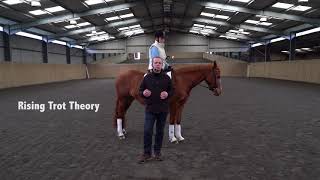
Peter Dove (author of Master Dressage) teaches lesson three on rising trot mechanics, demonstrating how correct thigh positioning, core stability and leg use produce a consistent rising trot and allow control of tempo. He explains the biomechanics (knee as fixed pivot, thigh as radius, pelvis/seat moving up and down), gives a practical partner exercise to feel the quads and ‘thigh as buffer’, and shows a mounted demonstration (Millie) illustrating how excess thrust or insufficient leg/tempo affects the horse’s tracking and energy. Also includes brief production notes about camera quality.
Hi there, everyone. My name is Peter Dove, author of Master Dressage. Thank you very much for attending. This is lesson three on rising trot mechanics. So we are going to talk about the correct mechanics for you to be able to get a consistent rising trot and to be able to get control over tempo, which is one of the real benefits of having a good rising trot. Okay, so the idea of having the thigh out in front of you like a buffer is. And reaching into the thigh is to help you avoid this happening in downward transitions. Or if you've got a horse that might want to pull you, or if you just tend to tip forwards in front of the thigh, the idea of having the thighs out in front really helps. And one of the ways you can get a sense of that happening is to get somebody to put their hand just where your knee is, gently try and push you back in the saddle as if they're trying to push your thigh back into the hip joint. And you want to get a feeling that you're trying to reach through here, down towards the knee, and resist my push forwards. And then when I let go, you're to maintain that same push, even though I'm not pushing back at you. You'll really feel your quads start to work really hard, and you'll find that the thigh stays out in front of you really clearly, like a buffer, which makes it more difficult for you to pitch forwards. And in fact, when you've got a really stable core through bearing down and your thighs out in front of you, you are not going to be shifted around very much at all. You don't rise by reaching into your stirrup. Essentially, what happens is the thigh. So if you imagine this was my knee, my elbow is my knee, and this is the ball in the ball and socket joint into the pelvis. And my body is kind of like stacked up like this. The. The knee is the fixed point of the circle, the thigh is the radius, and your pelvis essentially goes to the top of the rise and back down again and to the top of the rise and back down. And the other thing that's important to realize is what happens is, on the sit phase, your upper body, which is this arm, is inclined very, very slightly forwards on the sit. So when you get to the top of the rise, your body becomes upright. When you get to the bottom, there's a slight incline, actually. So, guys, I'll give you an idea of what Tink might occasionally have a look at here is this is kind of what it looks like behind the camera. So those of you that have paid for the DVD. This is being filmed by a 4K resolution low light camera, really designed to create incredible quality in these very dingy arenas. So that's what it kind of looks like from behind the camera. Good. So here you can see Millie's lower leg stays directly underneath her. She's levering herself up and down, sorry, forward and back. So the knee is the fixed point, the seat travels forward and up towards the hands. Now put less effort in Millie and hopefully what we'll get is that horse not tracking up. There we go. That's definitely. Oh, gosh, she's still managing it, bless her. That's less and less so now. So you can see how the horse is kind of losing the energy. Now it is possible for the rider to overthrust and, and no energy happens. So we often see this on really, really lazy horses where you start thrusting like this and nothing's happening underneath and the horse kind of gets confused. So it's important that if you are going to create any energy that you make sure you have the appropriate level of thrust, but you're also applying your leg as well.