
Dressage Training - Shoulder Hip Heel
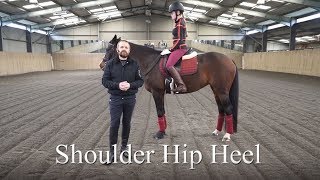
A Dressage Training TV lesson led by coach Peter Dove (author of Master Dressage) focused on the importance of shoulder-hip-heel alignment for flatwork. Dove explains why neutral alignment helps riders cope with acceleration/deceleration, demonstrates common faults (hollow/round back, leaning back/forward, too-short stirrups) and practical corrections (pelvis adjustments, sternum cues, changing stirrup length). He also discusses how saddle design and thigh blocks can impede correct positioning and previews a follow-up lesson on seat and core strength.
Questions this video answers
Peter Dove
Master Dressage
Approximately 45 degrees
So hi there everyone. My name is Peter Dove. I'm a coach at Dressage Training TV and author of the book Master Dressage. I'll be leading the lesson today, although other lessons may be led by Mary or by Ali Wakelin as well. As I said earlier, I'm quite excited about this. I've been a bit hyped up about it all day. I love this particular lesson on alignment. It's really important. It's the foundation for everything. You need to have correct alignment, you need to have correct angles for it all to work. You know, the moment those angles break down, the moment you lose neutral spine, there's all kinds of consequences which happen to you and to a horse which, you know, make it more difficult for you and for the horse as well. There's a lot of talk about shoulder, hip heel alignment in dress, in dressage and riding in flat work. And you know, I often think that mere lip service is paid to the idea of shoulder, hip heel. And we see a lot of riders in lots of different non shoulder hip heel alignments. Basically, when I look at a rider, I imagine if I was to suddenly make the horse disappear from underneath the rider, would they land on their feet? Would they land on their heels and fall backwards? So you can maybe show an example of that, Millie. So here Millie would probably land on her heels and then fall backwards. Would they fall forwards on their face if they're two tip forwards? And that's a really good visual for you to think about of the initial alignment for a rider. Now why are we so concerned about shoulder, hip, heel? And why are we concerned with this idea that the rider could just suddenly plop down, land on their feet in an on horse position? She's like, what are you doing? The reason this is really important is for flat work, we're looking for an ideal between balance and security. So if you were heel down, leg further forward, you're automatically putting yourself behind the movement. And if the horse were to suddenly accelerate, it's really difficult for you to stay up with the horse and stay up with the power of the horse. If you were two leg back underneath you and tipped forwards and so on. Then of course, as soon as the horse decelerates, you're in a very weak position to stabilize yourself. So shoulder, hip heel is a very good neutral place for you to be, to be able to cope with acceleration and deceleration. A short stirrup, on the other hand, ends up with all of the weight in your backside. The knee is up, zero balance like this all the way Ends up down in your seat. If you're always behind the movement, you're always heavy in the horse's back. The horse is going to find it very difficult for you for it to lift its back up and work correctly. So this is too short. So this is definitely not 45 degrees. You did have to go up hugely, didn't you? Yeah. To make this happen. So if I had a rider in front of me like this, I would immediately lengthen the stirrups before I did any of the other adjustments that you've seen. So, you know, the legs over the front, that the seat scooting forward into the right place. And I'm not going to do that with you. I just wanted to show that being there when the thigh is at 45 degrees, it's. It's in that kind of angle where it can help support your upper body. You know, it can help when the horse decelerates. It can help keep your upper body behind your thighs. That's another downside of having the thigh too straight is if it's too straight and the horse suddenly slows down, you're very easily going to go over your thigh and tip forwards as well. Okay, so shall I leave Kirsten to. Yeah, you can put them down now. Thank you. I guess what we'll deal with so that we don't take up too long is hollow and round and some of the corrections that need to be made there. And we'll do leaning back and leaning forwards as well. So I just go hollow back and upright. Millie for me. That's it. And then try and grow tall. And that's better. Yeah, that's more like it. Okay, so there's two corrections that for this type of rider that you're going to have to make. And Millie is doing a very extreme version of this. I don't think I've ever seen anybody riding like that, but. But I have seen fairly close to that. So could you imagine perhaps what standard corrections you might be making to this person? You know, sit up tall isn't going to do it. Relax isn't going to do it. You know, lean back. If we ask them to lean back, then, you know, they'll kind of end up back that way. And so we have to have some very specific corrections we can make. And we make those corrections initially on the rider's sternum, so this kind of position, and on their pelvis. So what I would say to this rider, and if I stand back this way, I'd get them to sit more on their pockets on the Back of the back of the pocket. So tilt the pelt. That's it. Now, actually, Millie's doing a really good bad job for me of following my instructions. And what you've seen here is Millie still has a hollow in her back, but she's leaning backwards at the same time. Another way you can say go hollow forward again for me. Another way you can say to the rider as well is if you grab hold of the back of their britches, and Millie's got a nice little loop belt loop there for me to do it and pull her back and say, fill out against my hand. So push against my hand or pull back that way and you can get them to adjust their pelvis. And that's really the first port of call, is to sort the pelvis out. So can you do bad? Good, bad. Good. So Millie's got her pelvis more in the right place, but you can see actually what's happened. She's kept the same angle in her upper body as she's brought her pelvis back, and she's now behind the vertical. And, you know, that's another way you can see it going wrong. And what you're looking at really is the length of the rider's front and in comparison to the length of the rider's back. Yes. So, Tamara asks, how much difference can the saddle make to the rider's ability to get the right position? Quite a bit. You know, it doesn't make it impossible. Generally, it doesn't make it impossible. I mean, some saddles, you feel like you're working very hard to get it right. Usually the rider can get the right position despite the saddle. But, you know, saddles will make a difference. If you've got a saddle that is high in the front and low in the back, so the cantle is lower, the pommel is higher, you'll find yourself sliding down the saddle and find it really difficult to not land too far back, to not be tipped forwards, to not be behind the movement. I mean, we've got a mare that is hugely up in front and you put a saddle on her and, you know, you just kind of feel like the horse is coming out from you that way. And for you to stay up with the horse, and she's quite powerful, too, for you to stay up with her is really hard work. You know, there's a real trend in having thigh blocks in dressage saddles. And I find with thigh blocks and saddles that put you in a certain place, well, you know, it's very difficult because my body's different to everybody else's body. And, you know, it might put you in a place that isn't suitable for you. It might put you in a place that isn't suitable for your horse. It might put you in a place that isn't suitable for you, you and the horse at that stage of training that the horse is at. You know, if you've got a thigh block that makes your thigh too long and you're riding a horse which is unbalanced on its forehand, you know you're going to find yourself over your thighs and in a very difficult place. Whereas you might want to be in a place where you have a slightly shorter stirrup and be able to stay back and lift the horse more up in front. Next lesson, we're going to be talking about the seat and core strength. You're going to learn how to put tone in the right points in your body. You're going to learn how to get tempo control over the horse in walk, you're going to learn how your seat bones move, how you can tell which hind legs are coming underneath you, for instance. All of these techniques that we're going to discuss will give you a much more stable feel on the horse and much more control over what's happening underneath you. Thank you very much for joining and no doubt I'll speak to you in the forums and through separate bits of video that we'll be putting out. Thank you very much.










