
Halting and downward transitions
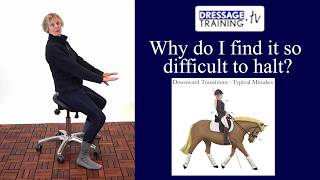
Mary Wanless breaks down why horses don't halt cleanly and how to fix it. Leaning back creates a water-ski effect that sends the horse forward instead of stopping. The fix: stay vertical with short reins and stable contact, letting the horse learn to accept the bit rather than fight a pull.
So the question is, why do I find it so difficult to halt? And really, there's two answers to this. One is it can really pay through groundwork to get your horse to understand the halt aid and that the reins mean stop. And we have some ways of doing this that we've shown on the webinars of having the reins over the horse's head and facing the horse in what we call the training position. So training that from the ground can really help, because then we don't have a clueless horse when it comes to being on top. But when it comes to being on top and riding, an awful lot of people work against themselves because majority of people would think that in order to halt, you need to lean back. And if you lean back, what you're going to do as you lean back and you go whoa. Is you are becoming potentially the water skier to a speedy horse's motorboat. So if you imagine if I was on a little rug on my feet, stood on a little rug here, and somebody pulls the rug out from under my feet, and the rug's on a polished floor, they pull out the rug. I lean backwards, the rug goes out from under my feet. The more I lean back, the more the rug goes out from under my feet. So my leaning back makes the rug go more. The same thing happens skiing. If you're there thinking, I don't want to go down the mountain, and you lean back, your skis go out from under you more. So. So here you are on your horse, probably thinking, whoa, whoa, whoa, whoa, whoa. And as you lean back, your horse will tend to go out front of you more. Now, he may do a motorboat in slow motion, so he may not really accelerate, but he won't stop. And staying vertical as you walk makes a huge difference. The other thing is how you use the rein in terms of staying vertical and stabilizing your body. So what happens to a lot of people is if he was the bit. And here's the horse's mouth. As the rider wants to halt, the horse's mouth comes against the bit, and it's kind of like the horse goes. And the rider goes, pull. And you get this. And eventually the horse grinds to a halt. You hope. So when that's happening, what we really have to do is retrain both the rider's and the horse's relationship to the bet. So here's the bet. The horse hits the bit instead of the rider pulling back. What we want is the bit just kind of acts like a brick wall. If the horse had Side reins on, attached to that bit, the bit would not pull back. The horse would meet the bit and have to sort out his own fate. It's the rider that pulls back that gets the pair of them into. And we teach what we call a passive resistance, where you have to have your body totally organized and vertical and solidly in place so that when the horse hits the bit, it acts like he hits a brick wall. And he kind of goes, come on, play the game, come on. You always pull, you always pull. Why aren't you pulling? You always pull, we always pull. And then eventually he goes, oh, shuck, she didn't pull. And then you're teaching him how to hit the bit and more easily go, ah. Ah. She won't pull. She isn't pulling. Ah, Rat. She didn't pull until he learns to kind of go. And the difference between that passive resistance, where your body stays vertical, your core stays strong, you're beari in place, your reins are short enough, and he hits that bit and you don't actually pull, but he hits, makes a world of difference. It's a totally different deal, but it can take an awful lot of learning when your pattern is maybe pushing your feet, leaning back, grow tall, hollow your back round your back, whatever it is. Which puts the both of you on the kind of way of relating to the bit as well as invoking waters chemo to boat. In terms of the skills it takes to ride a good horse, Anyone who can do that easily and imagine maybe that you should do it easily, is presupposing a whole load of things that will be true for her as a rider and may not be true for you as a rider. So one of the things that person may presuppose, for instance, is that she just stays vertical and neutral where you might go get taller. This is a very common one. And even though we often hear grow taller in a down transition, this is not good advice for the vast, vast majority of people. So many riders would stretch up tall, push down into their heels, and tend to lift themselves out of the saddle, as is happening to me here. So a good halt presupposes you don't do that, that your feet stay light, that your bum stays in the saddle, that you stay vertical. It's presupposing you don't lean forward or lean back, you don't hollow your back, you don't round your back, you don't push harder in the stirrups. It's presupposing you have your range short enough, because as soon as your reins are too long and you have to draw your hand back to take up the slack, you will very likely bring your body back and end up pulling. It is presupposing that you can be quiet, be organized, be in place before you do it. And in many ways, in terms of learning, it's kind of like once you take away all the wrong reactions, then the right things start to appear. So we try and take away the grow tall, take away the suck your stomach in, take away the push in the stirrup, take away the take your thighs off. And once people start instead, to keep their foot light, to keep vertical, to keep resisting a push, to keep their thigh on the saddle, to keep bearing down, the right things start to emerge.










