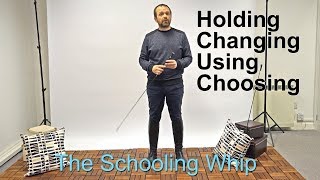
A short instructional video (Mary Wanless and Peter Dull) demonstrating correct holding, changeover, use, and selection of a dressage/schooling whip. Covers hand/handle position, changing the whip between hands smoothly to minimize disturbance, using a flick against the thigh for a precise tap, and recommendations for a lightweight, well-balanced Fleck carbon composite whip over bendy alternatives.
Hi there.
My name is Peter Dull, author of Master Dressage. And today I thought I'd put together a short video on how to hold a schooling whip, how to change over a schooling whip, how to use one correctly, and also how to choose a good schooling whip, too. So, first of all, let's look at how to hold a skinning whip. The important thing is really to hold it close to the top of the handle.
Make sure that the stick presses very slightly on the area slightly behind your knee. And then what you'll find is the stick end kind of ends up slightly behind your leg, your lower leg. The neat thing about getting the stick.
In the right place is, first of.
All, your hands are pretty much in the right place, too.
And, you know, you can see when it goes wrong with people when you.
See the stick doing this and pointing out behind. And often the riders straighten their arms and kind of jam their knuckles down. Also, if you see a stick sticking.
Out sideways like this, it's because they've.
Got knuckles up and hands down, too.
So really, the stick should just be.
Just behind the knee, pointing down, just where the foot is.
Changing a schooling whip correctly is really important because we want to disturb the horse least possible. You know, we want the changeover to be really smooth and not to upset the tempo, impulsion energy of the horse in any way. Now, I often see riders with schooling whips doing what I call drawing a sword, and they take hold of the whip and they kind of do this kind of thing, and it comes over, and then they, you know, gather their reins back up and so on. The right way of changing a schooling whip is you put both reins into the hand with the whip at the same time. You're kind of bringing the wrist up like this. You reach across, grab it, comes over, and you retake the reins. So again, so like this, and retake the reins, and you might have to push the stick down a little bit afterwards. But that's a sort of really quick way of changing the stick over from, you know, one side to the other, like so. Okay, so using a schooling whip correctly.
When you use a schooling whip correctly.
You shouldn't have to take your hands off the rein. You know, you don't use a schooling whip like this.
That's definitely not the way to go about using it.
And it's very unsubtle. And, you know, it disturbs the whole thing because you're taking the reins into one hand, bringing one hand up, it really is rather unsubtler and can easily disturb the way the Horse moves.
So it's important that, like we showed.
Earlier on, that your hands are in.
The right place, the stick is across the thigh, and essentially what you're doing is you are doing a quick flick of the wrist, bouncing the stick off your thigh, and that causes the end.
To touch the horse.
So like that. And obviously when it touches the horse's side, it takes the energy out the end. So you don't get this little wobble.
That'S happening there, but it is just.
A little tap like that, and that will create a very precise touch at the end of the stick.
So we get on to choosing a schooling whip. Now, this particular whip that I've been using all the time is a fleck carbon composite. One of the reasons I really love this schooling whip is it is extremely light, it's very well balanced, and you know that it's a fairly firm stick as well, so there's no massive wobble.
On the end of it, you know.
Where you point goes. So, for instance, if I'm using it for groundwork and I'm doing some whip habituation and desensitization, you know, I can point the stick exactly where I want it to go. It doesn't wobble or move around, you know, or anything like that. The other great thing about doing groundwork with this is it's a completely carbon fiber shaft and it's very smooth. So, you know, if you're doing a lot of groundwork desensitization with the horse, you know, it can kind of pick up grime on the stick. And because it's not a woven fabric covering the length of the stick, it can just be wiped and it's great again. And the shaft, the handle of it, feels really good too. So the other thing about this whip as well is the energy you put in one end comes out really nicely at the other end. And there isn't a huge amount of wobble with the stick as well. So if you need to do a little bit of tapping. So let's say you're doing a bit of groundwork and you want the horse to move back one leg and you just give it a little tap on the leg, then you can get a quite rapid little tap going, which, you know, with other sticks is really difficult. So I have an example here of a bad stick. And you'll see the difference in the kind of huge wobble this has. You know, if you're trying to kind of, you know, use it to tap with, it's really bendy, really wobbly, and, you know, you look at the. If you do a comparison of how much energy I'm having to put into the right hand, this stick here, as compared to the left one, you know, having to move an awful lot. So I really recommend these Whips. Fleck are an amazing whip designer company, and we've got them available on our shop. I do not use any other whip than this particular one, the Fleck carbon composite. It's the best one I've ever used. And, you know, I really recommend you go grab yourself one from the shop. Thank you very much.