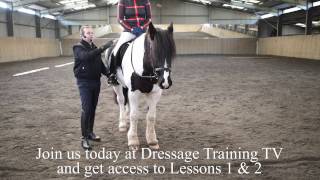
Mary Wanless addresses riders whose toes and knees turn out. She explains that toes turning out correlates with the knee turning out and the back of the thigh rolling under so the thigh rests on the saddle with its back flesh. She demonstrates placing the flat hand under the thigh and pulling the thigh slightly out/rotated in so the thigh lies flatter against the saddle, which helps the toes point more forward. Wanless emphasizes training the thigh to be snug (not gripping) against the saddle, keeping the foot light, and avoiding pushing into the stirrup.
Okay, so a couple of riders have said that they've got problems with their toes turning out. So toes turning out goes with. Knees turning out goes with the back part of the thigh tending to roll underneath. And when the rider's thigh is on the saddle, it is that part of the thigh, the back part of the thigh, that ends up against the saddle. So what I'm hoping to do is show you here. Can we just kind of arrange it so that your thigh does that more and comes more underneath? Sorry about that. You all right? Yeah. So then we've got. Then we've got knee turning out and toe turning out. And, you know, often riders will then push into the heel and you'll often have the toe turning out even more than that. So it's really important that the. The horse is just looking at me like, what, what is this? This is a bit. Bit far too weird. If you've got a problem with your toes turning out, knees turning out, you're going to have to pull the muscle of the thigh out of the way to get the thigh flatter against the saddle. You know, you can't get toes pointing forwards if knees are pointing out. I mean, you know, there's very little kind of wiggle room from where your knee is pointing. And, you know, I've seen people do that to try and get their leg on as well. So, you know, one of the exercises that we do and, you know, I do with riders, is to put the flat of the hand underneath the thigh here and just pull the thigh out of the way. So do you mind if I do that? Okay, so what we try and do is rotate the thigh in more and bring it flatter in against the saddle. So the thigh bone gets flatter against the saddle. And we can see already that the toe is more pointed forwards just by virtue of getting the thigh a little bit more rotate, rotated in and getting the muscle, the flesh out from underneath the thigh so that it lies flat. And it takes a while, but you can train your thigh and your body to be flatter, to be snugger against the saddle. If you watch any of the Charlotte or Carl riding, you know, especially if you watch them coming towards the camera, you'll see this sort of complete snugness here of the thigh. And being snug with the thigh doesn't mean you're gripping in or gripping up. For instance, to grip up with the knee, you're literally going to have to shorten the muscle in the front of the thigh and bring the knee up and in. But Actually, what we're after is that whole thing of the thigh reaching away, down towards the ground, and the foot remaining light. You know, pushing into the stirrup is the opposite of sitting deep. You know, you push down, something's going to go up. It's just physics.