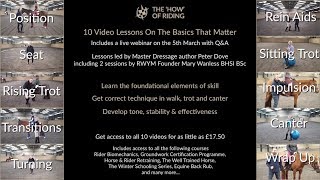
Mary Wanless teaches correct rider alignment and seat use in dressage. Keep your shoulders, hips, and heels stacked, keep your seat still so the horse doesn't interpret movement as noise, and avoid driving with your seat, which makes the horse hollow. In rising trot, your knee stays fixed and your pelvis moves over the saddle.
There's a lot of talk about shoulder hip heel alignment in dressage and riding in flatwork. And you know, I often think that mere lip service is paid to the idea of shoulder hip heel. And we see a lot of riders in lots of different non shoulder hip heel alignments. Basically when I look at a rider, I imagine if I was to suddenly make the horse disappear from underneath the rider, would they land on their feet? Would they land on their heels and fall backwards? So you can maybe show an example of that Millie. So here, Millie would probably, you know, land on her heels and then fall backwards. Would they fall forwards on their face if they're too. To keep a horse relaxed over its back and reaching into the rain. We do, we just don't teach driving with the seat. All that does is hollow. The horse leaves you behind. The movement and the horse can of squirting out from underneath you. You know, I think Carl Hester wrote an article all about leaning back and you know, ended up, you know, causing the horse to get be driven onto the forehand by doing this kind of leaning back. So it's really important that we just put aside this idea of using the seat. You know, the seat should be really still. Any excessive movement of the seat, any pushing, any shoving, any wiggling simply ends up being noise to the horse who then, you know, can't hear your other aids because you're so busy wiggling around another. It's, it's really important to have this line up correctly in rise and trot. So the way that I describe the rising trot is that the rider is kneeling up and down. I won't get you to move yet, Edward. I'll. I'll sort of describe it from here. So if you were to think of if I was sat in the saddle now, the lower leg should stay in the same place. The knee is the fixed point and the pelvis travels over the front of the saddle to the top of the rise and then back down again with a slight incline forwards like you can see here. And then back to the top of the rise where you're upright and then back down again with a slight incline and you know, depending on how toned you are. And so what I see people do is to try and drive their horse into trot. This happens a lot. So the rider will lean back, they'll push with their seat in the saddle and then they'll use the legs and often kind of start pushing with the seat as well. This can sometimes work for people, which is why so many people do it. But the reality is that you are pushing the saddle into the horse's back, causing it discomfort and causing it to lengthen its underneath and speed off like that. It's actually running away from your seat. So what you're going to have. So Millie's going to do outside thigh, outside leg, outside rein. Push the horse round in the direction that she wants to go. The inside rein is just slightly out, so you straighten her up. And remember it's just a push. You're going to turn left and you push the horse around so that outside leg's a bit further back and it's pushing the horse around. Millie's doing a. Yeah, so that's a good demonstration. Watch your lower leg doesn't slip forwards. Millie on the inside. Okay, so that was pretty good. Millie did a really good push round. And actually, you know when you want to do something like turn on the haunches.