
How to stop pulling back
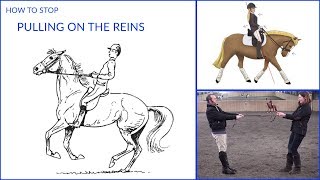
Mary Wanless teaches why riders pull back on the reins and how to fix it. She covers tucking your stomach, leaning forward, and hand position, then walks through partner and wall exercises with Claire to build the feel of pushing forward without using your hands to stop.
Today's lesson is all about rain aids. And we're going to cover pulling back, we're going to cover the turning rain, we're going to cover passive resistance, we are going to look at indirect rain, and we'll use a combination of mounted and dismounted to demonstrate this to you. So really, one of the things we're trying to do is avoid pulling back. So you need to avoid pulling back like the plague. And, you know, typical mistakes that people make when they get into using the rein and pulling is pulling the tummy in. So the rider pulls their tummy in and the hand starts coming backwards as they pull their tummy in. Almost inevitably, if you're pulling your tummy inwards, then you're pulling back in the rain. So, you know, we've talked about that in the past. We've counted that. We've sort of shown you how to bear down to activate your core so that you've always got a push out from your front, which prevents this kind of thing happening to you. Another way a person can end up pulling is by leaning back and by tipping forwards as well. Some of it is to do with how the rein is held. So whether you're holding the rein incorrectly and your knuckles up and you're jamming the hands down, that could cause you to pull, pull back by accident. The muscles that you're using to hold the rein can make a big difference as to whether you're pulling back or not. And also the rein length, too. So the amount, the length of rein that you have, so if your rein is too long, you can easily end up back in this position of pulling backwards. The problem with pulling backwards is often the hands never stop pulling backwards. And what I mean by that is. So actually, Claire, would you. Would you make your way down so we can do this sensation and just grab the reins as well on the way past? Hopefully. I've left them on the desk, so we'll show you a little demonstration of this. And the trouble with riders that pull back. And you know, and by the way, you know, people don't pull back on purpose. You know, often they feel that there is no other way for them to be able to deal with the horse that they're riding, then pull back. But the problem with pulling back is the pulling back never stops. And what I mean by that is you. If you're drawing backwards with your hands and your horse gives at the end of the rein, often your hands come back even further simply to take up the slack. So the question is, if we have a horse which pulls. How are we going to avoid pulling back? And it's really important as a rider that you get to the point where if your horse pulls at you, you don't pull back. So we're going to have do a couple of little exercises here to show you what that can look like. So I'll have those. I'll pop them. Those on the ground. So Claire's going to assist. So obviously, if you're sat by your computer and it's just you, it's hard for you to see this, it's hard for you to do this exercise, but if you've got a wall near your computer that you can try this on, go for that. So would you stand like this, Claire? Okay. And so I'm going to come a little bit closer. I'm going to put my hands out in front. Actually, you want to come a little bit further this way. So hands out in front. That's it. So we're going to push against each other to create a resistance, and we're going to push without leaning or pushing our hands forward. It is just a kind of resistance against each other. So. And you increase your. Bear down. Now, do you notice your stomach muscles engaging as you do that? Yeah. So just by doing this, your stomach muscles start to engage. And this is pretty much how your hands should feel when you're riding that you are pushing your hands forward as if against a resistance. Now, if Claire is to let go, the idea is my hands would stay in place so that it's as if against resistance. So try that on a wall. You know, if you've got a wall near you, push your hands against the wall and push really firmly. Now we can push against each other qu. And if we engage our core and keep our weight down into our pelvis, we're not leaning back or letting go. And if Clest suddenly moves her hands, I don't jerk around and move about all the place. So let me quickly show you what pulling back, what the main problem with pulling back is. So do you want to take the end of the reins there? Actually, you can take the reins this. So I'm going to be the horse. I'm going to be the horse. So as you walk past there, Chantal, can you just check that we're in frame and we're not doing all of this comedy relief for people whilst being out of shot. We're perfect. Good, good, good. All right. So Claire and I are going to both lean back against each other. So Claire's going to lean back and I'm going to lean back like this. No, it better not break. Now, the question is, if I were to. If Claire were to suddenly let go, so you can let go, I would simply fall backwards and essentially I still end up relying on the reins for support. And you know what you can end up with with a rider that pulls and a horse that pulls is you both go backwards again. You both end up creating this system where you are both pulling on the reins, both supporting each other, and neither person can let go. And in fact, it takes the rider to be able to step forwards. Whoops. And regain their balance and be not pulling for the horse to stop pulling. So, which is why it's really important that you know, you don't pull back. So the question is, what can we do instead? So we've talked about doing the little exercise of pushing against each other but not leaning forwards or leaning back. You're just engaging your core and creating a resistance by pushing your hands forwards. So we're going to swap roles. So you're going to hold on to these. So you're going to be the horse and I'm going to be the rider holding the reins. And we will get into how to hold reins as well. So I'm going to be my best to be an on a horse position, and I'm not sure horses do that. Claire. So Claire's going to glare. She doesn't glare very often. Claire's going to increase the pressure on the reins very gradually and now she's going to let go. And generally what you should see happen with the hands is that they stay pretty much in place. And we'll get to that again in a minute. But I will just quickly explain. As a rider with a horse that pulls against you, your job is to keep your angles the same. So you increase your bear down, you hold it through your shoulders, you hold it through the back of your arms. Your thighs stay out in front of you, you stay stable, you stay bearing down, take the gradual weight again and then let go. Hang on a second, you're pulling me a bit over my front foot. Let go. And then the hands stay here as well. So it would be very easy as Claire pulls for me to start pulling back like this. But actually you've got to be able to hold it through your shoulders, through your bearing down. You, you're stabilizing and you're keeping the hands in place. This is why pushing forward as if against resistance makes such a big difference. And when we talk about passive resist, I'll talk about the different techniques that you can use to increase your ability to not pull back on the horse. And, you know, a lot of it is your core strength. Some of it is, you know, is your thighs snug? Are you wrapped around the horse? Are your shoulder blades back together? There's a whole host of things that you can do to. To make yourself more stable.










