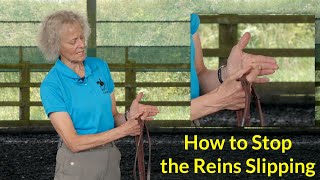
This instructional segment by Mary Wanless explains how to hold horse reins to prevent them slipping. Key points: choose reins that sit at the first bone of the fingers (not the second), let the rein pass out between the ring and little finger with the pad of the fingers against the palm (not the fingernails), keep the finger joint straight, and grip mainly between the thumb (shaped like a roof) and the first finger. Wanless notes that bending the joint encourages an overall clinging reflex (eg. curling toes) and that the correct hand shape improves whole-body stability.
Let's talk about how to hold the reins. First of all, you want to have reins that will fit in your hand within that length of the first bone of your fingers. So here to here. Now, I have very small hands, actually. I can buy child's gloves. And I really need reins made for children too, because if the rein goes longer than that bone, then it's hard to get your fingers in the right place. So many people hold the rein by the second bone of their fingers here, rather than the first. And if you do, I can promise you that your reins are just going to get longer and longer, even when they pass out between your forefinger and your little finger like that. This will not work. The rein needs to lie by the first bone, pass out of your hand, between your ring finger, your little finger, and with your thumb on the top of the rein and your fingers, so the pads of your fingers are against your palm. Now, what that means is that this joint is straight. Most people bend that joint too, which puts your fingernails against your palms. So pads against palms, not fingernails. You've then got your thumb, thumb, and your thumb really does the holding, holding the rein between the thumb and the first finger. And it works best when the middle joint of your thumb here is up and your thumb makes a roof shape. That's better than your thumb flat, better than your thumb doing this, better than your thumb up in the air, which people do do sometimes. So the real holding is between the thumb in the roof shape. The first bone of the fingers pads against palms, not fingernails against palms. Not that, not the rein by the second bone, but always the rein by the first bone. That gives you a really good starting point. One of the reasons why you don't want to bend this joint is as soon as you bend that joint, you're more likely if you're someone who curls your toes to. To curl your toes as well. The brain doesn't differentiate between hands and feet when it sends that yikes signal to everything to cling on. So one good reason for this is that your pads against your palms helps you with your feet. And we do some exercises sometimes that really demonstrate how just that change makes the body more stable.