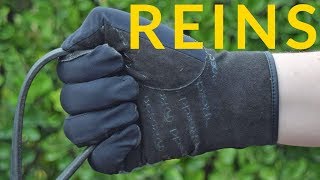
Mary Wanless explains how to grip reins so they don't slip. Keep your fingertips light on your palm, thread the rein between your knuckle and first joint of the little finger, and use your thumb on top to create pressure. Gripping with your fingers causes forearm tension and doesn't work.
It's really important that you don't dig your fingernails into your palm. The, the fingertips are going to rest fairly lightly on your palm. Try and make sure that the rain comes through here and fits between your knuckle and the joint of the little finger. It can be difficult. Some reins, for some people, end up being a little bit wide. So they're essentially wider than the distance between your knuckle and the first joint of the little finger. The problem there is if it is too wide, you'll find that you end up with your hand being a little bit more open than you really want. You know, you'll find that, you know, you can't quite close the fingers further down. So as a preference, I like narrower reins than wider reins, just because then it just sort of sits there nicely and your fingers can kind of rest in against the rain. The rain goes over the top here. Sorry, here. And then basically your thumb wants to go on top. Creates a little tent, just a little top like that. And that's where you're going to be putting the pressure on the rein just to stop it being pulled out of your hands if the horse does decide to pull. So that's what stops the rein slipping. The hand itself does not stop the slipping. So these fingers are not part of what really grips the rein. It is actually your thumb on top. The moment you start gripping in and pressing your fingers in like that, you'll start to get a lot of unnecessary tension in the forearm. So, yeah, keep the thumb pressed on top and, and the fingers just lightly against your palm. Just the, the, the fingertips there like that.