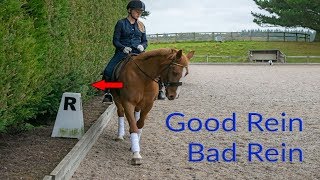
Mary Wanless teaches an instructional lesson on steering and turning horses by keeping them evenly balanced through both shoulders. She emphasizes that accurate turns (e.g., 20m or 15m circles) require the rider to correct a horse that leans on one shoulder, and she challenges the common label of a "good rein" versus a "bad rein," explaining that the issue is shoulder imbalance present in both directions. Wanless describes the correction as the same on both reins: straighten the neck, bring the shoulder back with appropriate aids (rein plus corresponding thigh/leg), so the horse rounds evenly through both shoulders.
This is a lesson that I really, really like teaching, and I think it's a lesson that's really important. When a person learns to steer correctly, to turn a horse correctly, what you're essentially doing, especially if you already have tempo control in place, is you're learning to teach the horse to remain balanced evenly through both shoulders. You know, being able to ride a 20 meter circle, a 15 meter circle accurately, with the horse evenly balanced through both shoulders to make turns, up lines, you know, turns across the middle corners. Once you really understand turning and steering the horse through its shoulders, then you have a really powerful tool for training horses to be more balanced. Other thing I want to talk about is this idea of good rein, bad rein. So I'll hear a lot of riders say that my horse has a good rein and my horse has a bad reinforcement. I think what they usually mean is there's a rein that my horse will bend on and a rein that my horse won't bend on so easily. The trouble is, I really encourage you not to think of good rein or bad rain. And the reason I say that is because whichever rein is good, whichever rein is labeled bad, essentially what you're saying is your horse leans on one shoulder or the other. So, for instance, if you think that your horse bends easily to the left, usually what that means is the horse is leaning on the right shoulder and you can bend him left and he's leaning right, so he's doing incorrect turning. Now, let's say you think that the left rein is really good, and then you go on the right rein and you're complaining that your horse won't bend, but the problem is he's still leaning on his right shoulder. And that is the issue. In fact, your horse is incorrect in both directions. The horses, if you're going to use the word bad, it's bad in both directions. There is no good rain or bad rain. It is that the horse is leaning on one shoulder or the other shoulder and almost always leans on that same shoulder, no matter which way it's going round. So on the rain that you're saying is good, you actually have to straighten the neck up and bring the shoulder back into place. And on the rein that you're labeling bad, it's actually exactly the same correction you have to make with your body. So if the horse's shoulder is over here, you're going to have to go right rein, right thigh, right leg, and push the shoulder back into place so that the horse goes round the turn evenly through both shoulders rather than leaning on one or the other.