
Mary Wanless teaches lateral movements in riding, starting with straightness and the horse reaching into the rein. She breaks down common mistakes like pulling the inside rein and lateral ribcage shifts, then walks through progressions from groundwork to shoulder-in, with biomechanical cues like keeping your zipper over the mane.
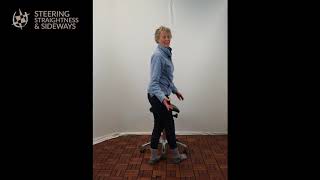
Hello there. I'm Mary Wanlis, founder of the Ride of Biomechanics Movement and author of the Ride with youh mind books and DVDs. I coach riders to develop their awareness, their feel, their skill, so that they begin to understand how profoundly they're influencing their horse, to use that in their favor to make their riding more fun, more ethical, and their training more effective. So this is a little introductory webinar here about the challenges of the lateral movements and riding the horse forward and sideways. And before you ever start doing this, you really need to be pretty good at riding on a straight line. And within that, I would include being able to get the horse to come up through his back and to reach in the rein. And those of you who know my work will know it's based a lot those basic understanding of the rider, horse interaction in getting the rider to not squash down the middle of the horse's back, but to have an almost suction up effect on the middle of the horse's back, which leads to him reaching into the rein. So we'd like to have some baseline skills on that and some baseline steering skills. And our last couple of webinars talked about the challenges of turning. So the danger of the horse jackknifing and some ideas about how to fix fix it. The idea of steering him along a balance beam, like a gymnast on a balance beam or a train on train tracks, and how you as rider need to be able to organize your body in a good way to have the horse organize his body in a good way. Everything in nature is asymmetrical, including you and your horse, me and my horse, and most of us will have one side of the body that tends to shorten, one side of the body that tends to lengthen. And unwittingly, in this case, the body will make a force from the shorter side to the longer side, which is this way. And that force will affect our horse, especially on circles and on the lateral movements. The way we're wanting to exert a force within the body to take the horse, let's say that direction or that direction presents some rather different challenges to just turning him on a circle, that direction or turning him on a circle, this direction, and my experience, both many years ago as a rider and in coaching goodness knows how many people, is that for many of us, unless you're supremely talented, learning to ride the lateral movements well is almost like learning a new language. You have to start all over again with this new challenge of sending the horse in that direction or sending the horse in this direction. And one of our ways of approaching this, as some of you will know if you've watched any of the groundwork webinars on DressHostraining TV, one of our approaches into this is to teach the horse from the ground to be able to take lateral steps, to move over with the hindquarters and move with the front end. So we're trying to prevent the situation of having a not very skilled rider on a totally clueless horse. So that happens sometimes. It's not ideal. We all start from where we start. But let's look at what happens for people in teaching the horse a lateral movement. And I'm going to turn around because I think this will work easier if you're seeing my back. So if I was going to ride a circle to the right, my typical mistake, or a rider's typical mistake, would be pull on the inside rein, give away the outside rein, shorten this side of the body. Horse goes out through the gap made in that shoulder. I am unwittingly in my body making a force from this side to that side and increasing the chance that the horse will jackknife. Supposing I wanted to ride my horse laterally in this direction over here. What happens to most riders is rather different because what they start doing is going, okay, I've got to get the horse to go that way, and they start getting themselves over here and making a shove and making a push and making a load of kicks and hoping that's going to send the horse over there. There is a problem with this, though. Supposing I was giving a piggyback to a child, and the child's on my back here, and the child is off to this side, would I move over here? The answer is, no, I wouldn't. It would be a kamikaze gesture. I would tend, if anything, to move my body weight to stay under the child, but I wouldn't tend to risk putting us both flat on our sides like that. So the rider is working totally against the ends she wishes to achieve just by going on instinct. And I think I'm going to say that this is everybody's instinct. And what it does in the body is a little different to what happens on a circle, because in that attempt here, the rider ends up making what would be known technically as a lateral shift with the pelvis. So, sorry, with the ribcage. So the ribcage is moving this way relative to my pelvis, and my spine is almost making an S shape like this. As I get carried away with Trying to make my horse go over there. So you could think of this being rather like break dance. And you remember breakdance doing this, kids doing break dance, moving themselves like that. That's how riders go wrong in the lateral movements. And you can get totally carried away if you're trying to make this happen on how you kick from here and how you push with this seat bone, and all your attention can get taken up on this side of the body. And suddenly you realize you have no clue what's going on in this side of you or this side of your horse.
And getting more attention on the side in the direction of motion is critical in creating your skill. And along with this, we could say when you ride a lateral movement, how much of your brain gets higher hijacked in the desperate attempt to make the horse move over. Because if it's 100% of your brain, you have totally probably lost your shoulder, hip, heel line. Bearing down. Those of you who know my work will know bearing down. It's how the rider generates core strength and matches the forces of the horse's movement before we ever add a sideways element to it. You probably forget to breathe. You may well suddenly find you can't kick, you know, so all those baseline things can get lost, but they need to really be there. And the more skilled a rider is, the less of her brain gets hijacked by the need to go sideways. And the more of her brain is present on how she organizes her body, how she's lined herself up, how she can bear down, how she can breathe, how she can kick, how she can stay in control of the horse's legs, how she might make a very good training decision by coming out of the movement, going straight for a little bit and starting again. How she doesn't contort her body to feel in for what the horse is not doing. Because all of us get tempted to make contortions and fill in for the horse. And that's a kind of downhill slope that you don't want to get hooked into. So I'm going to move my horse this way, and I'm getting carried away shoving from here, and I've forgotten about here. The first question would be, what's the weight on each seat bone? And the chances are there's a load of weight here, and the rider's got.
Very little weight there.
And we've got to this seat bone much more weighted. And another question would be, will I? Your chin and zipper over the horse's mane. And the chances are they're over here. When the chin and zipper need to be over the mane. And you know, what works so much better than the shove and the kick that everybody's tempted to do is supposing I'm going to go this way instead of getting carried away from here. To imagine that if somebody was in the corner of the arena at the quarter marker where I'm going, and that they had some strings attached to me in my side here, and I've grabbed quite a substantial layer of flesh here in myself, in what I would call the front right vertical edge of my torso as a box, and that person is reeling me in from that side. And once you can start to get to where you're being reeled in and really focusing on keeping your weight sufficiently in this direction and not letting your center of gravity disappear over that way, then you're going to have a much more cooperative horse underneath you to begin to learn this. So when you start learning this, you've got several options. One would be, if the edge of the arena is here, the horse's head towards the wall, moving like this. Putting a wall in front of him can make your life easier. But if you really feel you need to do that for a long time, I would suggest you go back to groundwork, because it means your horse hasn't really understood sideways and would much rather be going forwards. And you're trying to use the wall to stop that happening. But it can get you started. But it's not so great to kind of really keep doing that, but it can get you started. The other option, rather than his head to the wall, is his tail to the wall. So you're then in a shoulder in tight position at about a 45 degree angle, but with essentially a straight horse coming this way. And your problem is going to be if you start shoving here, that he probably doesn't go, but if he does go, he's going to fall on this shoulder and jackknife. And you need to be able to keep control of both shoulders. And at this point, the person would be pulling you in from the end of the long side again, as if we could attach some cords to you from this front corner of your body. And then of course, you have the version of maybe from the long side towards the centre line like this. That's another good way to learn to do it. Although I have to say that I see an awful lot of people doing what I call wandering vaguely sideways with their horses. And in the wandering vaguely sideways, kind of thinking they're leg yielding, you know, maybe this is happening, or kind of A kicking fest like this, and it's kind of sort of happening, but not really. And you may get a much better sense of what a lateral step feels like by going tail to the wall. And it gets really clear that you feel a different movement under the seat bone here on the side you're moving away from. When the hind leg goes under like this, it kind of lifts under your butt in a very distinctive way when you have things working well. So I'd love to show you more about this and if you're interested in a deeper dive that busts a lot of the myths about lateral work and steering and straightness in general and helps you understand how the rider horse interaction works. Because, you know, there are laws to this. There are laws of physics that govern what can otherwise seem incredibly mysterious. And in the horsewell, we hide behind the concept of talent and the idea that you've either got it or you haven't. And don't look closely enough at what is it the talented riders are doing that all of us who are less talented can learn to reproduce by building skill step by step. It is not a mystery. This is a learnable, step by step build, building block on building blocks way of learning skill. And we're planning five live webinars with horses and riders in our riding arena, using those sessions to hone the ideas behind steering, straightness and sideways, to give you strategies that make this work, that help you clue into the own ways that you don't mean to, but you become your own worst enemy and have steering in issues go wrong. We would like to show you the means to have them go way more right. And I'm looking forward to meeting you on those. Click the link below for more information and I'll see you on the other side.










