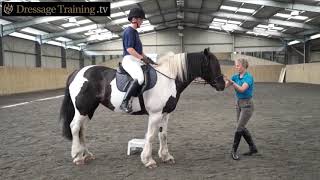
Mary Wanless explains neutral spine through the martial-arts horse stance and a tent mast with guy ropes. Stability comes from shortening overlong front muscles, not lengthening short ones. She demonstrates stepwise tests where you resist pushes at different points to train spinal stability and reduce back pain.
A shoulder, hip, heel line, which is essentially the martial arts posture of the horse stance. And if I was a martial artist, you would see me in front of my class pretty much in this kind of posture. If I was in front of my class like this, you might start to think this was a bit ivy. I could get knocked over really easily. I don't look resilient and strong, and I've made my front line longer than my back line. And I've lost the resilient strength that comes from a martial arts posture. And what we call neutral spine, where the length collarbone to pubic bone matches the length from the nape of your neck to your tailbone. So in this place, these two chains of muscle are coming into balance, and the spine is most able to withstand the forces placed on it. In this, you're much more likely to injure yourself and get back pain. And. And actually, interestingly here too, you are more likely prone to back pain. So we're evening out how muscles work because we want these chains of muscle in the front and the back to work really well and to keep pumping and to keep cooperating and working together. So muscles are in their mid range. Now, the challenge in riding more than anything else, is about stability. Yeah, we talk far too much about relaxation and not enough about stability. So if you think of Chantal's spine, let's suppose it's like the mast of a tent. We'll make it a round tent with a whole load of guy ropes. Okay. So come forward just a little bit. Is that enough? Yeah. Now you left a hind leg behind. I wonder if we can bring this. So if Shantal's spine was like a mast held up by guy ropes, and the guy rope at the front and the guy rope at the back right now are in a pretty good balance that holds the mast upright. Okay, but let's have you maybe just hollow a minute. Yeah, so we just go hollow. And so we've elongated the guy rope at the front and we've shortened the guy rope at the back. Okay. Now, if you really think of a tent, and we've got a long guy rope and a short guy rope, and the other guy ropes are all pretty long. Let's say we've got one shorter guy rope and a load of longer guy ropes. If we wanted to make that tent resilient and stay up and stay in place, would we lengthen the short guy rope? The answer then is that we'd have a whole load of long guy ropes and an even floppier, more disorganized tent. What we really have to do is shorten the long guy rope. And the long guy rope in this case is Chantal's front. And we're just going to go drop your test, bring your waistband back. That's it. Shorten the front guy rope. Okay. And so most of my work involves shortening the long guy rope rather than lengthening the short guy rope, because that's what gives us stability. And I'm going to do a stability test on Chantal here, where I'm going to go resist my push. Okay, now, as I have her, resist a push on her upper chest here, which she's doing very well, she needs to think of leaning in it. It's not a lift your chest thing. It's more a lean into it. That's great. And resisting that push starts to switch on all the muscles in the chain of the front line. Okay, now, I could equally well go resist my push on her back to see if we can firm up her back muscles. And it's harder than you think to resist a push on your back. So if I go resist my push here, actually, she did very well. Yoga. Yoga. Does this feel hard to do? Okay, now, a lot of people, when they do this, I'm going to show you how to do it wrong. A lot of people when they do this, will end up leaning forward a bit, curling their toes a bit, tightening their butt a bit, pop up a bit, tighten your butt and end up here and just not be able to resist that. And if you manage to get a friend to do this with you and you're struggling to resist it, I would recommend you go resist a push down here, resist a push here, resist a push here. So you're working your way up the back, increasing the challenge. Resist a push here and then resist a push here. So when she can resist those pushes on her front and her back and keep a good neutral, she's getting the kind of resilient strength that happens when those lines are in balance.