
On The Bit - The Seeking Reflexes
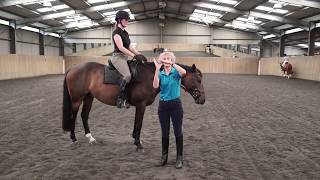
Mary Wanless teaches how to get a horse on the bit by fixing rider posture. She demonstrates common faults like rounded shoulders and hollow backs, then shows corrections: lengthen the front, weight in the thigh, drop the ribs, and match your thrust to the horse's hind legs. The goal is activating the seeking reflex so the horse's head reaches forward naturally.
Hello, everybody. It's so exciting to have many of you online in many different time zones in different parts of the world. And my aim through these five webinars is to give you some really practical ways of, first of all, understanding what on the bit really means and figuring out how to get there in ways that will change your riding. So as you look at Millie, I think it's pretty clear her front is shorter than her back and her shoulders are rounding and her head is really forward. And Millie, I want you to land in the saddle, all right? So let's get you more. Right, so can you elongate your front a little bigger thrust foot, more light, more weight in your thigh. That's it. You may need to kick a little bit, but we've got loads more energy here now. That's it. And this pony, at this point in time, doesn't come up through her back as well as she could. And through me doing the belly lift, we kind of could tell that that's an issue with her body, right? So for her, that's a bit of an alien place to come up in a more lifted in her back, short in her tumm, filled into her crest kind of a way. Whilst a fair number of you watching will be round backed, probably more of you guys will be hollow backed, doing what Demelza is doing now. So, Demelza, let's see if you can change it. And go collarbone forward, chest down, waistband back, guts in the bowl, and then foot light weight in your thigh. With any luck, you're seeing here the slide of the horse like a suspension bridge. So I think this is a brilliant image, actually. Demelza, maybe come and halt here. We could use your horse horse to play this on too. So stauncheons at the suspension bridge are like the wither and the croup. The horse's spine is like the roadway of the bridge. Okay. And from about where you sit, one set of ligaments, like the wires on the bridge, are pulling the horses back towards the croup, and the other set of ligaments are pulling towards the wither. And so from about here, you've got withers, ligaments pulling up like the wires on the suspension bridge towards the wither, and ligaments pulling up towards the croup. And when the whole suspension bridge system really works, the ligaments in the neck pull the neck into an arch, and the ligaments that go back to the tail pull up the tail. So it's carried. So this is a wonderful idea that the staunchons of the suspension bridge, and when it goes wrong. It's as if the horse collapses his staunchons. So it would be like his shoulders collapsed back towards the middle of his back. His croup collapses back towards the middle of his back. The ligaments go slack and the bridge in between hangs down. And the horse's back is hollow. And the rider literally feels like she's sitting down a hammock. And once you're sitting that hammock, of course, it's really hard for you to go right. It will bring out all your worst patterns. You'll round your back. As you fall back in the hammock, your back will slide backwards. As you fall back into the hammock, your body will respond according to its default, and you will find it way harder to do the corrections that your teacher might have been telling you to do. So Kirsten is making a mistake that lots of people make. So her weight is centered mostly on his back here. And when the horse hollows his back, I call that hollow the man trap. And that hollow happens under the top of the rider's thigh here and her bum. So this is the place where the horse hollows. Here's Kirsten's thigh. Now, she has her stirrups the right length, which is that we want her thigh bone where my arm is her is the seam line of her britches pretty much is her thigh bone. We want that thigh bone at about 45 degrees. Okay? So right now, the tendency is that if here's her knee, here's her thigh, here's her upper body stacked up here, here's the hollow of the horse's back, and she would go foot forward, knee up, weight on your butt in a way that tends to squash the horse's back down. Okay? So her weight is taken predominantly on her bum, and it's probably worse than the right side and the left, and that would tend to squash the horses back down, however much she might know, actually, that the idea of on the bit is better said by the seeking reflexes and is about his back coming up so his head and neck can reach away. So if we come to the up down plane, we've seen the version of wrong that Chantal was doing of stretch up and stretch down. It means from your waist you're going up, and from your waist you're going down. The fix drops your ribs. So Kirsten as well had to make a little extra crease here. Drops your ribs, flattens your back a little bit, makes your front and your back a pair. Okay. And it makes your chest and your knees closer Together. And many of you who would have grown up and grow down will have your stirrups too long and will need to adjust so you get your thigh to that 45 degree angle. So with any luck here, I've got myself in a good neutral, where the length of my front collarbone to pubic bone matches the length of my back from my collarbone to my, Sorry, the nape of my neck here to my tailbone. And my aim is to be vertical and neutral. And that if the horse were taking out Runde B by magic, I would land on my feet. A little tricky on this chair, but if I get myself right to the front of it, I can just about get that to happen. The sitting surface then becomes the inside of my thigh. So pretty much the whole area of suede on a pair of suede seater britches is the sitting surface. So the sitting surface extends really from the top inside of my boot all the way up my thigh here to what we call the back edge of my bum here, down the thigh that way. And that's very different for the horse to. If all your weight is on your bum and you sit on him here and Demel's a kick, keep doing really big thrust, thrust, thrust, thrust. That's it. So her thrust in this tennis ball game must match the thrust of the horse's hind leg. So you have to have a really bigger than you think, especially on a guy like this. Thrust, thrust, thrust, thrust. And this is good. Okay, well done. And if we took 100% of the weight of your leg, what percentage of that weight would be in your thigh compared to your foot? So this is a big transition for a teenager, isn't it, from the smaller pony to the bigger horse. Even though this horse is less than 16 hands, she's a big powerhouse of a mover compared to our kind of trundle trolley pony. Do I dare say that she might kill me later. I'm gonna get slaughtered. When you land, see if you can let your bum be less splodgy. Can you have a little bit more holding in those muscles around your seat bones? Good girl. Good, good. So she's doing a good job here. And you have to keep getting to the top of the rise, Mini, because it's a hell of a long way up on this horse. That's it. Good job. And can you get this smoothly and fluidly? Yep. And she's got a nice reach into the rein here and a really nice, actually transmission of energy from the hind legs over the quarters, over the loins, under the panels of the saddle up each side of the crest to the horse's ears. So I like to think of two hoses. Okay. And go. And Demelza's a little bit tempted to come back. She keeps her foot front really strong, and you can see the strength in her front. And Demelza, keep thinking, resist a push as you do it. Good. Well done. Okay. And trot again. And she's in a good balance point with him as she goes. Walk to trot. Okay, let's do one more over here. Can you keep resisting a push? Keep foot light. Keep feeling the shape of the back. Good for you. Okay. What you're doing is learning the. The course effect, rules of the rider, horse interaction. And I call that riding on interface. Discovering how that interface works, what you do to the horse, what the horse does to you, and how that interface works and how subtle it can become is part of that journey that can take a lifetime. That actually is why none of us ever get bored with riding, because there's always so much more to learn and to discover about how it all works. Sam.










